

Assignment vs Novation: Who Remains Liable?
By Anirudh Menon, Viaclause editor
A transfer and a release are different decisions. Compare two versions of one supplier handover, including future deliveries and an earlier unpaid invoice.
Assignment transfers a party's rights, while duties move through delegation; the original party usually remains liable for performance. A party-substitution novation replaces the outgoing party with the incoming party, requires all three parties' consent, and releases the outgoing party from the obligations being replaced.
Connect this task to the responsibilities and handover record in the contract administration plan.
Compare California Commercial Code section 2210 (assignment and delegation), Civil Code section 1531 (substitution with intent to release), and Shoreline Aviation, pages 17–18 (New York’s all-party agreement requirement). Consent to transfer is not itself a release; governing law and the agreed scope control.
Three parties, two different liability routes
Synthetic example: Alder supplies packaging trays to Brook under S-8 dated January 1, 2027. Cove takes over from July 1. Assume California goods law, a valid agreement, required consents and no competing third-party rights. June’s accepted deliveries leave a $4,000 invoice with Alder. July to September cost $3,000 each, payable after delivery and acceptance.
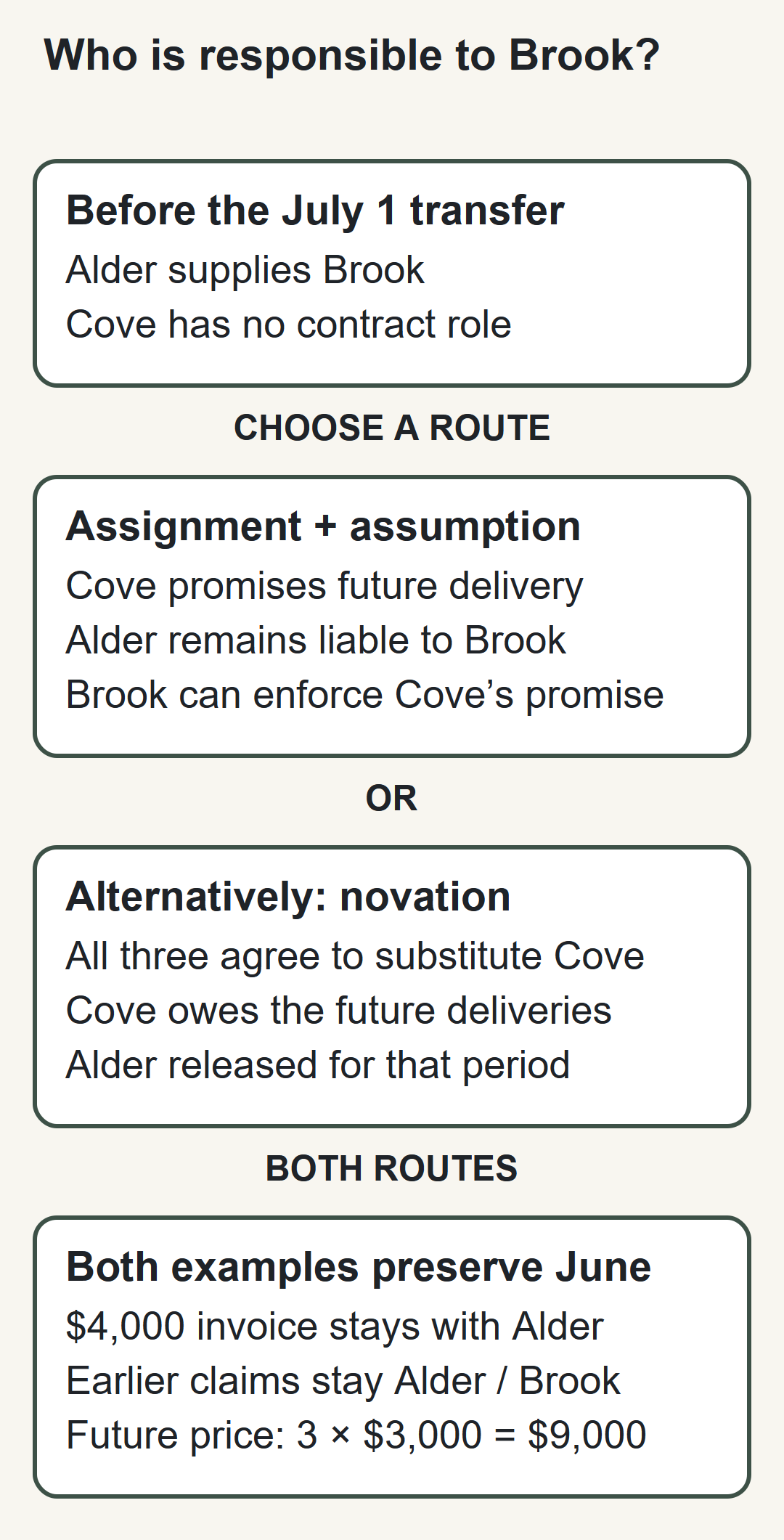
Under section 2210(1) and (5), delegation leaves Alder liable and Brook can enforce Cove’s express assumed promise. The novation uses section 1531(2) substitution and release. A June invoice sent July 5 remains Alder’s under either sample; the sending date does not move the underlying delivery.
| Position | Who can enforce payment? | Who must perform deliveries? | Who can Brook pursue for a missed August delivery? |
|---|---|---|---|
| Before July 1 | Alder can enforce Brook's payment obligations under S-8. | Alder owes Brook the promised deliveries. Cove has no role. | Alder, if the original arrangement continues unchanged. |
| Assignment plus delegation and assumption, no release | Alder retains the June $4,000 invoice. Cove receives the July to September payment rights, subject to the agreed conditions. | Cove has promised Alder and Brook to perform. Alder remains responsible to Brook. | Alder remains liable; Brook can also enforce Cove's express promise to it. |
| Novation of the remaining deliveries | Alder retains the June invoice. Cove has the payment rights under the replacement relationship for July to September. | Cove owes Brook the future deliveries under the replacement agreement. | Cove. Alder is released from those future obligations under this example's express terms. |
Which one do you need?
Use this as a practical screening check, then confirm the legal route under your agreement:
- Only moving a right to payment? Start with assignment. Identify the particular invoices or future payment rights; do not assume duties move too.
- Someone else will perform, but you will remain responsible? Examine delegation and assumption, along with any assignment of payment rights.
- The existing party must leave the future relationship? Examine novation. Confirm the continuing party agrees to the substitution and intended release.
- The same legal parties only want to change price or scope? Use our contract amendment sample; it addresses a different task.
Assignment is not unrestricted. For example, section 2210 limits transfers that materially change the counterparty's duty, burden, risk or prospect of return performance, and recognizes limits on delegated performance. That is a goods-law example, not a blanket rule for every service, license or regulated transaction. If a vendor acquisition prompted the request, use our vendor-acquisition contract checklist for the separate investigation into what actually changed.
Assignment sample: Alder remains responsible
Alternative synthetic clauses for S-8, not complete agreements. Add the document set, execution terms and authorized signatures.
ASSIGNMENT, DELEGATION AND ASSUMPTION
Effective July 1, 2027, Alder Components LLC assigns to Cove Manufacturing LLC its rights to payment for the July, August and September 2027 deliveries under Supply Agreement S-8 between Alder and Brook Retail LLC, dated January 1, 2027.

Cove accepts the assignment and promises both Alder and Brook to perform all supplier obligations for those deliveries on S-8's existing terms. Payment remains subject to S-8's delivery, acceptance and payment conditions and Brook's applicable defenses.

Brook consents to this assignment and delegation. Brook does not release Alder from its obligations or liability for the remaining deliveries. This agreement does not substitute Cove for Alder by novation.

The $4,000 June invoice and all rights and liabilities arising from pre-July performance remain between Alder and Brook. Cove does not acquire that invoice or assume those earlier liabilities. No existing claim is released. All other terms remain unchanged.
Novation sample: defined future release
NOVATION OF REMAINING SUPPLY OBLIGATIONS
Alder Components LLC, Brook Retail LLC and Cove Manufacturing LLC agree that, effective July 1, 2027, Cove replaces Alder as supplier for the July, August and September 2027 deliveries under Supply Agreement S-8 dated January 1, 2027.

For those deliveries, Brook and Cove enter a replacement contractual relationship incorporating S-8's existing terms. Cove promises Brook to perform all supplier obligations, and Brook promises Cove to perform all customer obligations, including payment subject to the existing conditions.

Alder and Brook extinguish their obligations to each other for those future deliveries and release each other from those obligations. Cove accepts the substitution. All three parties consent to this novation.

The $4,000 June invoice and all rights and liabilities arising from pre-July performance remain between Alder and Brook and are not extinguished, transferred or released. Cove does not assume them. No price, quantity, delivery date or other commercial term is changed.
The substituted obligation defines the release, consistent with California Civil Code section 1530. These samples preserve earlier liabilities; a complete settlement needs different wording.
Before changing the payee
Keep S-8 and the signed transfer together. Record: the three entities, effective date, assigned rights, assumed duties, release scope, earlier invoices and claims, future payment conditions, and the billing owner. For these samples: pay June’s $4,000 to Alder; pay Cove for July to September under the existing conditions. Mark Alder’s future liability “retained” for assignment or “released” for novation.
A real assignment clause: consent and assumption are separate
The Atlassian Customer Agreement, section 20.3, effective October 1, 2026 and inspected October 7, generally requires prior written consent for customer transfers. Its specified successor exception covers the entire agreement and all orders, with prompt notice, written assumption and procedural requirements. Unauthorized transfers are void under that clause; Atlassian has a different transfer permission. The exception does not expressly release the customer. Check each condition and any separate release; do not treat an acquisition announcement as the completed transfer document.
A useful review separates three questions: is this transfer permitted, what does the incoming party promise, and what liability does the outgoing party retain? An email saying “consent granted” may answer the first without resolving the other two. Request the actual wording, identify its scope and record any unanswered question.
New York goods-law comparison
New York UCC section 2-210 similarly distinguishes rights from delegated performance within its goods-law scope. Subsection (1) preserves the delegating party’s duties and liability. Subsection (2) qualifies assignability, including material changes to the counterparty’s duty, burden, risk or return performance. Under subsection (4), general assignment language can also delegate duties; acceptance creates a performance promise enforceable by the assignor or original counterparty. Do not substitute New York’s subsection numbers for California’s.
These state provisions support the distinction, rather than a universal consent rule for every lease, professional service, software license or government contract. Read the relevant agreement, governing law and transfer restrictions for that transaction. The California goods example above does not establish the outcome for an Atlassian account or a regulated contract.
A completed transfer handover record
Choose one of the two alternatives before completing the record. This synthetic record follows the assignment sample; it is an operating aid, not additional operative wording. The novation alternative would change the future-liability field and the identified controlling document.
TRANSFER RECORD: S-8 / ASSIGNMENT ROUTE
Outgoing supplier: Alder Components LLC.
Continuing customer: Brook Retail LLC.
Incoming supplier: Cove Manufacturing LLC.
Contract set: S-8 dated January 1, 2027; signed assignment, delegation and assumption instrument.
Effective cutover: July 1, 2027, under the stated example.
Payment rights transferred: July, August and September deliveries, subject to S-8 conditions.
Performance assumed: supplier obligations for those deliveries.
Consent evidence: Brook’s consent in the signed instrument.
Outgoing future liability: Alder retained; no release or novation.
Earlier invoice: June accepted deliveries, $4,000, payable to Alder even if the invoice arrives July 5.
Earlier claims: remain between Alder and Brook; no existing claim released.
Future price: $3,000 per month, $9,000 total, conditional on delivery and acceptance.
Billing action: separate June from July onward; verify payment instructions through the existing finance process.
Service action: give Brook the Cove delivery contact and escalation route.
Closure evidence: controlling signed document linked to the contract record; billing and delivery owners confirm the same cutover.
If Brook later disputes August performance, the assignment record directs the reviewer to retained Alder liability and Cove’s express promise. Under the alternative novation sample, the record instead directs the reviewer to Cove for the replaced future obligations. Neither record decides whether a particular breach occurred, a defense applies or damages are recoverable.
A reusable transfer review worksheet
Fill unresolved fields with “open” and name the person who will resolve them. A blank release field must not become a billing-system assumption that the outgoing party is discharged. Resolve the legal route before using this worksheet as a completed handover.
TRANSFER REVIEW
Agreement and amendments: [identify the full document set].
Outgoing / continuing / incoming entities: [legal names].
Transfer trigger and scope: [transaction, rights and obligations].
Proposed route: [assignment; delegation and assumption; novation; other, with review].
Permission and restrictions: [clause, exception, consent and conditions].
Assumption evidence: [incoming party’s promise and beneficiaries].
Release: [none, or exact obligations released and controlling wording].
Earlier invoices and claims: [allocation and retained rights].
Cutover: [effective date and conditions; actual execution dates separately].
Payment and performance conditions: [unchanged or specifically changed].
Third-party or security interests: [review result or open issue].
Operational owners: [billing, delivery and contract record].
Unresolved item / owner / target: [details].
Completion evidence: [executed documents, required consent and handover confirmations].
Business checklist before accepting the transfer
- Identify the entities. A new trading name, affiliate, asset buyer and continuing legal entity are different possibilities; an announcement alone does not resolve which one applies.
- Read the complete contract set, including assignment, change-of-control, notices and amendment provisions. Record applicable conditions instead of relying on the heading of the proposed document.
- Specify the rights being assigned and duties being assumed. If only selected invoices move, do not accidentally describe a transfer of the entire relationship.
- Get the relevant consent and assumption evidence. Make the intended release, or absence of release, express in the controlling terms.
- Allocate earlier deliveries, unpaid invoices, defects, disputes and future performance separately. Use the performance period rather than the invoice’s arrival date as the example’s cutover reference.
- Check guarantees, security and other affected rights separately. This worksheet does not establish whether third-party obligations continue or require their own consent.
- Verify new payment instructions through the existing finance control before changing the payee. A signed transfer document does not authenticate a later bank-detail email.
- Reconcile the billing and delivery records with the agreed route. Store the documents and unresolved issues together, then obtain operational handover confirmation.
Frequently asked questions
Does the other party have to consent to an assignment?
Read the contract and the law governing the particular right. An anti-assignment clause may require consent; the absence of that clause does not resolve every transfer restriction. The law also limits some transfers: California Commercial Code section 2210, for example, restricts assignments that would materially change the other party's duty, burden or risk. Our example assumes the required consents are obtained.
Does novation always erase earlier debts?
No, not automatically. A novation releases only the obligations the parties agree to replace; California Civil Code section 1531 ties it to the intent to release. Say in writing whether earlier invoices and claims are included. Our sample keeps them with the original parties.
Must a novation be in one signed document?
A signed three-party instrument is sensible documentation practice, not a universal statement of legal form. In Shoreline Aviation, pages 17 and 18, the federal district court applying New York law found the novation elements satisfied by the parties' conduct and related agreements. That does not dispense with writing requirements that apply to another transaction.
Does the incoming party’s assumption release the outgoing party?
Not by itself. The California goods rule above preserves the delegating party’s liability. Identify a separate agreed release or substitution if discharge is intended; a promise to perform and consent to transfer answer different questions.
Do the sample clauses transfer the June invoice to Cove?
No. Both expressly retain June’s $4,000 invoice with Alder. July to September payment rights follow the selected route, with delivery and acceptance conditions. Do not combine the alternatives into one document with contradictory release language.
Is a change of company name necessarily a novation?
No. First establish whether the legal entity changed. The name on a commercial announcement does not establish a substituted party or release. This article’s novation example involves three distinct entities and an agreed replacement of defined future obligations.
What should happen if the transfer document leaves past claims unclear?
Keep the issue open for legal review and request express allocation. Do not label it “all liabilities transferred” in the contract record before the parties resolve it. The synthetic samples preserve earlier claims; another transaction may have different agreed treatment.
Sources
- California Commercial Code section 2210: assignment, delegation, continuing liability and enforceable assumed performance in its goods-law scope.
- California Civil Code section 1530: definition of novation.
- California Civil Code section 1531: forms of substitution and intended release.
- Shoreline Aviation, Inc. v. Sound Aircraft Flight Enterprises, Inc., No. 2:20-cv-2161, memorandum and order (E.D.N.Y. May 30, 2025): pages 17 and 18, New York novation elements and their application. The opinion did not resolve every disputed breach claim.
- New York UCC section 2-210: full provision inspected October 7, 2026; rights, delegation, retained liability and enforceable assumption within its goods scope.
- Atlassian Customer Agreement: effective October 1, 2026; assignment provision 20.3 inspected October 7. Vendor-specific conditions, not a market-wide rule.