

Contract Effective Date vs Signing Date: A Worked Timeline
By Anirudh Menon, Viaclause editor
Separate signature, effective, service and billing dates with a worked timeline, conditional wording, past-service example and a date reconciliation worksheet.
A contract effective date is the date, or defined event, from which the agreement is intended to operate. Read the clause to identify which obligations it starts. It can differ from each party’s signing date, the date services begin and the date recurring charges begin. A date label alone does not establish enforceability or resolve a conflicting clause.
For a commercial agreement, create a separate record for each event before calculating fees, term expiry or notice deadlines. A signed document can still have an unsatisfied effectiveness condition. Conversely, work already performed needs an accurate historical record and a specific allocation of its charges and risks.
This guide uses fictional business examples and US sources with their jurisdiction limits stated. It is general information. Obtain transaction-specific advice for retrospective obligations, regulated transactions or disputed dates.
Signing, effectiveness, service and billing answer different questions
| Date field | Question to answer | Evidence to retain |
|---|---|---|
| Actual signing dates | When did each authorised person sign this version? | Each signed original and available signing record |
| Effective date | When does the agreement say it operates, and what conditions apply? | The clause plus evidence of the triggering event |
| Service commencement | When did specified work start? | Work order, delivery record or agreed service schedule |
| Billing commencement | From what date do specified charges accrue? | Fee clause and first-invoice calculation |
| Term and notice dates | What event starts the term, and how is notice calculated? | Term, renewal, notice and delivery clauses together |
Define “execution date” if you use it: a filing convention such as the date of the last required signature should not silently replace an approval condition. Our executed-contract guide separates signing status from completed performance. The types of contracts hub puts those labels in their wider context.
A condition can concern a particular duty rather than the entire agreement. Cornell’s condition-precedent explanation describes an event that must occur before a right or duty arises. In drafting, specify which duties await approval and whether any provisions operate earlier. Do not leave the reader to infer that distinction from a signature block.
A worked timeline with truthful signature dates
Fictional scenario: Cedar Analytics performs a small preparation task for Brookside Retail before the main service agreement is signed. The final agreement is intended to become effective only when both parties have signed and Brookside’s named budget approver has provided written approval. This is a drafting exercise, not a finding that the parties already have an enforceable agreement.
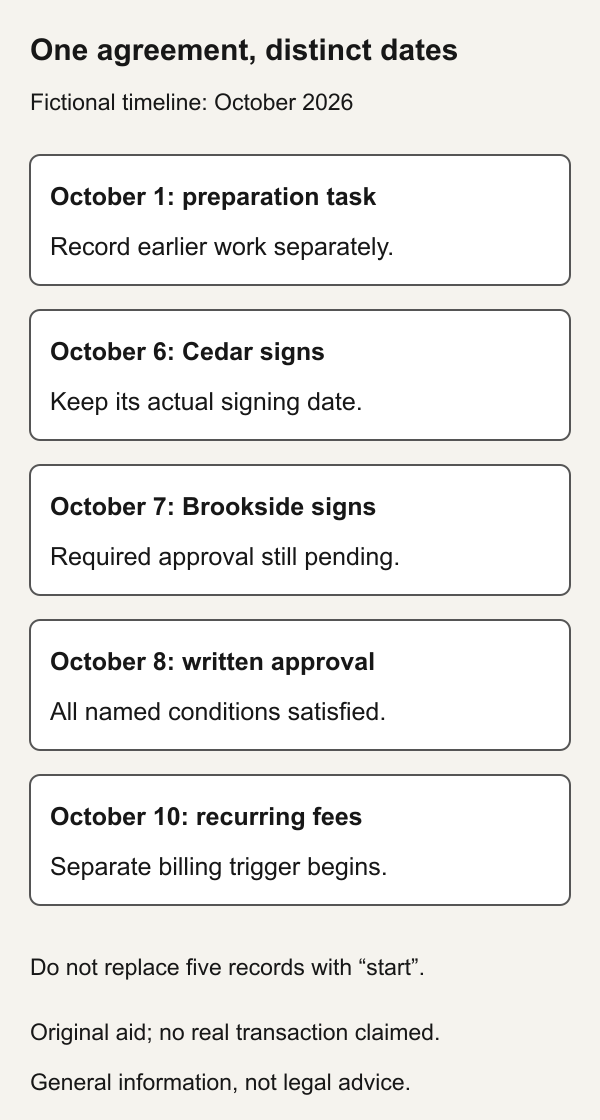
| Event in October 2026 | Record and consequence in this example | Owner |
|---|---|---|
| 1: preparation performed | Identify the task and its evidence; do not mark the main agreement effective | Service lead |
| 6: Cedar signs | Retain Cedar’s actual signing date and final version | Contract coordinator |
| 7: Brookside signs | Both signatures are present; approval remains outstanding | Contract coordinator |
| 8: required written approval received | All named effectiveness conditions now satisfied, under the illustrative wording | Budget approver |
| 10: recurring billing starts | Separate fee trigger; no recurring charge for October8 or9 | Finance |
October 1 to October 8 is seven elapsed calendar days. The two earlier signature dates remain October 6 and October 7. An intake entry reading “start: October 1” would conceal the approval condition and the later recurring-charge trigger.
The October 1 preparation task is identified separately as ten hours at $120 per hour: 10 × $120 = $1,200. The main recurring service begins on October 8 after the required approval; its first two days carry no recurring fee. The parties expressly agree an illustrative daily rate of $300 beginning October 10. The first invoice covers October 10 through October 12 inclusive: 3 × $300 = $900. If the parties agree to invoice both amounts together, the total is $2,100. No monthly proration, tax or late fee is assumed. Changing any of those assumptions requires a fresh calculation.
Copyable wording for distinct date triggers
These drafting fragments fit the fictional scenario only. They require integration with the complete agreement, authority checks and applicable law. In particular, review any early confidentiality, information-security or payment duties separately.
Effective Date means the date on which both parties have signed this Agreement and Brookside Retail's named budget approver has provided written approval of this Agreement. The contract coordinator shall retain the approval record and notify both parties of the resulting date. The notification records satisfaction of the conditions; it does not replace either condition.

Recurring Service begins on the Effective Date. Recurring Service Fees accrue at $300 per calendar day beginning on October 10, 2026, provided the Effective Date has occurred by then. If the conditions remain unsatisfied on that date, the parties must agree a revised service and billing schedule before recurring service begins.
The second paragraph deliberately prevents the billing date from bypassing the approval condition. Add the approver’s identity, approval method, recipient and a deadline for dealing with a failed condition. Decide what happens to work, access, deposits and costs if approval never arrives. Avoid using “subject to approval” without that operational detail.
Address earlier work without changing signature history
A past-service record and a retrospective legal allocation are different decisions. First establish what actually happened: who requested the task, what was delivered, who accepted it and what existing terms or communications applied. Then ask which specified provisions the parties now intend to apply to that period, subject to governing law and other people’s rights.
For Cedar and Brookside, a narrow discussion draft could read:
On the Effective Date, Brookside Retail shall owe $1,200 for the preparation task identified in Schedule A as ten hours performed on October 1, 2026. Schedule A shall identify the task, requesting person, delivery evidence and agreed acceptance record. This provision does not change either party's actual signing date. The treatment of any other earlier work or liability requires a separate express agreement.
This addresses a defined historical charge. It does not declare the whole agreement effective on October 1, settle every earlier dispute, create insurance coverage or resolve authority questions. Review those subjects expressly when relevant. If the document already signed contains a wrong date, use an agreed correction or the contract amendment sample; preserve the original and amendment rather than overwriting the execution record.
Jurisdiction and transaction rules can change the answer
NASA procurement: NASA FAR Supplement 1804.170 defines the effective date by the agreed beginning of performance and bars it from preceding the contracting officer’s or designated higher approval authority’s signature. That is a scoped procurement rule. Do not apply it as a universal prohibition on retrospective private agreements.
Federal contract modifications: FAR 43.101, expressly for Part 43, gives different triggers for different modifications. A supplemental agreement uses the agreed date; a change order or administrative change uses its issue date. This definition concerns modifications, rather than establishing a general rule for initial private-contract formation.
New York example: in Hasan v Macerich Co., 2024 NY Slip Op 30895(U), opinion pages 11–13, a March 19, 2024 trial-court decision considered an agreement signed March 2, 2020 that stated a January 6 effective date. The accident was January 8. The court rejected the contractor’s argument that it had not understood the retrospective term, treating the wording as unambiguous, and granted contractual indemnification on the circumstances before it. This uncorrected, non-final trial decision concerns a particular indemnity dispute. It does not establish that every retrospective clause or liability allocation is enforceable.
Take proposed retrospective wording to the reviewer with a list of affected provisions and known events. A single earlier date can reach much further than a past-service invoice. Explain the commercial objective before selecting the mechanism.
Correct the tracker, then recompute dependent dates
Keep the source clause beside each extracted field. A software fallback is a system rule, not a legal conclusion: Ironclad’s status documentation describes falling back from an undefined effective date to the agreement date, then the executed date. Review the underlying wording before relying on a populated status. No tenant or extraction test is claimed here.
If a record changes from October 1 to October 8, recalculate only deadlines actually anchored to that field. Billing explicitly starting October 10 stays tied to its own clause. A service acceptance date may start a warranty independently. For renewal dates, read the complete renewal agreement and checklist, including the notice-delivery requirements.
DATE RECONCILIATION RECORD
Agreement/version:
Each actual signature date and evidence:
Effectiveness clause and conditions:
Condition satisfied on / evidence / confirmed by:
Service commencement and evidence:
Billing commencement and calculation:
Earlier work, applicable terms and unresolved risks:
Term, renewal and notice clauses:
Old field / corrected field / reason / reviewer:
Affected calculations checked / unaffected dates explained:
File that record with the signed originals in the contract repository. Retain the incorrect entry’s history and correction evidence so the next reviewer can explain the change.
Effective-date checklist
- Read the preamble, definitions, conditions, fee schedule and term together.
- Retain each person’s actual signing date and the matching agreed version.
- Identify every condition, its owner, evidence and failure procedure.
- Separate service and billing dates wherever the agreement does.
- Identify past services precisely and review any retrospective risk allocation.
- Resolve conflicting dates through the agreed document process.
- Check the first invoice and every affected term or notice calculation.
- Save the evidence, reviewer and correction history with the agreement.
Frequently asked questions
Who fills in the effective date?
Assign a coordinator, but require that person to follow the agreed clause. If the date depends on an approval event, retain evidence of that event rather than inserting a convenient signing date.
Can the effective date be before the signing date?
The answer depends on the transaction, governing rules, wording and affected obligations. The jurisdiction examples above show why a universal yes or no would be misleading. Keep actual signature dates accurate and review the intended retrospective scope.
Does effective date mean service start?
Check the agreement. The fictional timeline separates effectiveness, earlier preparation and recurring service fees. A defined commencement date should identify the work it concerns.
How should I write the date?
Use an unambiguous calendar date, such as October 8, 2026, or a precisely defined event. For time-sensitive transactions, also specify the time zone and how receipt or approval is established.
What if the two parties sign on different days?
Retain both dates. Read the effectiveness clause and any remaining delivery or approval conditions before assigning a single operative date. Do not assume the last signature settles every trigger.
How do I fix an incorrect date after signing?
Preserve the signed original, establish the intended correction with the parties and follow the applicable amendment process. Update the tracker with an audit trail, then check each dependent deadline and invoice.
Sources
- NASA FAR Supplement 1804.170: scoped procurement definition and signature restriction.
- FAR 43.101: Part 43 modification definitions.
- Hasan v Macerich Co.: official March 19, 2024 decision, particularly opinion pages 11–13.
- Cornell Wex: condition precedent, secondary explanation.
- Ironclad: documented record-status date fallbacks.
Prepared with AI assistance. The banner is an AI-generated fictional illustration; the timeline, clauses, worksheet and calculations are original illustrative aids. No real transaction, professional review, software test or legal outcome is claimed for them.