

Contract vs Agreement: When a Promise Becomes Enforceable
By Anirudh Menon, Viaclause editor
Compare a plan, a counterproposal and a signed exchange. See why document titles do not settle enforceability, with California sources and an evidence checklist.
An agreement describes a mutual understanding; a contract is an agreement that creates legally enforceable obligations. A document called “Agreement” can be a contract. Changing its heading to “Contract” does not supply missing consent, consideration or other legal requirements. California's statutory definition itself describes a contract as an agreement to do or not do something. California Civil Code section 1549.
This US-oriented guide uses a California services example. For the complete formation framework, read the four elements of a contract. Here, the question is narrower: what changes between a discussion, a proposal and an agreed transaction, and what evidence shows the change?
Prepared with AI assistance. All people, communications, prices and project records in the example are fictional. The banner is an AI-generated illustration.
The difference is legal effect, not the document's name
| Question | Agreement | Contract |
|---|---|---|
| What does the word describe? | A mutual understanding; its legal effect depends on the facts and applicable law | An agreement creating enforceable obligations |
| Can it be called something else? | Yes, including an understanding, memorandum or arrangement | Yes, including a services agreement, lease or NDA |
| Must it be written? | The word alone does not answer | Check required formalities for the transaction and the parties' agreed conditions |
| What should the reviewer examine? | Words, conduct, agreed terms and whether the parties intended a commitment | Those facts plus capacity, lawful purpose, consideration and applicable formalities |
California lists capable parties, consent, a lawful object and sufficient cause or consideration as essentials. Civil Code section 1550. The court's practical guide also distinguishes a definite offer, acceptance and agreement on essential terms. California Courts: valid contracts and breach.
For disputed formation, California's jury instructions focus on sufficiently clear terms, an exchange of value and agreement, judged by outward words and conduct rather than hidden intentions. The directions preserve capacity and legality issues when disputed. 2026 CACI 302, Contract Formation. These are California rules, not a promise that the same checklist resolves every US or foreign transaction.
One business conversation, three stages
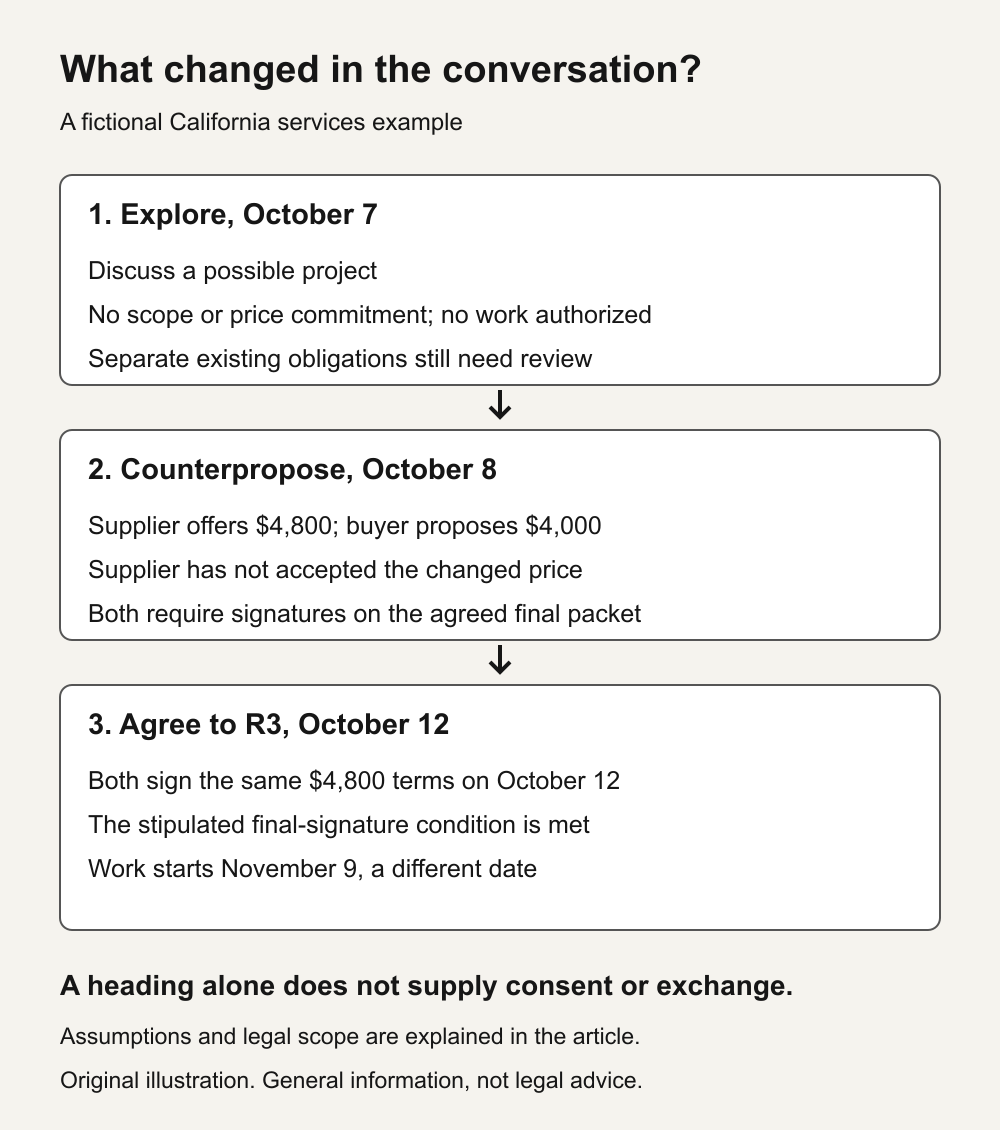
Fictional setting: an authorized buyer and an authorized supplier are discussing four process maps for the buyer's vendor-onboarding work. Assume capable parties, lawful services and no separate statutory writing requirement for this ordinary project. No one has started work, made a deposit or made a separate reliance-inducing promise during the first two stages.
Stage 1: discussing a possible project
October 7, 2026
Buyer: Could we explore mapping our onboarding process?
Supplier: Yes. We can discuss the scope next week.
Both: This discussion does not authorize work. We will
decide scope, price and approval conditions later.
The record shows an agreement to discuss an idea. It does not identify an accepted commitment to deliver four maps for a fee. The buyer should record “exploratory” rather than tell operations that a services contract has been approved. That is the assessment of the stipulated facts, not a rule that every early conversation is legally harmless.
Keep any independently agreed obligations separate. For example, an existing confidentiality commitment does not disappear because the project itself is still under discussion.
Stage 2: an offer and a different proposed price
October 8, 2026
Supplier: I propose four maps for $4,800, on the attached
scope R2. This proposal requires both authorized parties
to sign the agreed final packet before it is binding.
Buyer: I will agree if the total is $4,000.
Supplier: I have not accepted that change.
The $4,000 response is a counterproposal in this example, not acceptance of the $4,800 offer. California states that a qualified acceptance is a new proposal. Civil Code section 1585. Do not file the buyer's reply as approval of the supplier's price.
The parties have also chosen a final-signature condition. Whether parties agreed to be bound before a later signed writing matters; merely planning to document an existing deal later is different. 2026 CACI 306, Unformalized Agreement. Here, the stipulated record expressly requires both signatures and has no contrary performance.
Stage 3: accepting the same final packet
On October 12, both authorized parties sign R3 at the supplier's $4,800 price. The buyer accepts that price without the previous qualification. Their packet identifies the services, reciprocal payment obligation, dates and the agreed signature condition. On the stated assumptions, these facts support an ordinary express contract. A real dispute would require examining the complete communications and applicable law.
Fictional R3 terms extract, not a complete contract
Parties: Example Buyer and Example Supplier
Deliverables: Four process maps: intake, approval,
signature routing and repository filing.
Scope: Each map shows steps, owner roles and handoffs.
Format: One editable map file and one PDF per process.
Exclusions: No software deployment or legal advice.
Start: November 9, 2026.
Delivery: November 13, 2026, to the buyer's named reviewer.
Review: Buyer identifies any missing specified content
in writing; supplier corrects it before written acceptance.
Fee: $4,800 total; $960 due October 15; $3,840 due seven
calendar days after written acceptance, counting the
day after acceptance as day one.
Commitment: Both authorized parties agree to these R3
terms. The packet binds when the second party signs.
Signatures: Both completed October 12, 2026.
The signed packet date is October 12; the agreed work start is November 9. The later start date does not postpone the stipulated commitment. The deposit is 20% × $4,800 = $960; the balance is $4,800 − $960 = $3,840. If written acceptance occurs on November 16, the balance deadline is November 23: November 17 is day one and November 23 is day seven. These are fictional agreed terms, not standard market rates or statutory payment periods.
A complete project contract would need appropriate treatment of change control, delay, termination, intellectual property, confidentiality, liability and disputes. The extract illustrates formation evidence rather than supplying those terms. Use the separate specialist guides when building the complete packet.
The same R3 terms under three headings
Imagine three copies with identical parties, terms and signatures. One is headed “Services Agreement,” one “Services Contract,” and one “Project Memorandum.” The changed heading supplies no new exchange or assent. California's interpretation rule seeks the parties' ascertainable, lawful mutual intention at contracting. Civil Code section 1636.
Now change the body of the third copy to say that the parties have not agreed to be bound and still must negotiate price. That is a substantive change, not just a heading change. Review it against the actual communications and conduct. Do not resolve the conflict by selecting whichever filename sounds more formal.
A document headed “Nonbinding Memorandum” also deserves a clause-by-clause review. It might expressly commit the parties on confidentiality or another limited matter while leaving the proposed project unresolved. Record each obligation separately instead of assigning one status to every sentence.
Money, signatures and software are separate questions
Money is not the only possible consideration. California's definition includes a benefit conferred or promised, or a qualifying detriment undertaken, as an inducement to the promise. Civil Code section 1605. Read consideration in contract law for the deeper exchange and exception analysis. In R3, the exchange is the supplier's promised mapping work for the buyer's promised payment.
A signature is not a universal substitute for formation. It may evidence assent or satisfy an applicable formality. California allows oral contracts except those statutes specially require to be written. Civil Code section 1622. For oral evidence and limits, see verbal agreements in California.
Some transactions do require writing. California's statute includes agreements not performable by their terms within a year and specified real-property arrangements, with qualifications and exceptions that need their own review. Civil Code section 1624. The statute of frauds guide covers why evidence and transaction category matter.
Software records a process; the facts still need legal review. A draft marked “approved” in an application is not the same evidence as the counterparty accepting the intended version. Check who approved it, what they approved and whether any condition remained. Before relying on a sales statement outside the packet, use the missing vendor promises checklist.
Copyable decision and evidence record
Transaction and governing-law question: [ ]
Parties and authority evidence: [ ]
Exact proposal / version / date: [ ]
Exact acceptance / qualification / date: [ ]
Services or other promised performance: [ ]
Reciprocal exchange: [ ]
Essential terms still unresolved: [ ]
Required writing or other formalities: [ ]
Agreed condition for becoming bound: [ ]
Evidence that condition was met: [ ]
Formation date versus work-start date: [ ] / [ ]
Separate obligations during discussions: [ ]
Final packet and preserved communications: [ ]
Assessment: [exploratory / unresolved / formation supported]
Open legal questions and review owner: [ ]
Filled R3 record: proposal R2 offered $4,800; the $4,000 counterproposal was not accepted; both later signed R3 at $4,800 on October 12. The agreed final-signature condition was met. Work begins November 9, with the agreed $960 installment due earlier on October 15. The record preserves both R2 and R3 rather than silently treating the earlier counterproposal as the final bargain.
Frequently asked questions
Is every agreement a contract?
No. The word can describe an understanding without resolving whether enforceable obligations were created. It can also appear in the title of an enforceable contract. Review the transaction, not just the label.
Which is better, a contract or an agreement?
Neither heading is inherently better. If the goal is a binding project commitment, obtain clear agreed terms and the required formation evidence. If the parties are still exploring, document that status and identify any separate commitments.
When does an agreement become a contract?
When the relevant formation requirements and any applicable conditions are met. In R3, the parties deliberately require both authorized signatures. Other facts may support an earlier oral or conduct-based commitment; a signature deadline is not universal.
Does an agreement need to be written?
It depends on the transaction, governing law and any agreed condition. Oral arrangements can matter, while specified transactions require written evidence or other formalities. California's statutory rules are discussed above.
Are NDAs contracts or merely agreements?
An NDA can be a contract; its name does not remove the formation requirements. Examine the actual exchange and obligations instead of assuming every NDA lacks consideration. The NDA template and worked example shows a mutual confidentiality arrangement with reciprocal duties.
What are the four types of contracts?
There is no single four-part classification answering this comparison. Express versus implied concerns how assent is shown; bilateral versus unilateral concerns the promise or performance structure. These categories can overlap and do not replace the enforceability analysis.
Review checklist
- Identify the actual parties and who can commit them.
- Find the precise offer and the response accepting or changing it.
- Check whether the same version and essential terms were accepted.
- Identify the exchange, lawful purpose and capacity questions.
- Check statutory formalities and agreed final-approval conditions.
- Separate the commitment date from start, delivery and payment dates.
- Preserve negotiations, the final packet and relevant conduct.
- Review separately binding clauses in an otherwise preliminary document.
- Resolve material uncertainties with counsel before treating the arrangement as settled.
Sources
- California Civil Code section 1549: contract definition.
- California Civil Code section 1550: essential elements.
- California Courts: contracts and breach, practical self-help guide.
- Judicial Council 2026 CACI, instructions 302 and 306.
- California Civil Code section 1585: qualified acceptance.
- California Civil Code section 1636: interpretation and mutual intention.
- California Civil Code section 1605: consideration.
- California Civil Code section 1622: oral contracts.
- California Civil Code section 1624: required writings.