

Contract Elements: Four Essentials and a Worked Example
By Anirudh Menon, Viaclause editor
Understand mutual assent, consideration, capacity and lawful purpose. Follow an offer-to-acceptance example and copy the contract formation checklist.
The four basic contract elements are mutual assent, consideration, capacity and a lawful purpose. That means agreement, a bargained-for exchange, parties legally able to contract, and a legally permissible deal. Offer and acceptance usually establish mutual assent. This is the four-part framework in Cornell LII’s contract explanation. California’s official 2026 contract-formation instruction, CACI No. 302, separately addresses clear terms, exchange and agreement, with capacity and legal purpose added when disputed. A heading count is not a universal statutory test.
For a business, the practical question is whether the communications establish a deal you can rely on. Identify the governing law and transaction type first, then check agreement, exchange, parties and purpose. Finally, check required form and defenses. This guide uses California statutory examples, Virginia and New York decisions, and separately identified English and Indian authorities.
The four elements at a glance
| Element | Question | Useful evidence |
|---|---|---|
| Mutual assent | Did the parties communicate agreement to the bargain? | Offer, acceptance, agreed scope version, conditions and relevant conduct. |
| Consideration | What did each side promise, provide or give up in exchange? | Service and payment commitments, delivery terms or a requested lawful forbearance. |
| Capacity | Can the actual parties legally contract? | Party identities and relevant capacity facts. Check a representative’s authority separately. |
| Lawful purpose | Is the promised activity legally permissible? | Defined subject matter and applicable licensing, regulatory or public-policy restrictions. |
The evidence column is an editorial checklist, not a rule that every listed document is legally required. It applies the questions in CACI No. 302 to a reviewable business file. A signature or payment alone cannot answer every question.
1. Mutual assent: offer, acceptance and intention
An offer should make the proposed commitment understandable: who will do what, for whom, on what terms, and how the other side can agree. California’s official 2026 CACI No. 307 addresses a communicated willingness, specific terms and a reasonable understanding that acceptance will conclude the deal. In the service example below, the scope version, price, deadline and requested reply make the proposal concrete. Treat a request for proposals or an invitation to discuss prices as a different stage until the communications establish a commitment.
For the California service example, the official 2026 acceptance instruction, CACI No. 309, requires agreement to be bound by the offered terms and communicated acceptance. It separately addresses introduced conditions or new terms. “Accepted if you lower the price” therefore needs examination as a counteroffer, not automatic agreement to the original price. Read the actual message: a request accompanying an otherwise unqualified acceptance is not necessarily a counteroffer.
Check whether an offer was still open. CACI No. 308 in the official 2026 edition addresses withdrawal before acceptance and communication of that withdrawal. Preserve timing, stated expiry and any conditions rather than treating every later reply as effective acceptance. Do not transplant a postal acceptance rule into every email transaction.
A real case: an undisclosed joke did not defeat assent
In Lucy v. Zehmer, 196 Va. 493 (1954), the Virginia Supreme Court examined a signed agreement for a farm sale. The defendants argued that the transaction was a joke. The court relied on their outward words and conduct, the discussion and rewritten document, and the buyer’s reasonable understanding. It held the agreement binding and reversed the dismissal, directing specific performance. The writing was on a restaurant check, not a restaurant napkin.
Examine the communicated words and conduct. This holding concerned a particular signed land-sale record; it does not make every informal message a contract.
Goods can follow different formation rules
Model UCC section 2-204 allows a goods contract to arise through conduct and can tolerate open terms when the parties intended a contract and there is a reasonably certain basis for a remedy. Model UCC section 2-207 can recognize a timely, definite acceptance despite additional or different terms, unless it is expressly conditional. Additional terms between merchants face specific exceptions; they are not all automatically binding. The state enactment governs. Do not apply a simple service-contract counteroffer rule to every purchase order and acknowledgment.
Some offers invite acceptance by completing an act rather than exchanging promises. Our unilateral-contract reward example addresses when beginning performance differs from earning payment.
2. Consideration: identify the exchange
Consideration is not synonymous with a deposit. California’s 2026 CACI No. 302 recognizes an exchange of value, including a promise to do or refrain from doing something. A defined service promise exchanged for a payment promise can matter before either party performs. Simply relabeling a gift as “consideration” does not identify a bargain.
A useful review question is: what did the promisor request in return for this promise? Record that exchange separately from later payment. Also flag a proposed commitment to do only what the person was already legally obliged to do. The inspected 2025 California section 1605 text illustrates that preexisting-obligation limit; investigate the actual obligation and governing rule before treating a later promise as new consideration.
A real case: lawful forbearance supplied consideration
In Hamer v. Sidway, 124 N.Y. 538 (1891), the New York Court of Appeals treated the nephew’s requested forbearance from activities then lawful for him as consideration for the uncle’s payment promise. The court rejected the argument that the nephew’s own benefit or the uncle’s lack of tangible benefit defeated the exchange. This historical example illustrates surrender of a legal freedom, not a modern statement about drinking or tobacco age limits. The ultimate judgment also involved a later trust arrangement and limitation issues.
Use the consideration worked example to separate the original exchange from a later price or scope change. A failed ordinary contract claim also need not settle every alternative recovery question: Cornell discusses reliance and restitution as distinct doctrines with their own requirements.
3. Capacity and business signing authority
Capacity concerns the party’s legal ability to contract. Authority concerns whether a person can bind someone else. A capable adult signing a supplier agreement for a company does not establish authority merely by being employed there.
A statutory illustration shows why labels matter. In the inspected 2025 California Family Code section 6700 text, minors can contract subject to specified limits and disaffirmance. The same edition’s section 6710 generally permits disaffirmance before majority or within a reasonable time afterward, except as otherwise provided by statute. These provisions illustrate why “automatically void” and “subject to disaffirmance” should not be conflated. Verify the operative statute and exceptions for an actual minor’s transaction.
In Lucy, the actual evidence did not show drinking had prevented comprehension. That factual finding does not establish another person’s capacity or another state’s test.
For representatives, ask for the delegation, approval or other evidence supporting authority for this transaction and amount. Actual authorization is not the only possible issue. The authority discussion in California’s official 2026 CACI No. 3709 emphasizes principal conduct that creates an appearance of authority and reasonable reliance. That instruction is used for a tort agency issue, not a complete contract-enforcement test. Do not assume an internal approval breach automatically answers whether the company is bound externally.
4. Lawful purpose and genuine consent
The purpose and the promised exchange need scrutiny. A bookkeeping engagement to reconcile genuine records is different from a bargain to fabricate them. For a statutory illustration, the inspected 2025 California section 1598 text treats a single unlawful object as void. Section 1599 in that edition separately addresses several distinct lawful and unlawful objects. The nature, governing rule and separability of the obligations matter; a heading count cannot settle them.
That distinction explains why finding one challenged provision does not establish that the whole agreement disappears. Review the severability clause example alongside the actual governing rule. For a proposed restriction, the non-solicitation clause examples and exclusivity clause examples identify scope questions to examine.
Free consent is a separate concern from identifying the offered terms. California’s official 2026 CACI No. 332 requires specified wrongful pressure, its effect on free choice and inducement; No. 333 addresses economic duress and reasonable alternatives. No. 331 addresses bilateral mistake and identifies rescission authority. These are qualified doctrines, not a rule that any complaint about pressure automatically cancels a signed contract.
A complete formation checklist also does not settle whether a take-it-or-leave-it term is enforceable. Our adhesion contract example separates formation evidence from the later challenge to a provision.
Why do lists say four, five or six elements?
Lists often divide the same questions differently. Offer and acceptance can be grouped as mutual assent or counted separately. Other lists give intent, free consent or legally required form their own headings. A label count cannot replace checking the jurisdiction’s actual law.
Keep three stages separate: formation, whether a contract was made; enforceability, whether its obligations can be enforced given form rules and defenses; and performance, whether someone fulfilled those obligations. A later failure to deliver does not itself show that no contract ever formed. Our material versus minor breach guide addresses the performance question.
Writing, signatures and emails
Model UCC section 2-201 generally requires signed written evidence for goods priced at $500 or more, subject to its exceptions and the state enactment. Quantity limits matter. Its exceptions address specified specially manufactured goods, court admissions, and goods paid for and accepted or received and accepted. Formation and satisfaction of that writing requirement are different questions.
For California electronic agreements, the official 2026 CACI No. 380 requires proof, from context and conduct, that the parties agreed to use electronic records to formalize their agreement. Its directions also address electronic signatures and required records capable of retention. Email is not a shortcut around every substantive, attribution or form requirement.
Use the statute-of-frauds checklist when the agreement’s category may require written evidence. Our California verbal-agreement guide and wet signature guide address the next form questions.
England and India: separate legal frameworks
For English law, RTS Flexible Systems v. Müller [2010] UKSC 14, paragraphs 45 to 47 and 85 to 87, examines objectively communicated intention, essential terms and an anticipated signed agreement. The UK Supreme Court found that these parties’ conduct waived their signature condition and established a contract. Paragraph 47 expressly warns against assuming work begun during negotiations always creates a contract on the proposed terms. This is an English-law example, not a blanket rule for every UK jurisdiction.
The later RTS order, [2010] UKSC 38, paragraphs 1 to 6, addresses the form of order and costs, retaining the formation conclusion while leaving unresolved construction issues to the trial judge.
In India, Indian Contract Act, 1872, sections 10 to 14, expressly addresses free consent, competence, lawful consideration and lawful object, while preserving applicable writing, witness and registration rules. Sections 11 and 12 examine majority under the applicable law, soundness of mind and the ability to understand and judge the agreement when contracting. Section 14 identifies coercion, undue influence, fraud, misrepresentation and mistake as specified free-consent concerns. Section 23 identifies unlawful consideration or objects. These requirements should be applied in their own statutory setting, rather than substituting a US checklist.
Worked example: which email settles the deal?
Synthetic short service engagement: assume California law, capable adults acting personally, an ordinary lawful bookkeeping service, no specialized writing requirement, and no condition requiring a later signed agreement.
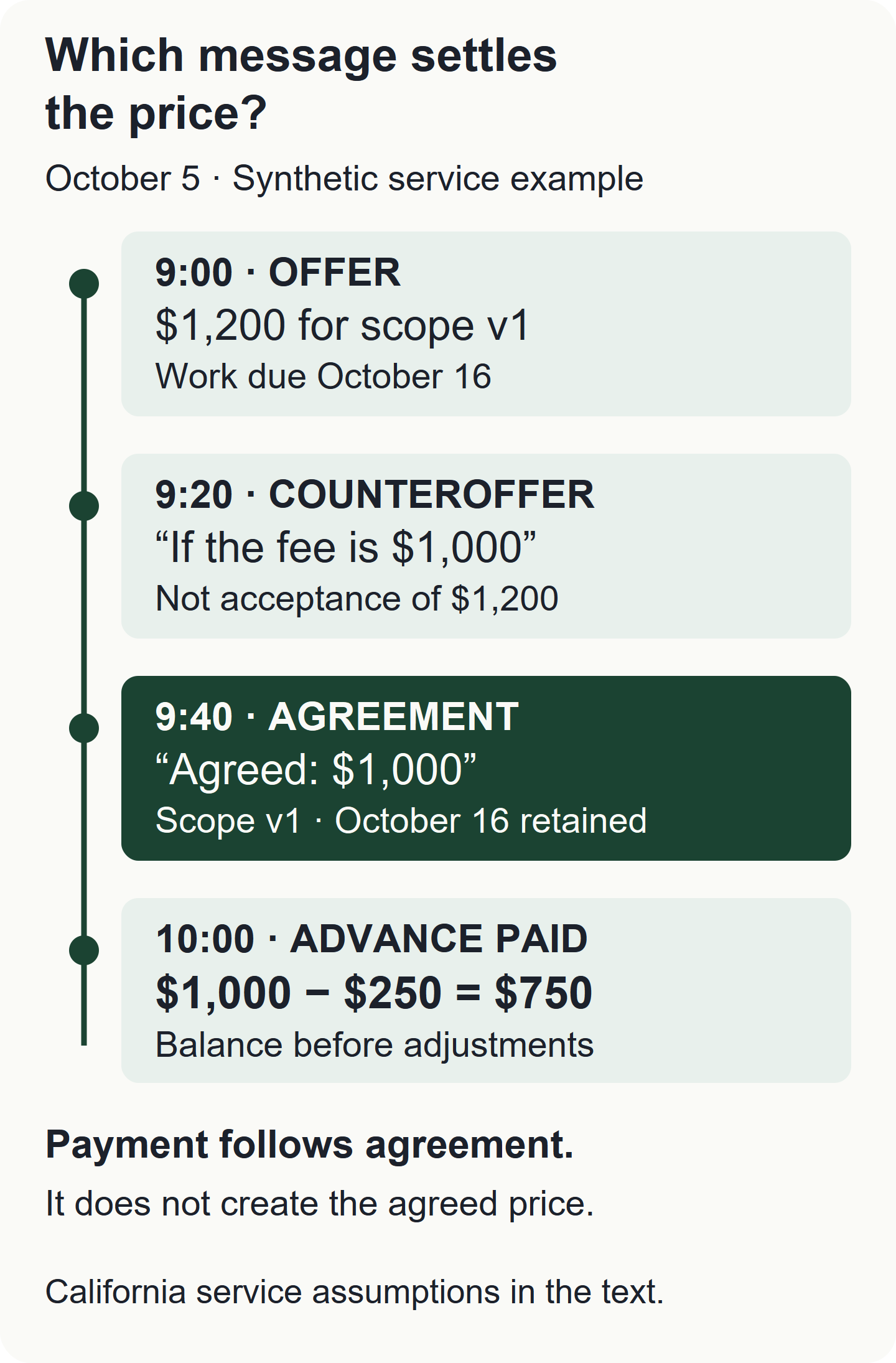
- 9:00: The bookkeeper offers July through September cleanup under attached scope v1 for $1,200, completed October 16; accept by 5 p.m.
- 9:20: The owner replies, “I will agree if the fee is $1,000. Keep the scope and October 16 date.”
- 9:40: The bookkeeper replies, “Agreed: $1,000 for scope v1, completion October 16.”
- 10:00: A $250 advance is paid and accepted as reducing the agreed fee.
The 9:20 reply changes the price. Under the example’s assumptions and California’s 2026 CACI No. 309, it is a new proposal; the 9:40 reply supplies agreement to it. The service promise and $1,000 payment promise supply the exchange. Capacity and lawfulness are assumptions here, not facts proved by the word “agreed.”
The agreed $1,000 less the $250 advance leaves $750 before later adjustments. The $200 difference from the original offer is negotiated price, not damages. A later $950 invoice needs support for its additional $200. Record any agreed scope or price change using the contract amendment sample.
A completed formation record
SYNTHETIC COMPLETED RECORD
Parties: bookkeeper and shop owner, acting personally.
Law and type: California, ordinary bookkeeping service.
Offer: October 5, 9:00; scope v1; $1,200; October 16 delivery.
New proposal: 9:20; $1,000 with scope and delivery unchanged.
Acceptance: 9:40; express agreement to the $1,000 proposal.
Exchange: bookkeeping service for promise to pay $1,000.
Capacity and lawful purpose: express example assumptions.
Representative authority: none assumed; personal parties.
Form: no specialized writing or later-signature condition assumed.
Payment: $250 advance; $1,000 minus $250 equals $750.
Contrary evidence to check: another approval condition, a different
scope version, disputed sender identity or additional price agreement.
Open issue: verify the assumptions in the actual file.
Copyable checklist for a real business file
Use this before describing a disputed agreement as binding. Complete each entry with the actual evidence or mark it unresolved. Preserve originals and attachments using the email evidence guide. If a sales promise never reached the final record, use the vendor-promise review to investigate that gap.
CONTRACT FORMATION RECORD
Actual parties and representatives:
Governing law and transaction type:
Offer: message, date, terms and attachment version:
Offer still open? Revocation, expiry or conditions checked:
Counteroffer or unresolved conditions:
Acceptance: exact message or conduct and date:
What each side promised, exchanged or lawfully gave up:
Capacity facts and remaining uncertainty:
Representative authority evidence, checked separately:
Lawful purpose and specialized rules:
Free-consent concern and its factual basis:
Required writing or signature and supporting record:
Any condition requiring formal execution or approval:
Final agreed scope, price and timing:
Payment received and balance calculation:
Evidence against our interpretation:
Next unresolved question and responsible person:
What if a contract element is missing or performance fails?
Identify the defect before choosing the label or remedy. No communicated agreement, a void unlawful bargain, a contract subject to disaffirmance and a transaction missing required signed evidence present different questions. The void versus voidable contract guide explains that distinction. Where work was performed without a formal document, the contractor nonpayment guide helps organize the evidence for possible recovery.
When an enforceable contract was made, proving breach and loss remains separate work. California’s official 2026 CACI No. 350 explains compensation, foreseeability and proof of the amount. CACI No. 3924’s authority discussion explains that punitive damages do not follow merely from breach. Lucy’s specific-performance order also demonstrates a remedy tied to the case’s facts, not an automatic entitlement in every deal.
Other remedy questions should also be kept distinct. The 2026 CACI No. 331 directions identify rescission in the bilateral-mistake setting. Revision of a writing is different: the inspected California section 3399 reproduction, whose source access is dated May 12, 2025, addresses a writing that fails to express the parties’ intention because of specified fraud or mistake, protecting qualifying third-party rights. This illustrates revision rather than permission simply to replace an unfavorable bargain.
For agreed liquidated damages, the inspected 2025 California section 1671 text distinguishes its general reasonableness rule from specified personal, household and residential-lease cases and other controlling statutes. Treat that as a statutory illustration and verify the operative transaction-specific rule. Preserve proof of loss, steps taken to limit it and relevant remedy clauses for a separate breach review. The official 2026 waiver instruction, CACI No. 336, separately addresses knowingly giving up a performance right. A concession or challenged damages clause needs its own evidence review.
Frequently asked questions
Are offer and acceptance two of the four contract elements?
In this framework, they sit within mutual assent. A list counting them separately may have five or six headings. The 2026 CACI No. 302 directions show that even jury instructions vary with the disputed issues. Check substance and governing law, rather than assuming another heading count is wrong.
Is an agreement the same as a contract?
Not every agreement creates enforceable obligations. Cornell’s contract framework asks about substance, including assent, exchange, capacity and lawfulness. Also check applicable form rules. Calling a document an “understanding” cannot alone settle its effect.
Is a signature always required?
No universal rule requires signatures for all bargains. A statute or the parties’ agreement can require a signed record. Model UCC section 2-201 and CACI No. 380 illustrate why the particular transaction needs its own form check.
Can a contract form before money changes hands?
Yes. California’s 2026 CACI No. 302 recognizes promises as possible value. In the bookkeeping example, a later deposit performs part of the payment commitment; it need not be the event that first established agreement.
Does “accepted, if you lower the price” create a contract?
In the stated California service example, it proposes a different price. The bookkeeper’s agreement to the revised proposal matters under 2026 CACI No. 309. Goods transactions with conflicting forms require the separate model UCC section 2-207 analysis described above and the governing state enactment.
Does a minor’s signature make a contract automatically void?
The inspected 2025 California Family Code section 6710 text illustrates disaffirmance, with exceptions, rather than automatic voidness. Verify the operative statute, capacity facts and applicable exceptions before deciding a real transaction.
Can starting work override “subject to contract” wording?
It depends on the jurisdiction and evidence. The English RTS decision found waiver on its facts while rejecting an automatic rule. Keep the condition, later communications and conduct in the same evidence file.
Sources
Sources inspected October 6, 2026. The California formation, acceptance, electronic-record, agency and remedy instructions are from the official 2026 CACI edition. The separately identified 2025 statutory reproductions are illustrations of their inspected editions, not certification of 2026 amendments. Model UCC text must be checked against the governing state enactment. Decisions illustrate their stated jurisdictions and facts.
- Judicial Council of California Civil Jury Instructions, official 2026 edition. CACI Nos. 302, 307 to 309, 331 to 333, 336, 350, 380, 3924 and the scoped agency discussion in 3709. Approved December 2025; actual instructions and directions inspected in the current court-hosted PDF.
- Cornell LII Wex: contract, reviewed October 2025. Secondary overview used for the four-part framework and separate reliance or restitution routes.
- Lucy v. Zehmer, 196 Va. 493, Virginia Supreme Court, November 22, 1954, opinion reproduced by Justia. Objective assent, the capacity finding and specific performance on its facts.
- Model UCC section 2-204, Cornell LII. Formation by conduct and qualified treatment of open terms.
- Model UCC section 2-207, Cornell LII. Additional or different terms in acceptance and confirmations.
- California Civil Code section 1605. Consideration and limits on preexisting obligations.
- Hamer v. Sidway, 124 N.Y. 538, New York Court of Appeals, April 14, 1891, official court reproduction. Lawful forbearance as consideration, with separate trust and limitation issues.
- California Family Code section 6700. Minors’ contracting power subject to limits.
- California Family Code section 6710. Disaffirmance and statutory exceptions.
- California Civil Code section 1598. A single unlawful object.
- California Civil Code section 1599. Several distinct lawful and unlawful objects.
- Model UCC section 2-201, Cornell LII. Goods writing requirement, quantity limits and exceptions.
- RTS Flexible Systems v. Müller [2010] UKSC 14, UK Supreme Court, March 10, 2010, paragraphs 45 to 47 and 85 to 87. English-law intention, essential terms and fact-specific waiver of formal execution.
- RTS Flexible Systems v. Müller (No. 2), [2010] UKSC 38, UK Supreme Court, July 21, 2010, paragraphs 1 to 6. Subsequent order and limits on construction issues decided.
- Indian Contract Act, 1872, India Code, sections 10 to 14 and 23. Indian statutory formation, capacity, consent, lawful object and separate formalities.
- California Civil Code section 3399, Public.Law statutory reproduction, original-source access date May 12, 2025. Revision of a writing for specified fraud or mistake and third-party limits.
- California Civil Code section 1671. Liquidated-damages standards and transaction-specific exceptions.