

Unilateral Contract: Examples, Acceptance and Payment
By Anirudh Menon, Viaclause editor
A unilateral contract exchanges a promise for performance. Compare bilateral contracts and follow a $500 reward from offer to payment.
AI-generated illustration of fictional people returning a tool case. Not a photograph of an actual transaction.
A unilateral contract exchanges a promise for a requested act. A bilateral contract exchanges promises. If a business offers $500 for returning its lost tool case, the requested return accepts the offer; saying “I will look” does not earn the reward. The person making the offer is the offeror, and its recipient is the offeree. Starting performance can protect the offer against withdrawal before payment becomes due. Cornell's unilateral-contract definition explains the model and its state-law limits.
The useful question is what the offer asks you to supply: a result, a commitment, or either. This guide explains that choice, the evidence needed when terms change, and the difference between an enforceable promise and an attractive advertisement.
Unilateral versus bilateral contracts
| Question | Unilateral offer | Bilateral agreement |
|---|---|---|
| What is exchanged? | A promise for the requested act. | A promise for a return promise. |
| Same task, different wording | “We will pay $500 if you return our case.” | “You agree to search for two hours; we agree to pay $100.” |
| Must the recipient take the task? | A performance-only offer does not require a promise to undertake it. | An enforceable commitment can require the agreed work. |
| What should the record show? | Offer conditions, actual conduct, completion and payment. | Exchanged commitments, agreed scope and later performance. |
The examples are hypothetical. Vanegas, Texas Supreme Court, 2009, distinguishes the two exchanges. A document's signature, title or author does not by itself answer which exchange it contains. A signed bonus plan can still invite acceptance by performance, as Boswell v. Panera Bread illustrates.
What makes a unilateral contract enforceable?
The label does not replace formation requirements. Cornell's contract overview identifies mutual assent, consideration, capacity and legality. For a performance-based offer, use these checks:
- A definite offer: identify the promised benefit, eligible recipient and requested act. “We appreciate helpful tips” is a weaker basis for a payment claim than a specified reward.
- The invited acceptance: compare what happened with the offer's conditions, including place, deadline and any required proof.
- Consideration: the requested act supplies the exchange for the promise. A recipient need not give a separate promise merely to make the exchange mutual.
- Capacity and lawful purpose: a performance-only structure does not remove these requirements or cure an unlawful arrangement.
- Applicable formalities: check any writing, signature or other requirements affecting the transaction.
Cook v. Coldwell Banker explains how performed services can supply consideration for a bonus promise. Our contract-elements guide develops the wider formation analysis. Use the statute-of-frauds checklist to identify formalities before treating performance as the entire answer.
Preparation, beginning performance and completion
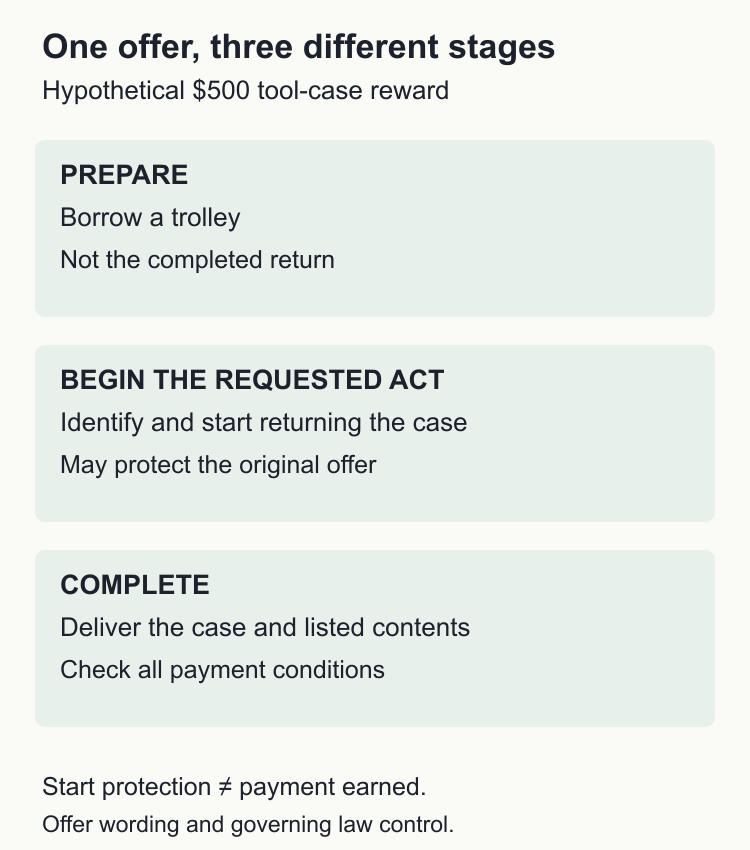
These are three different factual stages. Buying equipment, travelling or arranging help may be preparation rather than the act requested. New Mexico's instruction and commentary distinguish preparation from beginning invited performance. Keep observable acts separate from a conclusion that acceptance occurred.
Under New Mexico UJI 13-812 and commentary, beginning invited performance can protect a performance-only offer, with the promised duty conditional on completion. Partial performance is fact dependent. Where an offer permits a promise or performance, starting can instead imply a commitment to finish.
For your record, write “case collected at noon” rather than “contract accepted at noon.” The first is an observable event; the second combines a factual event with a legal conclusion. Save the exact wording that explains whether collection, searching, delivery or something else was the requested act.
Can a unilateral offer be revoked or changed?
Before invited performance begins, revocation is ordinarily possible, subject to applicable protection for the offer. After performance begins, many courts require an opportunity to complete. Cornell notes the jurisdictional variation. Avoid assuming either that every expense makes the offer irrevocable or that every offer remains freely revocable until the last step.
Reliance is separate. Cornell describes promissory estoppel as limited protection for reasonable detrimental reliance. Keep an expense log for that analysis without treating expenditure as proof that requested performance began or the reward was earned.
Save a changed notice, its receipt time and the recipient's response separately. In Boswell, continued work did not automatically establish assent to Panera's later bonus cap. Reserved discretion and modification language mattered.
Real examples: bonuses, public offers and insurance
Employment bonuses: Cook, Boswell and Vanegas
Cook, Missouri Court of Appeals, 1998: a real estate salesperson continued working and earned commissions under a bonus plan. Her firm later added a requirement to remain until the following March. The court found sufficient evidence of substantial performance before the change and affirmed the judgment for her. Read Cook's opinion, pages 657 to 658. This is a bonus case involving a salesperson, not a general rule that every property transaction is unilateral.
Boswell, Eighth Circuit, 2018: the majority predicted Missouri law would protect managers' beginning performance against a later bonus cap and affirmed liability. The concurrence relied on the written modification restriction. Read both opinions. This federal prediction is not a Missouri Supreme Court ruling or a nationwide rule.
Vanegas, Texas Supreme Court, 2009: employees alleged a promise to share five percent of sale or merger proceeds among original employees still employed when that event occurred. Assuming the offer was made, staying until the sale constituted performance. The court reversed summary judgment and remanded for further proceedings; it did not finally award the alleged share. Read Vanegas in the Texas court opinion volume. Its statute-of-frauds defense had been abandoned, so the case does not dispense with writing requirements.
Rewards, contests and advertising promises
Cornell identifies rewards and contests as common examples. Eligibility and the defined winning or delivery conditions still matter. A hypothetical “first verified report earns $500” offer asks a different question from “our team may award up to $500.” Save the language rather than treating those announcements as equivalent.
In Donovan v. RRL Corp., California Supreme Court, 2001, an advertisement for an identified vehicle at a stated price was an offer in the context of California's dealer advertising rules. Tendering that price formed a contract. However, the majority permitted rescission for the particular good-faith pricing mistake because the dealer did not bear its risk and enforcement would be unconscionable. Acceptance and a successful enforcement claim were separate questions. The opinion did not declare every advertisement an offer or every price error excusable.
Insurance: read the actual conditions
US Life v. Wilson, Maryland Court of Special Appeals, 2011, analyzed a life-policy reinstatement clause as a unilateral offer: paying the overdue premium within the specified period revived coverage. The court applied Illinois law and upheld the insurer's liability, while reversing liability against its administrator. This is a particular policy and choice-of-law analysis, not a universal classification of insurance. For other policies, inspect the coverage conditions. The National Association of Insurance Commissioners' policy guide separates the insuring agreement, exclusions, endorsements and general conditions, including what the insured must do after a loss.
For a hypothetical damaged tool case, the insurance record would ask which property and peril are covered, whether an exclusion applies, the deductible, limits and required claim evidence. It would not ask who first returned a lost case. Keep those records separate: the same item can feature in different promises with different triggers.
England and Wales and India: related principles, separate law
England and Wales: in Carlill v. Carbolic Smoke Ball Co., reported at [1893] 1 QB 256, the Court of Appeal enforced an advertised £100 promise to a user who followed the prescribed product-use conditions and nevertheless contracted influenza. The £1,000 bank deposit helped show that the offer was serious. The judges treated requested use as consideration and the advertisement as dispensing with advance notification of acceptance. The appeal was dismissed. This historic public-offer case is English authority, not a ruling governing every UK legal system.
India: Indian Contract Act, 1872, section 8 recognizes acceptance by performing a proposal's conditions or accepting consideration offered with a reciprocal promise. Sections 5 and 6 address revocation. Section 10 requires free consent, competent parties and lawful consideration and object, and preserves applicable writing, witnessing and registration laws. Section 8 alone does not establish that the US beginning-performance option rule applies in India. For an Indian reward, record the proposal, performance and communications, then apply Indian authority to any disputed withdrawal.
Worked example: the $500 reward and a disputed $200 change
This is a fictional New Mexico scenario. Cedar Workshop offers $500 to the first eligible finder returning its identified tool case and listed contents by 5 p.m. October 10, with payment on return. Assume lawful conduct, capable parties and Morgan's knowledge of the offer. The notice requests the complete return; it does not employ Morgan to search.
| Time | Saved event | Evidence and unresolved issue |
|---|---|---|
| October 7, 9 a.m. | Morgan saves the original $500 notice. | Screenshot shows item, contents, deadline, eligibility and payment trigger. |
| October 8, 10 a.m. | Morgan borrows a trolley and checks a route. | Preparation is documented without claiming that payment was earned. |
| October 8, noon | Morgan identifies the case, checks contents and starts returning it. | Photos and a message show actual conduct. Whether it began invited performance remains disputed. |
| October 8, 12:30 p.m. | Cedar announces a $200 reward instead. | The changed notice is saved separately; Morgan has not agreed to substitute it. |
| October 8, 1 p.m. | Cedar receives the complete case and pays $200. | A receipt records delivery and part payment without an agreed settlement or release. |
If the protected original offer governs and its conditions were satisfied, the claimed balance is $300: $500 minus $200 already paid. It is not another $500. If no payment was made, the same assumption produces a $500 claim. If the return was incomplete or late, this arithmetic does not establish entitlement. The unresolved protection question follows New Mexico's fact-dependent performance analysis.
The record deliberately assumes no settlement or release. If a receipt, payment message or signed form contains that language, add it to the review rather than silently treating the payment as an ordinary instalment. Record what was signed and when. Do not convert a disputed legal balance into an undisputed accounting debt.
Copyable offer and payment record
Use this completed example as a pattern, replacing every field with evidence from your transaction. Preserve originals and later versions together in your contract repository. Record unsupported or disputed facts as such.
Offer: Cedar Workshop tool-case reward, version 1
Saved: October 7, 9 a.m.; original notice attached
Law to assess: New Mexico
Recipient knew offer: saved notice before acting
Promised benefit: $500 to first eligible finder
Requested result: case and listed contents delivered
Deadline: October 10, 5 p.m.; workshop local time
Preparation: trolley borrowed October 8, 10 a.m.
Actual act started: case checked and return begun, noon
Change received: $200 announcement, 12:30 p.m.
Response: no agreement to reduced reward recorded
Completion: case and contents received, 1 p.m.
Proof: notice, messages, photos, checklist, receipt
Payment: $200 received; no settlement or release assumed
Conditional balance: $500 minus $200 = $300
Open question: did noon conduct protect version 1?
Decision owner: named reviewer; conclusion pending
Drafting checklist for a business offer
This is a proposed drafting workflow, not a tested form or assurance of enforceability:
- Choose the exchange. Use a result-based offer when participation is optional. If you need a named supplier committed to work, specify exchanged commitments and the required service scope.
- Define completion. Identify the property, deliverable or metric and an objective verification method.
- Define eligibility and priority. Explain whether one recipient or multiple recipients can qualify and how competing claims will be assessed.
- Set a clear deadline. Include time zone, delivery location and any submission channel.
- State the benefit and payment timing. Separate a fixed reward from a discretionary assessment or maximum possible award.
- Review change provisions before issuing the offer. Record the governing law and assess whether proposed withdrawal or modification terms work under it.
- Keep an evidence trail. Archive versions, communications, performance dates, completion proof, payments and any release.
For example, replace “reward for our missing case” with this hypothetical drafting prompt: “Cedar Workshop will pay $500 to the first eligible finder who delivers tool case CW-17 with the attached contents list to our front desk by October 10, 5 p.m. local time. Payment is due on verified delivery. No promise to search is required.” Add the actual eligibility, governing-law and verification terms before use.
The practical advantage is broad participation without first hiring a particular performer. The tradeoff is less certainty about who is working, whether someone will finish, and whether multiple people may claim the benefit. Version control and objective completion evidence address those operational problems. Software can store the record; it does not decide the legal effect of a changed offer.
If payment is refused
Build the claim around the original offer, evidence of qualifying performance, the promised amount and actual payments. Cook demonstrates an enforceable bonus claim after performance; Donovan demonstrates why formation can coexist with a defense. A refusal during performance raises a different timing issue from nonpayment after completion. Use our anticipatory-breach guide for that separate analysis.
Cornell distinguishes contract damages, reliance and restitution. Do not automatically add a reward to preparation expenses; identify the supported remedy under the governing law.
Frequently asked questions
What is a simple unilateral contract example?
A reward for returning an identified lost item. The requested act accepts the offer, while a promise to try does not complete it. Cornell's reward example illustrates this.
Are unilateral contracts legal?
Yes, subject to formation requirements and defenses. Cook upheld a bonus judgment; Donovan allowed rescission on its facts.
Does starting work make the full payment due?
No. Offer protection and payment conditions are different questions. Keep evidence of beginning and completion.
Can I stop after beginning performance?
New Mexico distinguishes a performance-only offer from one permitting promise or performance. In the latter route, starting can imply a commitment to finish.
Do I need to notify the offeror?
New Mexico's instruction addresses required notice and inability to learn of performance promptly. Check the offer and preserve submission and receipt evidence.
Is every advertisement, job posting or service request unilateral?
No. Donovan distinguishes a definite offer from preliminary negotiation. The requested exchange and applicable rules matter.
What if I spent money preparing but did not finish?
New Mexico's commentary distinguishes preparation from performance. A separate reliance argument needs its own factual and legal support.
Does unilateral mean one party may change an existing contract?
No. The performance structure differs from modification rights, which depend on terms and governing law. Boswell's cap dispute illustrates that distinction.
Sources
- Cornell Wex: unilateral contract, reviewed September 2025. Definition, rewards, contests and state-law variation.
- Cornell Wex: contract, reviewed October 2025. Formation and remedies; educational overview, not binding authority.
- New Mexico UJI 13-812 and commentary, approved November 1, 2020. Acceptance, performance and notification, pages 1 to 5.
- Cook v. Coldwell Banker, 967 S.W.2d 654, May 27, 1998. Missouri appellate opinion on bonus performance and modification, pages 657 to 658.
- Boswell v. Panera Bread, 879 F.3d 296, January 5, 2018. Eighth Circuit majority and concurrence, PDF pages 3 to 13.
- Vanegas v. American Energy Services, 302 S.W.3d 299, December 18, 2009. Official Texas court volume, PDF pages 311 to 319. Reversal and remand.
- Donovan v. RRL Corp., 26 Cal.4th 261, July 30, 2001. California majority opinion on advertisement, formation and mistake.
- US Life v. Wilson, 198 Md. App. 452, April 28, 2011. Maryland court opinion applying Illinois law, PDF pages 22 to 31.
- NAIC: Understanding Your Homeowners or Renter's Policy, July 1, 2012. Policy components and conditions.
- Carlill v. Carbolic Smoke Ball Co., [1893] 1 QB 256, December 7, 1892. English law-report reproduction; public offer, consideration and notification.
- India Code: Indian Contract Act, 1872, sections 5 to 10, PDF pages 12 to 13. Checked October 6, 2026.
By Anirudh Menon, Viaclause editor. Sources checked October 6, 2026. General information. Worked-example parties, dates and amounts are hypothetical.