

Anticipatory Breach: When an Early Refusal Lets You Act
By Anirudh Menon, Viaclause editor
Distinguish a proposed change, uncertainty and early refusal. See the assurance rules, a worked goods order and a copyable evidence record.
AI-generated illustration of a fictional supplier-delivery setting. Not a photograph of an actual dispute.
Anticipatory breach, also called anticipatory repudiation, is a sufficiently clear refusal to perform an important contractual obligation before it is due. A qualifying refusal can permit breach remedies before the deadline. A proposed change, uncertain forecast or fear of nonperformance does not automatically qualify. New York requires a positive and unequivocal
repudiation. Words and disabling conduct can matter. See Princes Point v. Muss Development, New York Court of Appeals.
This guide uses New York goods law for its completed example, with California cases and separate England and Wales and India notes. The UCC provisions are a model for state legislation, not one federal contract statute. Confirm the applicable state's enacted text and your agreement before choosing a remedy.
What must an early refusal establish?
Start with the promised performance, its due date and the whole communication. These five checks organize the analysis:
- An existing contractual duty: identify the agreement, changes and conditions that actually govern the obligation.
- Future performance: identify what remains due. Missing today's milestone may be an actual breach; abandoning next month's promised delivery raises the anticipatory question.
- A sufficiently definite refusal: preserve the exact words or act, rather than substituting a label such as “supplier breached.”
- Seriousness: New York UCC section 2-610 requires that losing the future performance substantially impair the contract's value to the other party. A minor issue is not automatically a total-contract exit. See New York's anticipatory-repudiation threshold.
- A response grounded in the contract and law: check any agreed variation, excuse, termination right and required notice before treating the refusal as wrongful.
A material breach concerns seriousness; anticipatory breach concerns a sufficiently serious refusal before performance is due. They can overlap. Review material breach and cure rights for that separate assessment. If an excusing event is raised, use the force-majeure clause example to examine the claimed excuse.
Examples: proposal, insecurity, refusal and actual delay
| Message or event | What to distinguish | Useful response |
|---|---|---|
| “Could we move delivery to November 4? If you disagree, we will honor October 30.” | A proposal preserving the current promise. | Accept or reject explicitly; keep the original date unless a change is agreed. |
| “Our line is down. We are checking another production line.” | Reason for concern, without a final refusal. | Record the operational facts; assess a justified assurance demand. |
| “We will not deliver this order. We have stopped work and will not resume.” | A definite refusal, subject to the legal threshold and any valid excuse. | Preserve the message; assess remedies and the effect of your response. |
| No desks arrive on October 30. | Actual nonperformance at the deadline, subject to the agreed terms. | Check breach, notice and cure provisions; quantify the resulting loss. |
These are editorial examples, not court findings. Norcon Power Partners v. Niagara Mohawk explains the risk of stopping your own performance after misreading an equivocal message. For broader consequences, see our breach-of-contract remedies guide.
Leading cases: what the actual records show
Roehm v. Horst: an absolute refusal can support an early suit
In Roehm v. Horst, 178 U.S. 1 (1900), Supreme Court opinion hosted by Cornell LII, a buyer rejected obligations under future hop contracts. The Court affirmed recovery before all delivery periods had arrived. It adopted the reasoning of the English courier case Hochster v. De la Tour (1853). The opinion also distinguishes ordinary unmatured notes and bonds, where consideration has already passed: a refusal alone does not necessarily accelerate a future money debt. Check any separate acceleration clause.
Dingley v. Oler: refusing a particular demand is not always abandoning the contract
In Dingley v. Oler, 117 U.S. 490 (1886), opinion hosted by Cornell LII, an ice contract allowed delivery during a shipping season. The Court read the correspondence as refusing the requested immediate delivery, rather than finally refusing all permitted performance. It reversed the judgment and found the suit premature. The full delivery window and exchange mattered.
Taylor v. Johnston: separate an early refusal from its later retraction
In Taylor v. Johnston, California Supreme Court (1975), hosted by Stanford, arrangements for horse-breeding performance retracted an initial refusal. Later booking difficulties did not establish renewed repudiation within the agreed period. The court reversed the judgment. Preserve the intervening response.
Howard S. Wright: refusal to pay can affect construction performance
In the published anticipatory-breach analysis of Howard S. Wright Construction v. BBIC Investors, California Court of Appeal, 2006, opinion reproduced by Justia, the construction customer said it would not pay further money. The contractor recorded the conversation and stopped work. The court treated the design-build obligations as terminated by anticipatory breach when deciding whether a mechanic's lien was prematurely recorded. This is a specific construction and lien dispute, not a universal lien deadline.
Princes Point: asking a court to resolve contract terms is not automatically repudiation
In Princes Point (2017), seeking changes to amendments and performance of the original agreement did not establish repudiation. The court reversed and denied defendants' partial summary judgment. The holding depends on that record.
When uncertainty justifies a demand for adequate assurance
The assurance mechanism addresses insecurity before it becomes a clearly established refusal. Model UCC section 2-609 permits a written demand when reasonable grounds for insecurity arise. Between merchants, commercial standards govern both the grounds and the adequacy of the response.
Under New York's enacted section 2-609, commercially reasonable suspension concerns performance for which the agreed return has not already been received. After receipt of a justified demand, failing to supply adequate assurance within a reasonable time, no more than 30 days, is repudiation. Thirty days is an outside limit, not an automatic grace period. A deadline written into your email is not self-validating.
An assurance request should address the actual risk. For the fictional desks below, an identified production plan and evidence of available stock help evaluate October 30 delivery. “We hope it works out” leaves different questions from a dated plan supported by verifiable records. The examples are proposed communications, not a finding that any particular response satisfies a court.
The transaction classification matters. Current New York Article 2 scope covers goods and specifies rules for hybrid transactions. A combined equipment, installation and support deal needs that analysis; a software-services label alone does not resolve it.
For non-UCC contracts, Norcon (1998) recognized a common-law assurance right for the type of complex, long-term commercial agreement between corporate parties before it. The court declined a universal expansion. Do not assume every consultancy, construction or subscription agreement carries Article 2's assurance rights and deadlines.
Act now, wait, or negotiate: record the election
For a qualifying New York goods repudiation, section 2-610 allows waiting for a commercially reasonable time or using breach remedies, and allows suspension of the aggrieved party's performance. It permits resort to remedies even after urging retraction or saying you would await performance. That rule is distinct from treating an uncertain warning as established repudiation.
Taylor explains the California common-law election between breach and continuing the contract. Effective retraction can matter. Record the chosen route and avoid contradictory cancellation and continuation messages.
A negotiated extension is also a practical option if both parties agree. Preserve its effect on price, delivery, accrued claims and replacement commitments through a clear contract amendment. Check the agreement's dispute-resolution process before selecting litigation, arbitration or mediation.
Your own readiness and the loss still matter
Excuse from a futile tender is not a universal exemption from proving your own position. In Pesa v. Yoma Development, New York Court of Appeals, 2012, buyers claiming damages for a seller's real-estate repudiation had to show they would and could have closed. The court also held that transfer to an affiliated company did not alone establish repudiation; factual issues remained. Keep evidence of funds, approvals, access and other conditions relevant to your transaction.
Which remedies are available?
- Cancellation and price recovery: New York UCC section 2-711 provides buyer remedies when the seller repudiates, including cancellation, recovery of price paid and the cover or non-delivery routes. The extent of the affected goods or whole-contract breach matters.
- Cover: make a reasonable substitute purchase in good faith and without unreasonable delay. Section 2-712 uses the cover cost less contract price, plus qualifying further losses and less saved expenses. Failure to cover does not by itself bar every other remedy.
- Market damages: section 2-713 provides a market-price route, subject to section 2-723's proof rules. Where trial precedes performance, section 2-723 specifies the price when the aggrieved party learned of repudiation. Do not substitute today's highest quote for the legally relevant measure.
- Further loss: section 2-715 distinguishes reasonable incidental expenses from consequential losses, including requirements the seller had reason to know at contracting that could not reasonably be prevented by cover or otherwise.
- Specific performance: section 2-716 allows a decree for unique goods or other proper circumstances. An early refusal does not automatically produce an order compelling performance.
Keep the contractual remedy provisions alongside the legal measure. The following calculation illustrates one buyer's goods-order assumptions; it does not predict an award. Our actual-damages guide explains why refunds, unpaid amounts and overlapping losses need separate entries.
Worked timeline: a $10,000 order and a $1,500 cover difference
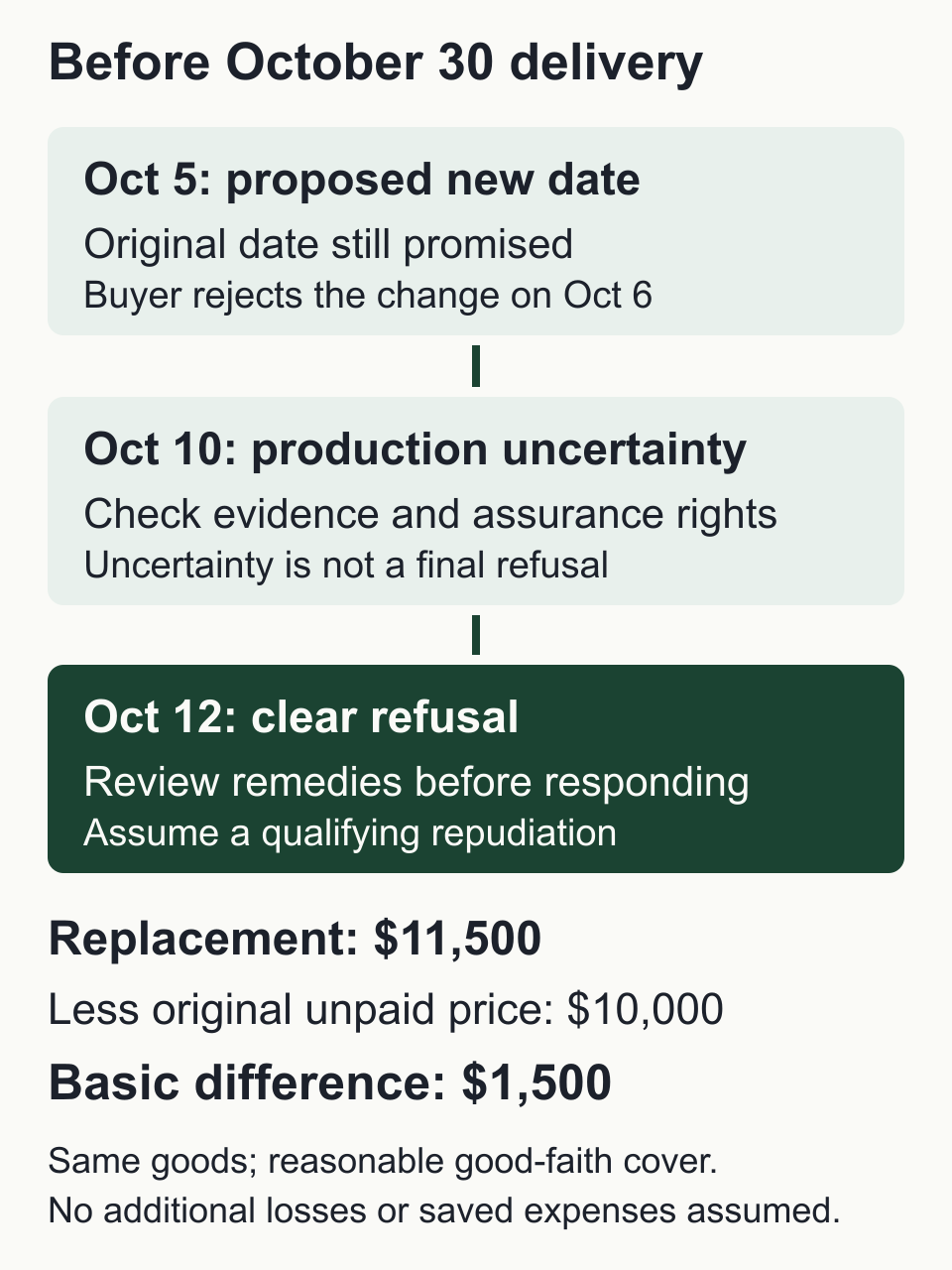
Assume Harbor Workspace buys 100 standard desks from Northline Furniture for $10,000, governed by New York Article 2, delivery October 30. Nothing has been paid. Timely delivery is important to the opening. Assume no agreed variation, valid excuse or remedy limit and a buyer able to pay and receive delivery.
- October 5 and 6: Northline proposes November 4 but promises October 30 if rejected. Harbor rejects the change and saves both messages.
- October 10: Northline reports a failed line and uncertain alternative production. Harbor records reasonable grounds for concern, checks assurance authority and sends the proposed demand below. It does not declare silence an automatic breach after an arbitrary 24 hours.
- October 11: a response supplies a recovery plan. Harbor records what is supported and what still needs verification. This stage illustrates how to evaluate evidence, not a legal determination of adequacy.
- October 12: Northline then says it will not deliver and will not resume work. Assume that this later communication qualifies as repudiation and substantially impairs the order's value.
- October 13: after checking available substitutes, Harbor commits to equivalent desks at $11,500 in good faith and without unreasonable delay, and records its cancellation and replacement commitment.
The basic section 2-712 cover calculation is $11,500 minus $10,000 equals $1,500. The example assumes zero incidental or consequential losses and zero additional saved expenses. It excludes deposits and refunds. The replacement invoice alone is not the cover-price difference; retain the original price and proof of equivalent scope.
Copyable assurance demand and supplier response
These completed fictional examples are drafting aids. Adjust the recipient, service method and response time to the agreement, governing law and actual circumstances. A request for specified evidence is not an automatic entitlement to every document requested.
SUBJECT: Assurance of delivery, order HW-100
To: Northline Furniture, contractual notice contact
From: Harbor Workspace
Date: October 10

Our agreement requires 100 standard desks for $10,000, delivery October 30. We rejected the proposed November 4 change on October 6.

Your October 10 message reports a failed production line and uncertainty about alternative production. Those facts create concern about the agreed delivery.

Subject to New York UCC section 2-609 and the agreement, we request adequate assurance of October 30 delivery. Please identify the production allocation, expected completion date and available shipping arrangement, with supporting evidence you can provide.

Please respond promptly and propose a feasible response date if this information requires time to assemble. No fixed legal deadline or cancellation is declared by this request.

Please use the agreement's notice route. We remain prepared to pay and receive conforming delivery as agreed.
SUBJECT: Response to HW-100 assurance request
From: Northline Furniture
Date: October 11

We confirm the existing October 30 date. We have allocated the order to Line B for completion October 24. Attached are the allocation record and a carrier booking for October 26 collection.

Please verify the booking with the carrier contact in the attachment. We will report completion status October 18. We are not requesting a revised price or delivery date.

Harbor's review entry:
Received October 11. Compare records to the quantity and specifications, verify the booking and track October 18 status. Record any unsupported assumption. Do not mark assurance adequate solely because the subject line says it is.
The October 11 response is one branch of the fictional sequence. The later October 12 refusal changes the evidence; preserve both. For your own record, use the checklist below and our email evidence collection guide.
Can the refusing party retract?
Under New York UCC section 2-611, retraction is possible until the repudiator's next performance is due, unless the aggrieved party has cancelled, materially changed position or otherwise indicated final treatment. Retraction must clearly indicate intended performance and include any justifiably demanded assurance. It reinstates rights with allowance for delay caused by the repudiation.
In the fictional order, an attempted October 14 retraction must be assessed against Harbor's October 13 cancellation and binding substitute order. Timing and the nature of the commitment matter. A mere quote request is different evidence from a completed replacement commitment.
Response checklist and a completed evidence record
- Collect the agreement, amendments, notice terms and governing-law clause.
- Identify the exact outstanding duty, whole performance window and importance of the lost performance.
- Preserve the original message or act, full context, sender authority and receipt time.
- Check uncertainty, a valid contractual exit or excuse, and definite wrongful refusal separately.
- Record your own payment, approvals and ability to perform.
- If assurance is available and justified, record the grounds, demand receipt and evidence actually supplied.
- Choose a response through an authorized decision-maker; use the required notice route.
- Document reasonable substitute options, equivalent scope and commitments. Avoid adding unnecessary loss.
- Preserve any retraction, amended agreement, refund and dispute-resolution deadline.
COMPLETED FICTIONAL RECORD, HW-100
Law and scope: New York goods sale, 100 standard desks
Duty: delivery October 30; price $10,000 unpaid
October 5 proposal: November 4 requested, October 30 preserved if refused
October 6 decision: change rejected, reply retained
October 10 concern: failed line and uncertain alternative production
Assurance demand: October 10, original deadline and risk identified
October 11 response: Line B plan and carrier record, verification tracked
October 12 refusal: will not deliver; work stopped and will not resume
Legal assumption: qualifying repudiation, substantial impairment, no valid excuse
Buyer's position: able to pay and receive desks; no prior unpaid obligation assumed
October 13 decision: cancellation recorded; equivalent order committed at $11,500
Basic cover difference: $11,500 less $10,000 = $1,500
Further loss and saved expenses: assumed zero for this calculation
October 14 attempted retraction: assess against cancellation and replacement commitment
Attachments: agreement, four message stages, quotes, substitute order, receipt timestamps
England and Wales and India: keep the rules separate
England and Wales
The UK Supreme Court's Bunge v. Nidera, [2015] UKSC 43, paragraph 12 explains acceptance of renunciation, release from further performance, immediate suit and mitigation, tracing the principle to Hochster. Its wheat-sale dispute also shows why early breach does not guarantee substantial damages: an export prohibition would have prevented contractual performance, and the Court substituted nominal damages of US$5. See paragraphs 35 and 36. These are English-law principles and a specific loss analysis, not authority to import UCC assurance deadlines into an English contract.
India
Indian Contract Act 1872, section 39 permits the promisee to end the contract when the other party refuses or disables itself from performing its promise entirely, unless the promisee has signified acquiescence in continuance. Section 51 addresses readiness for simultaneous reciprocal promises. Sections 73 and 75 address compensation and rightful rescission; section 73 excludes remote and indirect losses and takes available means of remedying the inconvenience into account. Apply those provisions and the relevant contract, rather than the New York example's procedure.
Frequently asked questions
Is anticipatory breach the same as anticipatory repudiation?
Princes Point uses anticipatory repudiation for refusal before performance is due. Contract labels may need separate interpretation. Check the substantive test instead of assuming uniformly different doctrines.
Does asking for more time automatically breach the contract?
No. Read whether the existing promise remains in place, the whole performance window and what happens if the request is declined. A refusal of a particular early demand can differ from rejecting all agreed performance, as Dingley illustrates.
Must I wait until the delivery deadline to sue?
A qualifying repudiation can support remedies earlier. For New York goods, section 2-610 supplies options subject to substantial impairment. Uncertain future performance needs a different assessment.
Must I demand assurance before every repudiation claim?
No universal rule requires it. Section 2-609 addresses reasonable insecurity; section 2-610 addresses qualifying repudiation. Check applicable notice requirements and any contractual assurance process.
Does every assurance request create a 30-day waiting period?
No. Under New York section 2-609, the demand must be justified and the response time reasonable, with 30 days the maximum. The period follows receipt, not merely sending.
Can I recover the whole replacement invoice?
The basic cover measure deducts the contract price and saved expenses and separately addresses qualifying further loss. Price already paid or refunded requires a separate account. The fictional unpaid $10,000 order replaced for $11,500 produces a $1,500 basic difference.
Can the refusal be withdrawn after I order replacements?
Section 2-611 bars retraction after cancellation, material change of position or other final treatment. Record the actual commitment and chronology; asking for a price is not the same as ordering.
Does the doctrine apply to services and construction?
Common-law repudiation can arise in those settings, as Taylor and Howard S. Wright illustrate. Separate that question from whether a particular assurance statute applies. Norcon does not create automatic UCC rights for all service contracts.
Sources
- Princes Point LLC v. Muss Development, New York Court of Appeals, October 19, 2017: repudiation and litigation, official corrected opinion.
- Roehm v. Horst, US Supreme Court, May 14, 1900: early action and money-debt distinction; opinion hosted by Cornell.
- Dingley v. Oler, US Supreme Court, March 29, 1886: correspondence and delivery window; opinion hosted by Cornell.
- Taylor v. Johnston, California Supreme Court, September 2, 1975: refusal, retraction and delay; opinion hosted by Stanford.
- Howard S. Wright Construction v. BBIC Investors, California Court of Appeal, January 31, 2006: published anticipatory-breach analysis, part II.D; actual opinion reproduced by Justia.
- Norcon Power Partners v. Niagara Mohawk, New York Court of Appeals, December 1, 1998: limited assurance extension; Cornell's opinion version notes possible revision.
- Pesa v. Yoma Development, New York Court of Appeals, February 9, 2012: real-estate buyer readiness and unresolved facts, official corrected opinion.
- Model UCC section 2-609, Cornell LII: model assurance wording, checked October 6, 2026.
- New York UCC section 2-102, New York Senate: current scope and hybrid transactions, revision displayed June 5, 2026.
- New York UCC section 2-609: assurance conditions and timing.
- New York UCC section 2-610: repudiation threshold and options.
- New York UCC section 2-611: retraction.
- New York UCC section 2-711: buyer remedies and price recovery.
- New York UCC section 2-712: substitute purchases and cover measure.
- New York UCC section 2-713: market damages.
- New York UCC section 2-715: incidental and consequential losses.
- New York UCC section 2-716: specific performance.
- New York UCC section 2-723: market-price proof and early trial. New York remedy provisions checked October 6, 2026.
- Bunge v. Nidera, UK Supreme Court, July 1, 2015, [2015] UKSC 43: paragraphs 12, 35 and 36; official judgment.
- Indian Contract Act 1872, India Code, sections 39, 51, 73 and 75: Indian scope, checked October 6, 2026.