

Force Majeure Examples: Events, Real Cases and Sample Clauses
By Anirudh Menon, Viaclause editor
Typical force majeure events, four real court outcomes, five sample clauses with a "which to use" table, a worked flood example and a notice letter.
A force majeure event is an extraordinary event outside a party's control, such as a flood, war or government shutdown order, that directly stops it from performing a contract. If the contract's force majeure clause covers the event, the affected party may be excused for the delay or failure.
Cornell's Legal Information Institute notes that mere impracticality or unexpected difficulty is not enough, and that courts generally do not treat an economic downturn as force majeure (LII Wex: force majeure). Below: common examples, real court outcomes, five sample clauses and a notice letter you can copy.
Short sample clause (the fuller versions are further down):
Force Majeure. Neither party is liable for a delay or failure to perform, other than a payment obligation, to the extent caused by an event beyond its reasonable control, such as flood, fire, epidemic, war or a government order. The affected party must notify the other party in writing within [5] business days and resume performance promptly once the event ends.
Common force majeure examples
Cornell LII describes force majeure events as both natural and man-made events, such as fires, floods, storms, war and labor disputes (LII). Real clauses name events like these:
- Natural events: floods, fires, storms, adverse weather, "Acts of God"
- War and unrest: war, riots, insurrection, armed conflict, terrorist attack
- Government action: restrictive laws or regulations, and orders that shut down businesses
- Health emergencies: pandemics, if the clause wording covers them
- Infrastructure: failure of utility service
- Labor: labor disputes and general strikes
For example, the lease in Kel Kim v. Central Markets listed "labor disputes, inability to procure materials, failure of utility service, restrictive governmental laws or regulations, riots, insurrection, war, adverse weather, Acts of God, or other similar causes beyond the control of such party." The auction contract in JN Contemporary Art v. Phillips Auctioneers listed "natural disaster, fire, flood, general strike, war, armed conflict, terrorist attack or nuclear or chemical contamination."
What usually does not count
- Higher costs, lower profit or a market downturn (LII).
- An unlisted event unlike the listed ones. In New York, catchall words are confined to things of the same kind as the listed events (Kel Kim).
- Problems caused by your own fault or negligence (LII).
- An event that did not actually stop your performance. A party is ordinarily excused only if the clause includes the event that actually prevents performance (Kel Kim).
Whether any event counts depends on the exact wording of your clause and the law that governs the contract.
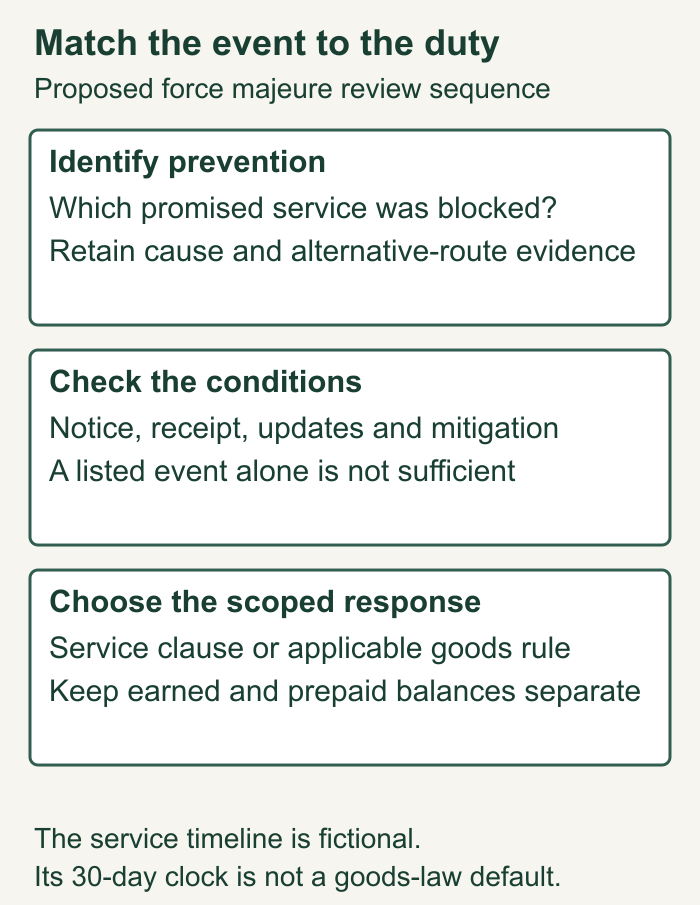
Force majeure examples from real cases
Short summaries. Read the linked source before relying on any of them.
| Case | What happened | Result |
|---|---|---|
| Kel Kim Corp. v. Central Markets, 70 N.Y.2d 900 (New York Court of Appeals, 1987) | A roller rink tenant could not renew the public liability insurance its lease required after its insurer declined to renew. | No excuse. Insurance was not a listed event, and the "other similar causes" catchall did not reach it. Impossibility also failed because the risk could have been foreseen and guarded against. (opinion) |
| JN Contemporary Art v. Phillips Auctioneers, 29 F.4th 118 (2d Cir. 2022) | An auction house agreed to offer a painting at its May 2020 New York auction with a $5,000,000 guaranteed minimum. COVID-19 and New York's orders restricting nonessential businesses forced the auction to be postponed. | Excused. The court held that the pandemic and the shutdown orders were "circumstances beyond our or your reasonable control" under the clause, so the auction house could terminate. It did not decide whether COVID-19 is a "natural disaster". (opinion) |
| RTI Ltd v MUR Shipping BV [2024] UKSC 18 (UK Supreme Court) | US sanctions on the charterer's parent company made timely US dollar payments to the shipowner likely to be difficult. The charterer offered to pay in euros and cover conversion costs. | Reasonable endeavours to overcome a force majeure event do not include accepting non-contractual performance, absent clear wording. The shipowner did not have to accept euros. (judgment, para 102) |
The pattern: courts look hard at whether the clause covers the event and whether the event, not cost, actually stopped performance.
Sample force majeure clauses
Illustrative wording. Adapt it to your contract and governing law.
1. Short balanced clause
Force Majeure. Neither party is liable for a delay or failure to perform, other than a payment obligation, to the extent caused by an event beyond its reasonable control, including flood, fire, earthquake, epidemic, war, terrorism, riot, government order, or failure of public utilities (a "Force Majeure Event"). The affected party must notify the other party in writing within [5] business days, describe the event and its expected duration, use reasonable efforts to resume performance, and resume promptly once the event ends. If a Force Majeure Event continues for more than [30] consecutive days, either party may terminate the affected services by written notice.
2. Broad clause (favors the party performing)
Force Majeure. A party is excused from performance, and from liability for delay, to the extent performance is prevented, hindered or delayed by any cause beyond its reasonable control, including the events listed in Section [x], labor disputes, and failures of its suppliers or subcontractors caused by such events. Performance dates are extended by the length of the delay.
3. Narrow clause (favors the customer)
Force Majeure. A party is excused only to the extent a listed Force Majeure Event prevents performance despite reasonable mitigation, including use of available backup systems. Increased costs, lack of funds, market changes and supplier failures are not Force Majeure Events. Payment obligations are not excused. If performance is prevented for more than [15] consecutive days, Customer may terminate the affected services and receive a refund of prepaid fees for unperformed services.
4. Pandemic and government order add-on
Force Majeure Events include epidemics, pandemics, quarantines, and government orders restricting business operations or movement, to the extent they prevent the affected obligation. The existence of an epidemic or pandemic alone does not excuse performance.
5. Detailed service clause (notice, suspension and refund)
FORCE MAJEURE
A party is excused from delay only to the extent a flood, fire, earthquake, epidemic, war, terrorism, government order, or failure of public utilities or transport networks beyond its reasonable control prevents an identified service obligation despite reasonable mitigation. Higher costs or lack of funds alone do not qualify.

To claim relief, that party must deliver written notice under the Agreement's notice provision within five calendar days after it becomes aware of the prevention, excluding the awareness date. The notice must identify the event, affected service, start date, expected duration and mitigation steps. It must update the other party weekly and resume promptly when prevention ends.

Only the prevented service is suspended. Unaffected duties and payment for completed services remain due; no fee accrues for unperformed services during suspension.

If prevention continues for 30 consecutive calendar days, either party may terminate the still-prevented service by written notice effective no earlier than day 31. The first day of prevention is day 1. The provider must refund any prepayment for that terminated, unperformed service within ten calendar days after termination takes effect. The remaining Agreement continues. Nonwaivable legal rights are preserved.
The day counts in every version are negotiated choices, not legal defaults.
| Your situation | Start with |
|---|---|
| Simple services or SaaS deal, both sides equal | Clause 1 |
| You are the supplier and rely on subcontractors | Clause 2, then negotiate a time limit |
| You are the customer and cannot afford long outages | Clause 3 |
| Your industry has seen shutdowns before | Add clause 4 to any of the above |
| You need exact notice, suspension and refund rules | Clause 5 |
For international deals, the International Chamber of Commerce publishes separate model force majeure and hardship clauses, updated in 2020, including a short form (ICC).
Worked example: a flood blocks a delivery
Fictional companies, using clause 5. Alder Logistics transports Brook's own goods. Assume no alternative route can get through.
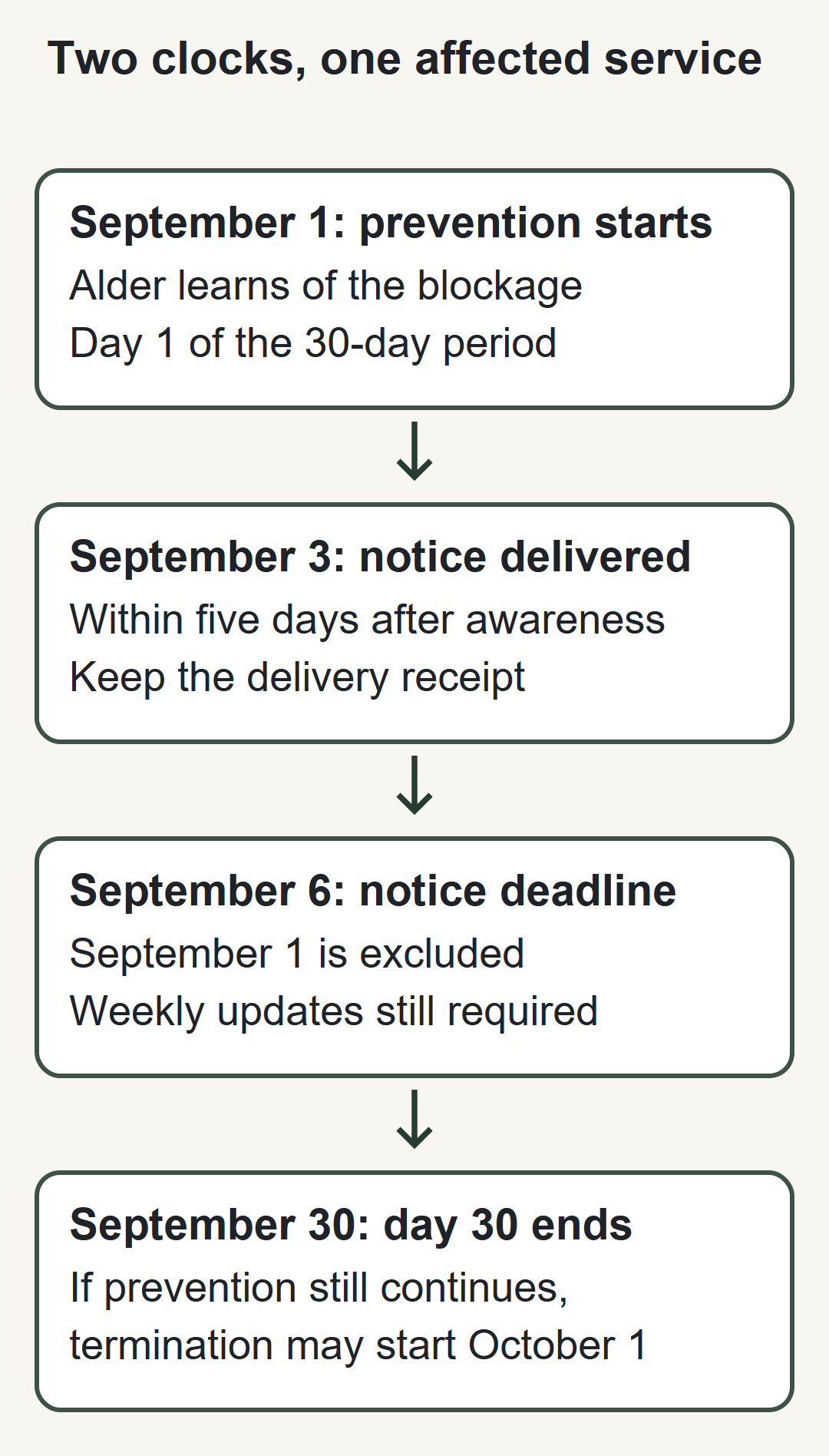
| Date (2026) | What happens | What it means |
|---|---|---|
| Sept 1 | A flood closes the only access road. Alder learns of it that day and cannot deliver for Brook. | A listed event that actually stops the delivery. Day 1 of the 30-day period. |
| Sept 3 | Alder delivers written notice with the cause, affected service, expected duration and mitigation steps. | Inside the window, which ends Sept 6 because Sept 1 is excluded. |
| Weekly | Alder sends updates and keeps checking other routes. | Mitigation. If a route opens, Alder must resume promptly, not wait for day 31. |
| Sept 30 | Day 30 ends with the road still closed. Brook sends written termination of the blocked service, effective Oct 1. | Exit right used. Nothing ends automatically. |
| By Oct 11 | Alder refunds the $2,000 Brook prepaid for the blocked September delivery. Brook still owes $6,000 for August work already done. | Force majeure excuses the blocked work, not payment for completed work. The clause does not let either side net the two amounts. |
If the notice was late or went to the wrong address, assess that separately. A real flood does not prove every contract condition was met.
Force majeure notice letter template
[Date]
To: [Other party legal name], [notice address from the contract]
Re: Force majeure notice under [agreement title and date], Section [x]

We give notice under Section [x] that [describe event] began on [date]. It is preventing us from performing [specific obligation] from [date].

Expected duration: [estimate or "unknown"].
Steps we are taking to reduce the impact: [steps].
We will send updates every [7] days and resume as soon as the event stops preventing performance.

All other obligations under the agreement continue.

[Name, title, company]
Send it the way the contract's notice clause requires, for example email plus courier, and keep proof of delivery.
Force majeure, impossibility and frustration
| Concept | Where it comes from | In short |
|---|---|---|
| Force majeure | A clause in your contract | Excuses performance for the events and on the terms the clause sets out. |
| Impossibility | General contract law | An unforeseen event after signing makes performance impossible (LII). In New York the impossibility must be objective and the event one that could not have been foreseen or guarded against (Kel Kim). |
| Frustration of purpose | General contract law | An unforeseeable event destroys the main purpose of the deal. Courts read it narrowly, and it does not apply where the event was foreseeable (LII). |
| Commercial impracticability | UCC 2-615, sale of goods | A seller's delay or non-delivery is not a breach if performance was made impracticable by an event whose non-occurrence was a basic assumption of the contract, or by good-faith compliance with a government regulation or order. The seller must notify the buyer seasonably (UCC 2-615). |
If no excuse applies, use the ordinary breach and damages framework. For the consequences of a disputed excuse, see the material-breach guide.
Before you sign: six checks
- Events: list the events that matter in your industry. Do not rely on a vague catchall.
- Trigger: decide whether the event must prevent, hinder or merely delay performance.
- Scope: name the affected duties, and say whether payment and supplier failures are covered.
- Notice: set a workable deadline, delivery method and update rhythm.
- Money: separate earned fees, unperformed work and prepayments, with refund dates.
- Exit: state who may terminate, after how long, and whether that covers one service or the whole contract.
A negotiated change to an existing clause belongs in an amendment identifying the exact clause changed. Assign evidence, updates and resumption steps through a contract administration record.
Frequently asked questions
Is COVID-19 a force majeure event?
Only if the clause covers it and it actually prevented performance. In JN Contemporary Art (cases table above), the court held that the pandemic and New York's shutdown orders were circumstances beyond reasonable control under that contract's clause.
Is a strike force majeure?
Only if your clause covers it. Many clauses do: the Kel Kim lease listed "labor disputes" and the JN auction contract listed "general strike". Check whether your clause limits it, for example to strikes outside your own workforce.
Does force majeure excuse payment?
Only if the clause says so. Clauses 1 and 3 above exclude payment obligations, and clause 5 keeps payment for completed work due. Read your own clause before you stop paying.
What if my contract has no force majeure clause?
You may need to rely on impossibility or frustration of purpose, which courts apply narrowly (LII). See the table above.
Does force majeure end the contract?
It depends on the clause. The Kel Kim lease excused performance "for the period of the delay", while the JN contract let the auction house "terminate this Agreement with immediate effect".
How fast must I give notice?
As fast as the clause requires. Late or wrongly addressed notice can cost you the protection even if the event was real. For sales of goods, UCC 2-615 also requires the seller to notify the buyer seasonably (UCC 2-615).
What if the contract concerns goods rather than services?
Check your state's version of UCC 2-615. After a seller's notice of a material or indefinite delay, UCC 2-616 lets the buyer terminate or take its available quota within a reasonable time not exceeding thirty days.
Sources
- Cornell LII Wex, force majeure: definition, economic downturn and New York's narrow reading (last reviewed May 2025).
- Kel Kim Corp. v. Central Markets, 70 N.Y.2d 900 (1987): clause scope, catchall wording and impossibility.
- JN Contemporary Art LLC v. Phillips Auctioneers LLC, 29 F.4th 118 (2d Cir. 2022): opinion text; COVID-19 and shutdown orders under a "reasonable control" clause.
- UK Supreme Court: RTI Ltd v MUR Shipping BV [2024] UKSC 18, judgment of May 15, 2024, especially paragraphs 102 and 103.
- Cornell LII Wex, impossibility.
- Cornell LII Wex, frustration of purpose.
- Cornell LII, UCC section 2-615: commercial impracticability, allocation and seller notice.
- Cornell LII, UCC section 2-616: buyer options following a seller's notice.
- New York UCC section 2-615 and section 2-616: enacted New York text.
- International Chamber of Commerce: force majeure and hardship clauses, 2020.