
Material Breach of Contract: Examples and Next Steps
By Anirudh Menon, Viaclause editor
See material versus minor breach examples, assess the benefit lost, and check notice and cure terms before stopping performance. Includes a copyable record.
A material breach is a substantial failure that undermines an important benefit of the contract. It may support suspension or termination, but seriousness and permission to end the contract are separate checks. State law, the agreed remedy and notice-and-cure terms govern; a serious complaint alone does not erase those conditions.
| Assess | The benefit actually lost |
|---|---|
| Check separately | Notice, cure and remedy |
| Scope | Identified US state examples |
Material breach vs. minor breach at a glance
This guide uses identified Iowa and New York decisions and case-specific federal instructions from the Western District of Tennessee. It does not state one rule for every state or every transaction. The same invoice amount or delay can have different significance when the agreed purpose differs.
| Question | Minor breach | Material breach |
|---|---|---|
| What happened to the bargain? | The main expected benefit remains, despite a failure to meet a term. | The failure substantially undermines an important expected benefit. |
| Does the size of the invoice decide it? | No. A small defect in an expensive project can remain minor. | No. A missed essential task can matter more than its share of the price. |
| Can compensation or correction help? | A correction or payment may address the shortfall while performance continues. | The realistic ability to restore the benefit is part of the assessment. |
| Can I stop performing immediately? | Under the ECIMOS instructions, a minor and insubstantial breach does not entitle the other party to reject the contract. Goods sales can follow a different rule (see New York UCC section 2-601 below). | Check the applicable law, affected obligations and agreed termination process before stopping. |
Five questions that help identify a material breach
The ECIMOS instructions, page 34, identify five factors for that case. They are a useful analytical framework here, not a nationwide statute. No single factor should replace examination of the whole bargain.
The Iowa Supreme Court in Dolly Investments distinguishes materiality under Restatement section 241 from discharge under section 242. The court interpreted that lease’s uncured nonpayment provisions rather than making every late payment automatically material. Its fifteen-day lease provision is not a national deadline.
- Lost benefit: What promised result did the failure prevent?
- Compensation: Can money adequately address that loss?
- Forfeiture: How much would the non-performing party lose, meaning a divestiture of specific property without compensation, if the contract were ended?
- Correction: Is there a credible plan to restore the benefit in time?
- Good faith: What do warnings, explanations and responses actually show?
Worked example: the same two-hour delay, two different bargains
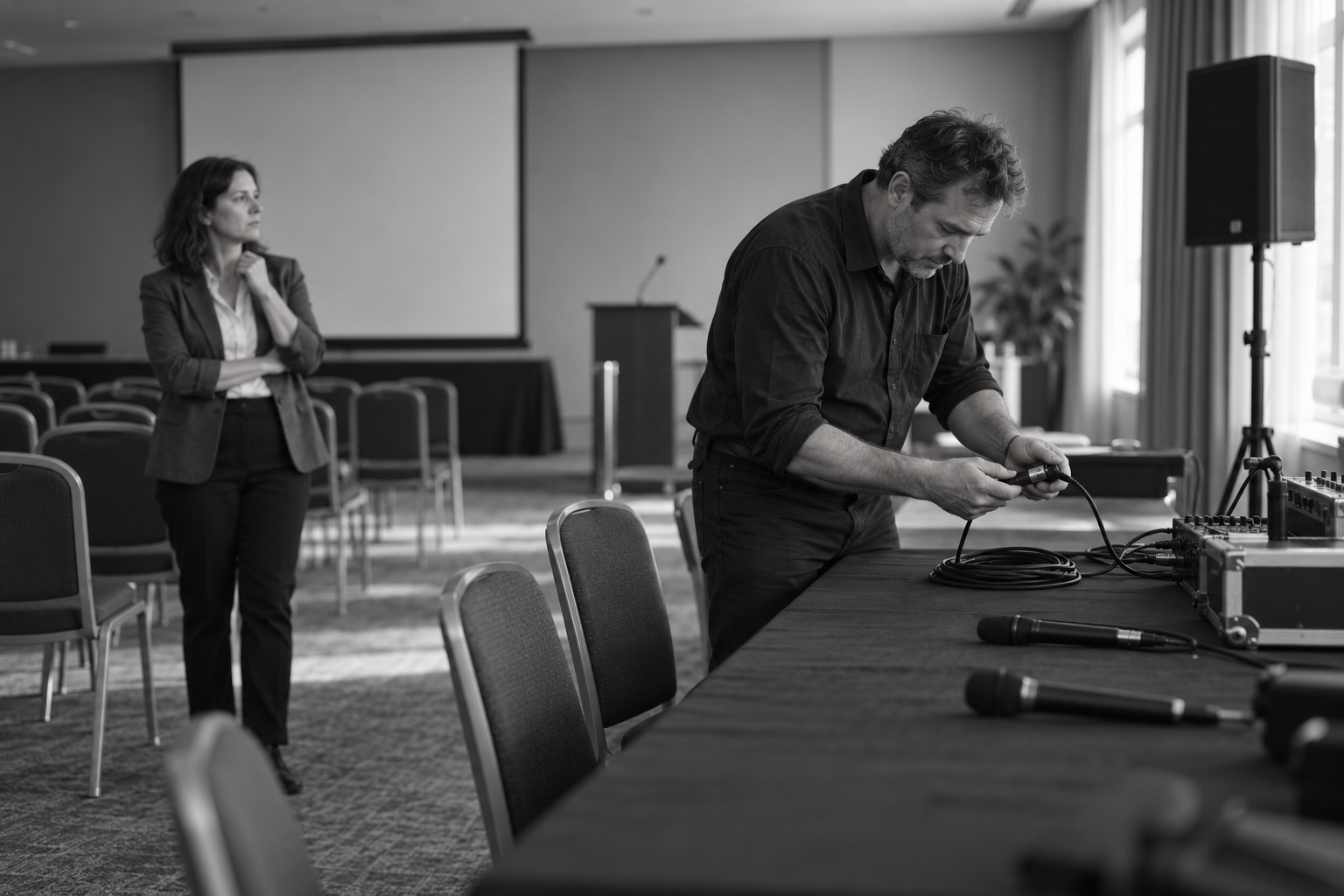
In this hypothetical, a business pays $4,000 for an audiovisual crew to set up and operate an event. Setup is due at 8 a.m. The crew finishes at 10 a.m., two hours late. Hold the price and delay constant, then change the agreed purpose. Assume the signed scope records these times, the coordinator logs completion at 10 a.m., the crew sends a 10 a.m. completion message, and the crew sends an 8:20 a.m. apology. These are hypothetical records, not observed events.
A, rehearsal: Morning rehearsal shifts, finishes before the 1 p.m. session and the audience program proceeds. The main benefit remains unless the rehearsal itself served an essential demonstration or safety purpose.
B, live announcement: The agreement makes the 9 to 9:30 a.m. slot essential. Sound unavailable then cannot be restored by finishing at 10. But useful afternoon service remains; investigate whether an available substitute or recovery offer could have reduced the disruption.
B supports a stronger materiality argument because of the lost benefit, not the number of late hours. A can still cause provable loss. Neither alone establishes a right to withhold every dollar or cancel remaining services.
Calculate loss separately, including replacement costs and remedy limits. Our actual damages example explains double counting.
Record venue access and available substitute arrangements as well as the late completion. This hypothetical does not decide whether the whole USD 4,000 fee may be withheld.
Completed evidence assessment for scenario B
Promise: equipment ready at 8 a.m.; signed scope identifies the 9 to 9:30 announcement. Failure: completion at 10 a.m., supported by the coordinator log and crew message. Lost benefit: sound for that fixed announcement. Useful performance: afternoon sessions. Finishing late restores later service, not the missed slot.
Facts against immediate termination: venue access and substitute availability remain uninvestigated; afternoon service had value. The 8:20 apology is evidence of communication, not proof of dishonesty. Obtain the actual notice and response terms. Proposed next step: preserve records and request the crew’s account before changing remaining performance.
Why a serious breach does not automatically erase a cure clause
Follow the agreed cure process unless a legally supported exception applies. In East Empire (1st Dep’t 2021), the subcontract allowed ten days to commence and continue correction. The contractor instead gave three days’ termination notice and ordered work stopped immediately.
The First Department affirmed summary judgment on liability against that contractor. The record did not establish repudiation, abandonment or an incurable defect. The subcontract rider gave the owner a three-day cure provision. It did not permit the general contractor to bypass the subcontract’s ten-day cure clause.
Ten days was that contract’s period, not a universal grace period. Check who gives notice, its required content and delivery, and whether correction must start or finish. See our vendor breach response guide.
Goods contracts can use a different rejection rule
Do not apply this service example mechanically to a shipment of goods. New York UCC section 2-601 permits rejection when goods or delivery fail to conform in any respect, subject to its installment-contract and agreed-remedy qualifications. The model UCC section 2-508, reproduced by Cornell LII, also provides seller cure rights in specified circumstances. Identify the applicable state's enacted rules and whether goods have already been accepted before choosing a response.
For a New York goods transaction, the enacted section 2-508 seller-cure provision allows timely notice and conforming delivery within the remaining contract time in the circumstances it specifies. Its second paragraph addresses a further reasonable time where the seller had reasonable grounds to believe the rejected tender would be acceptable. Neither route creates an unconditional extra cure period.
After acceptance, New York section 2-608 instead addresses revocation of acceptance. It requires substantial impairment of the value of the lot or commercial unit to the buyer and specified acceptance circumstances. Revocation must be timely, precede a substantial change not caused by the goods' own defects and be communicated to the seller. These New York rules do not establish that a service delay automatically permits rejection.
Digital contracts and repeated smaller failures
Virginia’s UCITA section 59.1-507.1 states that cumulative nonmaterial breaches may be material. That chapter concerns computer-information transactions; its definition excludes a transaction merely because communications are electronic. Do not generalize this rule to every emailed US contract. Preserve outage logs, promised functionality, dependencies and what each failure prevented.
Repudiation and remedies have separate conditions
The model UCC section 2-610 concerns repudiation before performance is due that substantially impairs the contract’s value. It differs from measuring a failure that has already happened. Identify your state’s enacted goods rules before choosing the response. Model section 2-716 permits specific performance for unique goods or other proper circumstances; it is not an automatic remedy for every serious service failure.
Record the evidence for and against materiality
For B, retain the signed scope with the 8 a.m. readiness and 9 a.m. announcement, the coordinator’s log, the crew’s 10 a.m. completion message and evidence of useful afternoon service. Check later changes, venue access, available substitutes and the 8:20 a.m. apology. The notice-and-cure clause still needs its own reading.
Preserve originals with our email evidence collection guide.
Proposed worksheet or sample wording, check against the agreement and governing law
MATERIALITY ASSESSMENT RECORD
Assessment date and person preparing it:
Governing law and agreement version:
Exact promise and source location:
Expected benefit, as recorded when agreed:
Failure, date and evidence:
Benefit actually lost:
Useful performance still received:
Compensation or substitute available:
Correction offered, timing and supporting evidence:
Consequences of termination for each party:
Conduct supporting or undermining good faith:
Facts against our preferred conclusion:
Notice, cure and termination wording:
Open questions and person checking them:
Proposed next step, without assuming a right to terminate:
Request facts, then check the proposed response
Use this proposed operational message to obtain missing information. Adapt it to the actual facts. It does not itself satisfy a contractual notice clause, create a cure deadline or declare a right to terminate.
Proposed worksheet or sample wording, check against the agreement and governing law
Subject: Performance record and recovery plan for [service/date]
Our signed scope records [exact obligation and location]. Our current records show [observed failure and time]. The affected business purpose was [purpose recorded in the agreement].
Please provide your account, supporting records and any proposed correction, including what can still be delivered and when. Please identify any dependency or change you believe affected performance.
We have preserved [records] and are checking the agreement's notice and response provisions. This operational request does not specify a contractual cure period or announce termination.
Contact for coordinating the facts: [name and channel].
- Identify the obligation and each party’s dependencies in the signed scope and amendments.
- Separate dated evidence from disputed allegations.
- Assess the benefit lost and useful performance retained.
- Check notice recipients, channels, cure wording and the remedy proposed.
- Record substitute costs and other loss separately; avoid double counting.
Drafting checklist for essential obligations
These questions help clarify a service agreement; they are not one clause suitable for every deal. State the genuine business purpose before failure occurs. An internal expectation never communicated to the supplier is different evidence from an essential milestone recorded in the scope.
Coordinate suspension, termination, replacement work, payment and remedy limits. A right to take one action does not establish every other response. Consult a lawyer licensed in the relevant state before a disputed termination, significant withholding or urgent safety response.
- Identify essential milestones and the result each protects. Avoid labelling every administrative task essential.
- Name access, information and approval dependencies and how changes are documented.
- Specify acceptance evidence and how defects are recorded.
- Identify notice recipients, permitted delivery and the event starting each period.
- Distinguish beginning diligent correction from completing it, as the New York East Empire clauses illustrate.
- Coordinate handover of records, data and unfinished work if services end.
Frequently asked questions
What is a material breach of contract in plain English?
It is a substantial failure that undermines an important benefit of the deal, rather than a minor shortfall. Compare the promised result with what was actually received, including any realistic correction.
Is every missed deadline a material breach?
No fixed number of late hours decides the question. Establish what the deadline protected and what the delay prevented. In the worked example, losing a fixed live event matters differently from moving a rehearsal.
Can I terminate immediately after a material breach?
Not automatically. Check termination and cure terms and applicable law. In East Empire, the general contractor's correction-cost offset defense was dismissed because it had not followed section 3.4, a separate clause requiring five days' notice and an opportunity to cure before it could correct the work and deduct the reasonable cost.
Does fixing the problem prove the breach was minor?
No. Correction matters, but so does the benefit already lost. Finishing the sound setup after a fixed announcement cannot restore that time slot, even though the equipment remains useful later.
Can I claim damages for a minor breach?
For Virginia computer-information transactions within UCITA, section 59.1-507.1(a) says a breach, whether or not material, entitles the aggrieved party to its remedies. That does not establish an automatic damages amount or a nationwide rule. Prove the loss and check the applicable remedy limits.
Does the contract itself define material breach?
It can. In Dolly Investments, pages 11 to 13, the Iowa Supreme Court read the lease to make uncured nonpayment material after its notice period. That was the interpretation of that lease, not a nationwide payment deadline. Read contractual definitions alongside the governing law.
Is late payment always a material breach?
There is no universal payment deadline in the authorities discussed here. The Iowa Supreme Court in Dolly Investments interpreted that lease's nonpayment and notice provisions. Check your due date, disputed amount, notice requirements and agreed definition rather than copying the lease's result into a different contract.
Can I withhold the whole invoice because one deliverable failed?
The label material breach does not establish the amount you may withhold. Record useful performance, the affected obligation and the agreement's payment, setoff and dispute terms. In East Empire, the general contractor lost its correction-cost offset defense because it skipped section 3.4, the separate five-day notice-and-cure step required before it could correct the work and deduct the cost.
Sources
- Dolly Investments, Iowa Supreme Court
- ECIMOS jury instructions, Western District of Tennessee
- East Empire, New York First Department
- New York UCC section 2-601
- New York UCC section 2-508
- New York UCC section 2-608
- Virginia UCITA section 59.1-507.1
- Virginia UCITA definitions section 59.1-501.2
- Model UCC section 2-610, Cornell LII
- Model UCC section 2-716, Cornell LII
Related: Understand breach consequences · Distinguish contract from tort · Assess a refusal before performance is due