

Email Evidence: How to Collect Emails for a Contract Dispute
By Anirudh Menon, Viaclause editor
Preserve source emails, check missing replies and attachments, and create a traceable handoff using Gmail or Microsoft 365 exports. Includes a filled manifest and checklist.
AI-generated editorial illustration by Viaclause. Person and setting are fictional.
Collect emails for a contract dispute by preserving the source mailbox, exporting relevant messages with their attachments, recording where each file came from and building a dated index. Keep originals separate from summaries and working copies. Gmail supports individual EML downloads; Microsoft 365 teams can use an appropriate Outlook export or an authorized Purview collection. Include messages that contradict your position. Give an AI tool only an approved review copy after checking for missing replies and confidential material.
Use the lawyer review packet checklist to assemble the documents and unresolved questions for advice.
This guide is for business buyers preparing an internal review or a handoff to their legal team. Separate three jobs: preserving information, selecting material for review and deciding what may be shared. A narrow AI upload must not become the whole preservation plan.
Preserve first, then choose what to review
List the people, mailboxes, shared accounts and project systems likely to contain relevant information. Include sent mail, later acknowledgments, attachments and linked documents. Identify who can authorize collection. Do not access another person's account merely because a dispute concerns their work.
When litigation is anticipated, involve the organization's legal and records teams promptly. Federal Rule of Civil Procedure 37(e) addresses electronic information that should have been preserved in anticipation or conduct of litigation, but is lost because reasonable preservation steps were not taken and cannot be restored or replaced. Its remedies depend on additional findings, including prejudice or intent to deprive. A missing email does not automatically trigger sanctions.
Have the responsible team address deletion schedules, departing employees and relevant archives. An export made today does not preserve tomorrow's replies or stop deletion at the source. Record what has been preserved, by whom and what remains outstanding.
If the messages concern a supplier security incident, the vendor data-breach response guide provides a request for missing facts and a completed incident record to keep with the original correspondence.
Define a search that can find an inconvenient answer
Write the factual question first: “What did the parties send and acknowledge about ending the renewal?” is more useful than “Find proof that we cancelled.” List contract numbers, project names, domains, addresses, aliases and relevant dates. Save the exact search, system, collection time and known exclusions.
Use several known messages as completeness checks. If a search misses an email you know exists, resolve that gap before relying on its results. Inspect the beginning and end of relevant threads. A reply outside the initial date range may change the meaning of an earlier notice. Preserve unfavorable messages as well as helpful ones.
Google documents differences between Gmail interface and API searches: the interface expands certain account aliases and supports thread-wide searching in ways the API does not. API date strings use midnight in the documented PST timezone; precise boundaries can instead use seconds. Record whether a person searched Gmail or a connector queried its API. The same words need not produce the same collection.
Choose an export route for your account
| Situation | Route | Check to retain |
|---|---|---|
| A few Gmail messages | Open each email, choose More, then Download message. Retain the EML files. | Check individual messages, attachments and earlier or later replies, not only the conversation summary. |
| A folder in classic Outlook | File, Open & Export, Import/Export, Export to a file, Outlook Data File (.pst), then the chosen folder. | Record folder and export settings. Confirm the intended messages are available in the export. |
| Multiple Microsoft 365 custodians or a formal investigation | Ask an authorized eDiscovery team to define a Purview case, searches and required holds, then export results. | Retain queries, source locations, reports, errors and exclusions. A search export and a preservation hold are different actions. |
The Gmail route follows Google's message-download instructions. The PST route follows Microsoft's Outlook backup instructions. These are not identical menus in every Outlook version. If your interface differs, consult instructions for that version or ask your administrator rather than improvising a mailbox migration.
Microsoft's Purview workflow supports mailbox exports as PST files or individual messages and describes separate holds for relevant sources. Search exports expire after 14 days, so download packages in time. For review-set exports, retain the export, summary and error reports. Permissions and organizational configuration determine which route you can use.
Open a working copy and check a sample against the source: a sent message, a message with an attachment and a reply crossing the date boundary. If an email links to a cloud document, record the link and obtain the relevant document version through an authorized process. A link alone does not show what that document contained at the time.
Preserve email evidence with originals and a collection manifest
A manifest is a file index. Assign stable evidence IDs and retain original filenames in the index. Keep collected originals separate from redacted or annotated copies. Record collector, source account, method and collection time. For each transfer, record sender, recipient, date, purpose and files transferred. These are proposed chain-of-custody practices for an orderly handoff, not a guarantee of admissibility.
Federal Rule of Evidence 901 requires evidence sufficient to support a finding that an item is what its proponent claims. A tidy spreadsheet alone does not establish authorship or truth. Keep the source context that a knowledgeable witness or technical reviewer may need.
| Evidence and file | Source and collection | Message and attachments | Status |
|---|---|---|---|
| E001: notice-2026-06-28.eml | Procurement shared mailbox; Maya Chen; Gmail Download message; July 3, 2026, 14:10 UTC | June 28 cancellation message; one PDF attachment retained. Message-ID recorded in restricted index. | Original retained; review copy approved. Related acknowledgment E002 needed. |
| E002: acknowledgment-2026-07-02.eml | Vendor reply found through an alias; same collector and method; July 3, 14:18 UTC | July 2 reply with revised schedule, indexed as attachment A002. | Added after date-range check. Effect on cancellation disputed. |
The real index can include a SHA-256 value calculated for each collected file. Record the tool and calculation time. Do not invent a hash or treat a filename as one. Matching hashes help check that copies are byte-identical; they do not establish the original sender or the truth of the message. Rule 902(14) and its committee note discuss identification of copied electronic data, including hash comparisons, within a certification framework with additional requirements. A self-made manifest does not itself meet those requirements.
Worked example: the reply a narrow search missed
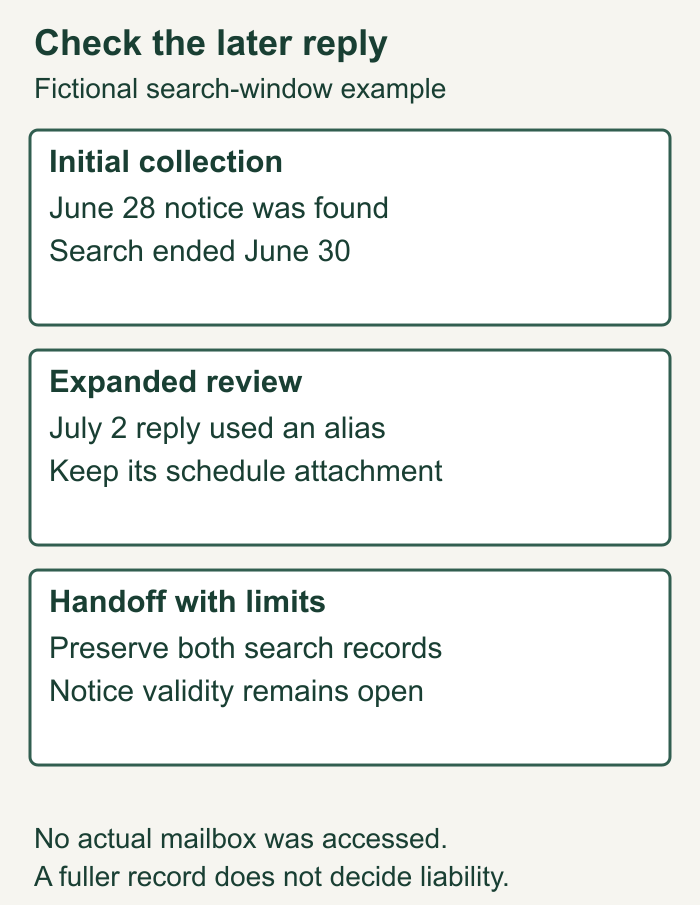
This scenario is fictional. A buyer sends a non-renewal message on June 28. A search ending June 30 finds it, and an AI summary reports cancellation was sent with no response. The vendor actually replied on July 2 to an alias, attached a revised schedule and disputed the notice's effect.
The correction is not a more forceful prompt. Expand the review window through the acknowledgment, search the alias explicitly where needed, retrieve the attachment and update the manifest. Retain the earlier collection and record why it was incomplete. The corrected chronology says a message was sent June 28 and a disputed acknowledgment followed July 2. Whether notice was effective is a separate question under the agreement.
Use the contract-notice delivery checklist to connect the chronology to the required recipient and delivery method. For failed performance, the vendor-breach response worksheet identifies the promise, dependencies and costs the email collection needs to support.
Use AI on an approved copy
For a one-off question, a reviewed file set makes the supplied material easier to inspect. A connector may suit ongoing work, but inspect actual permissions. Google's Gmail scope list distinguishes metadata access from message access and permissions that include sending. “Read only this dispute” in a prompt does not narrow permission already granted to an application.
Before uploading, check the approved tool, retention and data-use settings, confidentiality restrictions and potentially privileged material. Use the AI contract-upload review for that specific route. Preserve originals even when the analysis copy is narrower or redacted.
Use only the supplied review copies and manifest.
Create a chronology: evidence ID, message date and timezone,
sender, recipients, factual statement, supporting quotation,
and attachment relied on.
Separate what the message says from your inference.
Flag missing attachments, replies and inconsistent dates.
If information is absent, write "not supplied", not "did not happen".
Do not decide breach, valid notice, waiver or admissibility.
Do not send messages or alter source files.
Check each important output row against its cited file. If the tool cannot read EML or PST, use an approved processing step to create readable derivatives and document the conversion. Retain exported originals and attachment relationships. An unsupported-format warning must not become a finding that a message contained no evidence.
Copyable collection and handoff checklist
Dispute and factual question:
Collection owner and authority:
Preservation owner, scope and unresolved deletion risks:
Custodians, accounts, aliases and systems:
Exact searches, date boundaries and timezone:
Known-message checks and results:
Export method, application version, settings and time:
Evidence ID | filename | source | message date | attachments
Collector | export time | calculated hash, if any | storage
Missing items, errors and follow-up owner:
Review copies and relationship to originals:
Transfer date | sender | recipient | purpose | evidence IDs
Approved AI route and files supplied, if any:
Human checks of material chronology rows:
Unresolved contract question and decision deadline:
Make the handoff limitations visible
A receiving reviewer needs to know which question the collection can answer and which gaps remain. Keep a preservation record, the selected review set and the handoff decision distinct. The review set can be smaller than the preserved sources; an approved upload is not permission to discard the other relevant material.
Completed handoff record for the fictional messages
SYNTHETIC EMAIL HANDOFF H01
Question: what was sent and acknowledged about non-renewal?
Original window: through June 30; June 28 message E001 located.
Completeness issue: later acknowledgment and alias not covered.
Added item: July 2 vendor reply E002 with revised schedule A002.
Collection record: July 3 methods and times in the manifest above.
Preserve: E001, E002, attachments and earlier search record.
Revised chronology: sent June 28; disputed reply followed July 2.
Review scope: supplied records; not a claim of every relevant email.
Open questions: required route, receipt and effect of the reply.
Sharing: approved review copies only, with original-file mapping.
Hashes: none invented; record values only if actually calculated.
Conversion: retain method and relation to originals if performed.
AI summary: verify material rows against cited messages and files.
Legal outcome: no valid cancellation or admissibility inferred.
The synthetic example does not identify a real custodian or mailbox. In your operational record, put sensitive addresses, message identifiers and access details in approved restricted storage rather than a widely shared article-style example. Record who may receive which derivative, including the attachment relationships and any redaction or conversion.
When a package is unavailable or incomplete, record its identity, creation time and actual error. Ask the authorized owner to check the appropriate approved source or export route. Do not present a missing package as an empty mailbox or infer a hold's scope from the files selected for review.
Before handing over the packet
- Confirm the collection and sharing authority with the responsible owner.
- Record preserved sources separately from selected review copies.
- Test known messages, later replies, aliases and attachment relationships.
- Retain exact date boundaries, timezone and route-specific limitations.
- Keep original exports separate from annotated, redacted or converted derivatives.
- Retain errors and incomplete-search records with a follow-up owner.
- Calculate integrity values only through the approved process; never invent them.
- Record the recipient, supplied evidence IDs, purpose and transfer date.
- Verify material AI chronology rows against their cited source files.
- Hand off unresolved contractual and evidentiary questions explicitly.
Frequently asked questions
Are screenshots enough to preserve email evidence for a contract dispute?
Keep useful screenshots, but collect available message files and attachments too. Screenshots may omit context or headers. This is a preservation recommendation, not a rule that screenshots can never be used. Federal Rule of Evidence 1001(d) recognizes readable outputs that accurately reflect electronically stored information as originals for that rule. Other evidentiary requirements still matter.
How do I export a Gmail message for review?
On a computer, open the message and use More, then Download message, following Google's linked instructions. Keep the EML file and check that your review process can read the message and attachments.
Should I export my entire Microsoft 365 mailbox?
Not automatically. Agree preservation scope with the responsible team, then define the review collection. An authorized Purview search may suit multiple custodians better than a personal Outlook export. Document inclusions and omissions.
Does hashing prove an email is genuine?
It helps check file integrity between copies. It does not independently prove authorship, collection completeness or the truth of a message. Keep source and collection records alongside hashes.
Can I give an AI tool inbox access instead?
Use only an approved route appropriate to the task. Inspect permissions, retention and confidentiality before connecting. Selected-file review and ongoing mailbox access are different choices. Both need source preservation and checks for missing context.
If a relevant message is missing, start with our deleted-email recovery windows and options.
Does finding the later acknowledgment settle whether notice was valid?
No. It improves the collected chronology. The agreement, delivery requirement, contents and legal effect still need separate review. Preserve the later reply and attachment even if they weaken the preferred position.
What should we record when a search returns no result?
Record the accounts, aliases, locations, date boundaries, timezone, method and errors actually checked. Say no matching item was found within that scope. Do not turn an empty result into proof that a message never existed.
Sources
- Federal Rule of Civil Procedure 37(e): lost electronic information and conditional remedies in federal civil litigation.
- Google: Download and send emails as attachments: EML download route.
- Microsoft: Back up your Outlook email: documented PST export workflow.
- Microsoft: eDiscovery workflow: searches, exports, holds and reports.
- Google: Search and filter messages: API dates, aliases and threads.
- Google: Gmail API scopes: permission distinctions.
- Federal Rule of Evidence 901: authentication.
- Federal Rule of Evidence 902(14) and committee note: copied data and certification.
- Federal Rule of Evidence 1001(d): readable electronic outputs.