

What to Do When Your Vendor Has a Data Breach
By Anirudh Menon, Viaclause editor
A timely vendor notice can still leave critical facts unanswered. Use a worked example and copyable request to assign the next decisions without treating unknowns as reassurance.
When your vendor reports a data breach, verify the notice, bring in your security and privacy leads, preserve what you received, and establish whether your data or system access is involved. Review the vendor contract and your own notification duties in parallel. Ask for customer-specific findings and a timed update, rather than waiting for a final report. A vendor's promise to handle notifications does not establish that your obligations have been met.
AI-generated editorial illustration by Viaclause. People and setting are fictional; this does not depict an actual data breach or incident-response meeting.
This guide is for a US business receiving a supplier's incident notice. The practical problem is often an incomplete message: the supplier confirms an incident but has not identified which customers, records or credentials were affected. The worksheet below turns those unknowns into assigned questions without pretending the investigation is finished.
Get the right people and documents together
Confirm the notice through a contact or portal you already trust. Keep the original email and attachments. Route the incident to the people responsible for security, privacy, the vendor relationship and business operations. Avoid spreading copies of potentially exposed personal information in a broad email thread.
The FTC's business response guide recommends assembling the response team, preserving forensic evidence and determining the incident's scope. It also calls for checking applicable notification law. Its guidance supports prompt investigation; it does not supply one deadline for every US incident.
Pull the signed agreement, security addendum, data-processing terms and incident contact details. Put the relevant clauses beside the vendor's actual notice. If the response may involve insurance, have the policy owner check its notice, consent and provider requirements before making spending commitments.
Keep the incident email in its native format as well as a readable copy. Our guide to collecting emails for a contract dispute explains how to preserve messages and their context. Do not edit the original to create a cleaner chronology.
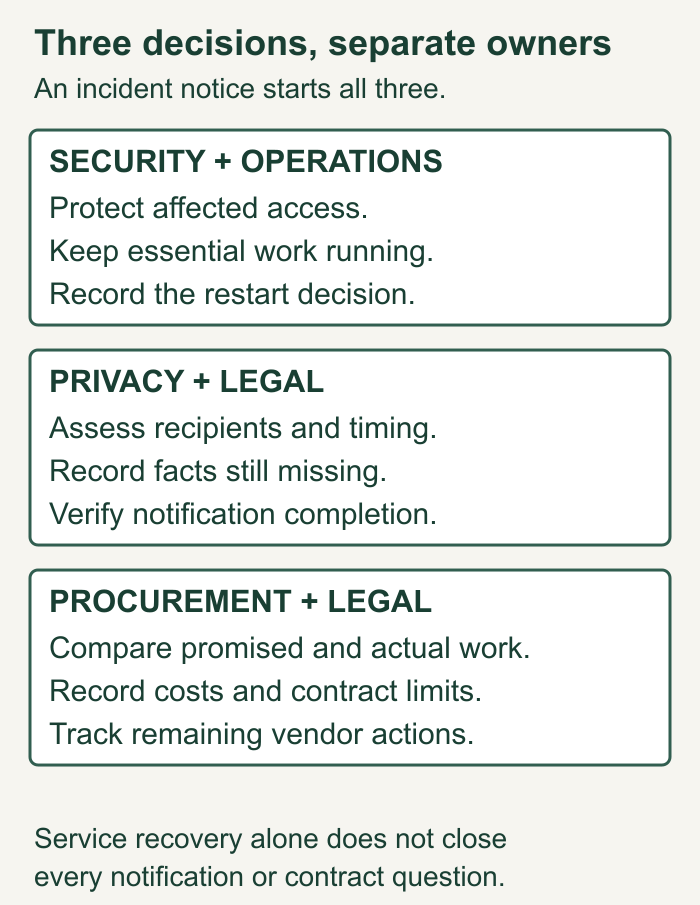
Separate three decisions that can move at different speeds
| Decision | Evidence needed | Useful interim output |
|---|---|---|
| Protect your systems and keep essential work running | Which connections, credentials and services are implicated; what your own logs show | Security lead's containment decision, operational workaround and review time |
| Determine who must be notified | Data fields, affected residents, your legal role, event and discovery dates, applicable rules and agreements | Privacy lead's recipient and deadline assessment, with unresolved facts identified |
| Assess the vendor's performance and costs | Signed obligations, notice delivery evidence, cooperation, documented expenses and contractual limits | A clause-by-clause record of what was promised, received and still missing |
This is our proposed division of work, not a legal test. The person negotiating reimbursement should not become the bottleneck for containment or notification. A supplier can have a genuine incident while its contractual compliance remains a separate question.
Ask security to assess the affected access rather than having procurement indiscriminately disable every integration. Record what is being restricted, who authorized it and how essential work will continue. The FTC's vendor-security guidance supports limiting access and obtaining specific remediation commitments. If the supplier says it has fixed the problem, ask what evidence supports restoring the affected connection.
Read the notice clause as a trigger, a clock and a delivery rule
Do not extract only the number of hours. Mark four things in the signed text:
- Trigger: suspicion, discovery, awareness, confirmation, or a defined incident affecting particular data?
- Clock: elapsed hours or business days, and from which event?
- Delivery: security contact, legal address, portal, or more than one recipient?
- Follow-up: initial facts, continuing updates, assistance, preservation or a final report?
These are reading questions for your agreement, not terms every supplier has accepted. Follow the contract notice delivery checks when sending a formal request. An account manager's acknowledgment may be useful evidence without satisfying every contractual notice requirement.
A worked example: a timely email with an unanswered question
The following company, clause, times and records are synthetic. A payroll supplier's signed addendum says:
Supplier will notify Customer's designated security contact within 24 elapsed hours after becoming aware of a Security Incident affecting Customer Data. Supplier will provide the facts then available and further material findings as they become available.
The supplier reports that it became aware of an incident affecting the customer's payroll export on Monday at 09:00 UTC. It emailed the designated security contact on Tuesday at 06:00 UTC. On those stipulated facts, 21 elapsed hours passed: the initial notice arrived three hours before the example clause's deadline. That calculation addresses timing only.
The email says an archive was encrypted and the investigation continues. It does not say whether the encryption key was accessed, which fields the archive contained or whether copies were downloaded. Do not turn that gap into either “nothing happened” or “all records were stolen.” The initial email and the unanswered scope questions can both be recorded accurately.
| Item and evidence | Current conclusion | Owner and next step |
|---|---|---|
| Notice email E01; reported awareness Monday 09:00 UTC; delivery Tuesday 06:00 UTC | 21 hours under the example's stipulated trigger; initial timing met. Full compliance not determined. | Procurement: preserve E01 and the signed addendum; confirm the reported awareness event. |
| E01 describes an encrypted payroll archive; key access and affected fields unspecified | Exposure scope unresolved. Encryption alone does not close the inquiry. | Security: request key-access findings and customer-specific field inventory at the next update. |
| Customer roster R01 contains 240 employees; affected-person list not supplied | 240 is the roster size, not a confirmed affected-person count. | Privacy: reconcile the supplier's eventual list against R01 and assess applicable duties now. |
| Supplier offers to prepare notices but provides no recipient list or dispatch evidence | Offer recorded; notification completion unverified. | Privacy: assign content approval, recipients, delivery responsibility and proof of dispatch. |
If later evidence moves awareness to Sunday, preserve the earlier entry and add a correction with its source. Recalculate the contractual clock. Do not silently replace the original chronology. If the real clause has a different trigger, the example calculation cannot establish your supplier's compliance.
Your contract clock is not the entire notification analysis
A useful US example is New York General Business Law section 899-aa. Its definition covers unauthorized access as well as acquisition. Certain encrypted information can still qualify as private information when the key was also accessed or acquired. Subdivision 3 requires a maintainer of another's covered data to notify the owner or licensee immediately, with an outside limit of 30 days following discovery when the stated conditions apply. That is not permission to wait 30 days.
Subdivision 2 separately addresses owners or licensees notifying affected New York residents, requiring expedient notice without unreasonable delay and a 30-day outside limit, subject to the law-enforcement provision. Definitions, exceptions, agency notices and sector-specific duties also matter. This example is not a fifty-state deadline chart. The buyer needs its own assessment of the applicable rules, even when a supplier agrees to perform the mailing.
For each potentially applicable requirement, record the triggering facts, recipient, deadline, decision owner and evidence of completion. If a fact is missing, specify who will obtain it and when the assessment will be revisited. “Waiting for the vendor” is a status description, not a notification decision.
A first request you can adapt
This is a proposed information request, not a consumer breach notice or a substitute for the contract's formal notice method. Replace the placeholders and route it through your response lead.
Subject: Incident [reference]: customer-specific facts and next update

We received your notice at [time and zone]. Please identify your security and legal response contacts and a secure channel for evidence.

For our organization, please provide:
1. Event, discovery and awareness times, with time zones and the basis for each.
2. Affected services, data fields, record populations and customer-access credentials. Distinguish confirmed findings from matters still under investigation.
3. Findings on unauthorized access or acquisition, encryption and key access. Identify material logging gaps.
4. Containment completed and actions you recommend we take, with the reason for each.
5. Relevant evidence preserved and the customer-specific findings you can share securely. Do not email exposed personal records in reply.
6. What assistance or notification work you propose, including who approves it and who records delivery.

Please confirm the next update by [requested time and zone]. If an answer is not yet available, identify the responsible contact and expected update time. This requested update time does not replace an applicable contractual or legal deadline.

Relevant agreement provision: [document, version, clause and designated recipient].
Keep cost recovery separate from the immediate response
Build a contemporaneous expense log with invoices, approvals and the reason each cost was incurred. Compare reimbursement requests with the actual security, cooperation, indemnity and liability provisions. Do not label every response expense recoverable simply because the incident originated at the vendor.
Evaluate cost allocation through the SaaS liability and indemnity claim map after the immediate response is underway.
Our vendor contract breach guide provides the separate obligation-and-loss analysis. Use this incident record to supply facts to that assessment. Before continuing or renewing the relationship, list the unresolved weaknesses and the evidence required to close them.
Check sector rules before relying on a general deadline
Two official examples show why your privacy lead must identify the business's role and data type. They are screening prompts, not an exhaustive compliance guide.
- HIPAA: the HHS Breach Notification Rule overview addresses covered entities, business associates and unsecured protected health information. It distinguishes individual, HHS and certain media notices from the business associate's notice to the covered entity. Delegating individual notices does not remove the covered entity's ultimate responsibility. Its risk assessment, exceptions and documentation requirements must be checked; an ordinary payroll supplier is not automatically a HIPAA business associate.
- FTC-regulated financial institutions: the FTC Safeguards Rule compliance guide describes notification events involving unauthorized acquisition of at least 500 consumers' unencrypted information, including specified encryption-key exposure. Covered institutions must report as soon as possible, no later than 30 days after discovery. The guide's definition of a financial institution is broader than a bank, but the rule does not apply to every business.
Check those official sources for the complete conditions. Different recipients and triggers require separate decisions. The contract's synthetic 24-hour supplier-to-customer clock does not replace any applicable legal notice requirement.
A decision log for notification work
Keep a separate entry for each recipient and requirement. This proposed worksheet records a decision and its supporting facts; filling it in is not proof that a notice was legally sufficient.
NOTIFICATION DECISION LOG
Incident reference and entry version:
Rule or agreement provision, linked to source:
Our role and supplier's role:
Relevant data, persons and locations:
Trigger event, timestamp, time zone and supporting record:
Required recipient and applicable timing:
Missing facts, owner and next review:
Decision and person approving it:
Delivery owner and method:
Approved notice version:
Dispatch record and any delivery failure:
Correction or follow-up required:
Closure decision and retained evidence:
For the fictional payroll notice, a completed interim entry might read: “Privacy lead assigned; customer-specific affected-person list and locations unresolved; supplier's offer to mail recorded; no customer notice approved or dispatch confirmed.” That is a useful status record without asserting that notice is unnecessary. The FTC response guide supports legal assessment and accurate communications; this worksheet is our proposed way to organize those decisions.
What evidence supports restoring access?
An account manager saying the incident is closed does not answer whether a specific integration is safe to reconnect. Use the FTC vendor-security guidance and your security lead's assessment to request relevant evidence. The following is a proposed business checklist, not a technical certification.
- Scope: identify which customer connections, credentials and data stores were examined, and the logging limitations.
- Containment: record the implicated access paths and the supplier's completed actions, with evidence appropriate to those actions.
- Correction: distinguish the proposed remediation plan from work completed and checked.
- Restart: assign who authorizes restored access, which connections are covered and what monitoring or review is required.
- Continuity: document how payroll or other essential work proceeds during restrictions, including approval of any alternative channel.
- Follow-through: keep notification and reimbursement tasks open independently until their owners record completion.
For the example, sound closure evidence would need to address the archive's fields and key-access question. Restoring service alone cannot establish which records were accessed earlier. Do not ask a vendor to send raw exposed payroll files to a broad distribution list just to prove its investigation.
Prepare the agreement before the next incident
Use what was hard to obtain during this response to improve the next negotiation. These are questions for drafting and vendor management, not a representation that every listed term is enforceable or necessary in every contract.
- Does the incident definition distinguish suspicion, awareness and confirmation, and specify which customer data or systems are covered?
- Can the supplier give an initial notice with available facts and follow up as material findings emerge?
- Are named security and legal recipients kept current, with a reliable backup channel?
- Are relevant subcontractor reporting and cooperation arrangements understood?
- Does the agreement address evidence preservation and secure customer-specific findings without demanding other customers' confidential records?
- Are assistance, notice approval, delivery records, response expenses and liability provisions coordinated?
- Who decides whether to restore access, continue the relationship or require additional evidence at renewal?
For covered financial institutions, the FTC Safeguards guide specifically addresses service-provider selection, contractual security expectations, monitoring and periodic reassessment. Our broader checklist is an editorial proposal; it does not make that sector rule a universal supplier-contract requirement.
Frequently asked questions
What should we do immediately after a vendor data breach?
Verify the message, preserve it, activate your response leads and assess the specific data and access involved. Set a next-update time. Do not wait for a final forensic report to begin assessing your own obligations.
Who is responsible for notifying people?
Identify the applicable law, each party's role and any agreed delivery arrangement. The New York example above distinguishes data maintainers from owners or licensees. A supplier's general announcement does not establish that the right people received the required notice.
Does encrypted data mean we can close the incident?
No automatic conclusion follows. Obtain the facts about the fields, encryption and key access, then apply the relevant rule. Record missing evidence as unknown, rather than treating a vendor's encryption statement as a completed assessment.
Can we make the vendor pay?
Do not assume that it must pay every cost. Preserve the contract, the relevant performance evidence and an itemized loss record. The contractual rights and limits, causal facts and applicable law need their own analysis.
What if the vendor cannot yet tell us whether our records were involved?
Ask what has been checked, what remains unexamined and which limitations prevent an answer. Assign your own interim containment and notification assessments. Keep the next update on the calendar; do not convert an incomplete investigation into reassurance.
Does timely notice establish that the vendor complied with the contract?
It establishes only the timing conclusion supported by the trigger and delivery evidence. In the example, the stated facts support 21 elapsed hours, but customer scope and further findings remain unresolved. Review the other promised duties separately.
Can we use the employee roster as the affected-person count?
No. The fictional roster has 240 employees, but it does not show that all 240 were involved. Obtain customer-specific evidence and record the population examined, confirmed findings and remaining uncertainty separately.
Should procurement disconnect all vendor systems?
Have security assess the implicated access and containment response, with business operations considering continuity. Procurement should preserve and escalate the notice. A generic supplier incident message does not identify every connection that must be disabled.
Can we wait for the supplier's final report before starting our review?
The initial review can proceed with known facts and clearly assigned unknowns. Record any applicable deadline and missing evidence now. The supplier's investigative timetable does not itself determine your legal or contractual timetable.
When is the response finished?
Use separate closure decisions for technical recovery, notification and the vendor-performance review. Keep the evidence of what was checked and who approved closure. A restored system or final invoice alone does not establish completion of all three.
Sources
- Federal Trade Commission: Data Breach Response, A Guide for Business. Response coordination, preservation, investigation and notification assessment.
- Federal Trade Commission: Cybersecurity for small business, Vendor security. Vendor access, contractual expectations and remediation follow-through.
- New York Senate: General Business Law section 899-aa, displayed revision March 28, 2025. Definitions and distinct maintainer and owner/licensee duties; inspect the full section for conditions and exceptions.
- HHS: HIPAA Breach Notification Rule overview. Full public guidance inspected October 7, 2026; role, breach assessment, notification and documentation scope.
- FTC: Safeguards Rule, What Your Business Needs to Know, December 2024. Full official compliance guide inspected October 7, 2026; coverage, service-provider oversight and notification-event conditions.