

How to Handle a Breach of Business Contract by a Vendor
By Anirudh Menon, Viaclause editor
Check the missed promise, customer dependencies, notice rules and supported costs. Use a vendor-response worksheet before demanding correction or ending the deal.
AI-generated editorial illustration by Viaclause. People and setting are fictional.
If a vendor breaches your contract, protect essential operations, identify the exact promise it missed, preserve the evidence and follow the agreement’s notice and cure requirements before choosing a remedy. Ask for a specific correction or negotiated solution. Do not assume a missed deadline automatically lets you cancel or stop paying. Your next move depends on the agreement, your own performance, the seriousness of the failure and the law governing the deal. The worksheet below helps you turn an operational complaint into a documented decision.
Place this issue in context with the contract breach consequences guide before choosing a response.
This guide is for a US business dealing with missed deliveries, incomplete implementation or deficient services. A cybersecurity incident needs a separate incident-response process alongside any contract review.
How to handle a vendor contract breach: choose the outcome first
Choose an immediate objective: finish the work, correct defective work, obtain a credit, negotiate an exit or recover a documented loss. “They breached” is a conclusion; “we need a working import before payroll closes” tells the team what to solve.
Assign one person to own the response. Preserve original files and messages before people edit tickets or replace failed test results. Arrange a temporary workaround where needed, recording its cost and why it was chosen. Keep the operational fix and the legal response on parallel tracks: a repair call should not make the team forget a contractual claim deadline.
If the vendor has reported a security incident, use our vendor data-breach response guide to coordinate containment, notification assessment and customer-specific follow-up alongside the contract review.
Cornell Legal Information Institute’s explanation of materiality focuses on whether an event or term significantly affects the parties’ contractual expectations. Identify the promised benefit that was lost and how seriously the failure affected it; do not label every missed deadline material. The agreement and governing law still determine the legal consequence.
Jafari Law Group’s California vendor-dispute guide explains why the contract, the buyer’s performance, the vendor’s failure and resulting harm matter. It also distinguishes minor delay from material breach and warns that withholding payment can create a competing claim. Those are useful issues to investigate, not a nationwide finding that your particular vendor is liable.
Compare the promise with what actually happened
Read the signed order, statement of work, service levels and amendments together. If their terms conflict, use the order-form and master-agreement comparison to locate the controlling language. A salesperson’s estimate, a project target and a contractual deadline may be different commitments.
| Question | Evidence to collect | Decision it changes |
|---|---|---|
| What was actually promised? | Exact clause, deliverable, quantity, deadline and acceptance test. | Whether the complaint concerns a binding requirement or a different expectation. |
| Was the promise conditional? | Customer inputs, access, approvals and change requests, with dates. | Whether customer delay or changed scope explains some of the missed work. |
| What failed, and what still works? | Logs, delivery records, screenshots, test results and unaffected deliverables. | Whether a targeted correction is possible and what business impact remains. |
| Which response process applies? | Notice, cure, warranty, credit, termination and dispute clauses. | Which message, recipient and deadline the team must use. |
| What loss can you substantiate? | Replacement quotes, paid invoices, staff hours and avoided costs. | Whether the proposed demand matches the evidence and remedy limits. |
Keep three columns in your working notes: agreed facts, disputed facts and missing evidence. A vendor’s explanation belongs in the second column until checked. Do the same with your own team’s assumptions. Save the full email thread, not only the sentence most favorable to your position.
A support ticket may not start the contractual cure period
A cure period is an opportunity to correct a failure. Find the clause that grants it, what triggers it and how the agreement counts time. Confirm the required delivery method and recipient, including any valid address changes. Use the contract-notice delivery checklist to preserve the message and delivery evidence together.
Do not borrow a deadline from another contract. For example, HubSpot’s terms, modified September 16, 2026, distinguish two routes:
- Section 4.3: termination for a material breach that remains uncured after 30 days’ notice.
- Section 10.1: a performance-warranty process with a 60-day remedy period after notification, followed by a 30-day written termination window if correction is unsuccessful. It excludes Free Services, contains causation exclusions and specifies the remedy for claims under that section.
These provisions illustrate why a complaint must be matched to the right clause. They do not establish a breach by HubSpot or supply a deadline for another vendor. Check the version and negotiated documents governing your own purchase.
Likewise, the cure and show-cause formats in FAR 49.607 concern federal procurement. Its cure-notice procedure includes a realistic period of at least ten days in the stated circumstances. It is not a universal ten-day grace period for private business contracts.
Worked example: a missed import deadline with shared dependencies
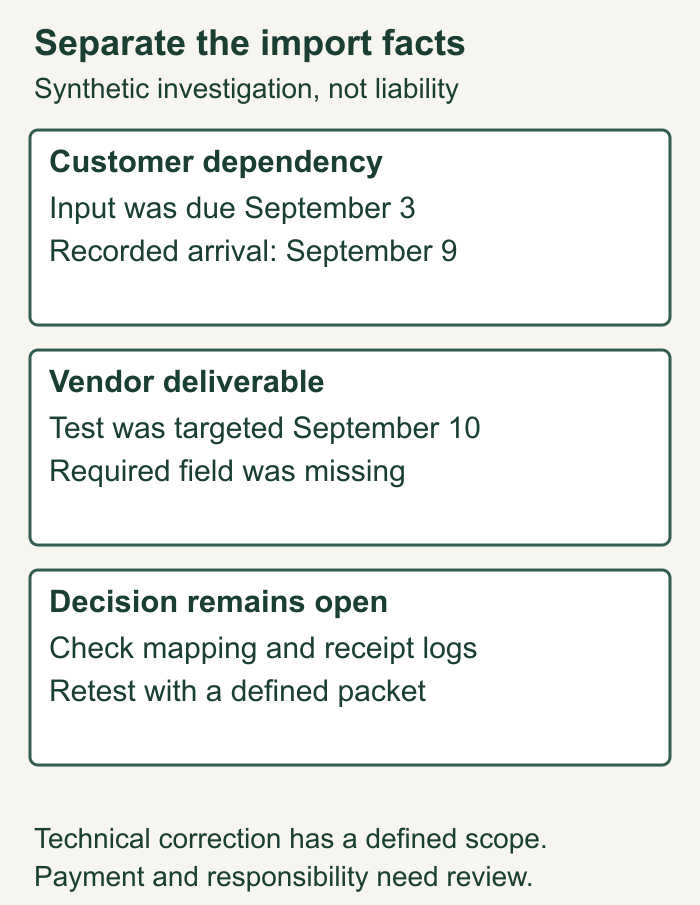
This example, its clause and all amounts are synthetic. A buyer hired an implementation vendor to deliver a working test import. The fictional statement of work says:
Vendor will deliver a test import by September 10, 2026,
provided Customer supplies a complete source file by September 3.
The test must import all required fields listed in Schedule A.
Any change to the agreed timetable must be confirmed in writing.
The customer delivered its complete file on September 9. The September 10 test omitted a required field. The vendor says the late file caused the delay; the customer says the field mapping was already wrong. There is no written timetable change in the file.
The missed date alone does not resolve responsibility. Separate the timing condition from the required-field defect. Request the mapping version, the vendor’s receipt confirmation, the failed test output and any message explaining the effect of the late file. That lets the team ask a narrower question: which problem prevented a conforming import, and when could each party have fixed it?
| Promise and observation | Unresolved point | Owner and next action |
|---|---|---|
| Schedule A requires the employee-ID field. The September 10 output lacks it. Complete customer file arrived September 9. | Was the field absent from the source file, omitted by the mapping or affected by insufficient processing time? | Implementation lead: preserve both files and request mapping logs. Procurement: identify the applicable notice route today. Set a documented retest with the required field included. |
Calculate the business impact separately from the legal claim
Suppose the buyer paid $900 for temporary processing and $300 in additional staff overtime. It avoided a planned $200 testing charge. Its initial incremental cash-cost subtotal is $900 + $300 − $200 = $1,000. If a vendor later pays a $250 reimbursement for those same costs, the remaining unreimbursed subtotal becomes $750. For a fuller calculation, see actual damages and the deposit-refund reconciliation.
Keep an offered but unpaid credit separate. Do not subtract it as received cash. Do not add the same overtime again under a second heading such as “project delay.” List regular salaried time and alleged lost sales separately with their assumptions and evidence.
This is a management calculation, not an award estimate. Contractual caps, exclusions, causation and governing law still affect recovery. The purpose is to make a proposed demand traceable and to stop guesses becoming totals.
Copy this vendor-response worksheet
Use this internally before sending a formal notice. The worksheet does not replace the agreement’s required notice text or delivery process.
VENDOR PERFORMANCE RESPONSE
Owner and next decision date:
Customer and vendor legal names:
Governing law, forum and dispute process:
Signed agreement, order and amendment filenames:

PROMISE
Clause and exact deliverable:
Deadline, acceptance test and customer dependencies:

FACTS
What happened, with dates and original evidence filenames:
Customer inputs and their delivery dates:
Vendor explanation and supporting evidence:
Agreed facts:
Disputed facts:
Missing evidence, owner and request date:

ACTION
Business outcome needed and operational deadline:
Applicable notice/cure/warranty/credit clause:
Required recipient, address and delivery method:
Notice trigger and deadline calculation:
Proposed correction and objective retest:
Temporary workaround, cost and approval:
Termination/payment decision requiring legal review:

COSTS
Incremental cost | evidence | avoided cost | reimbursement received
Unpaid offers and disputed amounts, listed separately:
Potential caps, exclusions or exclusive remedies:

FOLLOW-UP
Notice delivery evidence:
Vendor response and promised completion date:
Retest result:
Next decision, responsible person and date:
Choose a remedy that matches the failure
For a fixable service problem, propose measurable correction: a replacement deliverable, a successful retest and an accountable owner. If you accept a new schedule, document exactly what changed. Check whether a proposed credit or settlement also releases claims. If the agreement provides service credits, use the service-credit evidence guide to check the separate claim process.
If a reviewed decision supports termination, adapt the contract termination letter template to the actual clause.
For undelivered goods, replacement purchasing can have a specific legal basis. Under New York UCC section 2-711, specified seller failures, rightful buyer rejection or justifiable revocation can permit cancellation and other remedies. Section 2-712 permits qualifying substitute purchases made reasonably, in good faith and without unreasonable delay, with a damages calculation that accounts for the original price and saved expenses. Preserve competing quotes and explain the choice.
That is a goods-law example, not a rule that every SaaS implementation cost is recoverable. New York’s article 2 scope provision addresses goods and hybrid transactions; identify the relevant part of the deal before applying a goods remedy.
For termination, withholding payment or a disputed damages demand, obtain a focused legal decision before acting. Give the reviewer the worksheet, complete contract, notice evidence and proposed action. Ask whether that particular action is permitted, what prerequisites remain and what service or data access the business needs during the transition. This is more useful than asking only whether the vendor “breached.”
Close the technical gap without inventing a legal outcome
The team needs an observable retest, not another promise that the project is “on track.” Define the supplied packet, required result, checking person and record to retain. Keep the original failed output so a later correction does not erase the history. A technical result can be accepted for a narrow task while responsibility, payment or loss remains under review.
Completed proposed retest record
SYNTHETIC IMPORT FOLLOW-UP I01
Original target: September 10, 2026, subject to September 3 input.
Recorded input: complete customer file delivered September 9.
Original defect: required employee-ID field missing from output.
Retained record: original source file, failed output and messages.
Open evidence: source receipt, mapping version and processing logs.
Proposed test: use an identified complete file and agreed mapping;
check the required Schedule A fields in the resulting test import.
Checking owner: receiving implementation lead.
Acceptance scope: defined field checks, not every project obligation.
Current result: retest proposed, not performed in this illustration.
Responsibility: remains unresolved pending the requested evidence.
Cost branch: $1,000 incremental subtotal before reimbursement;
$750 unreimbursed if the described $250 was actually received.
Separate review: notice route, cure trigger, payment and any release.
Next: set a documented test time and assign open decisions.
For a real record, replace each field with verified evidence. “Test scheduled,” “test performed” and “test passed” are different states. If a workaround remains necessary, record its continuing cost separately and avoid adding the same invoice under multiple loss categories. A cost estimate, unpaid offer and received reimbursement also remain different states.
Before the next response
- Name the missed promise and distinguish it from an internal target.
- Preserve the controlling documents and unfavorable as well as favorable facts.
- Separate customer dependencies, vendor explanations and missing evidence.
- Identify the applicable notice or remedy route without importing another contract's period.
- Record the action required, authorized owner, recipient and delivery evidence.
- Set a measurable corrective task and retain the original failure.
- Track paid incremental costs, avoided expenses and received reimbursements once.
- Check whether a proposed credit, revised timetable or settlement changes rights.
- Obtain appropriate review before termination, withholding payment or a disputed demand.
- Keep an operational continuity plan and a date for the next owned decision.
Frequently asked questions
Can I stop paying when a vendor misses a deadline?
Do not treat delay alone as permission to stop every payment. Separate accepted work, disputed milestones and unaffected invoices. Check the payment and dispute provisions before withholding an amount. Jafari’s guide linked above explains the risk of creating a counterclaim; the worksheet makes the payment question specific enough to assess.
How long should I give a vendor to cure a breach of contract?
There is no single period established by the sources here for every private vendor agreement. Use your applicable cure or warranty provision and its trigger. The HubSpot example shows different periods within one agreement; the federal FAR example is confined to its procurement setting.
What happens if a seller fails to deliver goods?
State sales law may provide cancellation, substitute-purchase and damages remedies. New York’s provisions above illustrate the conditions. Preserve the order, delivery obligation and replacement costs, and check the law governing your sale before applying that example.
Is it worth suing for breach of contract?
Compare the supported amount at stake with the likely cost, time, collectability and disruption of the proposed process. Include any required arbitration or mediation. A small supported loss does not become a profitable lawsuit merely because it is well documented. A negotiated correction may better meet the business need.
What if our team also caused part of the delay?
Record it. Compare the customer dependency with the vendor’s separate obligations, as in the import example. Do not erase late approvals or inconvenient messages. Identifying the shared cause helps you request a feasible correction and avoid demanding compensation for a loss your evidence does not attribute to the vendor.
For a SaaS claim, use the SaaS liability and indemnity claim map to connect the alleged failure to the applicable provisions.
When a claim may engage an indemnity, review the indemnification clause guide alongside the actual trigger, defense and payment wording.
Does a successful retest settle the cost claim?
A technical retest establishes its defined technical result. Separately review any cost claim, credit, release, settlement or waiver language. Do not infer that a working deliverable either releases every claim or proves every requested amount is recoverable.
Should we hide our late inputs from the vendor-response record?
No. Preserve customer inputs and their dates alongside vendor obligations and explanations. The import example separates late delivery of the source file from the missing required field; further evidence is needed to assess responsibility.
Sources
Cornell LII Wex: Material; neutral explanation of contractual expectations and material breach.
- Jafari Law Group: Vendor Failed to Deliver? California practitioner analysis, May 25, 2026; contract review, materiality, evidence and payment risk.
- HubSpot Customer Terms of Service, modified September 16, 2026; sections 4.3 and 10.1, distinct contractual remedy routes and their conditions.
- FAR 49.607: Delinquency notices; federal cure and show-cause procedures, not private-contract defaults.
- New York UCC section 2-711; buyer remedies for the specified seller failures and buyer responses.
- New York UCC section 2-712; substitute goods and the cover calculation.
- New York UCC section 2-102; scope for goods and hybrid transactions.