

Indemnification Clause: Example, Defense and Claim Checklist
By Anirudh Menon, Viaclause editor
Understand an indemnification clause with a copyable business review draft, a filled third-party claim log, defense and settlement decisions, and US legal notes.
An indemnification clause allocates responsibility for specified liabilities, losses or claims between contract parties. It identifies who protects whom, which events are covered, what amounts are payable and how a claim is handled. A useful clause answers both the money question and the process question: who pays, and who acts when a claim arrives?
California's statutory definition describes indemnity as an agreement to protect another against legal consequences of specified conduct. That is one jurisdiction's starting point, not a universal rule for every contract. See California Civil Code 2772. This guide uses an original business-to-business software example, followed by California and New York notes. Start with the contract formation guide if you are also checking whether an agreement exists.
Read the coverage before the headline promise
The indemnitor is the party taking the specified obligation. The indemnitee is the protected party. Name both precisely. A promise to protect a customer is different from one covering the customer, every affiliate, their employees and future purchasers.
Then distinguish a third-party claim from a dispute between the signers. A copyright owner suing the customer over supplied software is a third-party claim. The customer demanding a refund from the provider for a missed delivery is a dispute between the parties. A clause can address either, but the example below deliberately covers only the first category. Ordinary performance remedies belong elsewhere.
| Decision | What to specify | Worked example choice |
|---|---|---|
| Protected party | Named entity and any deliberately included additional people. | Customer only; no automatic affiliate coverage. |
| Trigger | Claim type, supplied item and permitted activity. | Third-party allegation that the supplied module, used as authorized, infringes US copyright. |
| Excluded causes | Which changes or combinations remove coverage, and to what extent. | Unauthorized customer modifications or combinations, only to the extent they cause the allegation. |
| Covered money | Judgments, authorized settlements, defense costs and treatment of other expenses. | Final covered judgments, approved settlements and reasonable defense costs. |
| Claim process | Notice, request for defense, counsel, control, cooperation and consent. | Written tender; agreed counsel; express settlement safeguards. |
| Exposure | One cap, separate cap or expressly uncapped obligation; interaction with other remedies. | One fictional $100,000 aggregate cap including defense costs. |
A mutual clause gives each party obligations, but symmetry alone does not make the allocation suitable. Two parties may control different risks. A provider may control its supplied code while a customer controls its uploaded material. Write each trigger around the actual responsibility rather than adding reciprocal broad wording.
Indemnify, defend and hold harmless are separate drafting questions
Use these as review prompts, not universal dictionary shortcuts. Indemnify: what liability or payment must the obligated party cover, and when? Defend: must it arrange and fund an active response to a covered allegation, or only reimburse expenses afterward? Hold harmless: what additional protection is intended, and does the rest of the clause express it clearly? A three-word phrase does not resolve triggers, costs or control by itself.
In California, Civil Code 2778 supplies interpretive rules unless a contrary intention appears. Among them, indemnity against claims includes reasonable defense costs incurred in good faith, and the indemnitor is bound, on request, to defend proceedings within the indemnity's scope. The statute also distinguishes indemnity against liability from indemnity against claims or damages for recovery timing. Omitting the word defend is therefore not a reliable way to eliminate every defense obligation under California law.
The California Supreme Court's Crawford v. Weather Shield decision (2008), involving a pre-2006 residential construction subcontract, illustrates the timing distinction. Under that agreement and the statutory rules, the defense obligation did not wait for a finding that the subcontractor was negligent. The court distinguished defending covered allegations from ultimately owing indemnity. Read the actual agreement and applicable transaction rules; this construction decision does not make every software clause identical.
Copyable indemnification clause for business review
This original narrow sample is a review structure, not an approved form. Complete the defined product, permitted use, parties, notice method, law and cap choices. It does not promise regulatory coverage, insurance coverage, a replacement product or payment of every dispute expense.
THIRD-PARTY COPYRIGHT CLAIMS: REVIEW DRAFT

1. Covered claim. Provider will defend Customer, on Customer's
written request, against a third-party claim alleging that
[identified module and version], supplied by Provider and used
as authorized in [identified agreement], infringes US copyright.
Provider will indemnify Customer for final judgments on that
covered claim and settlements approved under paragraph 4.

2. Exclusions. This obligation excludes an allegation to the
extent caused by Customer's unauthorized modification or
combination with material not supplied or approved by Provider.
The parties will document any disputed allocation of covered
and excluded allegations; a mixed claim requires express review.

3. Notice and defense. Customer will promptly send the claim,
relevant documents and written request for defense using
[contractual notice method]. Late notice reduces the obligation
only to the extent Provider demonstrates resulting prejudice.
Provider will arrange and pay reasonable defense costs using
counsel reasonably acceptable to Customer, subject to paragraph 5.
Customer will provide reasonable cooperation at Provider's expense.
Customer may participate using its own counsel at its own expense,
except where the parties agree otherwise in writing. Conflicts,
mixed claims and failure to assume the defense require a written
allocation of counsel, control and payment before proceeding.
Nothing here extends a court or other external response deadline.

4. Settlement. Provider may not settle a covered claim against
Customer without Customer's written consent, not unreasonably
withheld for a settlement paid entirely by Provider that provides
Customer a full release, requires no admission and imposes no
nonmonetary duty on Customer. Other settlement terms require
Customer's express written consent. Customer may not settle at
Provider's expense without Provider's written consent.

5. Aggregate limit. All amounts payable by Provider under this
clause, including reasonable defense costs, judgments and approved
settlements, count together toward [selected aggregate limit]
over [defined aggregation period]. Identify explicitly whether
this limit replaces or shares the agreement's general cap.
No amount may be recovered twice under different provisions.
Before cap exhaustion, the parties must review continuation of
the defense and any disputed obligations under applicable law.

6. Relationship and duration. This clause covers third-party
claims only, not fees for a lawsuit between Customer and Provider
to enforce their agreement. Other remedies, product mitigation,
insurance and obligations surviving termination must be stated
in the agreement and reconciled with this clause. Complete the
governing-law and dispute-resolution provisions before signature.
The late-notice prejudice standard, acceptable-counsel requirement and consent wording are proposed contractual choices in this sample. They are not claimed as defaults everywhere. Paragraph 3 intentionally leaves a real conflict or mixed claim for an express allocation rather than pretending one lawyer can always represent all interests.
Paragraph 5 also needs a real answer. A cap that includes defense costs can run down while a case is pending. Decide what happens to control and funding at exhaustion, and whether mandatory law changes that choice. Use the SaaS claim and liability-cap map for the wider agreement's exclusions, general cap and separate caps.
Worked example: follow one claim from receipt to payment
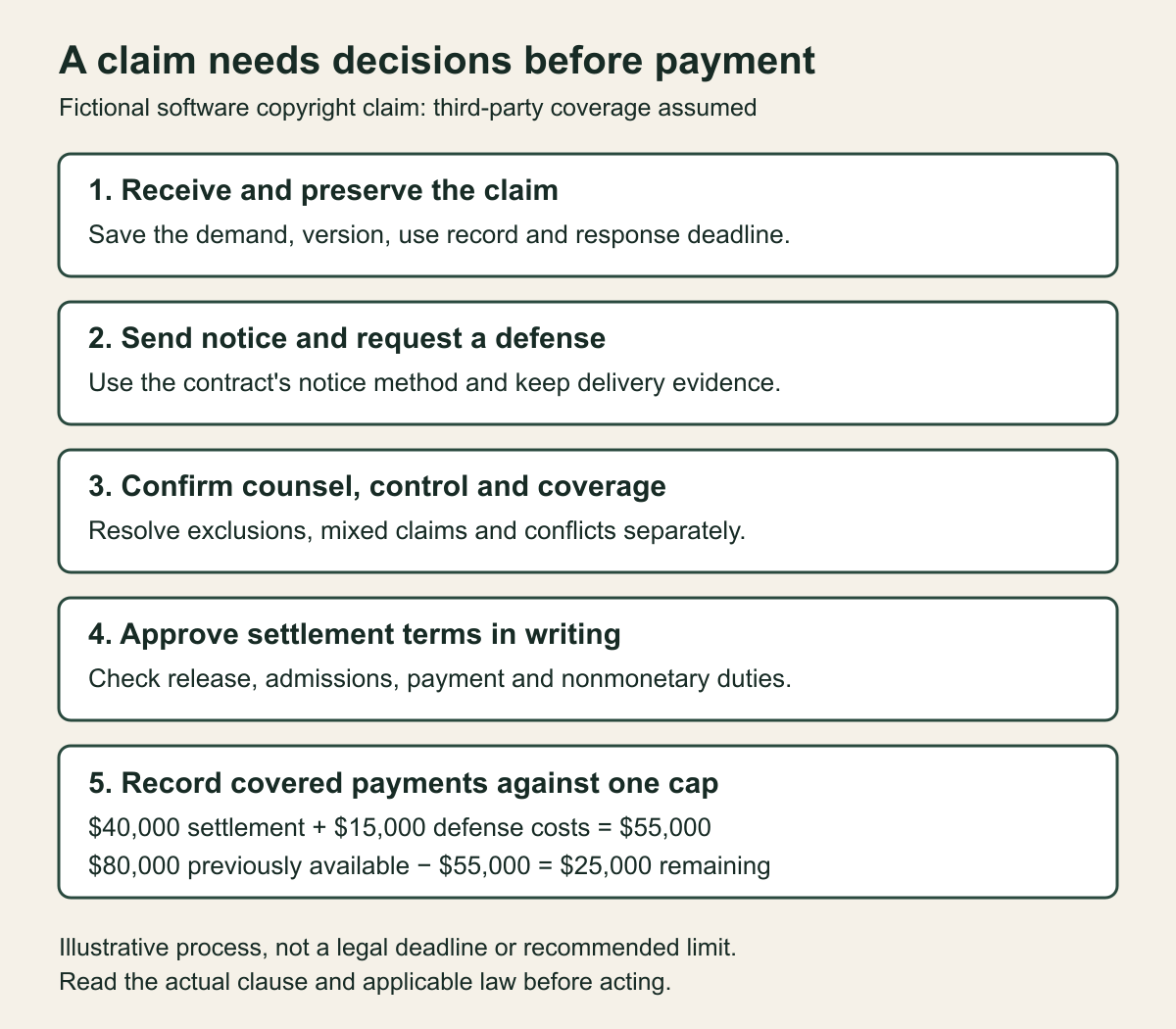
Everything in this scenario is fictional. Larch Module Works LLC supplies module LM-4 to Cedar Dispatch Systems LLC. Their reviewed agreement adopts the sample's narrow copyright coverage and one $100,000 aggregate limit for all obligations under that clause over the agreement's term, replacing the general cap for these obligations. It expressly includes defense costs. Neither the amount nor the period is a recommended legal standard.
A third party alleges that Cedar's authorized use of the unmodified LM-4 infringes its copyright. The parties agree, for this example, that the claim is covered and no exclusion applies. That assumption is a decision requiring evidence in a real matter, not proof that an allegation is true.
| Fictional date | Action and owner | Saved evidence and decision |
|---|---|---|
| October 6, 2026 | Cedar legal records the third-party demand. | Demand C-17, supplied version LM-4, authorized-use record and external response deadline. |
| October 7 | Cedar sends the documents and expressly requests a defense. | Notice N-17 through the agreed channel, delivery evidence and claim reference. A helpdesk ticket alone is not treated as contractual tender. |
| October 8 | Larch confirms it will assume the covered defense. | Acknowledgment A-17, accepted counsel, control plan and covered-cost ledger. External deadlines remain separately calendared. |
| October 26 | Counsel presents a proposed $40,000 settlement. | Full Cedar release, no admission or nonmonetary duty; $15,000 reasonable covered defense costs recorded separately. |
| October 29 | Both companies record the required written approvals. | Approved settlement S-17 and payment records. Counsel closes the claim after verifying release and completion. |
Preserve actual delivery evidence using the contract notice guide. Store the executed clause, amendments and claim documents together in the contract repository; a template from an unrelated deal is not evidence of this deal's coverage.
Check the arithmetic without creating a second cap
Assume $20,000 of earlier covered payments has already used the same aggregate limit. Before this claim, $100,000 minus $20,000 leaves $80,000. This claim's $40,000 approved settlement plus $15,000 covered defense costs totals $55,000. After payment, $80,000 minus $55,000 leaves $25,000.
FICTIONAL COVERED-PAYMENT LEDGER
Aggregate cap for this clause:           $100,000
Earlier covered payments:                $20,000
Available before claim C-17:             $80,000
Approved settlement S-17:                $40,000
Reasonable covered defense costs:        $15,000
Claim C-17 total:                        $55,000
Available after recorded payment:        $25,000

Check: $20,000 + $55,000 + $25,000 = $100,000.
Do not give settlement and defense costs separate $100,000 caps.
A requested amount is not automatically a covered payment. Check invoices, allocation, approvals and cap wording before reducing the ledger. A revised claim alleging an unauthorized modification would need a fresh coverage assessment. An insurer's payment or denial would also require separate policy analysis; this example makes no insurance assumption.
Jurisdiction and transaction notes
California construction: Civil Code 2782 contains construction-specific restrictions. Its subsection (a), subject to the statute's qualifications, voids specified indemnity provisions for losses arising from the promisee's sole negligence, willful misconduct or certain design defects. Other subsections distinguish public projects, private owners and residential arrangements. Do not use the software sample as a construction form or treat every state's treatment of negligence as the same.
New York enforcement fees: in Sage Systems v. Liss (2022), the Court of Appeals rejected an attorney-fee award based on a broad partnership indemnity provision that did not unmistakably clearly authorize fees for litigation between the parties. The case concerns interparty enforcement fees, not a blanket prohibition on third-party claim defense costs. If that expense matters, review a separate, express fee provision and applicable law.
These are bounded US examples, not a fifty-state enforceability survey. Construction, public contracts, corporate officer protection and regulated industries can involve rules absent from an ordinary software bargain. Choice of law, the actual wording and the transaction all need review.
Checklist before agreeing or responding to a claim
- Identify the indemnitor, every protected party and the exact covered activity.
- Separate third-party claims, direct party disputes and enforcement fees.
- Define covered payments, defense timing and any advancement or reimbursement choices.
- Allocate mixed claims, exclusions, counsel conflicts and defense control.
- Specify notice method, required documents and who tracks external deadlines.
- Require settlement approvals and resolve admissions, releases and nonmonetary duties.
- Reconcile defense costs with the cap, aggregation period, exclusions and other remedies.
- Check governing law, transaction-specific restrictions and separate insurance terms.
- Record obligations after termination using the survival clause guide.
- Send unresolved choices and a completed scenario in the lawyer review packet.
Frequently asked questions
Should I agree to an indemnification clause?
Assess the actual trigger, costs, control and available resources. Narrow protection for a risk your business controls is a different commitment from unlimited protection for another party's conduct. Run a plausible claim through the clause and obtain transaction-specific review before accepting unresolved exposure.
What is a simple example?
A software provider agrees to defend its customer against a specified third-party copyright claim involving authorized use of supplied code, and to pay covered judgments and approved settlements within an expressly defined cap. The worked draft above adds the process choices that this short description leaves open.
What are the three types of indemnity?
There is no universal three-type classification for every agreement. Some construction discussions distinguish broad, intermediate and limited allocations of fault. Other discussions distinguish unilateral and mutual promises, or contractual and noncontractual indemnity. Ask which taxonomy is being used and inspect the actual allocation; a label does not determine enforceability.
Is indemnification the same as hold harmless?
Do not assume interchangeability or a fixed difference everywhere. Identify the protection intended, write the operative obligations and check governing law. Neither phrase by itself explains when defense starts or who approves a settlement.
Does an indemnity always include a duty to defend?
Check the agreement and applicable law. California's statutory default described above can create a defense duty on request unless a contrary intention appears. Other wording and jurisdictions require their own analysis. Do not answer solely by searching the document for the word defend.
Does a liability cap apply to indemnification?
Read the cap and its exceptions together with the indemnity. The worked example expressly uses one aggregate cap including defense costs. A different agreement might share a general cap, create a separate limit or exclude specified indemnities from the cap. State the relationship and test the totals.
Prepared by the Viaclause editorial team. The clauses, companies, records and amounts are original fictional teaching examples. The banner is an AI-generated illustration of fictional people.
Sources
- California Civil Code 2772: statutory definition of indemnity
- California Civil Code 2778: interpretation, defense and recovery rules
- California Supreme Court, Crawford v. Weather Shield (2008): court opinion hosted by Stanford Law
- California Civil Code 2782: construction indemnity restrictions and qualifications
- New York Court of Appeals, Sage Systems v. Liss (2022): interparty attorney-fee issue