

Survival Clause: Example and Obligations After a Contract Ends
By Anirudh Menon, Viaclause editor
A survival clause keeps specified duties in place after a contract ends. Copy a sample and track payment, property and confidentiality on separate dates.
AI-generated illustration of a fictional operations manager closing a project room. Not a photograph of an actual transaction.
A survival clause identifies the rights and duties that continue after a contract expires, terminates or reaches a stated closing event. It should specify the surviving provisions, their duration and the event that starts each period. It does not renew the entire agreement, automatically validate an unlawful restriction or necessarily extend the time to sue.
Some rights can remain without express survival wording. For goods, model UCC section 2-106 preserves rights based on earlier breach or performance after termination. State enactments require checking; this is not a nationwide rule for services. Conversely, GRT v. Marathon shows that particular survival language can cut off a contractual remedy.
For procurement and legal operations teams, the useful output is a closeout record: what remains due, who owns it, when performance must happen, and which separate claim deadlines need legal review. Connect it to the contract administration plan.
A short survival clause example
This original sample assumes a fictional service agreement with the listed clauses. Its two-year period and 30-day return window are negotiated examples, not legal defaults.
Expiration or termination does not discharge payment obligations accrued before the agreement ends. Those amounts remain payable under clause 4.

Clause 8 (Confidentiality) continues for two years after expiration or termination, subject to its stated exceptions. Nothing in this paragraph releases obligations or rights protected independently by applicable law.

Clause 10 (Return of property) continues until the required property has been returned, which must occur within 30 calendar days after expiration or termination.

Clauses 12 (Liability limits), 14 (Dispute resolution) and 15 (Governing law) continue to apply to disputes concerning surviving obligations. This clause does not release accrued claims or alter an applicable deadline for bringing a claim.
Read it as three different instructions: payment keeps its existing due date; confidentiality has a duration; property return has a performance deadline. If equipment is returned late, the continuing duty does not excuse the missed deadline.
Before using the sample, settle any omitted indemnity, IP licence, data handling and transition terms. Match clause numbers to the signed version. Published examples contain both specific lists and broader formulations, but an example library is not a legal-validity decision. Spellbook's survival-clause examples.
What survives, and what needs its own instructions?
Use this as a drafting review, not a list of provisions that automatically survive every contract. Keep the underlying obligation, its exceptions and the supporting remedy together.
| Provision | Decision to record | Completion or ongoing evidence |
|---|---|---|
| Accrued fees, refunds and reconciliation | Which earned amounts, credits, disputed items and agreed set-off mechanics remain? | Final invoice, credit note, payment and reconciliation record. |
| Confidentiality and permitted use | Information covered, exceptions, start event and duration; separate trade-secret analysis. | Access removal plus continuing restrictions on use and disclosure. |
| IP ownership and licences | What ownership is established, which licences continue, and which permissions end? | Assignment, licence terms, deliverable inventory and access record. |
| Warranties and representations | Facts warranted, duration, remedy, notice steps and claim deadline. | Relevant version, issue evidence and timely required action. |
| Indemnities and liability limits | Covered events, cap, exclusions, defence control and notice procedure. | Claim record, defence arrangements and applicable cap calculation. |
| Property, data, records and audit | Return, deletion, permitted retention, audit access and certification. | Inventory, receipt, deletion evidence and restricted retention log. |
| Disputes, notices and governing law | Process and notice details for disputes about surviving matters. | Current contact, required delivery method and escalation record. |
Preserving an indemnity while overlooking its cap or defence process creates an interpretive problem. Decide explicitly whether those connected provisions apply after exit. Survival alone does not answer whether a claim falls within an indemnity, whether a cap covers it, or whether a mandatory rule prevents enforcement.
For the underlying promise, the warranty clause guide separates scope, procedure and remedy. A continuing restriction on employee or customer outreach also needs its own enforceability assessment; use the non-solicitation review worksheet.
Confidentiality, trade secrets, data and IP
Confidential information and statutory trade secrets are different categories. Under US federal law, trade-secret status requires reasonable secrecy measures and qualifying economic value from secrecy. Merely calling every document a trade secret does not satisfy that definition. A contract's two-year confidentiality period should not be treated as permission to disregard independently applicable law. 18 USC section 1839, trade-secret definitions.
For an NDA or employment exit, identify information the person may retain, permitted disclosures and lawful-use exceptions. Closing an account is an access-control task. It does not by itself discharge the person's continuing confidentiality duty. Avoid treating employment restraints as enforceable solely because the survival list mentions them.
Data return and deletion require a separate exit plan. Where EU GDPR applies, article 28(3)(g) requires the processor contract to provide for deletion or return at the controller's choice after processing services end, with deletion of copies unless Union or Member State law requires storage. This is a scoped EU processor obligation, not a universal rule to erase every business record. EU GDPR, article 28(3)(g).
List active systems, exports, backups, subcontractors and legally retained copies. State the owner, method, deadline and confirmation required for each. If electronically stored information should be preserved for anticipated or ongoing US federal litigation, Rule 37(e) addresses loss caused by failure to take reasonable preservation steps. Check preservation before executing routine deletion. Federal Rule of Civil Procedure 37(e). The email preservation guide helps organise the evidence.
IP ownership is not the same as permission to keep using software. Survival wording should not leave an expired subscription licence running accidentally. Identify any continuing deliverable licence separately, including use, users, territory, fees and restrictions. For US copyright transfers, section 204 generally requires a signed writing, except for transfers by operation of law; a generic survival sentence does not replace that requirement. 17 USC section 204, copyright transfer formalities.
Three obligations, three different end points
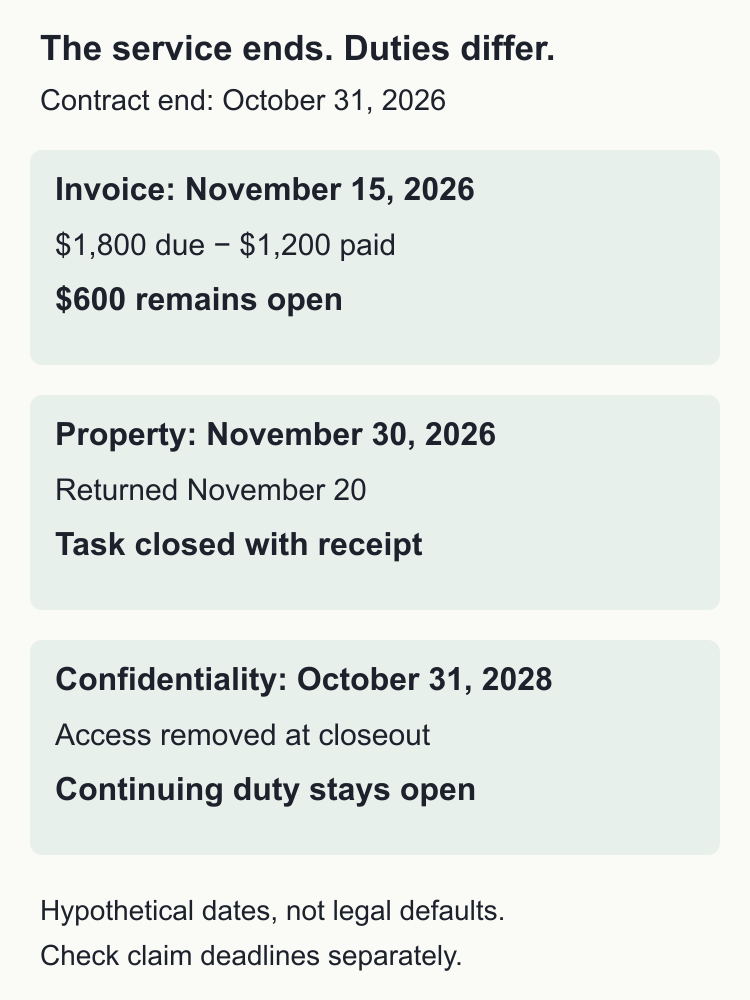
Fictional service closeout: the agreement ends October 31, 2026. A final $1,800 invoice is due November 15. Property must be returned within 30 calendar days, with no weekend extension assumed. The sample confidentiality period ends October 31, 2028.
| Duty and owner | Date | Evidence and status |
|---|---|---|
| Accrued payment; finance lead | November 15, 2026 | $1,200 paid November 12; $600 remains open. |
| Equipment return; operations lead | November 30, 2026 | Complete return confirmed November 20; task closed. |
| Confidentiality; information owner | Through October 31, 2028 | Access removed and staff notified; continuing duty open. |
$1,800 minus $1,200 = $600. The return receipt settles the equipment task, not the invoice. Access removal does not bring the two-year duty to an early end. The 30-day calculation runs from the day after October 31 through November 30.
For SaaS, add a row for an agreed export or transition window instead of assuming continued service access. For an MSA with several statements of work, record whether the trigger is an individual work order ending or the master agreement ending. For contractors and suppliers, attach the handover, warranty and final reconciliation records. These are proposed review steps, not statutory default periods.
Keep the register linked to the signed agreement and amendments using the contract repository checklist. If the parties change exit duties, document the agreed variation with an appropriate contract amendment; editing a reminder does not amend the bargain.
Survival periods and claim deadlines: three court lessons
1. Short wording can shorten a remedy. In GRT, Inc. v. Marathon GTF Technology, Ltd. (Delaware Chancery, 2011), a one-year period ended specified design representations and associated remedies. The court treated the wording as a contractual filing limit and dismissed the late claim. This interpreted that agreement under Delaware law; one year is not a general services-contract limit.
2. A remedy procedure need not restart accrual. In ACE Securities v. DB Structured Products (New York Court of Appeals, 2015), representations about mortgage loans as of execution were breached, if at all, then. Cure or repurchase was a remedy for that breach, not an independent promise of future performance. Required pre-suit steps did not defer accrual.
3. Choosing a later accrual event has legal limits. In Deutsche Bank v. Flagstar Capital Markets (New York Court of Appeals, 2018), the majority rejected the proposed postponement under the particular mortgage-loan agreement. Its holding preserved distinctions for true substantive conditions and separate future-performance promises. Do not turn that decision into a ban on every later obligation.
Jurisdictions differ. Delaware's current section 8106(c), subject to its stated qualifications, permits a period specified in a written contract involving at least $100,000, provided suit is brought before 20 years from accrual. That is not an automatic 20-year limitation period for every contract. 10 Delaware Code section 8106(c).
Give the reviewer four separate fields: performance deadline, duty duration, notice or cure prerequisite, and deadline to commence the required proceeding. Do not assume a complaint email preserves a claim or that a survival period adds time to a statutory limit. Escalate ambiguous wording before either potential deadline.
Real estate: survival after closing
Real estate survival wording can address a closing event instead of termination. Review it with the deed, promised later work and local merger doctrine. Merger can affect whether earlier purchase-contract terms remain enforceable after the deed is accepted; exceptions and proof of contrary intent matter.
For example, Shoney's Inc. v. Cooke (South Carolina Court of Appeals, 1987) applied merger to an asserted use restriction. The challengers failed to establish contrary intent or a collateral-agreement exception. That opinion concerns its property restriction and facts, not every post-closing repair promise nationwide.
FICTIONAL POST-CLOSING REVIEW RECORD
Closing date: October 31, 2026.
Proposed surviving promise: Seller completes specified roof repairs.
Proposed deadline: November 20, 2026.
Evidence: Agreed specification, completion record and acceptance process.
Documents to reconcile: Purchase agreement, addendum and deed.
Open legal check: Local merger rule, express survival and remedy.
Status: Proposed agreement for review; no completed repair claimed.
Specify the scope, access arrangements, payment or escrow terms, acceptance and remedy in the actual documents. A survival heading does not supply missing commercial details. It also does not decide the separate question of what happens if a party dies.
Disputes and jurisdiction checks
Keep the agreed forum, governing law, notice process and liability framework usable for surviving disputes. The Federal Arbitration Act's section 2 supports qualifying written arbitration agreements subject to its exceptions and contract defences; it does not resolve every post-expiration scope question. 9 USC section 2.
In the collective-bargaining context, Litton Financial Printing v. NLRB (US Supreme Court, 1991) distinguished disputes involving earlier events, accrued or vested rights, or rights surviving by interpretation. The particular later layoff dispute was not arbitrable. This is a labour-contract decision, not a universal rule that every commercial arbitration clause continues forever.
England and Wales: Limitation Act 1980 section 5 states a six-year period from accrual for actions founded on simple contract. Other provisions and exceptions need review; it is not a uniform deadline for every UK agreement. Limitation Act, section 5. Arbitration Act 1996 section 7 treats an arbitration agreement as distinct for its separability rule unless otherwise agreed. Separability and the scope of a particular post-exit dispute remain different questions. Arbitration Act, section 7.
A drafting and closeout checklist
- Identify the actual trigger: expiration, termination, closing, work-order completion or another defined event.
- List precise clause numbers and headings; check them again after amendments.
- Separate accrued amounts and claims from duties that require future conduct.
- State each duration, performance date or end condition; avoid relying only on what survives “by nature.”
- Reconcile indemnities, caps, exclusions, warranties, claim procedures and dispute terms.
- Map IP permissions, data return, retention exceptions, audits and transition assistance.
- Check governing law, mandatory protections and each notice and filing deadline.
- Assign an owner, reminder and evidence requirement; close tasks only on evidence.
Buyers should test whether protection remains usable after exit. Suppliers should test whether the intended limits still apply and whether continuing services are priced and bounded. If there are disputed claims, review any release wording alongside survival rather than assuming one silently cancels the other.
COPYABLE CLOSEOUT RECORD
Agreement and signed version:
Actual end event and evidence:
Clause number and surviving obligation:
Owner:
Performance deadline:
Duration or end trigger:
Notice/cure steps:
Claim deadline and required proceeding, separately reviewed:
Retention or preservation exception:
Evidence needed to close the task:
Continuing duty after task completion:
Status and next reminder:
A survival clause does not itself grant a right to terminate. Use material breach and cure requirements to assess that separate decision and the contract termination letter template for the notice task.
FAQs
What does “survive termination” mean?
The specified right or duty continues after the relationship ends, to the extent stated and legally enforceable. Identify the actual clause, trigger and duration rather than treating the phrase as a complete instruction.
What happens without a survival clause?
Do not assume all rights disappear. Model UCC section 2-106 preserves earlier breach or performance rights for goods after termination. Check the state's enacted rule and the actual agreement; services need their own analysis.
Does a survival clause last forever?
Not necessarily. A fixed period, completion condition or other end event may govern. An omitted duration requires interpretation, not an automatic instruction to assume permanence.
Does giving notice before the survival period ends preserve a claim?
It depends on the wording and law. Notice, cure and filing can be separate requirements. GRT and ACE illustrate why a reviewer must check the required formal action and its deadline.
Can confidentiality survive when the equipment-return task is closed?
Yes under the fictional sample. The receipt closes one task; the two-year confidentiality duty remains. Separately applicable statutory protections also require their own assessment.
Does survival keep every software licence active?
That cannot safely be assumed. Identify which permissions end and any licence expressly continuing for deliverables, transition or another agreed purpose.
Is survival the same as severability?
Survival concerns what continues after an end event. Severability addresses the effect of a failed provision. See the severability example.
Does survival renew the contract?
The sample preserves selected duties without beginning another service term. Automatic-renewal examples address that different mechanism.
Does survival mean a family must complete a purchase if a party dies?
The term alone does not answer that question. Review death, estate and succession issues separately. A clause about duties after closing should not be read as a complete estate-liability rule.
Do all provisions need to survive?
Start with the obligations that actually need continuing effect. Preserving every provision indiscriminately can conflict with provisions intended to end, such as ordinary service access.
Sources
Checked October 6, 2026. Court decisions below are used for their stated jurisdiction and facts.
- Model UCC section 2-106, Cornell LII: goods termination and accrued rights; check state enactment.
- GRT v. Marathon, Delaware Chancery, July 11, 2011: specified representations, remedies and one-year filing limit.
- 18 USC section 1839, Cornell LII: federal trade-secret definition.
- EU Regulation 2016/679, EUR-Lex, article 28(3)(g): processor return/deletion and statutory storage exception.
- Federal Rule of Civil Procedure 37(e), Cornell LII: loss of litigation-related electronic information.
- 17 USC section 204, Cornell LII: copyright-transfer writing requirements.
- ACE Securities v. DB Structured Products, New York Court of Appeals, June 11, 2015: accrual and remedial prerequisites.
- Deutsche Bank v. Flagstar Capital Markets, New York Court of Appeals, October 16, 2018: contractual accrual limits.
- 10 Delaware Code section 8106(c), official Code: qualifying written contracts and specified limitation periods.
- Shoney's Inc. v. Cooke, South Carolina Court of Appeals, February 9, 1987, opinion reproduced by Justia: deed merger and exceptions.
- 9 USC section 2, Cornell LII: qualifying arbitration agreements and exceptions.
- Litton Financial Printing v. NLRB, US Supreme Court, June 13, 1991, Cornell LII: post-expiration arbitration in collective bargaining.
- Limitation Act 1980, section 5, legislation.gov.uk: England and Wales simple-contract rule.
- Arbitration Act 1996, section 7, legislation.gov.uk: separability, with stated territorial extent.
- Spellbook, survival-clause examples: drafting patterns, not legal authority.
By Anirudh Menon, Viaclause editor. Sources checked October 6, 2026. Sample wording, dates, amounts and records are original hypothetical examples.