

Severability Clause Example: What Stays in the Contract?
By Anirudh Menon, Viaclause editor
A standard severability clause, three variants with a "which one to use" table, two worked examples, and the limits courts apply when one term fails.
A severability clause says what should happen to the rest of a contract if one provision is invalid or unenforceable. This short severability clause example aims to preserve the lawful remainder, subject to the governing law.
Cornell's Legal Information Institute defines a severability clause as a contract provision that keeps the remaining portions of the contract in force if a court declares one or more of its provisions void or unenforceable (LII Wex: severability clause).
Standard severability clause example
Severability. If a court with authority over the dispute holds a provision of this Agreement invalid or unenforceable, that provision will be ineffective only to the extent of that ruling. The remaining provisions will continue in effect to the extent permitted by applicable law.
Sample wording. Check it against your governing law before use. In plain English: remove only what the ruling requires, then check whether the remaining bargain can lawfully stand.
For the broader formation check, review the four contract elements alongside this specialist question.
4 severability clause examples by situation
Each version below answers the same question in a different way. Pick one, or combine them as the table suggests.
1. Standard (remove the bad part only)
If any provision of this Agreement is held invalid or unenforceable, it will be severed, and the remaining provisions will remain in full force and effect.
2. Modify rather than remove (reformation)
If any provision of this Agreement is held invalid or unenforceable, it will be enforced to the maximum extent permitted by law and modified only to the minimum extent necessary to make it enforceable, consistent with the parties' original intent. The remaining provisions will remain in full force and effect.
3. Multi-jurisdiction
If any provision of this Agreement is invalid or unenforceable in any jurisdiction, that will not affect the validity or enforceability of that provision in any other jurisdiction, or of the remaining provisions in that jurisdiction.
4. Essential-term safeguard
If a provision held invalid or unenforceable is essential to a party's rights or benefits under this Agreement, the parties will negotiate in good faith to replace it with a valid provision that comes as close as possible to its original economic effect. If they do not agree on a replacement within [30] days, the affected party may terminate this Agreement by written notice.
Sample wording for discussion. None of these versions can force a court to keep a term that the governing law does not allow.
| Your situation | Use | Watch out for |
|---|---|---|
| Standard commercial contract | 1 | A court may still refuse to sever if the bad term is central to the deal. |
| Contract with restrictive covenants, such as a non-compete or non-solicit | 2 | Courts differ on whether they will narrow a term. Some only strike it. |
| Deal performed in several countries or states | 3, combined with 1 or 2 | Each governing law still decides for itself. |
| Price, payment or core service could be at risk | 4, combined with 1 | A duty to negotiate in good faith does not guarantee agreement. |
Read the sample before copying it
The standard sample requires a court ruling, removes only what that ruling requires, and preserves the lawful remainder. Align the decision-maker with any arbitration clause. It gives neither party a power to invent a replacement fee. For a voluntary change to valid wording, use an agreed contract amendment.
Removal is not replacement
After such a ruling, the parties will discuss in good faith whether to agree to a lawful replacement provision. No replacement takes effect unless both parties approve it in the form required by this Agreement's amendment clause.
This optional sentence requires discussion, not agreement. A replacement needs both parties' approval. California Civil Code section 1670.5 lets a court refuse to enforce an unconscionable contract, enforce the rest without the unconscionable clause, or limit that clause. The template cannot dictate which remedy the court picks.
The non-solicitation review worksheet shows why an overbroad restraint requires its own legal analysis.
Example: how a severability clause works in practice
Fictional employment agreement, for illustration only.
A sales manager's agreement includes a salary, a confidentiality duty, and a non-compete that bans working for any competitor anywhere for five years. A court later finds the non-compete too broad.
- With clause 1 (standard): the court may strike the non-compete. Salary and confidentiality stay in force.
- With clause 2 (reformation): the parties asked for the term to be narrowed rather than removed. Whether a court will do that depends on local law. For example, Florida's statute on restrictive covenants says that if a restraint is overbroad, overlong or otherwise not reasonably necessary, a court shall modify it and grant only the relief reasonably necessary (Fla. Stat. 542.335(1)(c)).
- Either way: the clause shows what the parties wanted. The governing law decides what the court can actually do.
Worked example: remove $600, keep the service bill
Fictional transaction: Harbor Design buys six months of storage from Pine Records at $2,000 a month. Assume a court removes a separate $600 invoice-dispute charge and leaves the delivered service and payment terms intact. Harbor has paid $10,000. No tax, interest, credits or other claims apply.
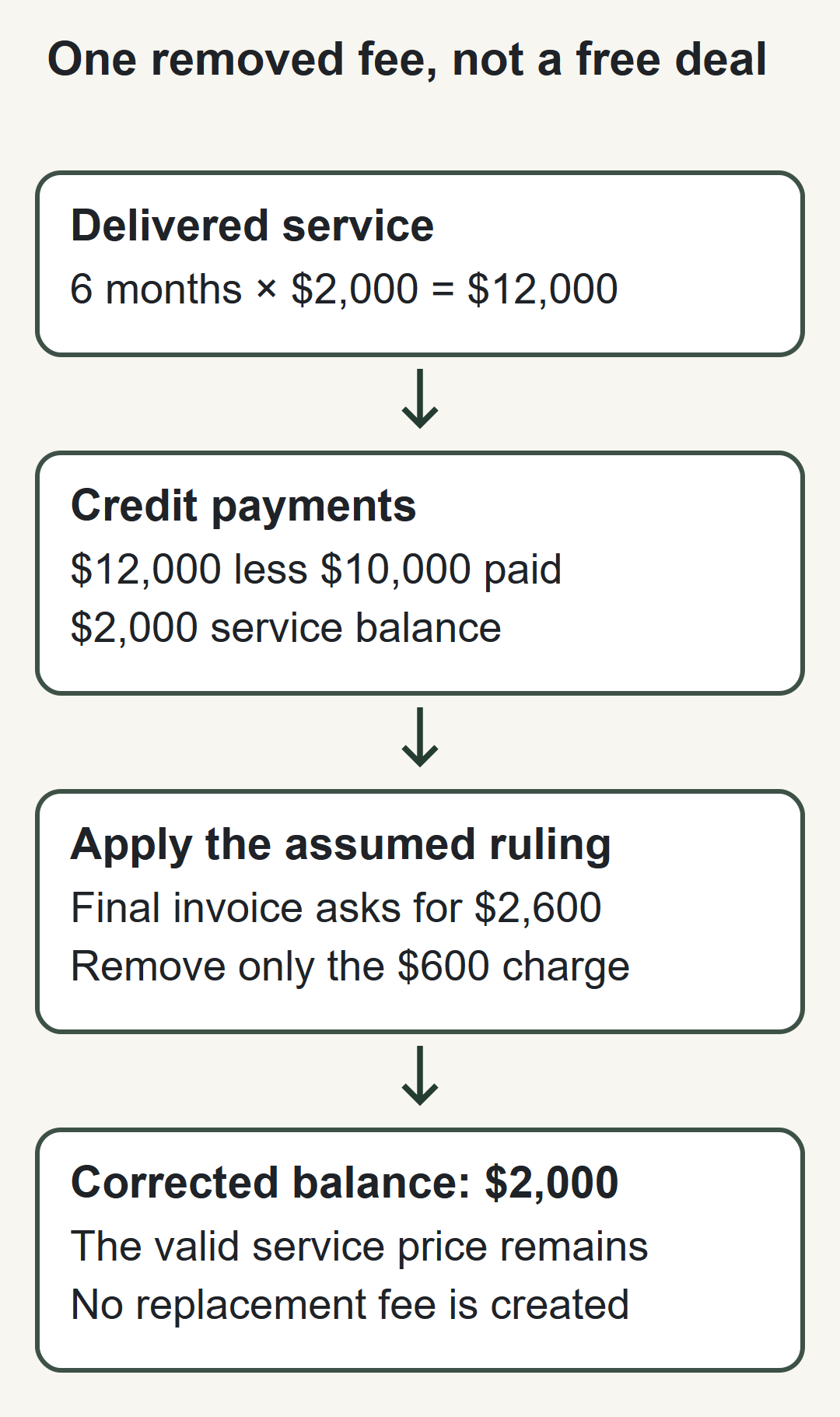
This does not establish that every dispute charge is unlawful. Without a ruling, mark the charge disputed. If the removed text defines the only promised service, the remaining bargain needs a different analysis. A defective term is also different from a valid obligation that was materially breached.
When a severability clause may not save the contract
- The bad part is the whole point of the deal. In California, where a contract has a single object and that object is unlawful, the entire contract is void (Cal. Civ. Code 1598). Where a contract has several distinct objects, it is void as to the unlawful one and valid as to the rest (Cal. Civ. Code 1599).
- The court would have to write new terms. In Ramirez v. Charter Communications (California Supreme Court, 2024), opinion pages 43 to 46, the court said severance or restriction is preferred for collateral terms, but if curing the problem would need new terms added, the court should refuse to enforce the contract. Courts cannot rewrite agreements and impose terms neither party agreed to. This was an employment-arbitration case, not a nationwide test.
- The court chooses the remedy for unfair terms. For unconscionable contracts, California lets the court refuse enforcement, sever the clause, or limit it (Cal. Civ. Code 1670.5). The model UCC has the same three options for sales of goods (UCC 2-302). Check the applicable state's enactment. A services agreement does not become a goods sale because its template cites the UCC.
So the clause is evidence of what the parties wanted. It is not an order the court must follow.
Before copying a sample, check these four points:
- What would disappear? Name the clause, sentence or limited application.
- What depends on it? Follow references to price, deliverables, liability limits and dispute resolution.
- What remains workable? Write down the obligations each party could still perform.
- Who decides the next step? Match the decision-maker, amendment process and any termination right to the actual agreement.
The completed record applies the Harbor example above. The blank worksheet below it is for your own agreement. Keep an objection, a legal assessment and an actual ruling separately identified. If the governing provision or effect remains uncertain, record the question rather than marking the contract valid or void.
Completed record (Harbor example)
Agreement: Harbor Design / Pine Records, six-month storage service
Governing law: Record the agreement's actual choice
Challenged text: The separate $600 invoice-dispute charge
Status: Assumed court ruling, not merely a party objection
Exact effect: Remove that charge; monthly service terms remain
Related terms checked: Monthly price, invoice timing, service scope
Delivered service: Six months at $2,000 = $12,000
Payments credited: $10,000
Remaining balance: $2,000
Replacement agreed: None
Evidence to retain: Signed terms, ruling, invoices, payment record
Owner and next action: Finance corrects the invoice; legal confirms scope
Blank worksheet
SEVERABILITY REVIEW
Agreement and amendments: [identify the document set]
Actual governing law: [record; do not assume from a template]
Challenged text: [provision and affected application]
Trigger status: [objection; legal review; actual ruling; agreed amendment]
Decision-maker and evidence: [court or agreed tribunal; document and date]
Exact effect: [removal, limited application or other result]
Related provisions: [price, service, liability, dispute resolution and references]
Remaining performance: [each party's obligations and dependencies]
Financial reconciliation: [original amounts, payments, removed amounts and resulting balance]
Replacement: [none, open discussion, or approved amendment and scope]
Unresolved question / owner: [details]
Operational action and proof: [invoice correction or other action, with completion evidence]
Three decisions the clause should keep separate
| Decision | Evidence needed | Example's result |
|---|---|---|
| Is the disputed provision ineffective? | The relevant ruling and its exact scope; a complaint alone does not satisfy this sample. | The assumed court ruling removes the separate $600 charge. |
| Can the remainder continue? | Review the lawful obligations, related wording and what the ruling actually preserves. | Delivered storage and the service price remain under the stated assumption. |
| Will the parties adopt replacement wording? | A separate agreed amendment, in the required form, with its scope recorded. | No replacement was agreed. Do not add a new fee. |
The sequence matters operationally. Finance should not close the whole service account because one charge is removed, or invent a replacement charge because the draft mentions good-faith discussion. Legal review should identify what the ruling decided; the billing record should then reflect that scope.
A current commercial clause and an enacted goods provision
Real contracts use these patterns. The Atlassian Customer Agreement, section 20.8 (effective October 1, 2026) limits an invalid, illegal or unenforceable provision to the minimum extent necessary so the rest stays in effect. That is a version of clause 2 above. It is a drafting choice, not proof that a court will keep any particular agreement.
New York UCC section 2-302 is an enacted goods-law example. For a contract or clause that was unconscionable when made, it lets the court refuse enforcement, enforce the rest without the clause, or limit the clause. It also gives the parties a chance to present evidence of commercial setting, purpose and effect.
A business drafting and response checklist
- Choose the trigger deliberately. The sample requires a court ruling; align any different tribunal or process with the actual dispute-resolution terms.
- Identify the intended remedy. Removal, restricted application and a negotiated replacement are distinct choices; avoid conflicting instructions across the document set.
- Check dependencies. Read cross-references, defined terms, pricing formulas and exceptions that may become incomplete when text is removed.
- Describe what remains performable. If deleting the affected promise leaves no meaningful service or agreed price, flag the issue for legal review rather than relying on boilerplate.
- Keep legal review beside the substantive term. A severability clause is not a reason to knowingly include an unlawful restriction.
- Specify the replacement process if desired. Discussion does not create a replacement.
- After a ruling, reconcile operational records with its actual effect. Preserve the ruling, document version, invoices and corrected balance.
- Review continuing obligations separately. The survival-clause examples address duties after termination; severability answers a different drafting question.
Severability vs similar boilerplate clauses
| Clause | Question it answers |
|---|---|
| Severability | If one term is invalid, what happens to the rest? |
| Survival | Which duties continue after the contract ends? |
| Entire agreement | Do earlier talks or documents still count? |
| Amendment | How can the parties change the contract? |
Related: survival clause examples and the contract amendment template.
Frequently asked questions
Does every contract need a severability clause?
No. Courts can sever an unlawful part even without one; California Civil Code section 1599 is an example. The clause records what the parties want to happen if one term fails.
Where does a severability clause go in a contract?
Usually in the general or miscellaneous section near the end, next to governing law, notices and entire agreement. Its position does not change its legal effect.
Can a severability clause save a non-compete?
Sometimes. It depends on the state. Florida, for example, requires a court to modify an overbroad or overlong restraint and grant only the relief reasonably necessary (Fla. Stat. 542.335(1)(c)). Other states treat non-competes very differently, so check the governing law first.
Can I remove a clause just because I think it is unfair?
Not under this sample: it requires a court ruling. You can propose an agreed amendment. For unconscionability, California section 1670.5 leaves the finding and the remedy to the court.
Does severability let the court rewrite the contract?
Not by adding terms. In Ramirez the California Supreme Court distinguished removing or restricting terms, which it allowed, from adding new terms to cure a problem, which it did not. The optional replacement sentence above only works if both parties agree.
Is severability the same as survival?
No. Severability deals with a defective provision. Survival names the duties that continue after the agreement ends. See the comparison table above.
Does the sample let either party replace a removed fee?
No. The optional replacement sentence calls for discussion and both parties' approval under the amendment clause. In the fictional transaction, no replacement was agreed, so the corrected balance excludes the $600 charge without substituting another fee.
What if the invalid text is the main service promise?
That is different from a separate charge. Identify what lawful, workable obligations remain and get transaction-specific legal review. The California single-object and multiple-object rules above show why the heading "severability" cannot decide the outcome alone.
Can this be copied into every country's contract?
No. Governing law, the affected provision, the tribunal, mandatory protections and document dependencies need separate review. Clause 3 above helps in multi-jurisdiction deals, but each governing law still decides for itself.
Sources
- Cornell LII Wex, severability clause: definition (last reviewed June 2024).
- California Civil Code section 1599: distinct lawful and unlawful contract objects.
- California Civil Code section 1598: contracts with a single unlawful object and other specified defects.
- California Civil Code section 1670.5: court choices when a contract or provision is unconscionable.
- Ramirez v. Charter Communications, Inc., 16 Cal.5th 478 (2024): California Supreme Court opinion, especially opinion pages 43 to 46, on severance and its limits in an employment-arbitration dispute.
- Florida Statutes section 542.335(1)(c): court must modify an overbroad or overlong restrictive covenant.
- UCC section 2-302, reproduced by Cornell LII: model sales-of-goods provision; the relevant state enactment controls.
- New York UCC section 2-302: enacted goods-law unconscionability remedies and opportunity for evidence.
- Atlassian Customer Agreement: effective October 1, 2026; section 20.8, vendor-specific severability wording.
Additional source: Tempus vendor agreement dated July 1, 2017, SEC exhibit 10.21, clauses 4 and 7.10: separate survival and severability wording in a real filed contract.