

Non-Solicitation Clause: Examples, Scope and Local Limits
By Anirudh Menon, Viaclause editor
Read non-solicitation wording with four outreach examples, California and New York notes, a sample for review and a copyable evidence checklist.
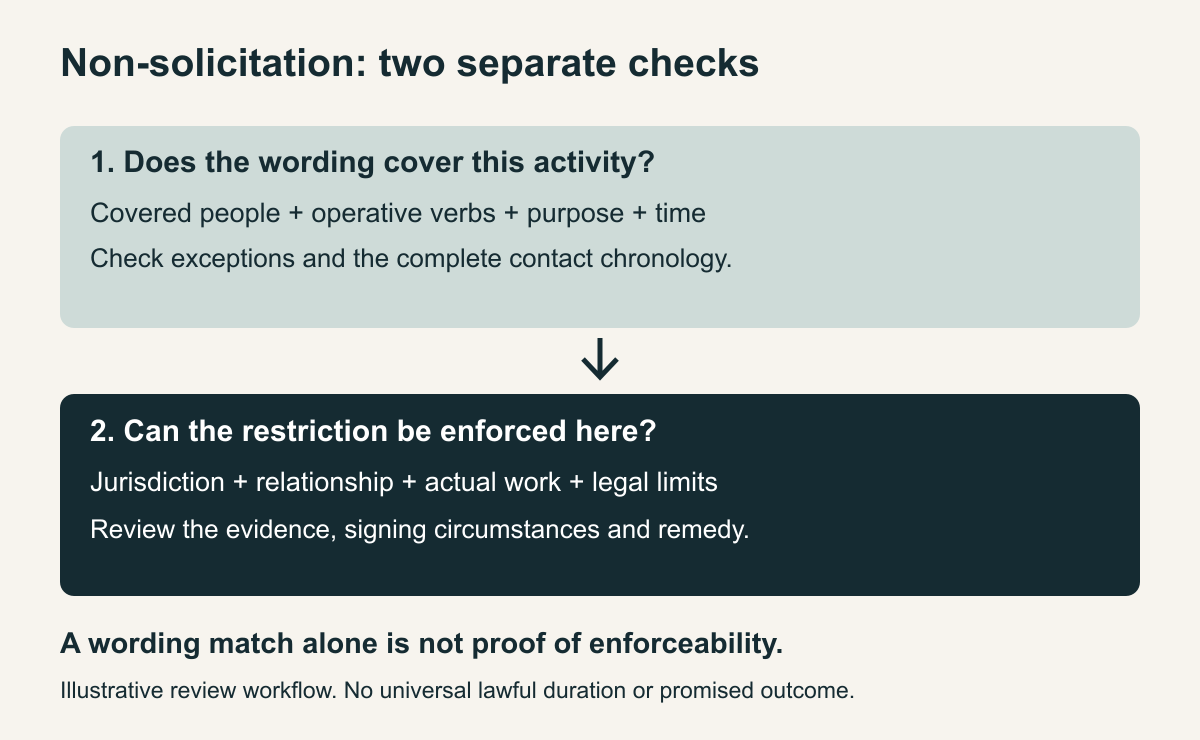
A non-solicitation clause is contract language restricting specified attempts to recruit people or divert business relationships. It may concern employees, customers or other defined groups. Its label does not establish enforceability, and its actual verbs may go beyond solicitation to prohibit hiring, accepting business or providing services.
Read two questions separately: what conduct does this clause describe, and can this restriction lawfully be enforced here? California employment restraints and New York customer restrictions illustrate why a generally worded promise about a reasonable duration is insufficient. California's statute broadly addresses restraints on lawful professions, trades and businesses, with chapter exceptions; New York's highest court has examined customer coverage, employee hardship and public interests. California Business and Professions Code 16600; Brown & Brown v Johnson, New York Court of Appeals, 2015.
This guide provides a worked wording exercise and an evidence worksheet, followed by selected jurisdiction notes. The sample is for legal review, not a ready-to-sign restriction or a promise of enforceability. Use the contract basics guide for formation questions and prepare a lawyer review packet before adopting or enforcing a restraint.
Customer solicitation, employee recruitment and non-competes are different tasks
| Restriction | Question the wording asks | Scope that needs particular attention |
|---|---|---|
| Customer non-solicitation | Did someone deliberately approach a covered customer to divert specified business? | Covered accounts, relationship history, competing services and indirect outreach. |
| Employee non-solicitation | Did someone recruit or encourage a covered worker to leave? | Worker group, hiring restrictions and the person's own recruiting profession. |
| Non-dealing or no-hire wording | Was business accepted or a worker hired, regardless of who initiated contact? | A broader verb can reach an unsolicited approach. |
| Non-compete wording | Was someone barred from specified competitive work or business activity? | Actual effect on work, not just the provision's title. |
| Acquisition no-shop provision | Were alternative transaction proposals sought or entertained? | A separate deal-process task; employee and customer examples do not explain it. |
These are reading distinctions, not findings that any category is permissible. In particular, a worker restriction can interfere with the worker's profession even when titled non-solicitation. The California travel-nurse recruiting decision below illustrates that effect. AMN Healthcare v Aya Healthcare Services, official 2018 opinion.
The seven fields to resolve before drafting
- Relationship: employee, contractor, business seller, supplier or two separate businesses? Record the real arrangement rather than relying only on a heading.
- Protected interest: identify the particular customer relationship or information said to need protection, with supporting facts.
- Covered group: named customers, personally serviced accounts, current staff or a different group? Identify who is excluded.
- Restricted verbs: solicit, induce, assist, hire, accept or service? Do not quietly substitute a broader verb.
- Time: state the start, end and any lookback period separately. Explain why the proposed duration was selected; do not call it universally lawful.
- Exceptions: general advertising, unsolicited approaches, pre-existing relationships and written permission, if intended.
- Legal and evidence checks: work location, governing-law analysis, statutory limits, agreement and consideration, approval history and available records.
A shorter duration or smaller customer list does not automatically solve a legal prohibition. California 16600 expressly addresses employment noncompete restraints regardless of narrow tailoring when no chapter exception applies. Current California statutory text.
One sample, four outreach scenarios
Fictional wording exercise: an account manager leaves a professional-services business. The draft below assumes a proposed customer restriction is being reviewed for a New York employment arrangement. Its twelve-month periods are invented choices for the exercise, not recommended or validated durations. No employee recruitment restriction is included.
Review draft only, subject to jurisdiction and fact review

Covered Customer means a customer listed in Schedule A
whom the departing account manager personally serviced
for the Company during the 12 months before departure.
Schedule A must identify the account and relationship basis.

For 12 months after departure, the account manager shall
not intentionally direct a communication to a Covered
Customer for the purpose of persuading that customer to
move the services identified in Schedule A from the Company
to a competing provider, or arrange for another person to
send such a communication on the manager's behalf.

This wording does not prohibit general advertising that
is not directed at Covered Customers, or responding to
a genuinely unsolicited inquiry that the manager did not
initiate or arrange. It does not prohibit accepting business
solely because a customer is listed in Schedule A.

It creates no restriction on employee recruitment.
Other duties concerning information and lawful conduct
must be identified and reviewed separately.
The defined group is deliberately narrower than every customer the business has ever served. That is a wording choice to examine, not a legal safe harbor. In Brown & Brown, coverage extending to customers the employee had never met, known about or worked for was overbroad. The court required further proceedings on possible partial enforcement rather than declaring the whole dispute resolved. The court's customer-scope analysis and disposition.
| Hypothetical event | Reading of this sample only | Evidence and unresolved question |
|---|---|---|
| The manager emails a Schedule A customer asking it to move the listed service to the new firm. | Matches the described targeted communication and purpose. | Keep the message and account history. Enforceability and remedy remain separate. |
| The new firm places a genuinely general advertisement, without targeting Covered Customers. | Falls within the express advertising exception on those facts. | Preserve audience-selection settings and campaign instructions, not only the advertisement image. |
| A Schedule A customer independently sends an inquiry; the manager did not initiate or arrange it. | The sample expressly permits responding and does not add an acceptance ban. | Preserve the complete chronology. An earlier arranged introduction could change the stated facts. |
| The manager asks a colleague to send the customer the switching pitch. | The sample expressly covers arranging outreach through another person. | Keep instructions and messages. Changing the sender does not change this sample's wording. |
If the real clause also prohibits accepting or servicing business, the inbound-contact row must be reconsidered. If the campaign was aimed at a customer list, it is a different example from the stated general advertisement. These observations interpret the fictional wording; they are not court findings about particular communications.
California: examine the restraint on the actual profession
California 16600 starts with a broad rule against contractual restraints on lawful professions, trades or businesses, subject to chapter exceptions. Its employment provision expressly refers to Edwards v Arthur Andersen. A label or agreement to a short period does not establish a valid exception. California Business and Professions Code 16600.
In AMN Healthcare v Aya Healthcare Services, former travel-nurse recruiters joined a competitor. Their employee non-solicitation provision restricted recruiting AMN employees, including travel nurses on temporary assignments. The Court of Appeal held the provision void under 16600 because it restrained the recruiters' chosen profession. The court affirmed the judgment. This is a California employment decision, distinct from later federal antitrust litigation involving the companies. Official opinion, particularly pages 16 to 21.
The practical review asks what work the person actually does and how the covered group and verbs constrain it. Do not use the New York sample as California employment permission. Also keep alleged misuse of trade secrets separate: AMN distinguishes independently wrongful use of protected information from enforcing a contractual ban simply because the employer describes information as confidential. AMN's discussion of independently wrongful conduct, pages 22 to 23.
New York: scope and signing circumstances matter
In Brown & Brown, the Court of Appeals described New York's employment-restraint test as protecting a legitimate employer interest without undue employee hardship or injury to the public. It rejected the agreement's Florida choice of law for the customer restriction because of the public-policy conflict in that case. Official 2015 opinion.
The court also treated the circumstances of imposing the agreement as relevant to possible partial enforcement. The signing discussion and opportunity to obtain advice were disputed. Record those facts before assuming a court will narrow an overbroad clause. A severability clause does not itself guarantee judicial repair. Brown & Brown's partial-enforcement analysis.
Business-to-business no-poach language needs a separate review
Do not convert the worker/customer sample into a mutual promise that two businesses will not recruit each other's staff. The DOJ and FTC's 2025 worker guidelines discuss antitrust risks of employer agreements not to recruit, solicit or hire, including potential criminal and civil liability. This is agency guidance, not a finding that every collaboration clause is criminal. Antitrust Guidelines for Business Activities Affecting Workers, pages 3 to 5.
California business restraints also require a distinct analysis. In Ixchel Pharma v Biogen, the California Supreme Court applied a rule-of-reason standard to a restraint on business dealings. It expressly did not decide whether the challenged agreement was valid. That decision supplies no automatic permission for a workforce no-poach term. Ixchel, official 2020 opinion, conclusion.
Copyable review and departure worksheet
Restriction and complete agreement version:
Relationship and actual work performed:
Work location and governing-law question:
Protected interest and supporting records:
Covered group, exclusions and relationship history:
Restricted verbs, purpose and indirect conduct:
Start, end and lookback period:
Advertising, inbound and permission exceptions:
Agreement, consideration and signing circumstances:
Proposed activity and complete contact chronology:
Separate information-use or other alleged misconduct:
Legal validity, remedy and unresolved questions:
Reviewer, next step and evidence location:
Filled excerpt: Schedule A customer Cedar Analytics, fictional; the manager personally serviced its reporting project; proposed action is responding to an inbound request. The email chronology currently shows the customer initiated contact, but campaign targeting settings have not been checked. Under the sample, no standalone acceptance ban exists. Next step: preserve the complete messages and obtain jurisdiction-specific review. No enforceability conclusion or permission to use former-company information is recorded.
Store the signed version, schedules, amendments and evidence in the contract repository. If correspondence is central, use the email evidence packet. Map any continuing duties separately using the survival clause guide.
Frequently asked questions
Can I work for a competitor after signing a non-solicitation clause?
Read the full agreement and your proposed activity. A customer-outreach provision and a ban on competitive employment ask different wording questions. Actual restrictions may overlap, and the legal analysis depends on jurisdiction and work. AMN demonstrates why a recruitment restriction can affect the profession itself. California recruiter example.
Does it prevent all contact with former customers?
That depends on the verbs, definitions and exceptions. In the fictional sample, social contact without the stated switching purpose is not the described conduct. The real document may say contact, accept or service and create a different reading. Preserve the actual message rather than relying on its label.
How long is a non-solicitation clause enforceable?
There is no universal duration established by this guide. Its twelve-month sample is an illustration, not a legal benchmark. California's statutory employment baseline and New York's fact-specific analysis should not be replaced with a nationwide recommended number. California rule; New York example.
What happens if someone allegedly breaches it?
Separate the alleged conduct, validity and requested remedy. An accusation or a clause promising an injunction is not a court order. The cases discussed here reached different procedural outcomes on different facts; they do not predict an award or injunction in another dispute. Preserve the agreement and chronology and seek prompt advice if enforcement is threatened.
How can I challenge an overbroad clause?
Assemble the actual document, work facts, customer or worker coverage, signing history and proposed conduct for a qualified reviewer. Identify the precise concern and request a lawful release, clarification or revision where appropriate. Do not delete evidence or assume that concealing the sender resolves an indirect-solicitation restriction.
Before signing or enforcing: checklist
- Classify the relationship and identify the person's actual work.
- Define the protected interest and covered group with records.
- Read every operative verb and distinguish solicitation from acceptance or hiring.
- Separate restriction duration from the relationship lookback period.
- Test targeted, general, unsolicited and arranged-contact examples.
- Check current jurisdictional restrictions and signing circumstances.
- Review workforce agreements between businesses for separate competition issues.
- Keep validity, alleged conduct and remedy as separate decisions.
Not legal advice. This educational guide uses selected authorities and fictional drafting exercises. Obtain qualified advice for the actual jurisdiction, relationship, agreement and activity. Prepared by the Viaclause editorial team. The documentary banner is an AI-generated illustration of fictional people.
Sources
- California Business and Professions Code 16600: restraints and employment context
- AMN Healthcare v Aya Healthcare Services, D071924, November 1, 2018: recruiter employee restriction
- Brown & Brown v Johnson, 2015 NY Slip Op 04876: customer scope, choice of law and partial enforcement
- Ixchel Pharma v Biogen, S256927, August 3, 2020: business restraints and rule of reason
- DOJ and FTC, Antitrust Guidelines for Business Activities Affecting Workers, January 16, 2025: workforce competition risks