

Contract Repository: A Practical Record and Retrieval Test
By Anirudh Menon, Viaclause editor
Build a searchable contract repository with linked agreements, amendments and checked fields. Use a completed example and three retrieval tests.
AI-generated illustration of fictional records staff. Not a photograph of a real organization.
A contract repository is a central, searchable record of your agreements, their related documents and the information needed to use them. At minimum, it should help a colleague find the signed agreement, see which amendments belong to it, and trace a recorded price or deadline to the source. A folder holds files; a useful repository also explains their relationships. Docusign describes this storage, organization and analysis role.
Use the CLM rollout operating agreement to assign ownership and test the handoffs around this task.
Start with the record below before buying software. If your team cannot identify which document supports a field, a faster search box will not fix that missing link.
What belongs in a contract repository?
| Keep | Record alongside it | Why it matters |
|---|---|---|
| Signed agreement and incorporated attachments | Parties, agreement ID, signature status and effective date | Separates the agreed document from a negotiation draft. |
| Orders, schedules and amendments | Parent agreement, document type and changed provisions | Shows the document family rather than one apparently final PDF. |
| Price and term fields | Source file, clause or page, effective period and reviewer | Makes a summary checkable before someone relies on it. |
| Notices and delivery evidence | What was sent, recipient, dispatch and receipt facts | Distinguishes a planned action from completed delivery. |
| Operational ownership | Business owner, legal contact, access group and next action | Gives the record a maintainer after the deal closes. |
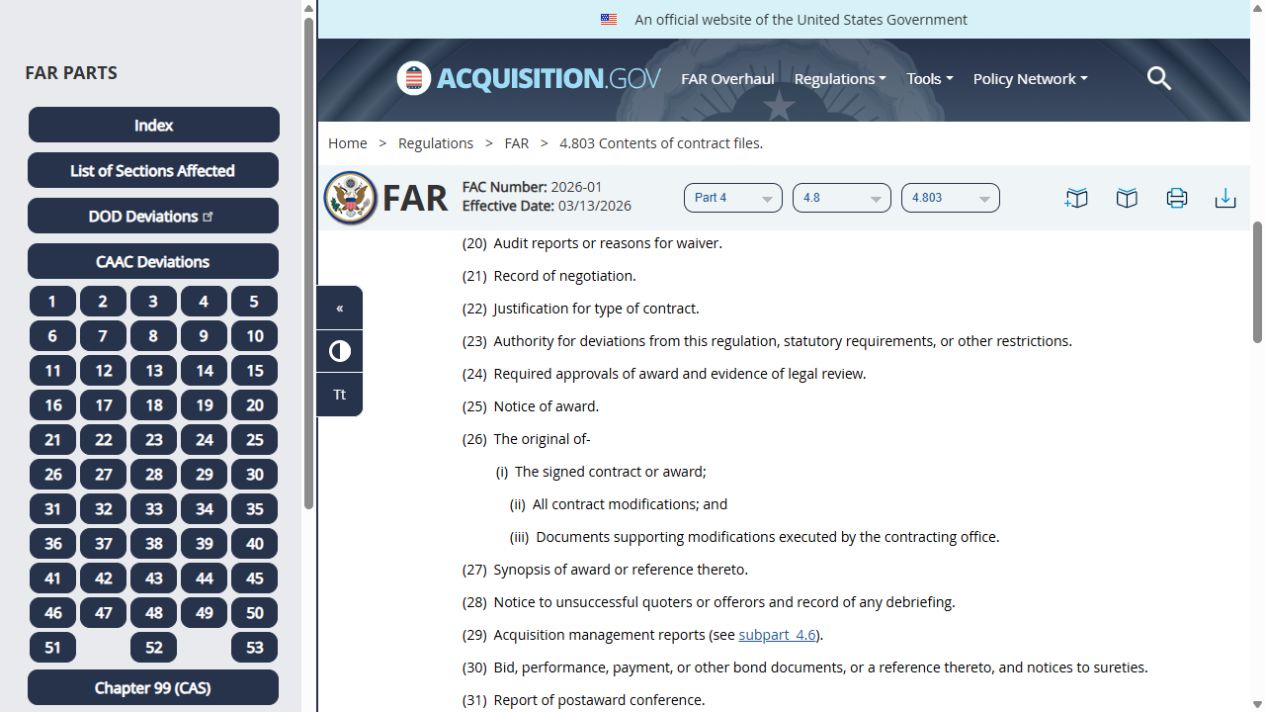
This is a proposed operating design, not a statutory checklist for every company. A useful public-sector illustration is FAR 4.803's contract-file list: it includes the signed contract, modifications and supporting records, and cross-references documents held elsewhere. Its federal procurement context should not be turned into a private-business retention rule.
Worked example: three files, two prices, one current answer
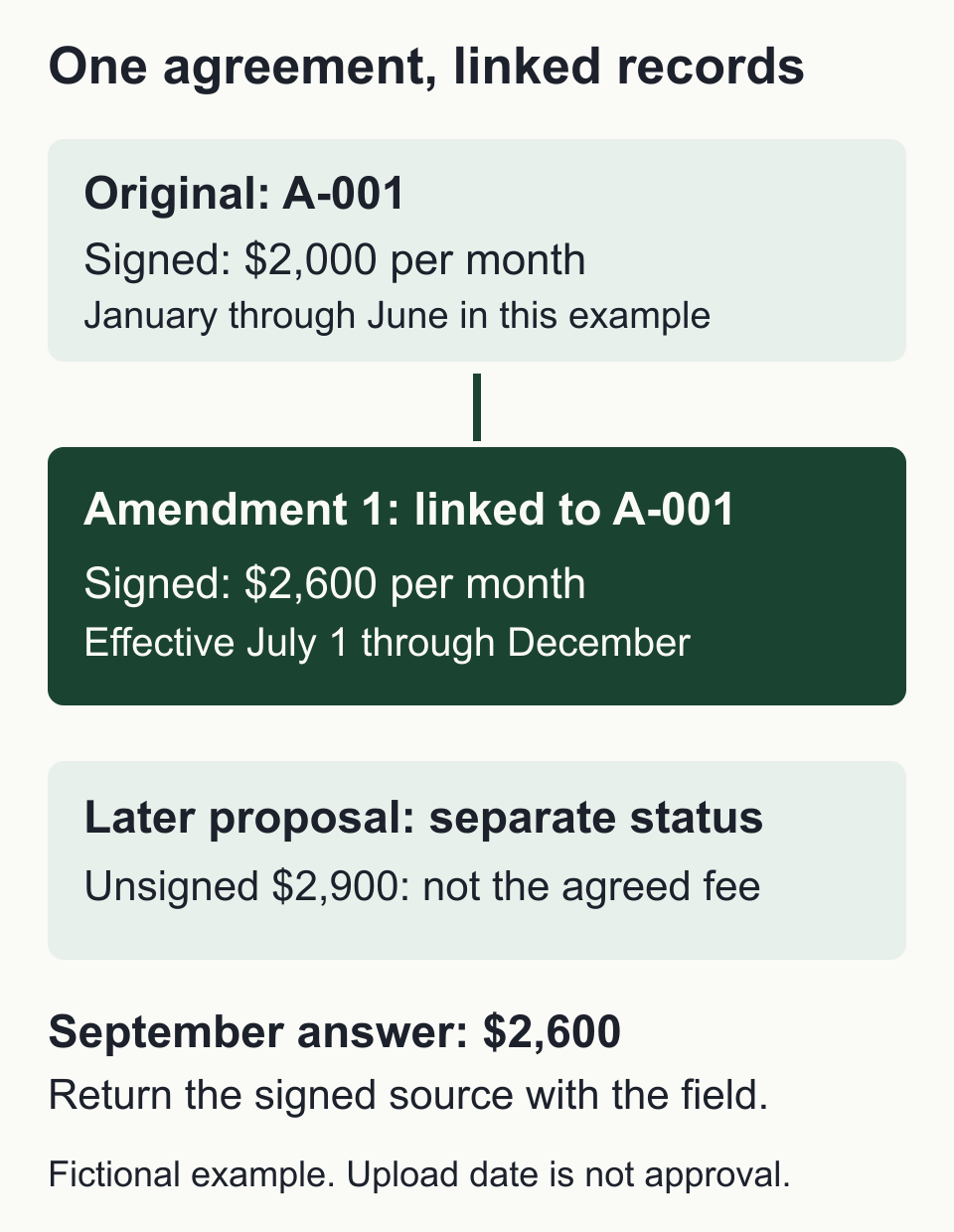
Fictional buyer Alder Services signs a twelve-month agreement with supplier Northbank on January 1, 2027. The signed agreement sets a monthly fee of $2,000. Both parties then sign Amendment 1, effective July 1, changing that fee to $2,600 for the remaining six months. A later draft proposes $2,900, but neither party signs it. Assume the amendment is valid and changes only the stated fee.
| Document | Status | Meaning for the recorded price |
|---|---|---|
| A-001: original agreement | Signed; January 1 effective date | $2,000 for January through June. Keep it linked after the amendment. |
| A-001-AM1 | Signed; July 1 effective date | $2,600 for July through December, supported by Amendment 1's fee clause. |
| A-001-AM2-draft | Unsigned proposal | $2,900 is proposed, not the approved price in this example. |
The year's scheduled fees are $27,600: six months at $2,000 plus six at $2,600. A September invoice for $2,900 is $300 above the assumed agreed monthly price. The repository should return the $2,600 field with the signed amendment link, not select the newest upload and call it current.
Do not overwrite the original agreement with Amendment 1. Preserve both and record exactly what changed. Our contract amendment sample explains the wording; the repository's job is to retain that relationship. If documents conflict, use the order-form and master-agreement conflict guide rather than assuming the newest file always wins.
Store a source and a review state with each important field
Use separate states such as extracted, checked, disputed and missing. An AI extraction or a spreadsheet import should not automatically become a checked fact. For example, the tool may find $2,900 perfectly accurately in the unsigned proposal and still give the wrong answer to “What do we owe this month?”
Agreement ID: A-001
Field: monthly service fee
Value: USD 2,600
Applies from: July 1, 2027
Applies through: December 31, 2027
Source: signed Amendment 1, fee clause
Parent record: original A-001 agreement
Review state: checked against both signed files
Reviewer and review date: [name and date]
Excluded proposal: A-001-AM2-draft, unsigned
Next action: compare September invoice against this amount
For renewal dates, preserve the notice wording and date-counting assumptions as well as the calculated date. See the auto-renewal calendar examples. A date without its trigger is hard to audit when the term changes.
Can SharePoint be a contract repository?
Yes, it can form the document-storage part of your design. Microsoft documents SharePoint version history, approval settings and draft visibility controls. Those features do not by themselves decide which signed amendment changes a particular term. Assign that relationship and review responsibility explicitly.
Choose between configured document storage, a dedicated repository and broader CLM software by testing the work you need done. Do not assume every general document system lacks version control, or that every contract product has a reliable alert, export or access design.
- Configured storage: test whether your team can maintain linked agreements and checked fields without a separate tool.
- Dedicated repository: test contract search, document relationships, reminders and export with your own sample family.
- Broader CLM: consider it when intake, drafting, approvals and post-signature work also need a connected workflow. Icertis distinguishes repository capabilities from the wider lifecycle; exact product features still need verification.
Run three retrieval tests before calling it reliable
- Price: ask a colleague who did not load the files for the September fee and its signed source. Expected answer in this example: $2,600, Amendment 1.
- Document family: ask for the original, signed amendment and unsigned proposal, with their different statuses. Finding one PDF is incomplete.
- Access and export: use an authorized test account to check what that role can see. Export the permitted files and field records; check whether relationships and source references survive.
Record the actual result, the missing item and the owner of the fix. There is no claimed universal passing time or accuracy percentage here. The useful comparison is whether your chosen system returns the right evidence for a defined task. Use our spreadsheet-to-CLM handover test for a broader buying exercise.
Common mistakes and the next step
- Using upload date as legal status: keep signature status and effective date separate.
- Marking missing data as “none”: an absent renewal field may mean nobody reviewed it yet.
- Giving every employee the whole repository: define the access required for each role and test it.
- Deleting old files because a new one arrived: preserve the document family under your applicable retention and preservation requirements; this guide does not set a deletion schedule.
Start with one complete agreement family and the three tests above. Fix its fields before importing a large collection. If you are moving between systems, our repository migration reconciliation guide covers the separate cutover problem.
Frequently asked questions
What is the difference between a repository and CLM?
The repository is the record and retrieval layer. CLM generally covers more of the process, such as drafting and approvals. Compare actual features rather than buying by label.
Should unsigned drafts be stored?
They may be useful, but separate them from signed documents and make their status clear. In the worked example, the unsigned $2,900 proposal must not replace the checked $2,600 fee.
Can AI populate the fields?
It can assist extraction, but require a source link and a review state before using a field for a payment or deadline decision. Correctly extracting a number is different from identifying the applicable term.
What should I ask a software vendor to demonstrate?
Give it the three-file example. Ask for the current fee, the signed source, the excluded draft and an export that retains the links. Add a permissions test using the roles your team actually needs.
For ink-signed agreements, use our wet-signature copy and original handoff guide to distinguish the signed paper from the stored scan.
Before archiving an expired agreement, use the survival-clause closeout record to keep continuing duties visible.
Sources
- Docusign: What is a Contract Repository?, definition and purpose.
- Acquisition.gov: FAR 4.803, Contents of contract files, federal procurement illustration only.
- Microsoft: How versioning works in lists and libraries, versioning, approval and visibility features.
- Icertis: What Is a Contract Repository?, repository and CLM distinction.