

Contract Auto-Renewal Clause: Three Evergreen Examples
By Anirudh Menon, Viaclause editor
Compare three auto-renewal clause samples, calculate a 60-day or bounded notice window, and keep proof of delivery with a copyable tracking record.
AI-generated fictional illustration of a professional preparing correspondence for dispatch. It does not depict an actual event.
A contract auto-renewal clause, also called an evergreen clause, renews the agreement for another term unless a party gives notice by the stated deadline. Three illustrative samples follow, each with a different notice or price rule.
1. Annual renewal with at least 60 days' notice
After the initial term, this agreement renews for successive one-year terms unless either party receives the other's written notice of non-renewal at least 60 calendar days before the current term expires.
Plain reading: notice must arrive 60 or more days before expiry; this clause sets no earliest notice date.
2. Annual renewal with a 90-to-60-day window
After the initial term, this agreement renews for successive one-year terms unless either party receives the other's written notice of non-renewal no earlier than 90 and no later than 60 calendar days before the current term expires.
Plain reading: notice must arrive inside the window; an earlier notice does not meet this example's timing requirement.
3. Annual renewal with advance price notice
This agreement renews for successive one-year terms unless either party receives written notice of non-renewal at least 60 calendar days before expiry. A renewal price increase applies only if Customer receives Supplier's new price at least 90 calendar days before expiry; otherwise the current price continues for that renewal term.
Plain reading: the supplier must disclose an increase before the customer's opt-out deadline; late price notice leaves the current price in place under this invented clause.
Each sample uses receives and calendar days. Add the initial term, permitted delivery method, notice addresses and any deemed-receipt or business-day rule before adapting it.
What makes a clause evergreen?
An evergreen clause keeps an agreement renewing without a fresh signature, unless a specified step stops renewal. The renewal period and exit mechanism come from the agreement, not the label. A real illustration is the ValidClick/Yahoo amendment filed with the SEC: it extends a stated end date and then provides annual renewals with at least 90 days' non-renewal notice. That is evidence of one negotiated provision, not a model endorsed by the SEC or a rule for every contract.
Non-renewal at expiry also differs from ending service during the current term. None of our three examples grants termination for convenience. If that flexibility matters, look for a separate right and check its notice, fee, refund and surviving-obligation provisions. A right to stop the next term does not, by itself, authorize immediate cancellation.
One expiry date, two different notice calendars
Assume expiry on August 31, 2027, whole calendar dates, inclusive endpoints and no business-day adjustment. The example permits courier delivery and makes actual receipt effective.
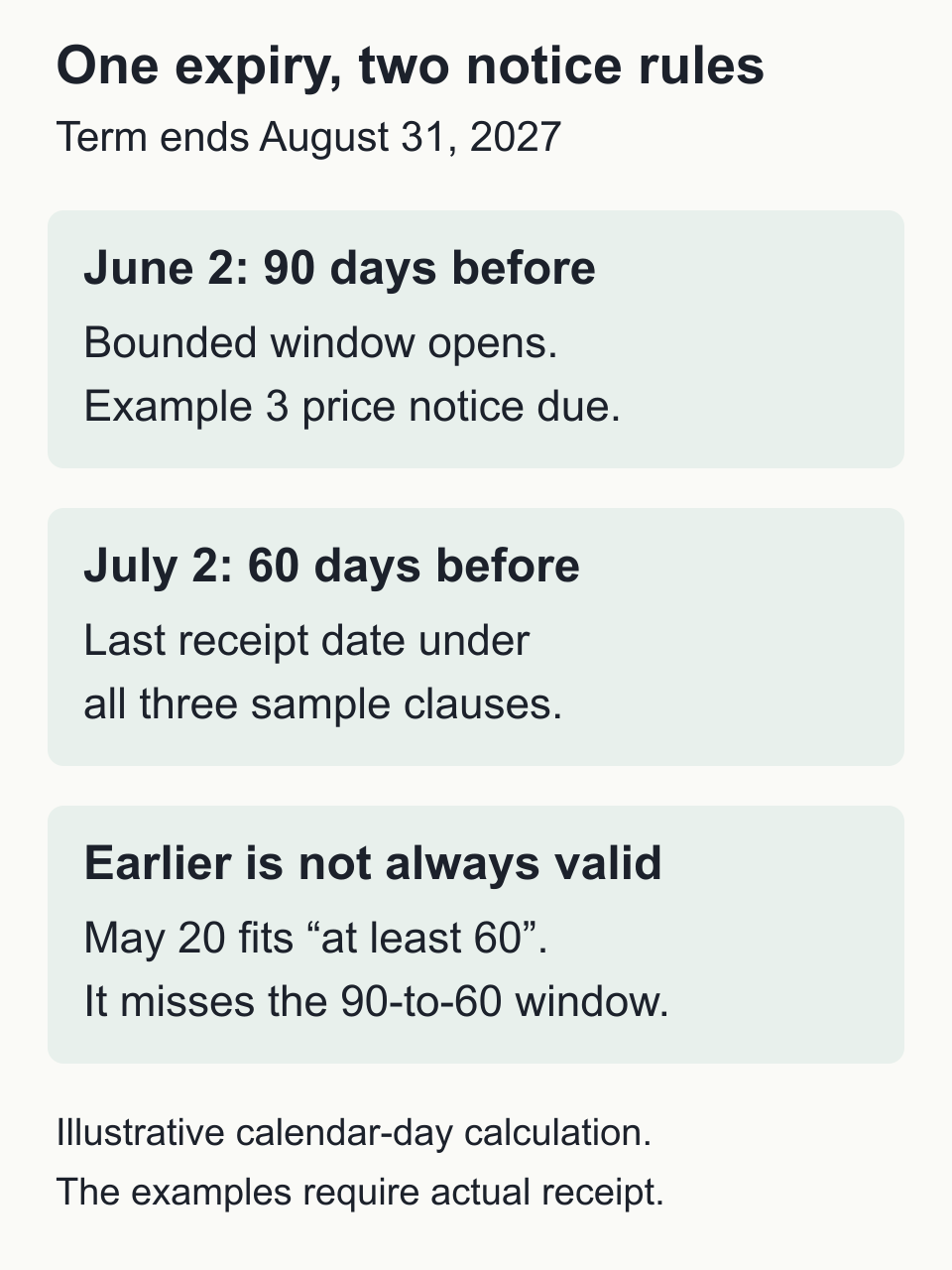
| Event | Example 1: at least 60 days | Example 2: 90-to-60-day window | Example 3: price notice |
|---|---|---|---|
| June 2, 2027: 90 days before expiry | Notice can already have been received; no opening date is stated. | First permitted receipt date. | Last date for receipt of an increased renewal price. |
| July 2, 2027: 60 days before expiry | Last permitted receipt date. | Last permitted receipt date. | Last permitted receipt date for non-renewal. |
| August 31, 2027 | Current term expires. | Current term expires. | Current term expires; pricing follows the stated condition. |
| September 1, 2027 | Next annual term starts if renewal was not prevented. | Same, subject to the bounded notice condition. | Same, at the applicable renewal price. |
Earlier is not always better. A notice received May 20 is early enough under example 1 but outside example 2's window. A notice received June 15 meets both timing tests. A notice received July 5 meets neither. The real agreement and applicable law can change the outcome.
In example 3, price notice received June 2 leaves 30 elapsed calendar days before the July 2 non-renewal deadline. A June 10 price notice does not satisfy that sample's advance-price condition. This conclusion comes from its express fallback to the current price, not a general right to reject any late price increase. For a broader commercial comparison, see our SaaS renewal price-increase guide.
Sending and receipt are different facts
Under the exercise's actual-receipt rule, a courier booking on July 1 followed by delivery on July 5 misses the July 2 deadline. The dispatch receipt proves dispatch, not timely arrival. If the real notices clause instead uses a specified deemed-receipt rule, apply that rule and preserve the facts needed to calculate it. Do not silently substitute actual receipt, postmark or a sales representative's reply for the contractual trigger.
Use the complete signed agreement and amendments to verify:
- Recipient: the named entity, address and any required copy recipient.
- Method: whether courier, certified mail, email or a portal is permitted for this notice.
- Effective time: receipt, dispatch, deemed delivery, time zone and any cut-off or non-business-day rule.
- Content and authority: the agreement and term being identified, the requested non-renewal and the authorized sender.
Use an internal target before the last permitted day while staying inside any earliest-date limit. Preserve the signed notice, dispatch evidence and delivery evidence separately. Where the method or deadline is unclear, record the ambiguity before describing notice as effective.
| Field | Recorded fact | What it establishes |
|---|---|---|
| Contract and term | Training supply agreement; term ends August 31, 2027. | The expiry used for this exercise. |
| Receipt window | June 2 through July 2, inclusive. | Calendar-date subtraction from the stated expiry. |
| Dispatch | June 14, courier to the designated contract address. | Notice was sent through the assumed permitted method. |
| Receipt | June 15, signed delivery record saved. | Receipt falls within the example's window. |
| Notice contents | Signed notice identifies this agreement and declines renewal after August 31. | A retained copy supports what was communicated. |
| Status | Timing and method match the exercise; owner retains the notice and proof. | Notice and delivery evidence remain linked for review. |
A tracking spreadsheet should not say “cancelled” just because someone created a task or booked a courier. Use separate fields for approved, sent, received and reviewed. If notice arrives too early under a bounded window, identify the problem while there is still time to send a fresh notice within the window, rather than relying on the first attempt without review.
Changing the renewal rule during the term? Use an amendment that identifies the exact clause being replaced. A separately signed renewal agreement needs its own term and price check.
Separate the signed renewal rule from the account action
Published vendor terms illustrate why one clause fragment is not every subscription's procedure. HubSpot's general customer terms, sections 4.1 and 4.2, distinguish the applicable subscription term and non-renewal arrangements, subject to the order and stated exceptions. Atlassian's section 10.1(c) supplies its own auto-renewal mechanics. Use the actual governing order, product terms and agreement rather than substituting this article's 60-day sample.
A purchasing decision, contractual notice and account setting can be separate actions. Record which action prevents the next term, which affects access and which changes billing. If the contract allows an account route, retain its confirmation and effective term. If it requires delivery to a named recipient, a dashboard screenshot is not evidence that this separate delivery occurred.
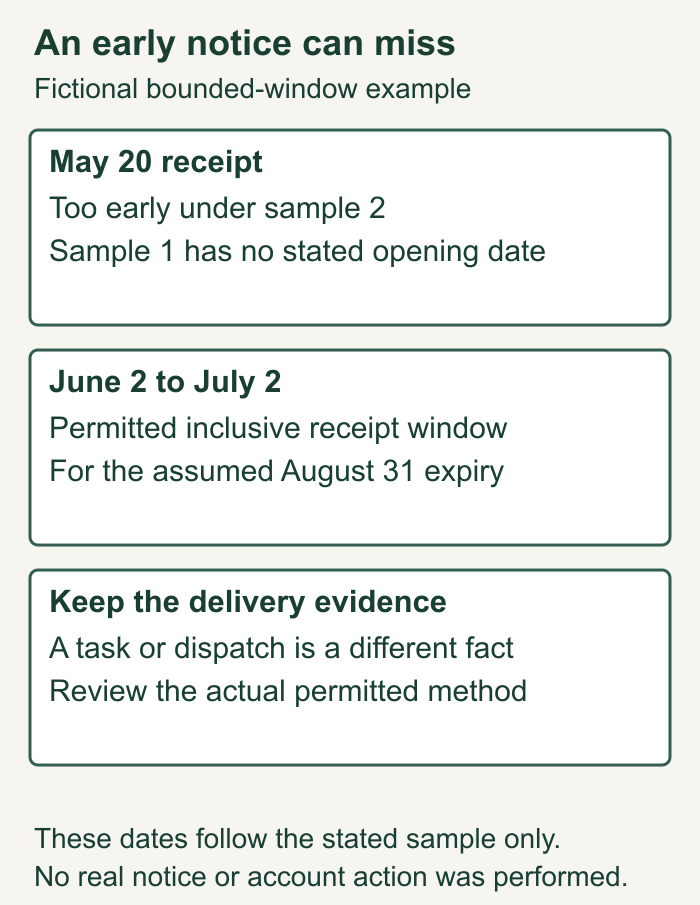
Filled exception record: an early notice under the bounded sample
SYNTHETIC WINDOW EXCEPTION E01
Source: sample 2, not a real vendor contract.
Expiry: August 31, 2027; calendar dates, inclusive endpoints.
Window opens: June 2, 2027, 90 days before expiry.
Window closes: July 2, 2027, 60 days before expiry.
First assumed receipt: May 20, before the permitted opening.
Initial result: outside this sample's bounded window.
Proposed correction: authorized fresh notice within the window.
Receiving evidence: record actual permitted delivery and receipt.
Do not assume: the early notice alone satisfies sample 2.
Different branch: May 20 is early enough for sample 1's latest-only rule.
Price notice: separate sample 3 condition, not opt-out receipt proof.
Open issue: actual agreement, amendments and law before real use.
Status: fictional teaching record; no notice was actually sent.
Assign the correction while there is time to act. The proposed fresh notice should still identify the agreement, term, authorized sender and permitted recipients. Do not mark an exception closed when a task is created; retain the later evidence and record whether it resolves the actual timing and method questions.
Use the renewal ownership record to name the decision owner and backup. Check the notice-delivery evidence guide for the separate sending and receipt questions. If the window has already passed, our missed renewal-deadline intake organizes the disputed source documents and remaining options without assuming an automatic escape.
Before relying on an evergreen clause
- Identify the operative signed clause and amendments.
- Distinguish stopping the next term from immediate termination.
- Record any opening date as well as the last permitted date.
- Check counting, effective-time and non-business-day rules.
- Keep price notice and statutory reminder requirements separate.
- Verify permitted method, recipient and sender authority.
- Record the account action without inferring contractual effect.
- Retain the actual notice, dispatch and receipt evidence.
- Assign correction, review and backup owners.
- Close exceptions only against the actual supporting record.
Copyable notice-tracking record
Agreement, parties and signed version:
Amendments checked:
Current term expiry:
Renewal length and price rule:
Non-renewal clause reference:
Earliest allowed effective date, if any:
Latest allowed effective date:
Date-counting assumptions, time zone and cut-off:
Permitted delivery method and required recipients:
When notice becomes effective under the agreement:

Decision owner and authorization:
Internal target inside the permitted window:
Final notice file and agreement/term identified:
Dispatch date and evidence:
Receipt or deemed-receipt date and evidence:
Price-change or statutory reminder record, kept separately:
Exceptions, disputed facts and follow-up owner:
Status: prepared / authorized / sent / received / reviewed
Link to the underlying files rather than replacing them with a summary. Our email-evidence collection guide covers preserving relevant messages. Keep vendor reminder notices separate from your own non-renewal notice: they may serve different purposes and follow different delivery rules.
Frequently asked questions
What is an evergreen clause?
It is a provision that renews a contract automatically for further terms unless the required opt-out step occurs. Read the renewal length and notice language; “evergreen” does not tell you whether you can leave at any time.
Is an evergreen clause enforceable?
It can be, but the signed wording and applicable law matter. For example, New York General Obligations Law section 5-903 conditions enforcement of covered service, maintenance or repair renewals on a provider's reminder. It does not cover every business agreement. Our New York automatic-renewal law guide explains that scope.
How do I cancel an evergreen contract?
To stop its next renewal, follow the agreement's non-renewal deadline, any earliest-date limit, notice method and recipient requirements, and retain proof. To end the current term early, identify a separate termination right or negotiate a release. If the deadline has passed, investigate the contract and applicable law instead of assuming either automatic escape or unavoidable renewal.
How do evergreen clauses relate to auto-renewal laws?
The clause supplies contractual mechanics; an applicable statute may impose additional conditions. For covered renewals longer than one month, New York section 5-903 requires the provider's written reminder personally or by certified mail 15 to 30 days before the customer's notice deadline. That is not 15 to 30 days before expiry, and it is not a universal delivery rule for the customer's notice.
New York General Business Law section 527-a separately addresses consumer automatic-renewal offers, including disclosure, consent and cancellation requirements, subject to its scope and exemptions. Do not apply a consumer rule to a business contract merely because both renew automatically.
Is “at least 60 days” the same as “between 90 and 60 days”?
No. The first sets a latest date without stating an earliest one. The second creates both boundaries. In our August 31 example, June 2 opens the bounded window and July 2 closes it.
Does cancelling in a dashboard prove timely non-renewal?
Record the account action and the agreement-specific result separately. Verify the permitted route, effective date and retained confirmation rather than assuming every dashboard action immediately ends the current term.
Who should maintain the renewal evidence?
Name a business decision owner, an authorized notice sender and a backup. Keep the agreement, amendments, notice and delivery record linked so another colleague can verify the action.
Sources
- ValidClick/Yahoo Amendment 32, SEC-filed exhibit, May 2023 signatures, term provision used solely as a real example of annual renewal with advance notice.
- New York General Obligations Law section 5-903, covered property-related services, provider reminder, delivery and one-month exception; checked October 5, 2026.
- New York General Business Law section 527-a, consumer automatic-renewal requirements and exemptions; checked October 5, 2026.
- HubSpot Customer Terms of Service, sections 4.1 and 4.2; actual applicable default term and non-renewal scope inspected October 7, not a rule for every SaaS product.
- Atlassian Customer Agreement, section 10.1(c); actual auto-renewal terms and distinctions inspected October 7.