

Who should own contract renewals: procurement, finance or legal?
By Anirudh Menon, Viaclause editor
A renewal responsibility map that separates the business decision, budget approval and proof that the required action happened.
Give each contract one named renewal coordinator, then assign the commercial decision, budget approval and notice action separately. Procurement can coordinate the process. The business owner decides whether the service still earns its place. Finance confirms the budget. Legal resolves questions about the terms. An authorized person completes the required notice or account action.
AI-generated editorial illustration. The person depicted is fictional.
This is Viaclause’s proposed operating model for US business buyers. It is not a rule assigning legal responsibility to a particular department. A small company may give several jobs to one person, but each job still needs an explicit answer.
Start with the action that prevents an unwanted renewal
Consider a hypothetical team that records “cancel” in its purchasing spreadsheet. Procurement assumes the account administrator will handle it. The administrator assumes legal will send a notice. Nobody completes the contract’s required action.
A real example shows why the execution step deserves its own owner. HubSpot’s General Terms, sections 4.1 and 4.2, describe automatic renewal and, unless the agreement or order provides otherwise, require turning off auto-renewal in Account & Billing before the current term ends. An internal decision alone does not perform that account action. Check the version and order that apply to your purchase; this example does not establish the requirements of other vendors.
Build your renewal record around two questions: who has authority to decide, and who can actually carry out that decision? Confirm both before the deadline approaches.
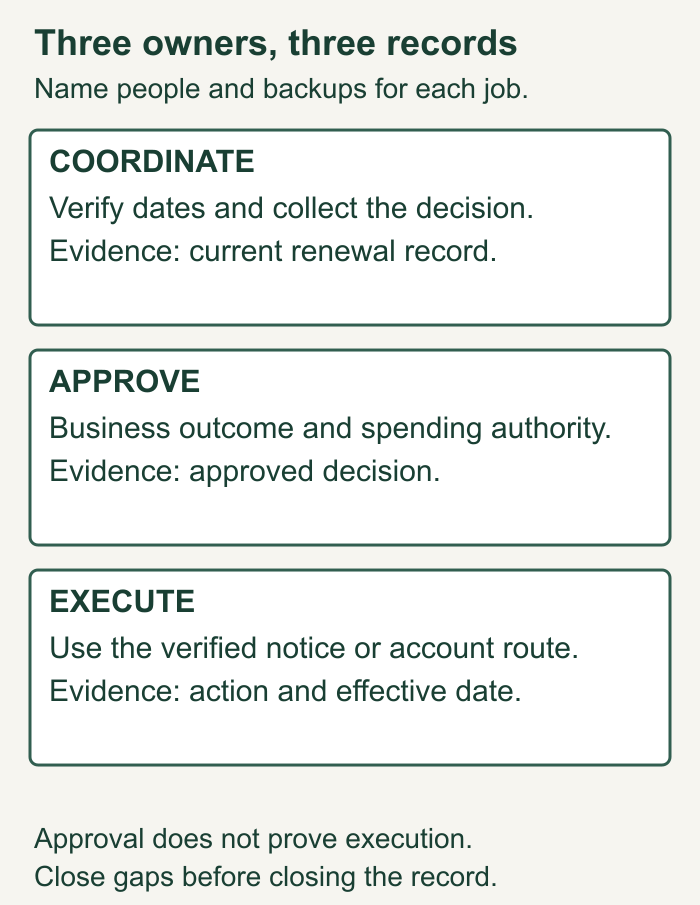
A responsibility map you can use
Our suggested allocation below separates decisions from proof of completion. Replace every role with a person’s name and a backup.
Keep customer intention in an account renewal-risk record separate from the formal notice status.
- Renewal coordinator, usually procurement or operations: maintains the dates, gathers missing information and follows up until the decision and action are recorded. Evidence: a complete renewal record.
- Business owner: recommends renew, change or exit based on actual use and business need. Evidence: a short decision note, including what stops working if access ends.
- Finance approver: confirms the spending authority and available budget. Evidence: the approved amount, period and cost center.
- Legal reviewer: checks uncertain notice language, conflicting documents or disputed obligations. Evidence: the interpretation or question that remains unresolved, with the relevant clause.
- Authorized executor: sends the approved notice or performs the required account action. Evidence: the submitted notice, delivery record, account confirmation or other applicable proof.
- Service or IT owner: plans continuity, replacement and data access. Evidence: a transition plan that works with the contractual dates.
CLOC describes legal operations as including financial management, project management and technology investment in its overview of legal operations. That supports treating renewal coordination as cross-functional work. CLOC does not prescribe this particular allocation; it is our proposed workflow.
Work backward from the controlling deadline
Use the contract’s verified notice deadline or account-action cutoff as the anchor. A renewal date on its own is insufficient when action must happen earlier. Record the clause, document version, time zone and delivery method. If the wording is unclear, ask counsel to resolve it before calculating a final deadline.
For planning, use this formula: internal review start date = verified action cutoff minus execution buffer minus approval time. The buffer and approval time are your operating assumptions, not extensions of the contract.
In a hypothetical case with a verified October 31 cutoff, five calendar days reserved for execution and ten for internal approvals produce an October 16 review start date and an October 26 approved-decision target. This illustration assumes calendar days and simple date subtraction. It does not resolve business-day rules, receipt requirements or ambiguous contract language. Calculate those separately from the actual terms.
Migration can require an even earlier start. Run the transition plan alongside the notice plan and use the earlier preparation date. Serving notice and being ready to leave are separate milestones.
Copy these fields into your renewal register
- Vendor, service, contracting entity and agreement location.
- Current term end, controlling action cutoff and source clause.
- Coordinator, business decision-maker, authorized executor and backups.
- Usage evidence, proposed outcome, budget approval and unresolved questions.
- Internal review start, approved-decision target, execution date and escalation contact.
- Required delivery channel or account permission, plus a link to completion evidence.
- Data export and replacement dependencies, with their owners.
Give the record an explicit “awaiting decision” state. Silence should trigger escalation to the named approver, rather than an assumed choice to renew or cancel. Record the actual outcome even when the business chooses to accept a renewal it would have preferred to avoid.
When the decision is to continue on agreed terms, use our renewal agreement example and amendment check to document what changes before completing the renewal.
Check whether the process works before buying another tool
Take your next five renewals and ask each executor to show that they have the necessary access or authority. Then ask the coordinator to locate the source clause and completion evidence. Missing names, permissions or documents become specific tasks. A new reminder system will not, by itself, settle those tasks.
If a deadline has already passed, use our missed-renewal evidence timeline before assuming the contract can be cancelled. This article is an operational proposal, not a determination of your contractual rights.
Confirm permissions before the decision is due
A job title does not establish account access. Ask the executor and backup to confirm the correct customer entity, subscription and billing account without making an unapproved change. Keep commercial approval separate from technical permission to click a cancellation control.
HubSpot’s cancellation guide, updated July 9, 2026, identifies Super Admin or billing admin permissions for turning off auto-renewal. Its confirmation includes the commitment term and effective cancellation date. Use the applicable agreement and order to resolve your requirements; a guide is not a substitute for them.
Atlassian’s Customer Agreement, effective October 1, 2026, section 10.1(c), also makes renewal subject to order exceptions and describes non-renewal through account settings, support or other notice. Its deactivation guide distinguishes original and improved billing experiences, permitted roles and Enterprise handling. That is a reason to verify the actual route early, rather than assume one cancellation screen works for every purchase.
If someone bought through a reseller or another group company, record that purchasing route and ask who can change it. Do not treat an unsuccessful login, an email to a sales contact or removal of a payment card as completed non-renewal. Obtain evidence of the action that applies to the agreement.
A completed renewal handover
This fictional example uses the October 31 cutoff above. It illustrates work allocation, not any named vendor’s contract. The service is needed until the term ends, and the business proposes an exit. A proposal is not approval, and approval is not execution.
Fictional renewal record R-017
Service and entity: Example reporting service; Example Buyer Co.
Source: signed agreement A-017 and its notice provision;
latest amendment checked, no conflicting renewal change found.
Verified action cutoff: October 31, 2026, 17:00 UTC.
Method in this invented agreement: approved account action.
Coordinator: procurement role; backup: operations role.
Business decision: exit proposed; sponsor approval pending.
Finance: confirm remaining commitment and transition budget.
Legal: source and notice-method check completed for this example.
Executor: billing administrator; backup access confirmed.
Review starts: October 16.
Approved decision target: October 26.
Execution buffer: five calendar days ending October 31.
Transition: IT to validate export and replacement access.
State on October 16: awaiting decision, no action completed.
Evidence still required: approval, account confirmation and
effective date checked against the intended subscription.
Escalation: sponsor if approval target is missed.
Before closing this record, the coordinator must link the actual approval and completion evidence, reconcile the effective date, and identify any continuing obligations or unresolved question. If the confirmation concerns a different subscription, the record stays open. Do not manufacture completion evidence to make a dashboard look clean.
Copyable renewal ownership template
Use one record per agreement or clearly defined subscription group. Store evidence in an authorized location and link it from the register. Limit access to people who need the contract, account or commercial information.
RENEWAL HANDOVER
Record ID / service / contracting entity:
Agreement, order and amendment locations / versions:
Term end / action cutoff / time zone / source provision:
Required action / delivery or account route:
Coordinator / backup / escalation contact:
Business decision-maker / recommendation / rationale:
Budget approver / amount and period / approval evidence:
Legal question / reviewer / resolution or open issue:
Authorized executor / backup / access checked on:
Review start / approval target / execution target:
Transition owner / export and replacement dependencies:
State: awaiting decision, approved awaiting action,
action submitted awaiting confirmation, or reconciled.
Action evidence / effective date / confirmation checked by:
Remaining obligations / next review / record closed by:
Keep a short change record when the owner, date, source clause or decision changes. Microsoft’s Show Changes guidance explains that Excel tracks some cell and formula changes, but excludes some actions and can have gaps or a cleared pane. A spreadsheet history is not complete proof that a vendor received notice. Retain the relevant agreement, approval and delivery or account confirmation separately.
When ownership breaks down
The owner leaves: the coordinator assigns a replacement through the organization’s authority process, obtains acceptance of the open record, and checks access again. An old employee’s name in a register is not a working backup.
The business and finance disagree: escalate the decision with the deadline and consequences, rather than letting the executor choose the commercial outcome. Record who made the final decision and what assumptions they accepted.
Negotiations are still open: keep the current cutoff active until an authorized, documented change has been verified. A discussion about a discount or extension is not evidence that the existing renewal mechanism changed. Capture unresolved scope using the vendor commitment check.
The migration is not ready: the business approver needs the continuity risk, options and remaining time. Counsel can assess the available contractual routes. The coordinator should not silently choose renewal or stop access while waiting.
Renewal ownership checklist
- Locate the agreement, relevant order and latest amendments in the contract repository.
- Verify the term end and separate action cutoff, with source, method and time zone.
- Name the coordinator, commercial approver, finance approver, executor and backups.
- Resolve uncertain terms with the appropriate reviewer and record remaining questions.
- Check permissions and the purchasing route before the execution target.
- Set review, approval and execution milestones using realistic preparation time.
- Check transition readiness separately from notice completion.
- Link approval and actual action evidence, reconcile the effective date and escalate gaps.
Carry the same owners and evidence into ongoing contract administration, so the handover remains usable after the renewal decision.
Frequently asked questions
Should procurement or legal own contract renewals?
Our proposed model gives procurement or operations coordination, with legal reviewing uncertain terms. Name a business decision-maker and an executor separately. The suitable allocation depends on your organization’s authority, service and agreement.
Can the same person coordinate and execute?
Yes, if that person has the necessary authority and access. Record both responsibilities and a backup. Separate approval or review where your organization requires it.
Does budget approval mean the contract has renewed?
It records internal spending approval. Check the agreement’s renewal mechanism and any required action to determine what happens externally. Do not use an internal status as a substitute for the contract.
What if the business owner does not answer?
Escalate to the named approver with the cutoff, missing decision and continuity implications. Keep the record awaiting decision. Silence is not our proposed approval policy.
Is the invoice due date the renewal cutoff?
Do not assume so. Record invoice timing, term end and notice or account-action cutoff separately from their actual sources. Ask counsel to resolve conflicting language.
Does turning off auto-renewal end access immediately?
The effect depends on the applicable agreement, service and action. Verify the confirmation and effective date before planning the transition. Non-renewal and immediate termination require separate checks.
Can a reminder tool replace the coordinator?
A reminder can prompt work. Someone still needs to verify the date, obtain the decision, resolve access problems and reconcile completion evidence. Test those steps before buying another system.
Sources
- HubSpot Customer Terms of Service. General Terms, last modified September 16, 2026, sections 4.1 and 4.2. Used only as a concrete example of renewal and account-action requirements; applicable orders and versions may differ.
- CLOC: What is Legal Ops?. Inspected October 7, 2026. Describes legal operations functions; does not validate or prescribe our responsibility map.
- HubSpot: Downgrade or cancel your subscription. Updated July 9, 2026. Full guide inspected October 7: permissions, account action and confirmation.
- Atlassian Customer Agreement. Effective October 1, 2026. Section 10.1(c) inspected October 7: renewal and order exceptions.
- Atlassian: Deactivate a subscription. Full guide inspected October 7: different billing experiences, authorized roles and Enterprise scope.
- Microsoft: Get help with Show Changes in Excel. Full guide inspected October 7: tracked edits, exclusions, gaps and clearing of history.