

Missed your SaaS renewal deadline? Check which deadline you missed
By Anirudh Menon, Viaclause editor
Trace the required action, its deadline and your evidence before responding to an unexpected renewal invoice.
AI-generated editorial illustration. People depicted are fictional.
General information for US business buyers. The applicable agreement and law require separate review.
Use the contract renewal checklist to connect this issue to the renewal decision, terms and notice record.
A renewal invoice arrives for software your team planned to leave. Finance says nobody approved another year. Procurement remembers telling the account manager. The vendor says the cancellation deadline passed.
Start by finding the document and action behind that deadline. You need the current subscription term, the required cancellation process and a record of what your team did. Until those line up, you may be arguing about different events.
This guide helps you prepare the facts for a vendor discussion or a business-contract lawyer. It cannot determine whether your particular renewal is enforceable.
Find the action the agreement requires
Read the signed order, applicable master agreement and any amendments together. Save the versions associated with your purchase. Today's online terms are a useful research source, but first establish whether they apply to your account.
For a concrete example, HubSpot's September 16, 2026 terms generally require customers to turn off auto-renewal in Account & Billing before the current term ends, unless the agreement or order provides otherwise. An email to an account manager may therefore leave a separate account action unresolved. HubSpot General Terms, section 4.2.
The related help page says the billing administrator receives a non-renewal notice with the term and effective cancellation date. That gives a customer a specific record to look for when checking whether the process finished. HubSpot cancellation instructions.
Other agreements may specify a notice address, portal or period. Write down the exact requirement in your own agreement before calculating a deadline. If two documents disagree, preserve both and flag the conflict for review.
Build a timeline that keeps uncertainty visible
Create one entry for each event below. Add the date, document name, section or message link, person involved and any unresolved question.
- The current term began, according to the applicable order or amendment.
- The current term ends, according to that same document set.
- The required non-renewal action had to happen, using the relevant notice provision.
- Your team sent a message or completed an account action.
- The vendor received or acknowledged it, if the evidence establishes that.
- The renewal invoice was issued and payment became due.
Keep the invoice date in its own entry. Check the agreement before treating it as the date from which cancellation time runs. For an account action, retain the confirmation and relevant product selection. For an email, retain the original message and attachments, rather than relying on someone's recollection.
Use three evidence labels: documented, reported by a person, and unresolved. A blank receipt field stays unresolved. An AI tool should not fill it by assuming that a sent message reached the contractual recipient.
A worked example: two plausible dates, one missing document
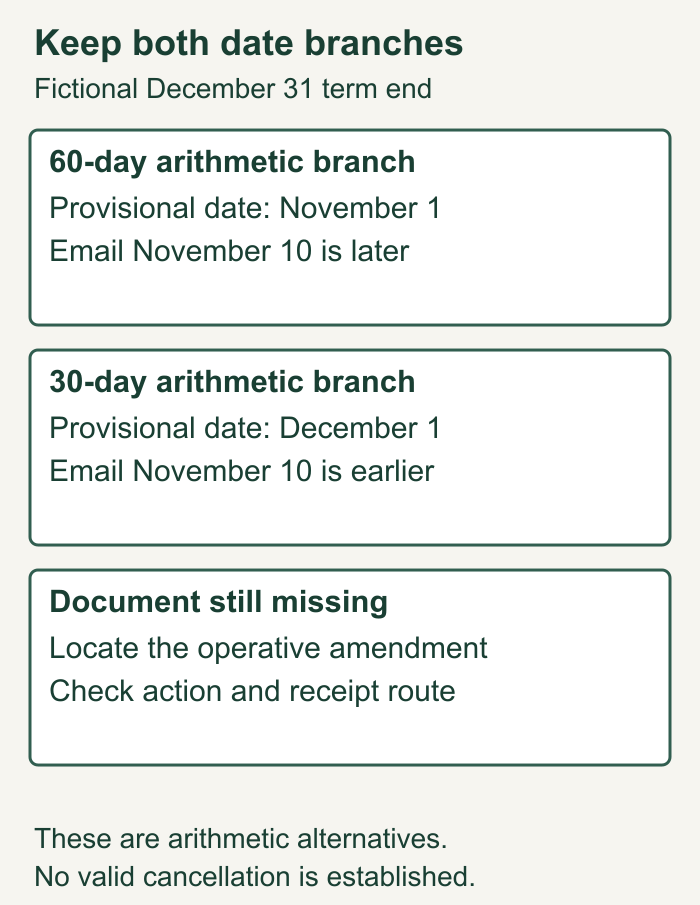
Consider this hypothetical case. An older master agreement requires non-renewal notice 60 calendar days before the term ends. The current order lists December 31, 2026 as the end date. Procurement emailed the account manager on November 10. A colleague remembers a later amendment shortening the period to 30 days, but cannot find it.
Simple date subtraction gives November 1 for 60 days and December 1 for 30 days. Those are provisional arithmetic results, not legal deadline determinations. The contract's counting rules, any receipt requirement and the operative documents still need checking.
The November 10 email falls after one provisional date and before the other. A summary that selects the remembered amendment could give the company false confidence. A summary that ignores it could send the company into negotiations with an incomplete position.
The next useful step is to find the amendment, establish whether it took effect and check the required notice route. Until then, record both possibilities. Ask counsel to resolve which governs if the documents or legal effect remain disputed.
Separate the disputed facts from the outcome you want
Prepare a short internal brief before contacting the vendor:
We want to end service on [date], or discuss [specific alternative]. The vendor says notice was due on [date] under [document and section]. Our records show [action, date and evidence]. We still need to establish [missing fact]. The business needs access until [date] for [named process]. The invoice is due on [date].
This is a preparation note, not a cancellation notice or legal admission. Have the responsible person review any external response, especially where money or rights are disputed.
Your preferred commercial outcome might be an agreed exit, a shorter extension, fewer seats or a credit. Record the fallback your business can accept and who may approve it. A negotiated exception requires the vendor's agreement; it should not be presented as an existing entitlement.
If the amount is material, the deadline is imminent or the vendor threatens to suspend access, involve counsel promptly. Do not wait for a perfect folder. Supply the available records and identify what is missing. Avoid assuming that stopping payment or deleting the account resolves the contractual issue.
Use AI to organize the evidence
If your company permits the tool and the documents can be shared under its rules, provide only the relevant authorized material. A whole inbox is unnecessary for this task. Use this prompt:
Build a renewal timeline from the supplied documents only. For each date or required action, identify the source file and section. Separate an action being sent from evidence of receipt or completion. List conflicting terms without selecting a winner. Mark missing information as unresolved. Show any date arithmetic and its assumptions. Do not decide enforceability, draft a legal threat or send anything.
Check every extracted date against the original. Give the verified timeline, conflicting documents and desired business outcome to the person handling the vendor discussion. Ask them to confirm the next action, its owner and its deadline in writing.
Separate an internal decision from completed non-renewal
“We approved cancellation” establishes an internal decision if its evidence supports that statement. It does not, by itself, establish that the required recipient received notice or that an account procedure finished. Give the person handling the issue both records rather than blending them into one event.
The Atlassian Customer Agreement, section 10.1(c), provides a different contractual example: unless the order specifies otherwise, non-renewal notice is required at least 30 days before the current subscription term ends. Its subscription-deactivation instructions distinguish billing experiences and authorized roles. Neither establishes the deadline for an unrelated vendor. Read the relevant account procedure together with the agreement governing your purchase.
| Item | What the record establishes | What stays open |
|---|---|---|
| Current order | Stated term-end date, December 31, 2026 in the example. | Any controlling amendment, counting rule or other contractual change. |
| Older master agreement | Text of a 60-calendar-day requirement. | Whether that provision still governs this order. |
| November 10 email | The retained message records a sent action to the account manager. | Contractual route, receipt and legal effect. |
| Remembered amendment | A colleague reports a possible 30-day change. | Actual signed document, effective date and operative scope. |
| Renewal invoice | The vendor's billed position and stated payment details. | Whether the renewal and amount are contractually or legally correct. |
If the timeline is kept in Excel, Microsoft's Show Changes guidance describes tracking limitations. Spreadsheet history is not a substitute for original agreement versions, messages or account confirmations. Record the source behind each entry and keep the actual source in the approved evidence location.
A completed intake record with an unresolved deadline
SYNTHETIC RENEWAL INTAKE R01
Business preference: exit, subject to authorized review.
Order: term ends December 31, 2026.
Older agreement: 60 calendar days before term end.
Reported change: possible 30-day amendment, document not found.
Arithmetic branches: December 31 minus 60 = November 1;
December 31 minus 30 = December 1.
Message: November 10 to account manager, retained sent copy.
Open: controlling provision, required route, receipt and completion.
Assessment: message is after first branch, before second branch.
Do not conclude: timely valid non-renewal or enforceable renewal.
Next: locate amendment and account confirmation; review conflicts.
Invoice: keep amount, due date and dispute position separately.
Continuity: confirm required service access and export needs.
External response: responsible owner reviews before sending.
The two branches are alternatives, not two deadlines that both govern. No assumption is made about receipt time, timezone, business-day adjustment or legal counting. There is no basis here to backdate an action or invent a missing confirmation. Preserve what actually happened and identify the earliest relevant open deadline for prompt review.
Blank dispute-preparation record
Service and applicable order/terms/amendment versions:
Term start, term end and source sections:
Required action, method, recipient and account permission:
Notice-period language, counting assumptions and timezone:
Sent action and separate receipt/completion evidence:
Conflicting documents or reported missing amendment:
Vendor position and supporting source:
Invoice amount, due date and payment/dispute status:
Business outcome requested and approval authority:
Essential access, data export and continuity needs:
Available evidence, gaps and responsible owners:
Counsel/contract-owner review and next external action:
Next decision date and confirmed written outcome:
For the delivery part of the record, use the contract notice and delivery guide if that is the applicable route. For continuing operations, use the SaaS export rehearsal. Neither companion determines whether this renewal is enforceable.
Immediate preparation checklist
- Preserve the applicable order, terms, amendments and invoice.
- Identify the exact required action and recipient or account route.
- Separate reported events from documented actions and receipt.
- Show alternative calculations when the operative term is disputed.
- Find the missing amendment instead of assuming its contents.
- Record the desired commercial outcome and who can approve it.
- Confirm access and export dependencies before proposing an exit date.
- Escalate material or imminent issues with the available evidence.
- Have an authorized person review the external response.
- Retain any agreed resolution, its scope and effective dates.
Frequently asked questions
Does missing the cancellation date always mean paying another year?
This guide cannot determine that. Review the controlling documents, completed actions, applicable law and any negotiated resolution. The vendor's invoice is evidence of its position, not the entire analysis.
Is emailing an account manager enough?
Check the applicable requirement. An agreement may require a particular account action, recipient or method. Retain the message and any response without assuming they satisfy an unrelated procedure.
Does the invoice date start the notice clock?
Use the actual provision. The example counts backward from term end, not from the invoice. Keep both events separately sourced.
What if an amendment cannot be found?
Record its reported existence and what remains unverified. Preserve alternative calculations and look for the actual operative document; do not treat memory as its text.
Should we stop paying or delete the account?
Do not assume either action resolves the disputed contract. Promptly give the authorized contract and finance owners the agreement, invoice, dispute facts and continuity needs for review.
Can the vendor agree to a shorter extension or credit?
You can seek a commercial resolution through the authorized owner, but availability and effect depend on agreement. Keep the proposal separate from any existing entitlement and preserve the written result.
Can AI decide whether our cancellation is valid?
Use an approved tool to organize authorized evidence, show arithmetic and list gaps. The person responsible must verify the original sources and obtain appropriate review of the disputed legal effect.
Sources
- HubSpot Customer Terms of Service
HubSpot, 2026-09-16. Check the applicable account documents; these are public vendor terms. - Downgrade or cancel your HubSpot subscription
HubSpot Knowledge Base, 2026-07-09. Account procedure and billing-admin confirmation; operational guidance. - Atlassian Customer Agreement, effective October 1, 2026. Section 10.1(c) inspected October 7; contractual non-renewal example, subject to its scope.
- Atlassian: Deactivate a subscription, full substantive instructions inspected October 7, billing-experience and account-role distinctions.
- Microsoft: Get help with Show Changes in Excel, full substantive instructions inspected October 7, change tracking and its limitations, not vendor receipt evidence.
Sources checked September 26 and October 7, 2026.