

Leaving a SaaS vendor? Test the data export before access ends
By Anirudh Menon, Viaclause editor
Rehearse a real business task using exported files, then resolve gaps before your vendor access ends.
AI-generated editorial illustration. People depicted are fictional.
General information for US business buyers. The applicable agreement and law require separate review.
Connect this task to the responsibilities and handover record in the contract administration plan.
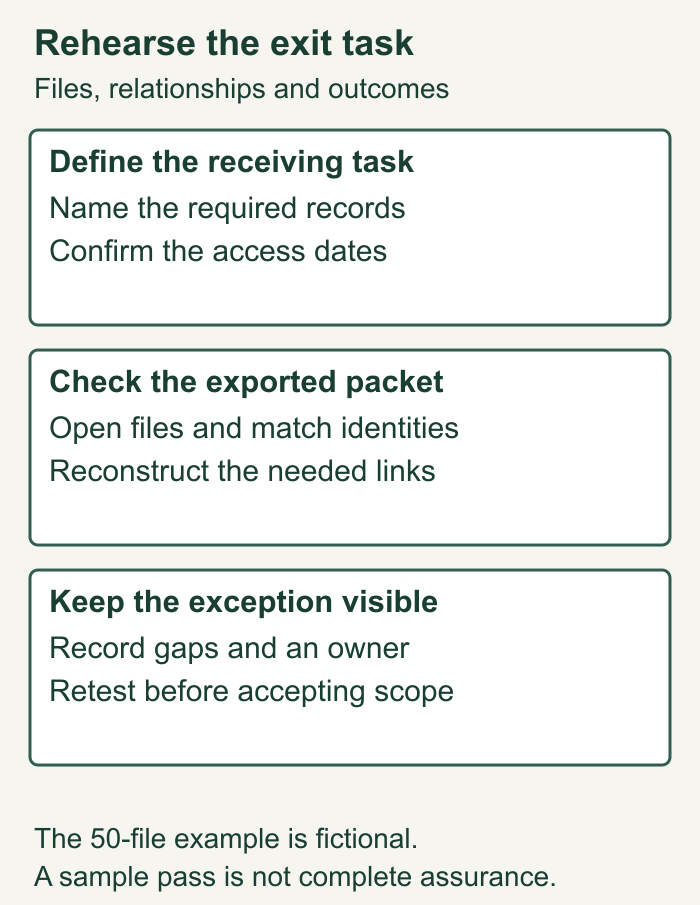
Before your software access ends, try to complete a real business task using only the exported files. Find a customer, open the related agreement and reconstruct one recent change. If your team has to sign back into the old service, record what it still needs to recover.
This small rehearsal gives procurement and legal a more precise question than “Can we export our data?” It identifies the records, relationships and help the business needs before it can leave.
The method below is a proposed readiness check. We have not tested a customer account or completed a vendor migration for this article.
Check the terms for your exact product
Find the order, product tier, applicable terms and data-processing agreement. Record the provisions governing access, retrieval, assistance and deletion. Verify the version that applies to your purchase, rather than assuming the newest public terms control it.
HubSpot's September 16, 2026 product terms illustrate why the product name matters. Section 3.3.3 provides a written-request route within 30 days after termination or expiration for Marketing Hub Professional and Enterprise with Marketing Contacts. The response can be temporary access or copies of customer data then held; reactivation may cost extra. The provision also addresses the end of maintenance obligations and deletion exceptions. Its named scope should not be assumed to cover every HubSpot plan. HubSpot Product Specific Terms.
A contractual request window leaves practical questions to resolve. Who will send the request? How will receipt be confirmed? What will arrive, when, in which format, and at what cost? Ask for written answers before building a migration calendar around an assumption.
Keep three dates in the exit plan
Record three dates separately:
- Non-renewal: the last date for the required cancellation action.
- Service access: the date ordinary access ends.
- Data retrieval: the deadline for requesting or retrieving data under the applicable terms.
Coordinate any notice through the contract termination letter template after checking the governing clause and timing.
They may differ. Write “unconfirmed” where the documents do not establish a date.
Add an internal test date early enough to investigate an incomplete export. That date is a planning choice, not a contractual extension. A team with complicated integrations will need more preparation than a team retrieving a small set of files.
Ask who can export while the account is active, whether specialist assistance is needed, and what changes after expiry. Preserve the relevant request and response. Keep deletion instructions separate from the decision to stop renewing, and coordinate retention requirements with legal and records owners.
Check what each export contains
Read the export documentation for the actual objects you need. HubSpot's guidance, for example, describes separate routes for different data and says workflow exports omit performance data, workflow history and data from emails used in the workflow. A workflow spreadsheet therefore needs checking against the business record you intend to preserve. HubSpot export guidance.
Make a short inventory. For each business process, name the records, attachments, links between records, history and permissions the destination needs. Ask the receiving team's owner to define what a usable result looks like.
For contract operations, a possible acceptance check is whether the destination connects a signed agreement to its amendment and the correct counterparty. For finance, it might be whether staff can match an invoice to the relevant order. Your requirements determine the test.
Run a small, documented rehearsal
Choose a few records that cover different conditions: a simple record, one with attachments, one with related records and one with a change history you need. Use authorized company data in an approved location. Label this a sample check, not proof that every record will transfer.
Extend the export rehearsal into the SaaS shutdown recovery test when continuity of an essential task is at risk.
For each sample, ask a member of the receiving team to complete a named task without using the old service. Record what they could open, identify and reconstruct. Count checks can help, but identical totals alone do not establish that attachments, relationships and field meanings survived.
Use these fields in the test record:
- Business task: [the work someone must complete].
- Sample and selection reason: [record identifiers and conditions covered].
- Required elements: [fields, files, relationships and history].
- Export method and date: [documented procedure and account permissions].
- Destination check: [what the receiving person could complete].
- Missing elements: [specific gaps, with evidence].
- Owner and next action: [person, vendor question and due date].
Treat a gap as a specific dependency
In a hypothetical migration, a team exports 50 agreements and confirms that all 50 PDFs open. During a sample review, it finds that amendment files lack the identifiers used to connect them to the original agreements.
The useful finding is narrow: the tested method did not preserve a relationship that the receiving team needs. The team should investigate another export route or a documented mapping process, then repeat the affected check. This example does not establish that any named vendor loses those links.
If the issue is unresolved near expiry, ask the vendor about assistance, delivery timing or a limited access extension. Get the scope and cost in writing. Counsel can assess the contractual position; the migration owner can assess whether the proposed technical fix works.
Before approving the exit, give the responsible business owner the test record, unresolved gaps and confirmed access dates. Name who will receive the final export and who will verify it. Ask them to decide whether the remaining work fits within the available time and agreed support.
Distinguish the export file from a usable business record
An export menu is a starting point. HubSpot's record-export instructions describe current property values and associations, with export permission required. The selected options affect what the file contains; exporting activity records follows separate routes. A successful export notification alone therefore cannot answer whether the receiving team has the information it needs.
In a contract repository, Ironclad's sharing documentation distinguishes export-column choices from permission-limited shared views. Those are documented features of that platform, not guarantees about every SaaS service. Test the actual view, account and export method named in your plan.
Nomio's vendor-authored repository checklist highlights source traceability and relationships between agreements. Those are useful questions for a receiving team, but the checklist does not validate a particular migration. Use the repository reconciliation worksheet for identity and relationship checks when that is the destination.
| Layer | What to check | What a pass does not prove |
|---|---|---|
| Files | Expected file exists and opens in the approved destination. | All related files and earlier versions were exported. |
| Records | Identifiers, required fields and source meanings match the selected sample. | Equal row totals prove there are no duplicates or omissions. |
| Relationships | The agreement links to its correct amendment and counterparty. | A filename similarity establishes the relationship. |
| Business task | The receiving person completes the defined task without signing into the former service. | A small sample proves every workflow works. |
| Access | Authorized receiving roles can use the approved copy, with excluded roles checked separately. | An administrator's successful access proves all role permissions are correct. |
A completed export exception record
Extend the earlier fictional 50-agreement example with one selected agreement. It passes the file-opening check but fails the needed amendment relationship. No real vendor, dataset or customer was tested, and no failure percentage for the other 49 agreements is inferred.
SYNTHETIC EXPORT EXCEPTION E01
Inventory unit: 50 agreement PDFs, not 50 complete document sets.
Sample: agreement A17 with an expected later amendment.
Task: identify which supplied document sets the current fee.
File check: A17 PDF opens in the destination.
Relationship check: amendment identifier is missing in this export.
Result: file-opening check passes; business task is unresolved.
Do not infer: amendment was deleted, no amendment exists, or all
other agreements have complete relationships.
Next action: migration owner investigates the documented mapping
or alternative export route, retaining source identities.
Retest: receiving owner checks the complete A17 packet without
returning to the old service.
Access-end date: record the confirmed agreement date separately.
Exit decision: no accepted complete packet claimed in this example.
Keep the initial failed result. If a later export or mapping resolves it, add the new outcome and its evidence. A revised file total can be informative, but acceptance depends on the required identities and task. A vendor's promise of help belongs in the record with scope, timing and cost; it is not the completed test.
Copyable exit-readiness record
Service, purchased product/tier and controlling document versions:
Non-renewal action, method and confirmed deadline:
Ordinary access-end date and separate retrieval-request deadline:
Internal rehearsal date, owner and receiving team:
Business task, counting unit and required source elements:
Authorized sample identifiers and selection limitations:
Export route, configuration, permissions and collection date:
Expected files, fields, relationships, history and approved access:
What the recipient completed without the old service:
Gaps, evidence and responsible owner:
Vendor assistance request, written response, timing and cost:
Corrective route, retest evidence and remaining limitations:
Approved storage, retention and access responsibilities:
Decision owner, accepted scope, next action and due date:
Exit checklist
- Locate the applicable order, terms and any data-processing agreement.
- Separate cancellation, access expiry and retrieval clocks.
- Name the receiving task before choosing an export format.
- Record export scope and exclusions rather than assuming a full backup.
- Reconcile identifiers and relationships as well as counts.
- Check approved destination access with the intended roles.
- Retain gaps and retest outcomes, including unsuccessful attempts.
- Obtain written assistance or extension terms before relying on them.
- Assign the final collection, acceptance and retention owners.
- Keep deletion and legal retention decisions under their authorized process.
Frequently asked questions
Does every SaaS vendor give 30 days to retrieve data?
No. The HubSpot example above is a named product-tier provision. Use the agreement governing your purchase and distinguish a written-request window from a delivery or temporary-access arrangement.
Is a CSV export a complete backup?
Do not assume that. Check the documented contents and configuration against the required fields, files, relationships and history. A backup or restore requirement needs its own scope and verification.
Do matching totals prove the export is complete?
No. One duplicate can hide one omission. Define what is being counted, compare identities and inspect the relationships needed for the task.
What if the export is incomplete close to expiry?
Record the gap and contact the responsible technical and contract owners promptly. Ask for documented assistance, timing and any access extension. Do not treat an unanswered request as an extension.
Can the new team approve the export after opening the PDFs?
That proves only the file-opening result. Have the receiving owner complete the agreed business task and record any missing relationships or history before accepting its scope.
Should cancellation and deletion be requested together?
Keep those decisions distinct. The applicable agreement, retention requirements and approved records process determine the appropriate deletion or return instruction. This rehearsal supplies no universal retention period.
Has Viaclause tested this migration procedure?
No customer account or migration was tested. The examples and worksheets are editorial proposals, with platform behavior attributed to the cited publisher documentation.
Sources
- HubSpot Product Specific Terms
HubSpot, 2026-09-16. Section 3.3.3, specifically the named Marketing Contacts plans. - Export your content and data
HubSpot Knowledge Base. Workflows section; documented export exclusions, checked September 26 and October 7, 2026. - HubSpot: Export your records, April 2, 2026. Full substantive instructions inspected October 7: current values, associations, export permissions and options.
- Ironclad: Share Repository Information, April 10, 2025. Full substantive documentation inspected October 7 for the repository companion: export columns and access-limited shared views. A later re-fetch timed out.
- Nomio: The Contract Repository Quality Checklist, April 9, 2025. Full substantive checklist inspected October 7; vendor-authored criteria, not independent validation.
Sources checked September 26 and October 7, 2026.