

Contract Repository Migration: Reconcile Records Before Cutover
By Anirudh Menon, Viaclause editor
Use a source-to-destination crosswalk, explicit unknowns and a worked reconciliation to check what moved, what was excluded and what remains unresolved.
Before moving a contract repository, decide how you will account for every source record, its linked documents and its unresolved fields. An import that reports success can still leave the buyer unable to tell whether a blank renewal field means no renewal clause, an unreadable clause or work nobody has completed.
AI-generated editorial illustration by Viaclause. The person and setting are fictional.
Start with the decisions the new repository must support. If procurement needs renewal reminders, importing a document and a date is only part of the job. Someone must know where the date came from, whether a later amendment changes it and who owns the next action.
Keep the value and its status separate
Nomio's repository quality checklist emphasizes traceability, linked documents and checking whether information is absent. Our proposed migration worksheet turns those concerns into separate fields a team can reconcile before cutover.
For each decision-critical field, keep the following alongside the imported value:
- Source: document identifier, version and page or clause.
- Review state: verified, not yet reviewed, unreadable, conflicting or absent from the reviewed document set.
- Scope: which order, agreement or amendment the value applies to.
- Responsibility: reviewer, review date and owner of any unresolved question.
These are suggested working categories, not a universal CLM schema. Keep them in companion fields or a controlled exception register if the destination cannot store them. Never force an unknown yes/no answer into “No” merely to satisfy a required field. “Absent” also needs a defined scope: no clause found in one file is different from no clause found in a complete, reviewed agreement set.
Build a crosswalk before changing records
Create one row per source record with its source ID, intended destination ID, document identity, parent agreement, intended operation and result. The operation should say whether you are creating, updating, linking or deliberately excluding it. Retain the reason for an exclusion and the location of the preserved source.
Product rules can change the result. Ironclad's Metadata Import instructions, updated August 26, 2026, require unique filenames or record IDs and consistent column formats. They distinguish options that stop on unmatched rows from options that ignore them. The instructions also distinguish supported parent relationships from related records, which this import method does not support. Check the selected route rather than assume every visible relationship will transfer.
For another platform, ask for its equivalent mapping, matching and error rules. Verify what empty cells do during an update: preserve the existing value, erase it or reject the row. Test with disposable records approved for that purpose. Do not discover destructive behavior on the production contract set.
A reconciliation example you can reuse
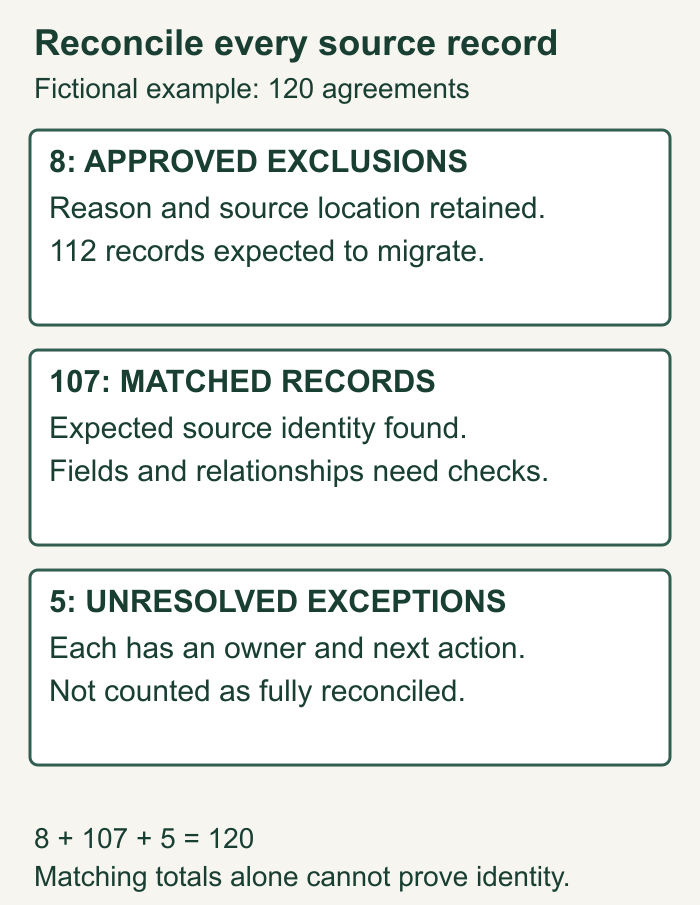
Hypothetical example: your inventory contains 120 source records. The migration owner approves eight for exclusion from this import. That leaves 112 expected records. The import produces 107 successful matches and five exceptions.
The count reconciliation is 120 = 8 excluded + 107 matched + 5 unresolved. The unresolved five still require a destination decision. Reporting 107 imported records without the other categories conceals the unfinished work.
Now check identity as well as counts. Suppose one intended record was imported twice and another was omitted. A total of 112 destination records would look right while the crosswalk would still be wrong. Match each expected source ID to its intended destination, and investigate unexpected duplicates. A file checksum can help detect exact copies; it cannot establish that differently named or edited documents have the same legal effect.
Use separate reconciliations for separate objects. Do not compare 120 agreements with 170 files and call the extra 50 errors: one agreement may include several documents. State the counting unit at the top of every report.
Choose acceptance checks by consequence
For your pilot, include a signed agreement with amendments, a poor scan, a duplicate filename, a missing field and a restricted record. This is a proposed test set, not a statistically representative sample or proof that all records are correct.
- Document check: open the intended destination file and compare it with the source. Confirm access restrictions with permitted and excluded test accounts.
- Relationship check: follow the agreement to its orders and amendments. Where terms conflict, use the document-conflict worksheet instead of choosing the newest date automatically.
- Action check: verify a decision-critical field against the source and test the resulting task. A correct reminder date is insufficient if nobody receives the reminder.
- Exception check: give each unresolved record an owner, next action and due date. Decide which exceptions prevent cutover and which can remain open with an approved temporary control.
Keep a usable route back
Before cutover, preserve an authorized source export and record changes made after it. Agree how those later changes will be replayed or reconciled if the migration is repeated. Retention and access must follow the organization's applicable requirements; keeping every duplicate forever is not the recommendation.
Run the spreadsheet versus CLM handover test to confirm the migrated record works for another colleague.
If the move accompanies a vendor exit, complete the data-export test before access ends. Ask the migration owner to sign off the crosswalk, exceptions and access checks together. That creates a record of what the team accepted, including what remains unresolved.
A mapping worksheet with a completed exception
Use one row per source record in the crosswalk, then companion rows for its files and decision-critical fields. The following proposed record is completed with fictional identifiers. It is not an import performed on Ironclad or another platform.
COMPLETED CROSSWALK EXCEPTION
Counting unit: agreement record
Source ID: SRC-014
Source files: signed agreement A14 and amendment AM14
Intended destination: DST-014
Intended operation: create agreement and link amendment
Observed rehearsal result: agreement opened; amendment link missing
Renewal field: blank
Review state: not yet reviewed across the agreement and amendment
Decision: not accepted as fully reconciled
Owner: migration lead for linking; contract reviewer for renewal interpretation
Next action: restore relationship, review both documents and retest reminder ownership
Cutover treatment: hold this record until its decision-critical field is checked, unless the responsible owner approves a documented temporary control
Evidence: source manifest, rehearsal report and exception EX-014
Final resolution: not yet recorded
A blank date does not tell the next colleague why the reminder is missing. Preserve both the value and the unresolved state so the acceptance record does not hide unfinished interpretation. This applies the traceability and absence concerns in Nomio's vendor-authored checklist. Our categories and fictional outcome are editorial proposals.
Distinguish metadata exports from document recovery
Before relying on an export, record which objects it contains. Ironclad's repository-sharing instructions distinguish visible-column and all-column exports of selected results. An exported view is not, by itself, evidence that every source agreement, attachment, relationship or access rule is recoverable.
Write a manifest for the authorized export: selected record population, filters, fields, file inventory, relationship inventory, export time and person preparing it. Reconcile the manifest against what was expected. Keep an approved location for the source copies and a separate record of changes made after that snapshot. This is a proposed recovery control, not a statement that a product supplies a complete backup through any particular button.
If a shared view is part of acceptance, test it with the intended colleague. Ironclad's instructions say sharing a view does not grant access to all records in that view; recipients see records they are permitted to access. A link that works for the administrator may therefore prove little about the next user's ability to retrieve an agreement.
Test transformation and permissions separately
Ironclad's Use Metadata Import guide describes modifying exported metadata and importing it back. It warns that its capitalization example can change specialized names, acronyms and branded terms. Review a transformation before replacing original values, and record its purpose rather than treating cosmetic consistency as improved legal accuracy.
For the rehearsal, include a name with intentional capitalization, an ambiguous date, a blank field and a record with an amendment. Agree the expected destination value and review state before running the import. Compare observed results with those expectations. The guide also distinguishes existing-record cleanup from changes to future workflow configuration; fixing historical values does not demonstrate that new records will follow the same structure.
Ironclad's user-management documentation explains that group membership and workflow assignments determine permissions and user seat types. Use permitted and excluded test accounts appropriate to your actual configuration. Do not conclude that an import is permission-safe because an administrator can see the files.
Record positive and negative access results separately: the authorized backup owner could retrieve the amended agreement, and the excluded role could not. Any untested role remains untested. These proposed checks do not certify a platform's security or establish legal compliance.
Cutover checklist and acceptance record
The migration owner can use this proposed checklist to turn a successful import message into a reviewable acceptance decision.
- Population: every source ID has one explained outcome, with counting units defined and exclusions approved.
- Identity: expected destination records are matched individually; unexpected extras and duplicate identities are investigated.
- Files and relationships: selected documents open and agreement, order and amendment links are tested.
- Important fields: decision-critical values have source locations and review states, including unresolved conflicts.
- Actions: reminders reach current primary and backup owners; a sent notification is distinguished from an action completed.
- Access: permitted and excluded roles have recorded outcomes under the actual configuration.
- Exceptions: each has an owner, next action, review date and a decision on whether it blocks cutover.
- Recovery: the source snapshot, subsequent change log and agreed recovery route are usable by the authorized team.
MIGRATION ACCEPTANCE RECORD
Population, counting unit and snapshot date:
Expected outcomes and actual reconciled totals:
Crosswalk and file/relationship manifests:
Import route, settings and mapping version:
Checks performed, evidence and untested areas:
Blocking exceptions:
Approved temporary controls and responsible owners:
Recovery route and subsequent-change reconciliation:
Accept, reject or conditional acceptance, with reason:
Decision owner, date and next review:
Conditional acceptance must describe the remaining work. In the 120-record example, five unresolved records are still exceptions even if a business owner decides they can temporarily remain outside the new repository. Record the interim retrieval location and person responsible for decisions on those records. The count should remain transparent after cutover.
Frequently asked questions
What should a contract repository migration checklist include?
Include a source inventory, source-to-destination crosswalk, file and relationship checks, field review states, access tests, action ownership, an exception register and an acceptance decision with a recovery route.
Does matching the record count prove the migration succeeded?
No. The worked example shows how one duplicate can conceal one omission. Reconcile identities and relationships as well as totals, and state whether you are counting agreements, files or metadata rows.
How should missing renewal dates be treated?
Keep a separate review state and source scope. Blank, not reviewed, unreadable, conflicting and absent from a complete reviewed set have different implications. Assign the unresolved interpretation rather than silently treating the field as no renewal.
Do amendments always transfer with metadata?
Check the actual route. The cited Ironclad Metadata Import instructions support specified parent relationships but say related records are not supported through that method. Test the required relationship instead of assuming all links transfer.
Can we test permissions with the administrator account only?
That establishes the administrator's result, not other roles' results. Rehearse with authorized and excluded test accounts and retain outcomes. Do not expand permissions merely to make a demonstration work.
When can the old repository be retired?
After the responsible owners accept the reconciled outcomes, unresolved controls and usable recovery or retention arrangements under the organization's requirements. This guide supplies no universal legal retention period or automatic deletion instruction.
Is this a tested migration method?
No live customer migration was performed for this article. The worksheets, numbers and rehearsal are editorial proposals. Product-specific behavior is attributed to official documentation and should be verified in the buyer's configuration.
Before migration, use our contract repository record and retrieval test to define which document supports each field.
Sources
- The Contract Repository Quality Checklist, Nomio, April 9, 2025. Practitioner/vendor criteria on traceability, missing information and document relationships; not independent product validation.
- Import Data to Ironclad Repository Using Metadata Import, Ironclad, updated August 26, 2026. Product-specific matching, formatting, relationship and error-handling rules.
- Ironclad: Use Metadata Import, May 12, 2026. Full documentation checked October 7: transformations, review and workflow distinctions.
- Ironclad: Share Repository Information, April 10, 2025. Full documentation checked October 7: export columns and permission-limited shared views.
- Ironclad: Manage Admin, Standard, and Requester Users, September 29, 2026. Full documentation checked October 7: permission and assignment scope.