

Contract Lifecycle Management: Stages, Owners and a Worked Example
By Anirudh Menon, Viaclause editor
Follow one agreement through contract lifecycle management with accountable owners, stage records, an amendment handoff test, a copyable worksheet and FAQs.
Contract lifecycle management (CLM) is the process of managing an agreement from its initial request through drafting, negotiation, approval, execution, performance, changes, and renewal or closure. CLM software can support that process. A workable lifecycle still needs people who make decisions, records that show what was agreed, and handoffs that keep operating teams aligned with the current terms.
IBM's CLM overview describes the end-to-end process and notes that stage counts vary by organization. This guide uses an original eight-stage operating model and a fictional completed agreement. The model is a practical design choice, not a legal requirement or a claim that every vendor uses eight stages.
What CLM includes, and who owns it
CLM connects the commercial request, legal terms, signing process, operational commitments and final disposition of an agreement. Procurement may lead a supplier relationship; sales may lead a customer deal. Legal reviews legal questions, finance checks financial choices, and operations owns the service or delivery outcomes. Assign one accountable owner to each decision and a coordinator to the agreement, rather than making every team jointly responsible for everything.
In a small organization, one person may fill several roles. In a larger one, role names may differ. Define the responsibility and backup before choosing job titles. For example, the person who approved a budget is not automatically the person who may sign, accept a deliverable or send a termination notice.
CLOC's Core 12 framework treats information governance, project management, technology and other legal-operations functions as distinct areas. It is a useful reminder that a contract program needs operating practices as well as a technology choice. The workflow below is Viaclause's own example, not a CLOC certification or maturity assessment.
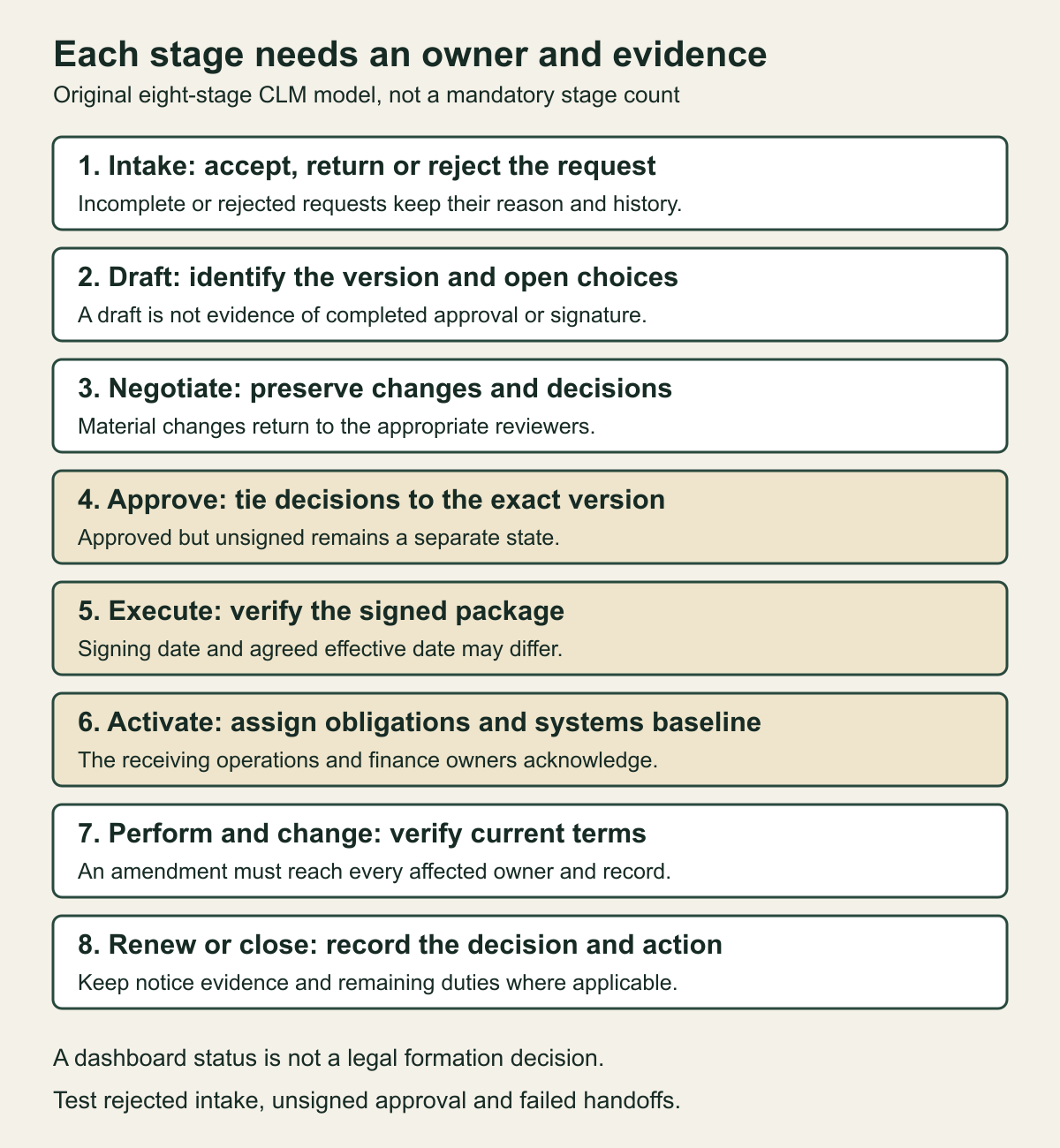
Eight stages, with a decision and record at each handoff
Do not force every request to become a signed agreement. Preserve rejected requests and paused negotiations with their reasons. Store approval and execution as separate states, and keep the effective date separate from the signing date when the agreement does.
| Stage | Decision and accountable role | Record required by this model | Next handoff |
|---|---|---|---|
| 1. Intake | Business sponsor confirms the need; procurement checks the request's completeness. | Request ID, parties, scope, budget, data/use needs and accept/reject reason. | Accepted scope goes to the drafter; incomplete requests return to sponsor. |
| 2. Drafting | Assigned drafter selects the appropriate form and completes business decisions. | Identified draft version, schedules, dependencies and unresolved choices. | Controlled draft goes to the negotiator and reviewers. |
| 3. Negotiation | Lead negotiator coordinates commercial positions with legal and specialist input. | Redlines, decision log and proposed final version. | Resolved version goes to the required internal approvers. |
| 4. Approval | Each designated approver decides within their authority. | Approval tied to exact version, budget and documented exceptions. | Approved version goes to authorized signers; later changes return for review. |
| 5. Execution | Authorized signers complete the agreed signing route. | Executed agreement and appropriate signature/authority evidence. | Coordinator verifies completeness and sends the package for activation. |
| 6. Activation | Contract owner assigns obligations and confirms readiness to start. | Effective dates, owners, systems baseline, dependencies and handover acceptance. | Operations and finance receive the verified current terms. |
| 7. Performance and change | Service owner checks delivery; authorized reviewers handle changes. | Acceptance, invoices, issues, notices and approved effective amendments. | Updated obligations and terms go to affected teams. |
| 8. Renewal or closure | Relationship owner leads the decision with relevant reviewers. | Decision, required notice/delivery evidence, renewed terms or closure record. | New term re-enters the applicable stages; closure retains required records and duties. |
The CLM rollout operating agreement helps define cross-team decisions and escalation. The contract repository guide supplies the more detailed record-retrieval test. Avoid copying a stage label into a dashboard without defining its entry evidence and exit decision.
Worked example: one agreement, from request to renewal
All companies, records, dates and amounts below are fictional. Osier Dispatch LLC wants a reporting service from Fen Data Works LLC. The proposed term is November 1, 2026, through October 31, 2027, at $1,200 a month. The base price is therefore 12 × $1,200 = $14,400, excluding any taxes or other separately agreed charges.
Intake: request O-41 initially omits the data categories and service owner. Procurement returns it as incomplete rather than labeling it legally approved. The sponsor supplies synthetic dispatch-event data requirements, a named operations owner and a budget. The corrected request is accepted; it does not yet authorize supplier access or spending.
Draft and negotiate: drafter D-41 prepares the service schedule, access limits and reporting outputs. The negotiator records the agreed positions in version 3. Legal and finance give internal approvals for that identified version.
Return after a change: the supplier sends version 4 with a different retention provision. The coordinator compares it with the approved version and returns the change for legal review. An unchanged price does not mean every other term remains approved. The parties resolve the provision in version 5, and required reviewers approve that version.
Sign and activate: authorized signers execute version 5 on October 6. The agreed effective date remains November 1. The owner confirms readiness, enters the $1,200 monthly baseline, assigns the reporting and invoice checks, and records the supplier-access prerequisites. The team does not mark the service active merely because a draft was approved.
Perform: operations checks the agreed report outputs against delivery evidence, and finance compares invoices with the current authorized terms. An invoice and an acceptance record answer different questions. Use the contract administration guide for the detailed performance and exception routine.
Test the amendment handoff, including a failure
In February 2027, the sponsor requests an additional output for $200 a month from March 1. Internally approved amendment A-41 is still unsigned when a March invoice arrives for $1,400. In this example, the existing agreement expressly requires a signed amendment for this change; no other effective variation or authorization exists. The invoice checker flags the disputed $200 increment and routes it for review. Internal approval is not treated as evidence that the supplier's new charge is already payable.
The parties correct the March invoice to the established $1,200 baseline. They then sign a revised amendment on March 10, effective April 1, adding $200 a month for April through October. The coordinator sends the executed amendment, effective date and new obligation to operations and finance. Both acknowledge the update.
The calculation changes with the effective period. Seven months, April through October, at $200 adds $1,400. The revised term total is $14,400 + $1,400 = $15,800. November through March remains five months at $1,200, or $6,000; April through October becomes seven months at $1,400, or $9,800. Together, $6,000 + $9,800 = $15,800.
The rejected March increment is not counted as a realized saving or a paid obligation. This is an illustrative control test, not a real customer result. A different agreement's variation language, conduct or law could change the legal analysis.
Make the renewal decision before the action becomes urgent
The owner records whether to renew, replace or close the service, supported by current performance, needed scope and an approved commercial decision. Any contractual notice method and deadline come from the actual agreement. This example deliberately does not invent a universal reminder interval or statutory renewal deadline.
The renewal ownership guide helps allocate the decision. The renewal terms checklist covers the next agreement. If closing, assign remaining payments, access removal, data handling and continuing duties before marking the record closed.
Copyable lifecycle handoff worksheet
Replace the completed details below with the actual agreement's evidence. A missing record should remain visibly missing, rather than silently converted into a completed state.
FICTIONAL LIFECYCLE HANDOFF: O-41

Parties: Osier Dispatch LLC / Fen Data Works LLC
Accountable relationship owner: operations sponsor
Coordinator: assigned procurement owner
Current executed version: agreement version 5, October 6, 2026
Base effective term: November 1, 2026 to October 31, 2027
Base recurring price: $1,200 per month
Signature evidence: completed executed package E-41
Activation prerequisites: owner, access limits and invoice baseline

Change request: added report output, initially proposed for March
Initial amendment: A-41 internally approved, unsigned
Exception: March invoice $1,400; disputed increment $200
Correction: March invoice returned to $1,200 baseline
Final amendment: A-41 revision 2 signed March 10, 2027
Amendment effective date: April 1, 2027
New monthly baseline: $1,400 from April through October
Additional term amount: 7 x $200 = $1,400
Revised total for the term: $15,800
Operations acknowledgment: recorded against A-41 revision 2
Finance acknowledgment: recorded against A-41 revision 2

Renewal owner: relationship owner, with procurement/legal/finance
Notice deadline and method: extract and verify from executed terms
Current renewal decision: not yet made in this fictional record
Closure prerequisites: payments, access, data and continuing duties
Open fields must be resolved before the corresponding action.
Approval, signature and legal formation are different questions
A CLM status is an internal control label. It does not conclusively decide legal formation. For example, California Civil Code 1550 identifies capable parties, consent, a lawful object and consideration as contract essentials. Do not infer that every unsigned agreement is legally nonexistent or that a completed signature cures every substantive defect.
Within California's electronic-transactions framework, Civil Code 1633.7 recognizes electronic records and signatures and rejects denial of legal effect solely for electronic form. 1633.5 addresses agreement to transact electronically. Transaction scope, authority and other substantive requirements still need review; an e-signature integration is not a universal compliance guarantee.
Federal procurement has its own record expectations. FAR 4.803 lists examples normally contained, if applicable, in contracting, administration and paying-office files, including approvals, signed agreements, modifications, performance records and payment records. That federal context illustrates why multiple records matter. It is not a mandatory commercial-business retention schedule or the source of this eight-stage model.
Standardize the process before evaluating software
Start with one agreement type and document its states, decision owners, version rules, escalation route and required records. Then test how software supports them. Common CLM capabilities include templates, routing, signing integrations, repositories, obligation alerts and reporting, as described in IBM's overview. Their depth and configuration vary; verify them with your own scenarios.
- Return an incomplete request and preserve the reason without losing its history.
- Approve one version, change a material term and show the correct re-review route.
- Keep an approved-but-unsigned agreement separate from an executed one.
- Activate only after the example's required package and owners are ready.
- Trace an extracted price or date back to the exact clause and amendment.
- Fail a handoff, identify the affected invoice or obligation and record the correction.
- Show who acknowledges a renewal task and what happens if they do not.
- Retrieve or export the complete record with suitable access controls.
AI-extracted dates, clause summaries and obligations should retain source references and unresolved exceptions for review. An alert is not evidence that someone acted. A saved PDF is not evidence that the current amendment reached finance. Measure actual outcomes using the CLM business-case guide, rather than importing a vendor's savings percentage.
During performance monitoring, use the contract audit worksheet to match contractual duties to invoices, acceptance records and documented closure of findings.
For operational reporting, the contract management KPI worksheet defines cohort membership, due-item denominators, missing evidence and correction history before anyone compares results.
Checklist for a usable lifecycle
- One relationship owner and a defined coordinator.
- Accepted, returned, rejected and withdrawn intake states with reasons.
- Approvals tied to the exact version and reviewed exceptions.
- Authority, execution and effective dates separately recorded.
- Obligations assigned with source terms and completion evidence.
- Amendments linked to the baseline and acknowledged by affected teams.
- Invoices, acceptance and disputes tracked as different records.
- Renewal and closure decisions connected to required action evidence.
- Record access, preservation and retention matched to applicable requirements.
- Measured process results with a stated scope and sample.
Frequently asked questions
What are the five stages of the contract lifecycle?
A five-part summary can group request/drafting, negotiation, approval/execution, performance/change, and renewal/closure. It is a simplification, not the only correct count. Keep the underlying decisions distinct even when a diagram combines stages.
How many stages are in contract lifecycle management?
Organizations group activities differently. This guide uses eight operational stages so approval, execution and activation remain separately testable. Choose a model that reflects the actual handoffs rather than treating a stage count as a legal rule.
Is CLM a process or a software product?
CLM describes the management process; CLM platforms support it. A team can define roles and records before deploying specialized software. Buying a platform does not by itself resolve ownership, missing terms or incorrect data.
Is CLM a CRM tool?
They address different purposes. CRM manages customer relationships and sales activity; CLM manages agreements and their lifecycle. They can exchange data, but a sales opportunity marked won is not proof that the required agreement, approvals and operational handoff are complete.
What does CLM software do?
Depending on the product and setup, it can support drafting, version control, routing, signature, storage, obligation tracking and reporting. Test the capabilities against actual agreement states and exceptions. Do not assume every platform handles every stage equally.
What is the difference between CLM and contract administration?
CLM covers the wider path from request through final disposition. Contract administration focuses on carrying out and documenting the agreement's obligations and changes. A good lifecycle connects those operational records back to current executed terms.
Prepared by the Viaclause editorial team. The model, businesses, record IDs, dates and amounts are original fictional teaching examples, not implementation results. The banner is an AI-generated illustration of fictional people.
Related guides
For the document chain, use the master service agreement template with its separate scope, risk schedule and matching SOW.
Use the contract risk management record to connect identified issues to an owner, response and supporting evidence.
Sources
- IBM Think: CLM definition, stage variation and common software capabilities
- CLOC Core 12: distinct legal-operations functions
- California Civil Code 1550: contract essentials
- California Civil Code 1633.7: electronic records and signatures
- California Civil Code 1633.5: agreement to transact electronically
- Federal Acquisition Regulation 4.803: examples of contract-file contents