

Master Service Agreement Template: Scope, Risk and Order Forms
By Anirudh Menon, Viaclause editor
Copy an original B2B MSA review template and matching SOW. Follow a filled example through purchase-order conflicts, scope changes and active projects on termination.
A master service agreement template is a reusable framework for the legal and commercial terms between a client and a service provider. A matching statement of work defines each project's deliverables, dates and price. The useful template is the document pair: shared rules in the MSA, project commitments in the SOW, and an explicit way to resolve conflicts and approve changes.
Below is an original US B2B services review template, a matching SOW and a filled document-chain example. Copy the text into your own drafting environment, replace every bracketed field, and review the pair together. The example uses ordinary business reporting services with no production-system access or personal-data processing.
California authorities illustrate jurisdiction checks; the final documents need review for their actual law and transaction. Names, amounts, dates and execution events are fictional. The banner is an AI-generated fictional illustration.
When this MSA template fits
Use the framework when the same parties expect several services projects, recurring work or separately commissioned phases. A single short engagement may be easier to document in one services agreement. The benefit of an MSA is reusing settled terms; it still needs a complete scope and risk decision each time the work changes.
This version fits ordinary B2B project services. Software development needs decisions about source code, dependencies, third-party components, defect correction and support. Hosted software needs access, availability and suspension terms. Ongoing outsourcing needs staffing, service levels, continuity and an exit plan. Personal data, healthcare information or production credentials require the appropriate data and security schedules before access begins.
Name the actual contracting entities. A parent's signature should not be treated as permission for every group company to order work. If affiliates will participate, document how each joins, who pays, who may enforce obligations and how their claims affect the cap. For international work, specify currency, tax allocation, service locations, applicable mandatory rules, governing law and dispute forum. Choosing one law does not complete the other decisions.
What the MSA governs and what the SOW supplies
Agree shared terms once, then specify the work for each project. An MSA can contain obligations even before any SOW, such as confidentiality or the ordering process. Whether it creates a minimum purchasing obligation depends on its actual wording. This template deliberately creates none.
| Document | Place these terms here | Check before release |
|---|---|---|
| MSA | Ordering, default payment, IP approach, confidentiality, risk allocation, notices and termination. | Are the shared terms complete and appropriate for this relationship? |
| SOW | Project ID, deliverables, acceptance tests, dependencies, dates, fees and approved exceptions. | Does it identify the exact MSA version and the people authorized to approve it? |
| Signed change record | Exact changed scope, price, deadlines and affected provisions. | Does it change this project only, or the framework as well? |
| Purchase order | Administrative billing reference in this template. | Have attached or linked legal terms been reviewed and handled expressly? |
| Risk or data schedule | Deal-specific obligations that the basic services template cannot safely assume. | Is it completed, incorporated and given a defined priority? |
For detailed project drafting, use the SOW template and acceptance tests. Keep the MSA version, signed projects and changes together through the contract lifecycle workflow.
Copyable MSA review template
This is a compact framework for a narrow services relationship, not a substitute for regulated, construction, employment, healthcare, financial-services, goods-supply or hosted-software terms. Bracketed fields are drafting decisions. Complete them before signature. The IP provision below grants a license rather than assigning ownership; change that approach explicitly if the commercial bargain requires ownership.
Parties, ordering, priority and payment
MASTER SERVICES AGREEMENT, REVIEW TEMPLATE
MSA ID and version: [ID, version]
Client: [full legal name, entity type, jurisdiction, address]
Provider: [full legal name, entity type, jurisdiction, address]
Effective date: [date]
Framework end date: [date]

1. Services and orders
Provider will perform only the services in a SOW signed by authorized representatives of both parties. Each SOW must identify this MSA ID and version and include scope, deliverables, acceptance, dependencies, dates and fees. Neither party must buy or provide a minimum volume. This arrangement is nonexclusive. Production access, personal-data processing and regulated work are outside scope unless the parties first sign the necessary terms and schedules.

2. Document priority
For a project, this MSA controls legal terms. The SOW supplies project scope, deliverables, dates and fees. A SOW overrides an MSA provision only in an Exceptions paragraph identifying that provision and the replacement, signed by both authorized representatives. A signed amendment overrides only the provisions it expressly changes. Later documents do not change unrelated terms merely because they are later. Purchase orders and their linked or printed terms provide administrative references only and do not amend the agreement. A separate signed agreement is required to adopt them.

3. Changes and authority
A project change must identify its SOW, scope, price, timing and dependency effects. Both authorized representatives must sign it before changed work starts. Operational contacts may coordinate delivery but cannot approve legal amendments or additional fees unless separately authorized. No party is required to accept a proposed change.

4. Fees, invoices and disputes
The SOW states fees and invoice milestones. Undisputed amounts are due [number] calendar days after receipt of a correct invoice identifying the MSA and SOW. Client will promptly explain a good-faith dispute in writing and pay the undisputed portion when due. The parties will investigate the disputed portion and document any adjustment. Expenses require Client's prior written approval of the amount and purpose. Applicable transaction taxes must be separately identified; each party bears taxes on its own income. No late-payment interest or cancellation fee is included unless separately agreed and legally reviewed.
Acceptance, IP, confidentiality and risk
5. Performance and acceptance
Provider will perform professionally with reasonable skill and care and comply with laws applicable to its performance. The SOW states measurable acceptance tests, review timing, correction timing and the consequence of an unresolved failure. Silence is not acceptance under this template. Acceptance does not waive rights concerning concealed defects or other breaches. Provider will notify Client promptly of a dependency failure, explain its impact and seek an agreed change; no automatic fee or deadline change follows.

6. Materials and IP
Each party retains its pre-existing materials. Client permits Provider to use Client materials solely to perform the project. Provider must identify third-party materials and license restrictions before incorporating them and secure the rights needed for the promised use. Upon payment of the relevant deliverable fee, Provider grants Client a perpetual, worldwide, nonexclusive license to use, copy and adapt that deliverable for Client's internal business and to share it with advisers under confidentiality duties. This includes Provider materials embedded in the deliverable to the extent needed for that use, but not stand-alone resale rights. No copyright ownership is assigned by this paragraph. Mandatory legal rights are unaffected.

7. Confidentiality and information handling
Each party will use the other's nonpublic information only for this relationship, protect it with reasonable care, and disclose it only to people who need access and are subject to confidentiality duties. Exclusions apply to information demonstrably public without breach, already lawfully held, lawfully received without restriction, or independently developed without use of the information. Legally required disclosure is permitted; give prior notice where lawful and reasonably practicable and disclose only what is required. Nothing here restricts disclosures protected by applicable law or requires notice or approval that would interfere with that protection. No party may use the other's name or logo publicly without written consent. Confidentiality continues for [period] after the applicable project ends, and for trade secrets while legally protected as such. Return or delete information at project end or request, except legally required retention and inaccessible routine backups, which remain protected. If information is accessed or disclosed without authorization, promptly notify the other party and cooperate on containment; this does not replace any statutory obligation.

8. Third-party claims
Each party will defend the other against third-party claims to the extent caused by its negligent injury to persons or damage to tangible property during performance, and pay the resulting final damages or approved settlement. Prompt notice, reasonable cooperation and defense control apply. No settlement may admit the protected party's fault, impose nonmonetary duties on it, or leave it without a release without its written consent. Counsel must complete any additional IP, data or other agreed indemnity in an incorporated risk schedule. If none is agreed, state that expressly; do not leave a proposed obligation unresolved.

9. Liability allocation, complete before signing
For claims attributable to one SOW, each party's aggregate liability is limited to [cap and calculation]. For framework-only claims not attributable to a SOW, the aggregate limit is [amount]. Complete a rule for claims spanning several SOWs in the risk schedule. Exclusions from these limits: [express list]. Any exclusion of categories of loss: [express list, or none]. These limits do not restrict liability that applicable law prohibits restricting. An insurance requirement, if agreed, belongs in the risk schedule with coverage, limits and evidence; insurance limits do not themselves amend the liability cap.
The risk fields are essential completion items, not optional blanks. For a simple relationship, the signed risk schedule can state the selected cap, exclusions, multi-project treatment, whether additional indemnities apply and whether insurance is required. For a more complex relationship, draft fuller obligations. Use the liability cap and claim map to distinguish a claim trigger, defense obligation and monetary limit.
Term, termination, notices and general terms
10. Framework and project termination
The framework remains open for new SOWs until its end date unless either party closes it earlier on [number] calendar days' written notice. Closing or expiring the framework prevents new SOWs but does not end signed active SOWs. This MSA continues to govern each active SOW until completion or separate termination, and its surviving obligations afterward.
Either party may terminate an affected SOW for the other's material breach if it remains uncured [number] calendar days after receipt of a notice specifying the breach and required cure. The notice must identify the affected SOW. The SOW may also grant a separate termination right for unresolved acceptance failure under section 5. Material breach of the framework may justify closing it after the same cure process, but does not automatically terminate unrelated SOWs. The SOW must state whether convenience termination is permitted, who may exercise it, notice and payment consequences. No automatic insolvency termination is included in this template.

11. Consequences and survival
At project termination, Provider will stop the affected work and deliver completed and partial work covered by fees paid or payable under the agreed termination calculation. Client will pay undisputed amounts properly due, with any prepaid excess refunded under that calculation. No lost future profit or cancellation fee is payable unless expressly agreed and legally reviewed. The parties will arrange return or deletion of information and any separately priced transition work. Accrued payment rights, IP licenses for paid deliverables, confidentiality, claim procedures and liability allocation for covered claims, dispute terms and necessary interpretation provisions survive as applicable. This does not revive new-work rights under a closed framework.

12. Notices and dispute process
Formal notices must be delivered by tracked courier to [each party's notice address and recipient], with an email copy to [each email]. Receipt of the courier delivery starts the notice period; count the next calendar day as day one. The parties may update notice details by a formal notice. Operational email alone is not a termination notice under this template. Senior contacts will first discuss disputes for [number] calendar days, without preventing urgent court applications or action needed to preserve legal rights or meet deadlines. Governing law: [jurisdiction]. Agreed court forum: [forum], subject to applicable jurisdiction and mandatory law.

13. Other terms and execution
Neither party may bind the other or assign this agreement without the other's written consent. Provider remains responsible for approved subcontractors; complete any subcontractor approval requirements in the risk schedule. Neither party may waive a term except through an authorized written waiver identifying its scope. The MSA, signed SOWs and incorporated schedules contain the agreement on their stated subject matter. A signed amendment is the agreed change process, subject to applicable law. If a provision is held unenforceable, the parties will review the remaining agreement and any necessary replacement; this paragraph does not guarantee enforceability. Counterparts may be signed through the agreed signing process and retained together.

Client authorized signatory: [name, title, signature, date]
Provider authorized signatory: [name, title, signature, date]
Incorporated risk schedule: [ID and version]
Other incorporated schedules: [list or none]
Replace the survival list with provisions that actually exist in the final document. The survival clause guide helps identify duration and surviving duties. Notice periods, business days and cancellation amounts in a deal are negotiated choices; the template does not establish a market standard.
Matching SOW template
STATEMENT OF WORK, REVIEW TEMPLATE
SOW ID and version: [ID, version]
Client and Provider: [same legal parties as MSA]
Incorporated MSA: [ID, version, effective date]
Incorporated risk/data schedules: [IDs and versions]
Project period: [start, delivery dates, completion conditions]
Scope and exclusions: [specific activities and boundaries]
Deliverables: [items, formats, quantities and due dates]
Dependencies: [inputs, owner and due date]
Acceptance: [tests, reviewer, review period, correction period]
Unresolved failure: [rejection and remedy process]
Fees and invoice milestones: [amounts, currency, triggers]
Expense allowance: [approved amount or none]
Client operational contact: [name and role]
Provider operational contact: [name and role]
Convenience termination: [right, notice, payment calculation, or none]
MSA Exceptions: [specific provision and replacement, or none]
Purchase-order reference: [administrative number only, or none]
Change records: [none initially; list signed changes later]
Client authorized signatory: [name, title, signature, date]
Provider authorized signatory: [name, title, signature, date]
Filled example: one MSA, one SOW and one change
In this fictional scenario, Harbor Metrics LLC and Oak Route Inc. sign MSA R1 on October 12, 2026. The framework end date is October 11, 2027. They use 30 calendar days for invoice payment and framework-closing notice, 15 calendar days for a material-breach cure, three years of ordinary confidentiality after project end, and ten calendar days of senior-level dispute discussion. Their notice recipients and tracked-courier addresses are populated in the fictional signed records; no actual addresses or signatures are supplied here.
Completed fictional risk schedule RS1
These are negotiated choices for this example, not recommended cap amounts or a finding of enforceability.
RS1, effective October 12, 2026, incorporated into MSA R1
Single-SOW ordinary aggregate cap: that SOW's fees paid or payable
Framework-only aggregate cap: $10,000 USD
One event spanning SOWs: one aggregate cap equal to combined fees
paid or payable under affected SOWs, without duplicate recovery
Cap exclusions: payment obligations, fraud, willful misconduct,
confidentiality breaches, the stated third-party injury/property
indemnity, and liability that cannot lawfully be limited
Loss-category exclusions: none
Additional IP indemnity: none
Contractual insurance minimum: none; mandatory requirements apply
Subcontracting: prior written client approval required
Other risk changes: none
SOW 01 R1, fictional completed project record
Client: Oak Route Inc.
Provider: Harbor Metrics LLC
MSA: R1, effective October 12, 2026
Risk schedule: RS1, same effective date
Scenario signing date: October 14, 2026
Work starts: October 19, 2026
Work: six regional operations reports
Inputs: Oak's public and synthetic route data, supplied October 19
Excluded: personal data, production access, software deployment
Deliverables: six PDFs and six editable report source files
Initial delivery deadline: December 18, 2026
Acceptance test: each file opens, covers its named region, reconciles
to the agreed input totals and includes its documented assumptions
Reviewer: Dana Reed, Oak operations
Review period: five calendar days after delivery
Correction period: five calendar days after a specific rejection
Second failed review: Oak may terminate the affected SOW by notice;
rejected undelivered value is not charged, paid excess is refunded
Fee: $12,000 USD
Invoice 1: $3,000 after signing, credited to project fees
Invoice 2: $9,000 after written acceptance of all six reports
Expenses: none
Provider contact: Morgan Hale, project lead
Convenience termination: Oak may end this SOW on 15 calendar days'
formal notice; pay accepted reports at $2,000 each and documented
unfinished report work up to $2,000 per report, less payments made;
total cannot exceed the then-agreed SOW fee; refund prepaid excess
MSA Exceptions: none
Purchase-order reference: PO88, administration only
Change records at signing: none
Execution events above are assumed facts of this fictional scenario
The initial $3,000 payment is credited toward the $12,000 fee, not added to it. The unfinished-work ceiling prevents the convenience calculation from exceeding the agreed report price. Accepted and unfinished value for the same report must not be counted twice. A genuine defect dispute still follows the agreed acceptance and remedy terms.
Conflicting purchase-order terms
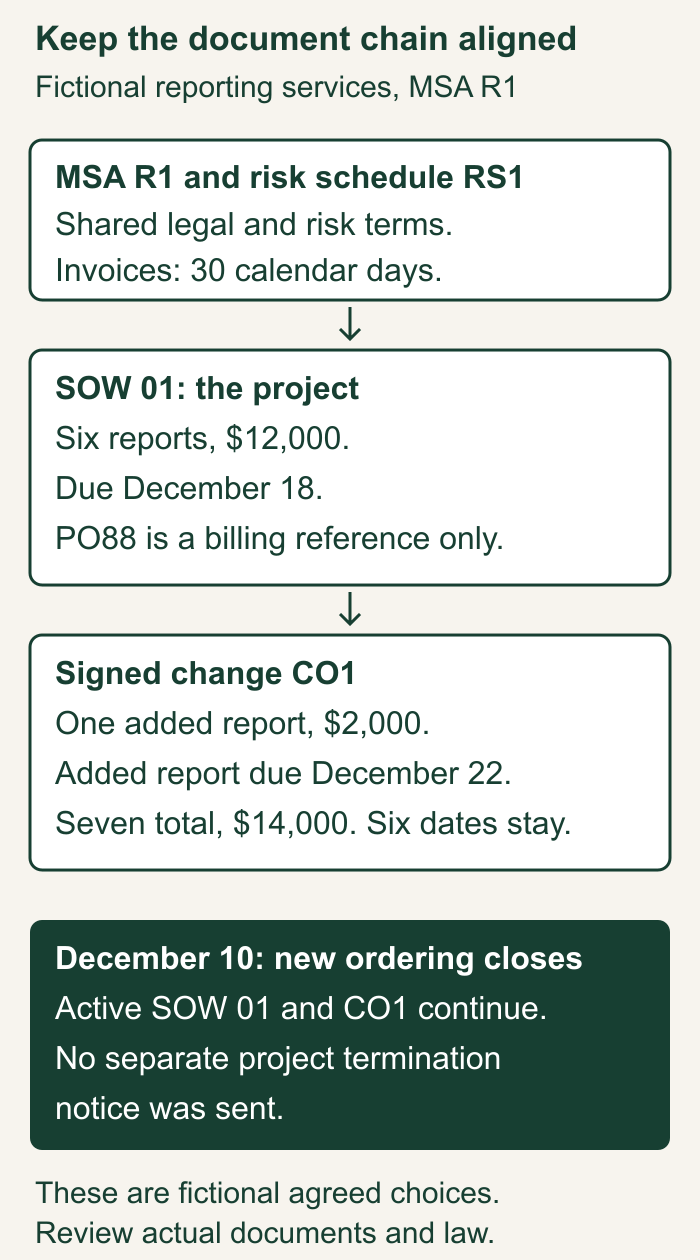
PO88 contains a printed 60-day payment term. The signed MSA requires 30 calendar days after receipt of a correct invoice, and SOW 01 has no approved exception. Under the example's agreed structure, PO88 supplies the billing reference and does not replace the payment rule. The team records the conflict and asks procurement to align the PO rather than silently treating its extra terms as an amendment.
That is a reading of the fictional agreed terms, not a universal legal rule that every purchase order loses. Actual assent, incorporation, course of dealing and applicable law may change the result. Use the order form and master agreement conflict guide for the deeper analysis.
Approved project change
Both authorized representatives sign CO1 on November 25. It adds one report for $2,000, using the same acceptance test and $2,000 per-report convenience calculation. The original six remain due December 18; the additional report is due December 22. Total project fees become $14,000. The initial $3,000 and six-report $9,000 milestones stay intact; the extra $2,000 is invoiced after written acceptance of the seventh report. No MSA legal term changes.
For an ordinary capped claim attributable only to this SOW, the example's fee-based cap now uses $14,000 paid or payable, rather than only cash paid so far. Excluded claims still require separate analysis. Record the change and avoid taking a cap from an outdated scope snapshot. Use the amendment and change record guide.
Closing the framework while work remains active
Oak's valid framework-closing notice is received November 10. With the agreed next-day calendar counting, November 11 is day one and December 10 is day thirty. The example closes the framework to new SOWs on December 10. SOW 01 and its previously signed CO1 remain active, governed by MSA R1 and RS1. Their December 18 and December 22 delivery obligations are preserved.
A proposed SOW 02 on December 12 cannot be released under the closed framework without a separately agreed reopening or new agreement. Neither party sent an SOW 01 termination notice, so the team does not mark it cancelled. Completing the reports later does not reopen ordering.
| Ledger event | Changed record | Terms retained |
|---|---|---|
| PO88 received | Billing reference recorded; conflicting 60-day text flagged. | 30-day MSA payment rule; no agreed override. |
| CO1 signed November 25 | Seven reports, $14,000; seventh due December 22. | Original six due December 18; shared legal terms unchanged. |
| Framework closes December 10 | New ordering closed. | SOW 01, CO1 and their governing MSA terms remain active. |
| SOW 02 proposed December 12 | Held pending a new or reopened framework. | No unauthorized work or fee commitment recorded. |
Add an operating schedule for ongoing services
A project deliverable and a continuing service need different controls. Complete these choices before adapting the template to ongoing work; a general promise to perform professionally does not supply them.
- Governance: name operational contacts, escalation contacts, reporting frequency and decision deadlines. Keep a decision log. State which people can approve commercial changes, and whether meeting minutes have any contractual effect.
- Performance: define the metric, measurement period, exclusions, evidence owner and reporting method. Connect misses to correction, credits and any repeated-failure exit right. State whether credits replace or accompany other remedies.
- Continuity: identify recovery arrangements, test frequency and results access. Decide whether a force majeure provision applies, its qualifying causes, notice and mitigation duties, affected obligations, payment treatment and prolonged-disruption exit. This template grants no automatic force majeure extension.
- People and locations: specify approved subcontractors, relevant flow-down duties, key roles and location changes. Keep provider responsibility clear even when subcontracting is approved.
- Evidence and audit: choose records, retention, access scope, notice, frequency, costs and remediation. Protect unrelated customer information and security. Reserve any access required by applicable law.
- Security and compliance: identify the actual information and systems, access controls, incident contacts, agreed response deadlines and required sector obligations. A confidentiality clause alone does not establish data-law compliance.
- Exit: list handover files, formats, knowledge transfer, transition duration and price. Check rights in background and third-party materials, retention exceptions and deletion confirmation. Reconcile the plan with payment, licenses and surviving duties.
The 2009 Intelenet and Apria agreement filed with the SEC illustrates how an outsourcing MSA uses separate governance, performance, continuity, security, audit and transition schedules. Its framework termination ends its SOWs, unlike the choice here. It is a historical negotiated contract, not current legal authority or a market benchmark. Asterisks hide confidential provisions, including important commercial figures, so those figures cannot support recommended caps or prices.
Jurisdiction and legal review notes
Start with formation. California Civil Code section 1550 identifies capacity, consent, lawful object and sufficient cause or consideration. Calling a document an MSA or adding signature blocks does not answer each issue.
For interpretation, section 1636 addresses the parties' ascertainable lawful mutual intention, and section 1641 requires the whole contract to be read together. A priority clause helps document the intended relationship; it does not permit the reviewer to ignore formation or the rest of the transaction.
The signed-writing process is the template's selected process. California's 2026 civil jury instruction 313 asks whether the parties agreed to a modification, considering their words and conduct, and includes an oral modification carried out by the parties. A writing clause does not justify ignoring what happened in performance. Preserve change requests, approvals and conduct evidence, and have counsel evaluate any claimed departure from the agreed process.
Review the cap and exclusions together. Section 1668 rejects contracts whose object is exemption from responsibility for one's own fraud, willful injury or violation of law, within its stated terms. A savings sentence does not establish that every other cap or disclaimer is enforceable. Counsel should evaluate the actual allocation, transaction and mandatory rules.
First verify the provider's rights. 17 U.S.C. section 201 places initial copyright ownership in the author, with a separate rule for qualifying works made for hire. Do not assume payment for commissioned work alone settles ownership. Check the chain of rights from employees, consultants and component suppliers before promising the client an assignment or license.
IP needs its own decision. The Copyright Office's text of 17 U.S.C. section 204 requires a signed writing for copyright ownership transfers other than by operation of law. The example's nonexclusive license is deliberately not an ownership assignment. If ownership is required, identify the rights, owner, covered works, background materials and proper signed transfer rather than relying on a statement that the client paid for the work.
Separate contractual confidentiality from trade-secret status. 18 U.S.C. section 1839 requires reasonable secrecy measures and independent economic value from secrecy for its trade-secret definition. Calling every file confidential does not establish those elements. Set an ordinary confidentiality period separately, identify sensitive materials and control access; the template protects trade secrets while legally protected.
Protected reporting needs a separate check. 18 U.S.C. section 1833(b) protects specified confidential disclosures to officials or attorneys for reporting or investigating suspected illegality, and specified sealed court filings. Its employer notice rule includes individuals working as contractors or consultants. For covered individual agreements, supply the required immunity notice or qualifying policy reference; omission can prevent specified federal exemplary damages and attorney-fee awards. The general exception in this B2B template does not itself supply that individual notice or authorize unlawful access.
Before broadening the scope, review the relevant data, security, tax, insurance, sector and cross-border terms. A services template is not a safe way to skip those decisions. Do not apply goods-specific ordering law to every professional-services arrangement.
For measurable service commitments, the service-level agreement template supplies a completed availability calculation, overlapping maintenance example and separate service-credit record.
Checklist before signing the document pair
- Confirm full legal parties, signing authority, dates and exact document versions.
- Complete all risk, notice, forum and confidentiality fields.
- Check incorporated schedules and define their priority expressly.
- Verify scope exclusions match the actual work and data access.
- Make acceptance tests, correction and unresolved-failure consequences usable.
- Reconcile deposits, invoices, taxes, expenses and cancellation calculations.
- Choose IP ownership or license terms and identify background restrictions.
- Map third-party claims to defense procedures, exclusions and caps.
- Check purchase orders and website terms for unintended legal changes.
- Separate framework closure from each active SOW's termination.
- Record authorized changes and review surviving obligations.
- Have appropriate counsel review the final pair for the actual jurisdiction and deal.
Frequently asked questions
How do you create a master service agreement?
Define the relationship and work boundaries, choose the shared commercial and legal terms, and complete a matching SOW. Resolve document priority, changes and unfinished-work treatment before signing. Review the final pair and every incorporated schedule together.
Where can you find MSA templates?
You can copy the original text above. Other options include your organization's approved forms and provider or counsel templates. Check jurisdiction, access conditions, date and scope. A preview of a template is not evidence that its editable body has been inspected.
What does an MSA include?
For this services relationship: ordering, document priority, changes, payment, performance, IP, confidentiality, third-party claims, liability, termination, notices, disputes and general terms. The SOW supplies the actual project commitments. Additional terms depend on the deal.
How much does an MSA agreement cost?
The text here is freely copyable. That does not establish the cost of legal advice or negotiation. Review effort depends on scope, risk, counterpart terms and jurisdiction; obtain a quote tied to the actual documents rather than assuming a universal MSA price.
Can an MSA exist without an SOW?
Yes, a framework can establish shared obligations before a project is ordered. This template requires a signed SOW to commit work and creates no minimum purchase. Other MSAs may commit baseline services or spending directly, so read the actual terms.
Which document controls if an order conflicts with the MSA?
Read the agreed priority, incorporation and exception provisions, along with the facts and applicable law. Here, the SOW sets project variables, an express signed exception can replace a named MSA term, and the PO is administrative. That structure is an agreed choice in the example.
Does ending the MSA end all SOWs?
It depends on the agreed terms and termination route. This template closes new ordering while preserving active SOWs. A project must be separately terminated under its applicable terms. Other agreements may connect the two events differently.
Is an MSA the same as an SLA?
The MSA supplies shared relationship terms. An SLA defines measurable service performance and what happens when a target is missed. Identify the SLA version, measurement evidence, credits and escalation route, then reconcile its remedies with the MSA's liability and termination provisions.
Does paying for services transfer ownership of the deliverables?
Check the agreed rights and applicable IP law. This template grants a defined nonexclusive license after the relevant fees are paid. An ownership assignment requires a different decision, the correct rights holder and appropriate transfer language. Background materials and third-party restrictions need their own treatment.
Can an MSA cover personal-data processing?
It can be part of the document set, but this example excludes that work. Before expanding it, determine the parties' roles, applicable laws, information involved, security controls, subprocessors, incident duties, transfers and deletion requirements. Sign the necessary schedules before permitting access.
Prepared with AI assistance by Viaclause. The copyable drafting text and fictional document-chain example are original editorial aids; no lawyer review is claimed.
Sources
- California Civil Code section 1550: essential contract elements.
- California Civil Code section 1636: mutual intention.
- California Civil Code section 1641: whole-contract interpretation.
- Judicial Council of California, 2026 civil jury instruction 313: modification.
- California Civil Code section 1668: limits on exemptions from responsibility.
- U.S. Copyright Office, 17 U.S.C. section 204: copyright ownership transfers.
- U.S. Copyright Office, 17 U.S.C. section 201: initial ownership and qualifying works made for hire.
- 18 U.S.C. section 1839, reproduced by LII: trade-secret definition.
- 18 U.S.C. section 1833, reproduced by LII: protected disclosures and employer notice.
- SEC Exhibit 10.2: Intelenet and Apria MSA dated May 14, 2009, public redacted contract example.