

Governing Law Clauses: Choosing Law Without Choosing a Court
By Anirudh Menon, Viaclause editor
Separate governing law, courts and arbitration. Compare New York and Delaware statutory routes and resolve a worked master-agreement and order-form conflict.
A governing law clause identifies the legal system the parties choose to govern their contractual rights and duties. A separate forum or jurisdiction clause identifies the courts they select for disputes. An arbitration clause chooses a different dispute process. Check all three choices together, while keeping their purposes distinct.
For example, choosing New York law does not, by those words alone, choose New York courts. A contract can propose one jurisdiction's substantive law and a dispute process elsewhere. Whether that arrangement works for the transaction requires the relevant legal rules, wording and facts. Use the contract review checklist to examine the complete agreement rather than one sentence in isolation.
This is general contract education and general information. The examples and prices are fictional drafting aids for commercial negotiation. They are not enforceability opinions or clauses approved for a particular transaction.
Separate the law, forum and dispute process
| Choice | Question answered | What to record |
|---|---|---|
| Substantive governing law | Which legal system is selected for contractual rights and duties? | Precise jurisdiction, covered documents and claims, plus any deliberate exclusions. |
| Courts and venue | Where do the parties propose bringing court proceedings? | Specified courts and location, exclusive or nonexclusive choice, consent and service arrangements. |
| Arbitration | Will specified disputes go to arbitration? | Covered disputes, administrator, rules, legal seat, arbitrator selection and language. |
| Hearing location | Where might witnesses or participants attend? | Physical or remote arrangements. Identify separately from the proposed arbitration seat. |
| Enforcement location | Where are assets against which relief may be pursued? | Asset locations and the recognition, service and enforcement questions for local counsel. |
The review should produce a coherent route for a dispute. A governing-law sentence does not specify an arbitration administrator or establish that an overseas judgment will be recognised. Parties also cannot confer federal subject-matter jurisdiction by agreement, as the Supreme Court explains in Insurance Corporation of Ireland v Compagnie des Bauxites, pages 701–704. Treat these as separate questions to resolve, not effects silently supplied by the law clause.
New York: two statutes, two monetary screens
New York General Obligations Law section 5-1401 allows a New York-law choice for qualifying transactions covering at least $250,000 in the aggregate, even without a reasonable relation to New York. It excludes labor or personal services, personal, family or household services transactions, and specified contrary UCC provisions. It also preserves the possibility of enforcing choice-of-law provisions in other agreements. Falling outside this statutory route therefore does not itself prove that a clause is invalid.
Section 5-1402 provides a separate New York forum route for qualifying transactions covering at least $1 million, with a New York-law choice under section 5-1401 and an agreement by the relevant foreign corporation or nonresident to submit to New York courts. Its text also preserves other forum provisions. A transaction's price alone does not resolve every condition or establish jurisdiction.
In IRB-Brasil Resseguros v Inepar Investments, decided December 18, 2012, New York's Court of Appeals applied New York substantive law under section 5-1401 to the disputed guarantee. Expressly excluding New York conflict-of-laws principles was unnecessary in that statutory context. The decision addresses that commercial transaction and statutory route. It does not establish that every choice clause everywhere overrides every otherwise applicable rule.
Delaware has its own statutory conditions
Delaware Code title 6, section 2708 provides a written Delaware-law route where the parties are subject to Delaware courts or arbitration in Delaware and may be served with process, as provided by law or their writing. It excludes undertakings involving less than $100,000 and specified contrary UCC provisions. It preserves other jurisdiction and choice-of-law provisions. These are Delaware's conditions, not New York's thresholds.
Check the actual type of agreement and affected issues. A commercial supply agreement, personal-services arrangement and consumer purchase should not be classified as interchangeable merely because their templates contain the same boilerplate. If a statutory route is unavailable, counsel must assess the other applicable choice-of-law rules rather than treating the monetary screen as a universal validity test.
A worked cross-border document conflict
Fictional Alder Components in Illinois buys equipment from fictional Maple Assembly in Ontario. The negotiated programme has 24 monthly equipment releases at $25,000 each: $600,000 in total. Delivery is to Illinois, and the supplier's main assets are in Canada. These facts describe the example; they do not establish legal eligibility under either statute.
The master agreement's draft says New York law and exclusive New York County courts. The supplier's proposed order form says Delaware law and exclusive Delaware courts. The master permits orders to specify price, quantity and delivery dates, but its priority language is ambiguous about other terms. The order is not yet signed.
| Field | Master draft | Order draft | Review finding |
|---|---|---|---|
| Governing law | New York | Delaware | Direct conflict requiring an agreed resolution. |
| Courts | Exclusive New York County courts | Exclusive Delaware courts | Separate direct conflict. Changing law alone leaves it unresolved. |
| Order authority | Price, quantity, delivery dates | Additional legal boilerplate | Identify whether the order can vary either dispute provision. |
| Price screen | 24 × $25,000 = $600,000 | Above $250,000 and $100,000; below $1 million. Monetary comparisons only. | |
| Assets and service | Supplier and main assets in Ontario | Canadian counsel must examine service, recognition and enforcement. |
The $600,000 total crosses New York section 5-1401's monetary screen, but other conditions and exclusions still require examination. It does not cross section 5-1402's $1 million screen. It exceeds Delaware section 2708's excluded under-$100,000 category, but service and jurisdiction conditions remain separate. Neither comparison decides which proposed clause the parties accepted.
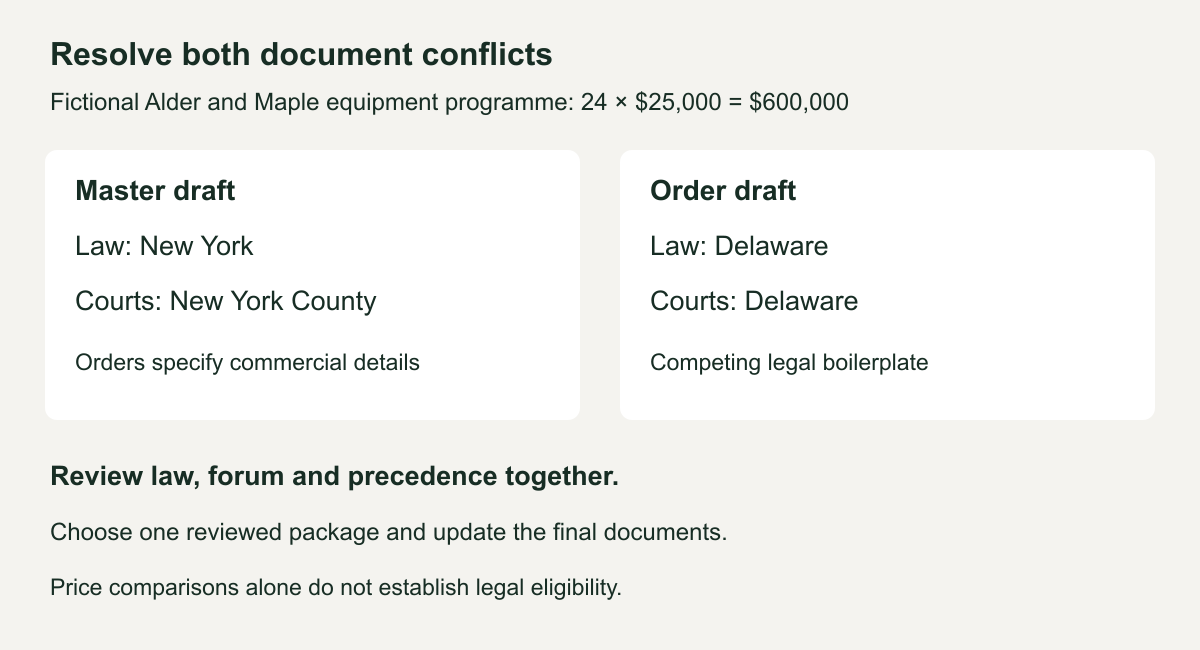
Alder's reviewer prepares two coherent alternatives: retain the master's New York package and remove the order's competing language, or amend the master and order together to a reviewed Delaware package. The commercial owner selects a negotiating position. Counsel checks its legal fit, dispute costs, local service and overseas enforcement. The team then records the agreed package in the final documents.
This is a document review workflow, not a conclusion that an unsigned order automatically overrides a master. Use the order-form conflict guide to examine incorporation, assent and precedence. Where a signed agreement needs changing, follow the agreed change process and use the amendment example to identify the exact provisions being replaced.
Illustrative law and court wording
The following original commercial drafting structure separates the two decisions. It needs transaction-specific legal review and completed placeholders. It does not promise jurisdiction or enforceability. Do not insert a court name without checking that the court can hear the relevant dispute.
GOVERNING LAW
This Agreement and the Orders governed by it shall be governed by and construed in accordance with the substantive laws of [specified jurisdiction].

COURT DISPUTES
Subject to [identified exceptions, if any], the parties agree that disputes arising out of or relating to this Agreement or those Orders shall be brought exclusively in [specified courts and location] having jurisdiction over the dispute. Each party consents to the personal jurisdiction of those courts. [Complete legally reviewed service arrangements.]

ORDER PRECEDENCE
An Order may specify price, quantity and delivery dates. It does not change the governing-law or dispute-resolution provisions unless a written amendment expressly identifies the change and is agreed through [the required amendment process].
In the fictional New York alternative, the law placeholder is “the State of New York.” Counsel reviews whether to identify the state courts in New York County and the relevant federal court, with the federal alternative conditional on its jurisdiction. The order's Delaware law and court sentences are removed by agreement. The final file contains a reviewed service arrangement and the agreed priority wording.
In the fictional Delaware alternative, the law placeholder is “the State of Delaware.” Counsel identifies the competent Delaware courts and reviews the service and jurisdiction provisions against section 2708. The master is changed through the authorised process, and the order uses the same package. This is an alternative negotiation choice, not an instruction to include both packages.
If arbitration is proposed, complete that package separately
A proposal for New York substantive law with arbitration seated elsewhere raises a different set of questions from either court package. Record the legal seat, administrator and rules, scope of disputes, arbitrator selection, language and any court-relief provisions. Ask counsel which law governs the arbitration agreement itself. Do not assume it follows automatically from the main contract's governing-law sentence.
The parties should also examine where evidence and assets are located and what proceedings may be needed to obtain relief. A convenient remote hearing arrangement does not answer recognition or enforcement questions. Keep the commercial comparison grounded in available procedures and costs, without promising arbitration will always be faster, cheaper or confidential.
A decision worksheet for the reviewer
LAW AND DISPUTE REVIEW
Parties, locations and contract type:
Transaction value and aggregation basis:
Performance and asset locations:
Chosen substantive law and covered documents:
Court forum and exclusivity, or arbitration package:
Personal jurisdiction and service arrangements:
Applicable statutory route, conditions and exclusions:
Other mandatory-law and public-policy questions:
Recognition and enforcement advice needed:
Conflicting documents and proposed precedence:
Exact amendment or deletion required:
Decision owner, counsel review and final version:
For Alder, the worksheet records $600,000 calculated from the 24-release programme, Illinois delivery and Ontario assets. It records the two conflicting rows, flags the distinct New York monetary screens, and leaves legal eligibility and Canadian enforcement for counsel. The final action is to adopt one reviewed package and update both documents before signature, not to mark the deal approved because a threshold was crossed.
Send the agreement, order, precedence text and decision worksheet together. The lawyer review packet guide helps turn that material into a concrete question. The contract elements guide covers formation separately. For contractual notices, keep their method and evidence distinct from service of court process; the email notice guide addresses that operational step.
Before-signing checklist
- Name the precise legal jurisdiction and scope of the law choice.
- Resolve courts or arbitration, exclusivity and any deliberate exceptions.
- Check value, contract type, statutory conditions and exclusions.
- Inspect every master, order, schedule and incorporated set of terms.
- Record the authorised priority and amendment process.
- Obtain the relevant local advice on service and asset enforcement.
- Save the final agreed wording and review decision with the signed version.
Frequently asked questions
Does governing law decide where a dispute is heard?
Its principal purpose is choosing the law for contractual rights and duties. Specify and review the court forum or arbitration package separately. Do not infer a court selection from a law choice alone.
Can the law and forum be different?
Parties can propose that arrangement, but it needs review of the applicable rules, forum competence and practical consequences. Identify which forum may need to apply foreign substantive law and obtain the relevant advice before using the structure.
Is every New York clause valid above $250,000?
No. Section 5-1401 has conditions and exclusions. A monetary comparison is one screen. The separate section 5-1402 forum route has a different threshold and additional requirements.
What should a Delaware clause address?
A section 2708 review includes the written law choice, jurisdiction or arbitration in Delaware, service of process, value and the specified UCC exception. Other choice provisions may still be valid outside that particular statutory route.
Can an order form change the governing law?
Inspect assent, incorporation, the order's authorised scope and the agreement's change and priority provisions. Conflicting wording deserves an express agreed resolution. This example supplies no automatic rule that the later document wins.
Can we choose a law and ignore every local rule?
Do not make that assumption. Identify the specific mandatory-law, public-policy and enforcement questions in the jurisdictions involved and have counsel assess them. The statutory examples here have express limits and do not resolve every cross-border issue.
Sources
- New York General Obligations Law section 5-1401, choice of law, monetary scope, exclusions and preservation of other provisions.
- New York General Obligations Law section 5-1402, separate choice-of-forum route and conditions.
- IRB-Brasil Resseguros v Inepar Investments, New York Court of Appeals, December 18, 2012, application of section 5-1401 and substantive law.
- Delaware Code title 6, section 2708, written choice, jurisdiction, service, exclusions and other provisions.
- Insurance Corporation of Ireland v Compagnie des Bauxites, 456 US 694 (1982), pages 701–704, distinction between federal subject-matter and personal jurisdiction.
Prepared with AI assistance. The banner depicts fictional adults and is AI-generated. The graphic, conflict example and worksheets are original illustrations. No real negotiation, court result for the fictional parties or professional legal review is claimed.