

Arbitration Clauses: Process, Cost and Practical Choices
By Anirudh Menon, Viaclause editor
Review dispute scope, rules, seat, costs and court relief. Compare two fictional business disputes, an annotated clause and the FAA's important limitations.
An arbitration clause is an agreement to submit specified disputes to one or more arbitrators for a decision under an agreed process. It should identify the disputes and parties covered, the administrator and rules, the legal seat, how arbitrators are selected and how costs are handled. It does not determine who wins a future dispute.
Before accepting a clause, examine the agreement you actually received, the likely dispute and the complete procedural package. A small domestic invoice claim and a complex cross-border supply claim can call for different choices. The contract review checklist helps place arbitration alongside notice, governing law and the rest of the agreement.
This is general contract education and not legal advice. The examples, budgets and time periods are fictional planning aids. They are not administrator quotations, legal deadlines, outcome predictions or clauses approved for a specific deal.
What agreeing to arbitration changes
Arbitration gives the agreed tribunal the job of deciding the covered dispute. Mediation instead seeks a negotiated resolution; an unsuccessful mediation does not itself decide the merits. A clause can combine negotiation, mediation and arbitration, but it must say whether the earlier step is a condition to filing or can run alongside the arbitration. The AAA drafting guidance offers both sequential and concurrent arrangements.
For binding arbitration, the practical tradeoff is a decision through the agreed private process, with the applicable routes for enforcement and challenge. You should understand the effect on a court trial, individual versus group claims, obtaining evidence, deposits and review of the award. Neither speed nor lower total cost follows automatically from choosing arbitration.
Define what the clause covers
Identify the contracting parties and covered agreements, orders and claims. Compare language about interpretation, performance and termination with any deliberate exclusions. Do not assume a reference to “all disputes” resolves questions about assent, nonparties, statutory limits or the scope of an incorporated document.
For a master agreement and multiple orders, decide whether one arbitration arrangement governs them all and how a conflict is resolved. An order's court clause can contradict the master's arbitration clause. Use the order-form conflict guide to inspect incorporation and precedence rather than assuming the latest document wins.
The US statutory starting point has limits
9 USC section 2, reproduced by Cornell LII, addresses written arbitration provisions in maritime transactions and contracts involving commerce. It provides for enforcement subject to grounds for revoking a contract and the separate chapter 4 provisions. That is a statutory starting point, not proof that every clause, claimant or dispute must be arbitrated.
Section 1 contains a specified employment-contract exclusion involving seamen, railroad employees and a class of workers engaged in foreign or interstate commerce. In Bissonnette v LePage Bakeries, April 12, 2024, the Supreme Court held that a transportation worker need not work in the transportation industry to fall within that exemption. It left other questions about the particular workers unresolved and remanded. Employer industry alone does not answer this scope question.
Section 402 allows the person alleging a sexual assault or sexual harassment dispute, or the specified representative, to elect against enforcement of a predispute arbitration agreement or joint-action waiver for the covered case. The court determines the chapter's applicability despite an attempted delegation to an arbitrator. The definitions and effective-date note in section 401 matter: the Act applies to disputes or claims arising or accruing on or after March 3, 2022. Apply the definitions and case facts; do not treat it as a blanket rule for every disagreement.
Consumer, workplace and other regulated arrangements need their applicable safeguards and rules. This article's commercial drafting structure should not be repurposed as a consumer or employee clause without that review. Cross-border transactions also need advice on the seat's law, any applicable enforcement regime and the locations of assets.
Is the clause enforceable? Check agreement, law and objections
Start with evidence of agreement: the contracting entity, authorized signatory or acceptance process, complete terms, incorporated rules and the version accepted. A clause embedded in an app, order or employment package still raises an agreement question. Preserve the acceptance screen or signed document and the terms it presented. Fine print alone does not establish that every person connected with a transaction agreed to arbitration.
First Options of Chicago v Kaplan, 514 US 938 (1995) concerned a company that signed an arbitration document and individual owners who had not personally signed it. The Court required clear and unmistakable evidence before treating the arbitrators as empowered to decide arbitrability. The owners' written objection before the tribunal did not itself show agreement to accept its decision on that issue. Identify the actual party and agreement; do not assume a related person is bound.
Next check statutory coverage and defenses under the applicable law. The FAA preserves generally applicable contract defenses, including fraud, duress and unconscionability. State law cannot impose a rule that impermissibly disfavors arbitration or obstructs the FAA. In AT&T Mobility v Concepcion, 563 US 333 (2011), the majority held California's Discover Bank rule concerning certain consumer class waivers preempted. That decision does not establish that every modern class waiver, every employee clause or every contested acceptance process is enforceable.
For an unconscionability review, record the actual signing circumstances and disputed burdens: meaningful access to terms, bargaining constraints, one-sided exclusions, distant proceedings, deposits and restrictions on presenting a claim. These are questions for the relevant legal test, not a universal list that automatically invalidates a clause. A commercial template should not quietly strip statutory remedies from a worker or consumer.
Severability and delegation answer different questions
Severability here concerns treating the arbitration agreement separately from the surrounding contract. In Buckeye Check Cashing v Cardegna, 546 US 440 (2006), customers alleged the check-cashing contract was illegal as a whole. Because their challenge did not specifically attack the arbitration provisions, the majority sent that validity question to the arbitrator. It expressly distinguished whether any agreement was ever concluded. This is not an automatic cure for a missing agreement or defective arbitration clause.
Delegation addresses who decides specified threshold objections about arbitration. In the employment dispute Rent-A-Center, West v Jackson, 561 US 63 (2010), the majority enforced the delegation provision because Jackson's unconscionability challenge had not been directed specifically to it. A challenge to that precise provision requires separate consideration. The Court addressed validity, not whether an agreement had ever been concluded. Review any delegation language and incorporated jurisdiction rule with counsel; naming an institution is not a substitute for that analysis.
Conflicting documents also matter. Coinbase v Suski, 602 US 143 (2024) involved an earlier user agreement with arbitration and delegation and later sweepstakes rules pointing to courts. The Court held that a court must decide which agreement controlled the competing routes. It did not decide whether the lower court correctly applied California supersession law. Align master agreements, orders and later transaction terms.
Consumer, employment and commercial clauses need different checks
| Setting | Practical review | Primary rule example |
|---|---|---|
| Consumer purchases, subscriptions or services | Clear agreement, usable access, applicable fees, small claims route and any group-action waiver | AAA Consumer Rules, effective May 1, 2025, address standardized personal or household transactions. R-9 allows qualifying small claims routes; R-1 and R-12 address due process review and the consumer clause registry. |
| Employment and individual contractor work | Statutory coverage, worker classification, claim-specific exceptions, practical access and the correct rules and fee schedule | AAA Employment/Workplace Rules, effective May 1, 2025, also cover specified work disputes involving unincorporated individual contractors. Rule R-1 requires modifications to remain consistent with the Employment Due Process Protocol. |
| Negotiated business contracts | Proportionate evidence exchange, tribunal expertise, selection, language, coordinated contracts and enforcement needs | AAA Commercial Rules, effective September 1, 2022, address tailored preliminary planning and information exchange in R-22 and R-23, preserving each party's opportunity to present its case. |
These are examples from the PDFs offered by AAA's current resource pages when inspected on October 6, 2026. Their operative dates are stated inside the documents; a filename containing “2026” does not establish a new rules amendment. Select the rules and applicable-version convention for the actual dispute. Obtain the separate current fee schedule rather than applying the fictional business budget below to consumers or workers.
AAA's consumer registry review is an administrative determination, not a legal opinion that the clause is enforceable. Its rules can provide routes to an appropriate court when AAA declines or ceases administration for listed reasons. Check the precise rule and facts rather than treating a provider's refusal as a universal cancellation of every arbitration obligation.
Record the procedural choices
| Decision | What to specify | Question before signing |
|---|---|---|
| Administrator and rules | Exact institution and rules, including how the applicable version is determined | Does the institution administer this category of dispute under those rules? |
| Legal seat | City and jurisdiction proposed as the arbitration's legal seat | Which procedural law and courts support or supervise the arbitration? |
| Hearing arrangements | Physical, remote or documents-only process where appropriate | Can witnesses and participants practically use the proposed arrangement? |
| Arbitrators | Number, appointment mechanism, qualifications and conflict checks | Is the selection procedure workable if the parties disagree? |
| Costs and remedies | Deposits, administrator charges, arbitrator fees, party costs and award powers | Who pays initially, who may ultimately bear costs, and what if a deposit is unpaid? |
| Escalation and court relief | Notice, negotiation or mediation steps, urgent relief and rights-preserving proceedings | Do these provisions create conflicting routes or block necessary action? |
| Confidentiality | Information covered, persons bound and permitted disclosures | What disclosures are required for advice, reporting or court proceedings? |
The AAA's clause-drafting guidance provides commercial models and lists choices including arbitrator number, qualifications, locale, governing law, discovery, fees and confidentiality. Its commercial models are starting points for that setting. An institution's name alone does not complete your negotiation.
The legal seat and the place people attend a hearing should be separately identified. A proposed remote hearing does not itself select the legal seat. Likewise, the contract's substantive law is a separate choice; use the governing-law guide and ask counsel to resolve any separate law applicable to the arbitration agreement.
Compare two business disputes before choosing the process
Fictional Fieldstone Design has a $12,000 unpaid domestic business invoice. Its immediate evidence is an order, delivery acceptance and invoice. The reviewer asks whether a sole arbitrator, proportionate information exchange and documents-only procedure could fit, and whether the available court route is more practical. The clause review should not assume the full disputed amount will be recovered.
Fictional Seabright Equipment has a $400,000 cross-border supply dispute involving technical testing, several releases and overseas assets. Its reviewer asks about expert evidence, language, arbitrator expertise, the proposed seat, a workable institution and recognition or enforcement advice where assets are located. The larger value does not automatically justify three arbitrators.
For a controlled illustration, hold the following invented hours and rates constant while changing only the panel size. This isolates the arbitrator-fee component. It is not an actual budget for either business or an AAA fee schedule.
| Assumption or result | One arbitrator | Three arbitrators |
|---|---|---|
| Hours per arbitrator | 16 | 16 each |
| Assumed hourly rate | $400 | $400 each |
| Arbitrator component | 1 × 16 × $400 = $6,400 | 3 × 16 × $400 = $19,200 |
| Assumed combined administrative charges | $1,500 | $1,500 |
| One party's assumed counsel budget | 40 × $250 = $10,000 | 40 × $250 = $10,000 |
| Total illustrative process budget | $17,900 | $30,700 |
The difference is $12,800. Only the arbitrator component triples in this model; the total does not. Both totals omit experts, travel, taxes, extra hearings, enforcement proceedings and the opponent's costs. They also make no allocation decision: the combined process charges and one party's counsel budget are a planning sum, not an amount automatically payable by either side.
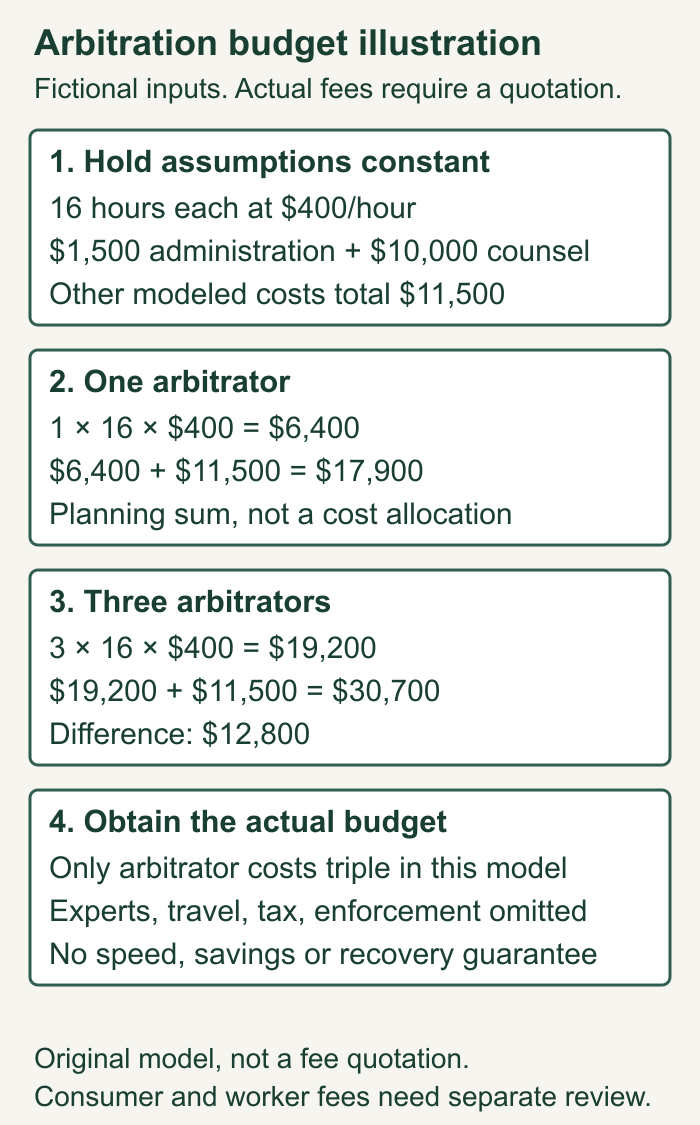
Check the administrator's current rules and fee information before negotiating. The AAA commercial rules and fee resource distinguishes rules, forms and administrative fee materials, with current and archived versions. This article has not adopted its fee amounts. Save the version and actual quotation used for your transaction.
An original clause structure with annotations
Complete and legally review every bracketed item. The structure deliberately leaves commercial and procedural choices visible. It is not an institution's standard clause or an assurance that a court will enforce the result.
ARBITRATION STRUCTURE
Covered disputes: [define the parties, agreements and disputes submitted to arbitration, plus any deliberate exclusions].

Those covered disputes will be submitted to arbitration administered by [exact institution] using [identified rules and applicable-version convention].

The legal seat will be [city and jurisdiction]. The tribunal will consist of [number] arbitrator(s), selected through [workable appointment process]. The proceeding's language will be [language]. Hearing arrangements and information exchange will follow [reviewed provisions consistent with the applicable rules].

Before commencing arbitration, the parties will [defined negotiation or mediation step, notice trigger and end point]. That step will not prevent action needed to preserve applicable deadlines or seek [reviewed urgent relief].

Advance deposits, unpaid deposits, administrative charges, arbitrator fees, party legal costs and any eventual cost allocation will be addressed by [reviewed rule and contractual provisions].

Confidentiality obligations and permitted disclosures will be [defined separately]. Governing law, any separate arbitration-agreement law, available court relief and award enforcement will follow [coordinated, reviewed provisions].
A completed fictional negotiation note for Fieldstone proposes AAA administration under its Commercial Arbitration Rules, one arbitrator, a New York City seat, English language and proportionate documents-only treatment where the rules and tribunal permit. It proposes a 20-calendar-day negotiation window after receipt of the dispute notice, without blocking rights-preserving or urgent steps. Counsel still checks suitability, assent, procedural fit, cost allocation and the completed legal text.
If notice is received October 5, 2026 and the parties' agreed counting convention excludes the receipt date, day 1 is October 6 and day 20 is October 25. The ordinary next step under that illustrative convention would begin October 26. Those dates are not statutory limitation periods or institution-mandated deadlines. Ask counsel about applicable filing limits and any needed tolling arrangement. Preserve the notice and delivery evidence.
Follow the dispute through the process
- Preserve the agreement and claim evidence. Assemble the accepted contract version, order, delivery record, invoices and correspondence. Identify the actual parties and any disputed acceptance or coverage.
- Check notices and deadlines before escalation. Apply the reviewed negotiation or mediation trigger. Calendar legal limits separately from the contractual waiting period; obtain advice before assuming a conversation pauses them.
- File under the correct package. Check the administrator's demand requirements, serving the other party, relevant rules and required payment. Record any timely jurisdiction objection and any court application separately.
- Select the tribunal and plan the evidence. Review qualifications and conflicts, then identify documents, witnesses, expert questions and a workable hearing method. Under AAA Commercial R-22 and R-23, planning and information exchange should fit the dispute while preserving a fair opportunity to present it. A streamlined procedure is not permission to hide necessary evidence.
- Read the award and obtain deadline advice promptly. Separate compliance, enforcement, any permitted institutional review and a possible court challenge. The clause alone does not identify the correct court or every filing deadline.
For Seabright's fictional technical dispute, a focused evidence plan would identify the test protocol, retained samples, inspection records, specifications and the expert question actually in dispute. Ask how electronic records will be exchanged and whether witnesses need to be heard. For Fieldstone's invoice, the delivery and acceptance records may be the starting point. Neither plan guarantees that documents-only treatment will be suitable.
Private proceedings and court review need separate treatment
Specify the confidentiality commitments you need rather than assuming the word “arbitration” supplies a complete agreement about disclosure. Define covered information, persons bound, advisers, witnesses, compulsory disclosures and any court filings. Coordinate this with the confidentiality clause. AAA's drafting guidance expressly lists confidentiality as a choice to consider.
“No court review” is too broad. 9 USC section 10 identifies specified grounds for vacating an award, including corruption or fraud, evident partiality, certain prejudicial misconduct and arbitrators exceeding their powers. This is not a general rehearing of every disputed legal or factual conclusion. Applicable review routes, deadlines, jurisdiction and any agreed appellate procedure require legal analysis.
Section 4 also provides a district-court petition route for alleged refusal to arbitrate under a written agreement, subject to its conditions, including an independent jurisdictional basis. Arbitration does not remove every role for a court.
Do not promise that a drafting sentence creates a general judicial appeal for legal mistakes. In Hall Street Associates v Mattel, 552 US 576 (2008), the majority held the statutory grounds exclusive for the FAA's expedited award-review mechanism. It left other possible avenues of enforcement outside that mechanism open. A reasoned award may help explain the decision, but it does not itself expand that court-review standard.
Cross-border clauses require a separate jurisdiction check
The US examples do not supply a worldwide enforceability test. For England, Wales and Northern Ireland, Arbitration Act 1996 section 7 separately treats an arbitration agreement as distinct from its surrounding agreement unless the parties agree otherwise. That provision is one part of the applicable framework, not authority to export the FAA's delegation, court-review or worker rules. Identify the seat, arbitration-agreement law, mandatory safeguards and possible enforcement destinations with local counsel.
For Seabright, write down where counterparties and assets are located before choosing the seat. Ask counsel about the applicable recognition regime, arbitrability and enforcement defenses in those jurisdictions. A well-drafted process is of limited practical value if the award cannot reach relevant assets. No cross-border recovery result is assumed here.
Copy a dispute-process worksheet
ARBITRATION REVIEW RECORD
Agreement version and parties:
Likely disputes, amounts and evidence:
Covered disputes and deliberate exclusions:
Administrator, rules and saved version:
Seat / hearing arrangements / language:
Number, expertise and appointment process:
Substantive law and arbitration-agreement law:
Notice, escalation and end point:
Urgent relief and deadline-preserving action:
Actual fees, deposits and nonpayment procedure:
Party costs and final allocation powers:
Confidentiality and permitted disclosures:
Asset locations and enforcement advice:
Statutory scope, exceptions and counsel decision:
Completed Fieldstone review record
FICTIONAL PROPOSAL, PENDING LEGAL REVIEW
Parties: Fieldstone Design and its business customer
Likely dispute: $12,000 invoice; order, delivery acceptance, invoice
Scope: this services agreement and identified orders; exclusions unresolved
Proposed administrator/rules: AAA Commercial; version convention unresolved
Proposed seat/language: New York City / English
Tribunal: one arbitrator; appointment and conflicts follow reviewed rules
Evidence proposal: proportionate document exchange; documents-only if appropriate
Notice proposal: 20 calendar days from receipt, excluding receipt day
Urgent action/deadlines: preservation route and legal limits require counsel
Costs: actual fees and payment obligations not yet obtained
Illustrative comparison: $17,900 versus $30,700 under invented equal-hour inputs
Confidentiality: define adviser, witness and compulsory-disclosure exceptions
Open legal decisions: assent, scope, governing law, delegation, remedies, costs
Decision: compare the available court route before approving final text
The unresolved entries are deliberate. This record converts a preference for arbitration into questions a reviewer can answer. It does not present fictional choices as agreed terms or an approved clause.
Before-signing checklist
- Confirm the actual agreement, contracting parties and evidence of assent.
- Identify covered parties, disputes, documents and exceptions.
- Check the applicable legal framework, statutory exclusions, contract defenses, delegation and any class or collective-action waiver.
- Choose a coherent administrator, rules, seat and appointment process.
- Obtain actual charges and a proportionate budget.
- Resolve escalation, urgent relief, confidentiality and court provisions.
- Record counsel's decision and save the final clause with the agreement.
Send the completed worksheet with the full agreement and competing document terms using the lawyer review packet. Explain the choice you need, such as a proportionate process for small invoices or a workable cross-border procedure, rather than asking only whether the clause looks standard.
Frequently asked questions
What makes a useful arbitration clause?
Clear scope and a workable procedural package: administrator, rules, seat, arbitrator selection, language, costs and coordinated exceptions. It also needs legal fit and actual agreement. A detailed clause is not automatically enforceable.
Can you sue despite an arbitration clause?
It depends on agreement, scope, statutory limits and the relief sought. A court may address enforceability or specified award-related issues. Do not assume every court proceeding is barred merely because the contract contains the clause.
Are arbitration clauses illegal?
The FAA provides an enforcement framework with important limits, including the provisions discussed above. Particular arrangements need their applicable legal analysis. A label or broad sentence does not resolve those limits.
Should I agree to arbitration?
Compare the likely disputes, procedures, actual costs, practical access and enforcement needs with the available alternatives. Review who pays deposits and what happens if a party does not pay. No universal answer fits both fictional examples.
Does arbitration guarantee confidentiality?
Define the required obligations and check the relevant rules and law. Distinguish a private hearing from a complete duty binding every participant and addressing permitted disclosures. Court-related steps also need consideration.
Is the seat the same as the hearing location?
Identify them separately. The seat is the proposed legal place of arbitration. The parties may propose remote or other hearing arrangements, subject to the applicable framework, without treating that proposal as a change of seat.
What is a delegation clause?
It addresses who decides specified threshold questions about arbitration. Check the precise language, evidence of agreement, any specific challenge and statutory overrides. Rent-A-Center does not make every delegation provision immune from judicial scrutiny.
Does an invalid main contract automatically invalidate arbitration?
Not under the severability rule applied in Buckeye. A whole-contract validity challenge differs from a challenge specifically to arbitration and from whether agreement ever occurred. Counsel should identify which objection the facts actually support.
Can a class-action waiver be included?
It requires separate review. Concepcion preempted a particular California rule in its consumer setting; it is not a universal approval of every group-action restriction. The statutory election for covered assault or harassment cases also reaches predispute joint-action waivers.
Can I opt out or refuse to arbitrate?
Check whether the actual agreement provides an opt-out, its required method and deadline. Preserve proof of a timely election. A requested deletion before acceptance and refusal after accepting a potentially enforceable clause raise different questions. Obtain advice before ignoring a demand or court application.
Is arbitration always cheaper or faster?
No result is guaranteed. Tribunal size, information exchange, counsel, experts, hearings and later enforcement can change the budget. The fictional cost comparison isolates one component and does not establish market savings or time to resolution.
Can I appeal an arbitration award?
Court challenges and any agreed institutional appeal require separate analysis. FAA section 10 provides limited grounds for vacatur. Hall Street rejects contractual expansion of the FAA's expedited review mechanism; a disappointing result alone is not a general merits appeal.
Which rules apply to an individual contractor?
Check the substance of the work relationship and administrator rules. AAA's workplace rules cover specified disputes with unincorporated individual contractors. A business-to-business label or reference to commercial rules should not substitute for that check.
Sources
- 9 USC section 2, written maritime or commerce agreements and enforcement limits; statutory text reproduced by Cornell LII.
- 9 USC section 1, specified employment exclusion; statutory text reproduced by Cornell LII.
- Bissonnette v LePage Bakeries, 601 US 246 (2024), Court opinion in the newer U.S. Reports preliminary page proof reproduced by LII; transportation-worker scope and reserved issues. The proof remains subject to formal revision.
- 9 USC section 401, definitions and March 3, 2022 effective-date note; statutory text reproduced by Cornell LII.
- 9 USC section 402, covered cases, election, joint-action waivers and court determination; statutory text reproduced by Cornell LII.
- First Options of Chicago v Kaplan, 514 US 938 (1995), unanimous Court opinion, official bound U.S. Reports; agreement and arbitrability.
- AT&T Mobility v Concepcion, 563 US 333 (2011), majority opinion, official bound U.S. Reports; contract defenses and preemption of the Discover Bank rule.
- Buckeye Check Cashing v Cardegna, 546 US 440 (2006), majority opinion, official bound U.S. Reports; severability, validity and the formation distinction.
- Rent-A-Center, West v Jackson, 561 US 63 (2010), majority opinion, official bound U.S. Reports; specific challenges to delegation.
- Coinbase v Suski, 602 US 143 (2024), Court opinion in the current official preliminary print; conflicting arbitration and court provisions. The proof remains subject to formal revision.
- AAA clause-drafting guidance, commercial models and procedural choices, inspected October 6, 2026.
- AAA Consumer Arbitration Rules, effective May 1, 2025; R-1, R-9, R-10 and R-12, downloaded from the current resource page.
- AAA Employment/Workplace Arbitration Rules, effective May 1, 2025; R-1 and due process requirements, downloaded from the current resource page.
- AAA Commercial Arbitration Rules, effective September 1, 2022; R-22 and R-23, downloaded from the current resource page.
- AAA commercial rules, forms and fees resource, current and archived materials, inspected October 6, 2026. No actual fee amount is adopted here.
- 9 USC section 10, specified award-vacatur grounds; statutory text reproduced by Cornell LII.
- 9 USC section 4, district-court petition and jurisdictional conditions; statutory text reproduced by Cornell LII.
- Hall Street Associates v Mattel, 552 US 576 (2008), majority opinion, official bound U.S. Reports; FAA expedited review and issues reserved.
- Arbitration Act 1996 section 7, latest available revised provision inspected October 6, 2026; separability, England, Wales and Northern Ireland.
Prepared with AI assistance. The banner is an AI-generated illustration of fictional adults. The graphic, budgets, scenarios and worksheets are original illustrative aids. No real dispute, administrator quote, speed or savings test, or professional legal review is claimed.