

Service Level Agreement Template: Metrics, Measurement and Remedies
By Anirudh Menon, Viaclause editor
Copy an SLA structure and calculate a complete outage example with maintenance overlap, eligible minutes, response clocks, credit bands and a measurement worksheet.
A service level agreement template is a starting document for defining a covered service, measurable commitments, evidence and the consequences of missing them. Complete the measurement rules before choosing an uptime percentage. “99.9% uptime” leaves open what counts as unavailable, which minutes are measured, what is excluded and which charges support a credit.
The copyable text below covers those choices and includes a fictional filled example. It separates availability, response, restoration and credit calculations. For the surrounding agreement, use the master service agreement template; the SLA should identify that agreement and its order form.
All example targets, fees, incidents and deadlines are illustrative negotiation choices. They are not industry benchmarks or observations of a real service. Review enforceability, incorporation, remedies and transaction-specific requirements under the governing law.
SLA, SLO and SLI: distinguish the promise, target and measure
Google's original SRE chapter on service-level objectives separates the indicator being measured, the target for that indicator and the agreement's consequences. For this template, the SLI is measured availability, the SLO is the chosen target, and the SLA records the commitment and consequence. A dashboard target does not by itself establish a contractual remedy.
Make the distinction concrete in the signed schedule. Write which promises are binding commitments, which are operational goals, who measures them and what follows a miss. A response-time commitment and a restoration goal can coexist. An internal engineering error budget can guide release decisions without becoming the customer's credit entitlement.
Choose the structure for your relationship
- Customer-based: one customer's covered services and agreed exceptions sit together. The owner can review a single relationship, but must distinguish each service's measurement and remedy.
- Service-based: a common service schedule applies to covered customers through their agreements. Identify the actual version incorporated into each customer's order.
- Multilevel: shared rules, customer terms and service-specific schedules work together. State which layer changes a named commitment; avoid contradictory clocks or credit rules.
- Internal: two teams agree handoffs, owners and escalation within the same organization. Record operational accountability without assuming an internal team arrangement is a separate enforceable contract between legal persons.
These are useful drafting arrangements, not an exhaustive statutory classification. This article's example is an external customer-specific application schedule. An internal help desk may use the same measurement record but a management escalation instead of a customer invoice credit. A construction engagement needs its own safety, milestones and acceptance terms; copying a cloud uptime clause does not supply those.
Decide what the service commitment covers
Fictional scenario: Orion Service hosts an order-processing application for Beacon Supply. The covered function is submitting a valid order through the production application’s named endpoint. Beacon wants that function measured, rather than a server being powered on while order submission fails.
| Decision | Filled illustrative choice | Evidence or owner |
|---|---|---|
| Covered service | Named production order-submission endpoint for Beacon | Endpoint and test specification in Schedule A |
| Measurement window | UTC calendar month, minute intervals, end boundary excluded | Jointly accessible monitoring export |
| Unavailable minute | The agreed valid synthetic order fails from both agreed monitor locations | Timestamped test outcomes and incident log |
| Scheduled maintenance | Documented window notified 48 hours ahead, no more than 120 excluded minutes monthly | Notice and approved window record |
| Availability target | At least 99.9% of eligible minutes | Unrounded calculation, service owner |
| Credit basis | Covered monthly recurring service fee; no unrelated charges | Order form and invoice |
Define success, authentication, the endpoint and the monitoring method in the test specification. A failed customer internet connection and an application failure are different facts. Do not exclude either merely because someone selected a convenient incident label. Missing monitoring data needs a reconciliation process, rather than automatic treatment as available.
The statement of work template helps align the service description with deliverables and dependencies.
Choose a metric that captures the customer's task
Google's SRE Workbook, Implementing SLOs, distinguishes the service outcome from its measurement implementation and explains ratios of successful events to eligible events. Server logs, external probes and client instrumentation can observe different failures. Use that distinction when deciding what evidence the contract accepts.
The following original alternatives show the decisions to complete; their thresholds are fictional choices, not supplier or industry standards:
| Commitment | Complete definition | Review risk |
|---|---|---|
| Availability | Successful eligible minutes divided by all eligible minutes, using the agreed application test. | A healthy server may coexist with a failed customer workflow. |
| Request success | Successful valid submissions divided by all included valid submissions. | Decide how retries, duplicates and rejected invalid requests count. |
| Latency | Included valid requests completed within a specified duration divided by all included valid requests. | State the start and end events; an average can conceal slow requests. |
| Batch delivery | Named jobs delivered with the agreed quality by their due times divided by all jobs due. | Completion alone does not establish correctness or required coverage. |
| Support response | Qualifying incidents receiving the defined human action within the agreed covered clock. | An automated acknowledgment and resolution are different events. |
Separate fictional request example: 19,960 successful valid submissions out of 20,000 included valid submissions give 99.8% success. That is an event ratio, not the Orion minute-based availability below. Do not mix the 40 failed requests into a minute denominator. Keep any request-success commitment in a separately identified schedule with its own consequence.
Before agreeing a target, compare the proposed test with representative failure records. Ask whether an unavailable dependency, a failed authentication step or a partially completed order is observed. Agree how disputed and missing observations are reconciled, who can inspect the export and who approves measurement changes. Preserve the original records when the method changes.
Copyable SLA template: scope and measurement
Replace every bracketed item and reconcile this schedule with the complete contract. This text is editable by copying it into your document. No downloadable Word or spreadsheet file is claimed.
SERVICE LEVEL SCHEDULE
Parties: [Provider] and [Customer]
Related agreement / order form / version: [identify]
Effective date and review owner: [complete]
Covered production service and customer environment: [identify]
Excluded products, beta features and environments: [list expressly]

Availability target: [percentage] during each [defined window and time zone]. Measurement uses [interval size] and [agreed test and observation sources]. An interval is unavailable when [objective failure condition]. Missing or conflicting observations must be jointly reconciled using [sources and process].

Eligible intervals equal all intervals in the covered window less documented intervals excluded under this schedule. Eligible unavailable intervals are unavailable intervals within that eligible set. Availability equals 100 × (eligible intervals minus eligible unavailable intervals) / eligible intervals. Compare the unrounded result with the target. If no eligible intervals exist, record the result as undefined and review the window; do not report 100%.

Exclusions: [specific events, evidence, notice requirements and maxima]. Remove overlaps once. Any maintenance overrun or excess above an exclusion maximum is measured normally unless another agreed exclusion applies. Changes to scope, tests or exclusions require the documented contract change process; preserve prior measurements.
This particular formula removes an excluded minute from both the measured set and any unavailable overlap. Other agreements can define exclusions differently. Use the actual formula consistently. Do not borrow a provider’s percentage while substituting your own measurement rules.
Copyable SLA template: response, remedies and review
INCIDENT AND REMEDY SCHEDULE
Severity definition: [business impact and affected function]
Reporting channel / monitoring alert / escalation contacts: [identify]
Response clock starts: [precise event and evidence]
Coverage: [24/7 or defined business hours, zone and holidays]
Initial human response commitment: [duration and required action]
Update cadence: [duration and information required]
Restoration commitment or separate non-binding goal: [identify clearly]
Customer dependencies / permitted clock pauses: [evidence and restart]

Credits: [performance bands] × [specified eligible fee]. State the period, maximum, application method, claim recipient, submission deadline and evidence. Reconcile overlapping credits and damages for the same failure. State expressly whether credits are the exclusive remedy for a defined failure, and identify any preserved remedies, termination rights and mandatory legal limits in the complete agreement.

Reporting: [owner] issues a measurement and incident report by [date]. Records include raw observations, excluded intervals, overlap adjustments, unrounded result, response timestamps and credit calculation. Disputes follow [recipient, review deadline and escalation procedure].

Review and changes: [frequency, participants and version control]. Changes require [agreed authorisation process] and a new effective version. Review repeated failures against the agreed escalation or termination provisions.
A restoration goal should not be presented as a binding promise in one place and an aspiration elsewhere. Define any customer-dependency pause with its evidence. If a remedy amount functions as agreed compensation, the liquidated damages guide helps prepare the separate legal-review questions.
Filled incident: overlap changes the denominator
Use the following fictional September 2026 record. The covered window runs from September 1 at 00:00 UTC to October 1 at 00:00 UTC, excluding the final boundary. It contains 30 × 24 × 60 = 43,200 minutes.
The agreed maintenance exclusion is September 12 from 02:00 to 04:00 UTC: 120 minutes. A qualifying outage runs from 03:40 to 05:00 that day: 80 minutes. Twenty outage minutes overlap the maintenance window. Assume the maintenance notice and all other conditions are satisfied and there are no other exclusions or outages.
| Step | Calculation | Result |
|---|---|---|
| All measured minutes | 30 × 24 × 60 | 43,200 |
| Eligible denominator | 43,200 − 120 maintenance minutes | 43,080 |
| Eligible unavailable minutes | 80 outage minutes − 20 overlapping excluded minutes | 60 |
| Availability | 100 × (43,080 − 60) / 43,080 | 99.860724…% |
| Comparison with 99.9% | Use unrounded result | Target missed |
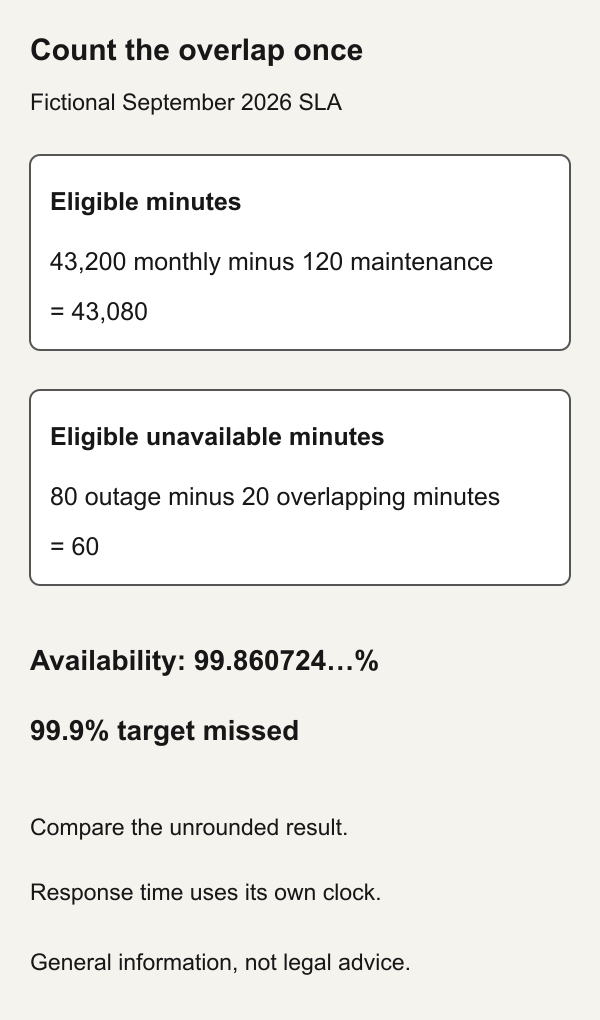
Under this formula, a 99.9% target allows 0.1% of 43,080 eligible minutes: 43.08 minutes. The example’s 60 eligible unavailable minutes exceed that allowance. Rounding the result to one decimal place would display 99.9% and conceal the miss. Keep the full calculation for the comparison, even if a report uses fewer display decimals.
Do not subtract all 80 minutes from the already reduced denominator: that would charge the maintenance overlap again. Equally, do not remove the entire outage merely because it began during maintenance; the 04:00 to 05:00 period remains eligible in this example.
Response time is a separate calculation
Orion’s agreed response clock starts at the monitoring alert at 03:40 UTC, with 24/7 coverage and a 15-minute initial human response commitment. A qualified person acknowledges the incident and starts triage at 03:52: 12 minutes, meeting that illustrative response commitment. An automated receipt alone would not satisfy the defined human action.
The service is restored at 05:00. That is 80 elapsed minutes after detection, regardless of the availability exclusion. The example has a two-hour restoration goal, not a contractual guarantee. Meeting the response commitment or that goal does not erase the monthly availability miss. Define each clock and consequence separately.
Fill the credit rule without assuming every remedy is exclusive
For this fictional schedule, the negotiated bands are: no credit at or above 99.9%; a 5% credit below 99.9% but at or above 99.0%; and a 10% credit below 99.0%, with a 10% monthly maximum. These are illustrative choices, not borrowed supplier terms or legal standards.
The covered recurring monthly fee is $2,000. The 99.860724…% result falls in the 5% band: $2,000 × 5% = $100. Assume the completed example requires a supported claim to the named service owner within 30 calendar days after the measured month ends, with the approved credit applied to the next invoice. State the deadline’s reference event and recipient in the final agreement.
The complete contract must decide exclusivity, same-loss overlap, repeated failures and termination rights. Use the existing outage-credit claim guide for claim execution and the vendor breach facts record for a wider obligation dispute.
Jurisdiction and supplier examples have limits
US federal performance-based service contracts: FAR 37.601 requires a performance work statement, measurable performance standards and a method of assessing performance, with corresponding incentives where appropriate. This is federal procurement scope, not a rule making every private SLA enforceable.
A particular supplier policy: Amazon’s Compute SLA, displayed update May 25, 2022, distinguishes region-level and individual-instance commitments, defines unavailability, sets credit procedures and exclusions, and limits remedies subject to its agreement. Architecture and definitions matter. Its specific commitments do not establish a universal SaaS uptime target or right to damages. No AWS account, incident or credit request was tested here.
US federal surveillance: FAR 37.604 addresses preparation of the Government's quality-assurance surveillance plan and refers to the applicable quality-assurance requirements. It illustrates why a measurable standard also needs a documented assessment process. It does not impose a private-sector SLA template.
Electronic form in US commerce: 15 U.S.C. section 7001(a) and (b) prevents denial of legal effect solely because of electronic form or signature within its scope, while preserving other rights and obligations. It does not make unclear service terms or unauthorized assent effective. Subsections (d) and (e) address retained records and accurate reproducibility. Save the agreement and incorporated SLA version, rather than only a changeable web link.
Separate India note: Indian Contract Act 1872, section 73, addresses compensation for breach, including natural or contemplated loss, exclusion of remote and indirect loss, and available means of remedying the inconvenience. An outage log alone does not settle that analysis. Assess an Indian agreement's actual remedy and applicable law separately; the fictional US credit rule is not an Indian damages rule.
Another supplier policy: Google's current Compute Engine SLA, displayed modification March 4, 2025, distinguishes service configuration and network tier, defines qualifying downtime periods, requires a supported credit request and limits stacking and remedies. Its measurement and credit conditions are its own. Comparing it with AWS demonstrates why a percentage should travel with its scope, definitions and evidence process, rather than being copied into a different service.
Identify the governing agreement, law and document hierarchy before treating an SLA as an enforceable obligation. A signed order form, an incorporated schedule and a public policy can play different roles in the transaction. Our order form versus master agreement guide helps record conflicting terms for resolution.
Review cadence, security and repeated failures
Specify a monthly calculation owner and report delivery date, then choose a separate review cadence appropriate to the service. Do not quietly replace last month's measurement method during a quarterly discussion. A change record should state its effective window, revised test, target, exclusion and credit terms, along with any unchanged commitments.
A security incident, a data-restoration failure and an availability miss can overlap without being identical. Identify any separate security, breach-notice, backup and recovery obligations in the governing documents. Restoring access does not prove that data remained correct or that every notification duty was met. Keep these obligations in their appropriate schedules and cross-reference the incident record.
For recurring failures, complete a defined review or exit trigger: the relevant metric, number of qualifying windows, notice route, review or cure period and resulting right. Distinguish that right from the credit calculation. Neither the template nor an incident count automatically creates a termination right. Track unresolved exclusions and disputed records so a repeated-failure clause cannot be evaluated from inconsistent monthly reports.
Measurement worksheet and checklist
MONTHLY SLA RECORD
Covered service / agreement version:
Window start / end / time zone / interval size:
Raw interval count / observation source:
Exclusion intervals / clause / evidence / overlap removed:
Eligible denominator:
Unavailable intervals / overlap with exclusions:
Eligible unavailable numerator:
Unrounded availability / target / comparison:
Alert / human response / restoration timestamps:
Fee basis / credit band / amount / claim deadline:
Disputed records / reconciliation / reviewer:
Report owner / review date / authorised changes:
- Specify the service and an objective failure test.
- Define the window, interval, time zone and data sources.
- State exclusions, notice requirements and maxima.
- Handle missing records and overlapping intervals explicitly.
- Separate response commitments from restoration promises or goals.
- Define credit bands, fee basis, procedure and remedy interaction.
- Resolve document hierarchy and governing-law questions.
- Preserve calculations, evidence and authorised versions.
Frequently asked questions
What does SLA stand for?
Service level agreement. It records the service expectations and how performance and consequences are assessed.
Are SLAs legally binding?
The label alone does not answer that. Review the agreement, incorporation, authority, wording, governing law and applicable requirements. Keep a contractual promise distinct from a non-binding operational goal.
What are customer, service and multilevel SLAs?
They organise commitments around a particular customer, a service used by multiple customers, or several layers of commitments. Whichever structure you choose, specify the covered service and measurements.
What should an SLA measure?
Measure the function and business consequence that matter: availability, response, delivery or quality, with defined tests and evidence. A percentage without a denominator is incomplete.
Are service credits the only remedy?
Read the actual remedy and exclusivity wording alongside the complete agreement and applicable law. The template asks you to decide this expressly; it does not supply a universal rule.
Can I use this template unchanged?
Complete its placeholders and assess the service, monitoring, exclusions, fees, incident process and legal context. The filled Orion example is a calculation exercise, not a ready agreement for another service.
Is 99.9% uptime a daily allowance?
Not under this example's monthly formula. Its eligible monthly minutes produce the allowance. Do not translate it into a guaranteed daily interruption period or assume every supplier uses the same exclusions.
Should scheduled maintenance disappear from every metric?
No. This example removes its agreed excluded minutes from the availability calculation but still measures elapsed incident response and restoration. Each metric needs its own defined treatment.
Can a failed request count as an unavailable minute?
Only if the agreed test and interval rule say so. A request ratio and a minute ratio use different denominators. Preserve the raw evidence and apply the stated classification.
How often should we review an SLA?
Choose reporting and review dates that fit the service and its changes. Keep a periodic review separate from an approved contractual amendment; no universal quarterly or annual legal interval is asserted.
Sources
- FAR 37.601: federal performance-based service requirements; FAC 2026-01, effective March 13, 2026.
- FAR 37.604: Government quality-assurance surveillance plans; same current FAR edition.
- Amazon Compute SLA: particular configuration, definitions, exclusions and credit policy, displayed May 25, 2022.
- Compute Engine SLA: current Google configuration, downtime, tier and credit terms, displayed March 4, 2025.
- Google SRE, Service Level Objectives: original engineering definitions and measurement discussion; not legislation or a current supplier rate sheet.
- Google SRE Workbook, Implementing SLOs: original measurement implementation and event-ratio guidance.
- 15 U.S.C. section 7001: federal electronic-form scope, preserved obligations and retention, reproduced by Cornell LII.
- Indian Contract Act 1872: official India Code, section 73, scoped compensation note.
Prepared with AI assistance. The banner is an AI-generated fictional illustration. The template, Orion and Beacon scenario, calculations, graphic and worksheet are original illustrative aids. No real monitoring, customer incident, supplier performance test or professional legal review is claimed.