

Liquidated Damages Clauses: Estimating Loss Without a Penalty
By Anirudh Menon, Viaclause editor
Build an illustrative delay-loss estimate, calculate daily amounts and caps, prevent overlapping recovery and compare scoped California, New York and federal rules.
A liquidated damages clause sets an agreed amount or formula payable for a specified contractual breach. Its purpose is to address loss in advance, rather than calculate every component after the event. A daily delay amount is one example. Calling it “liquidated damages” does not settle whether the provision is enforceable. Cornell’s liquidated-damages explanation describes the amount-or-formula approach and the risk of punitive provisions.
The useful drafting question is: what anticipated loss does this amount represent, for this breach, over this period? Write down the assumptions before signing. Then have the provision assessed under the governing law and transaction rules, including its interaction with other remedies.
This guide provides a fictional business-services example, a calculation worksheet and scoped US legal sources. It is general information, not legal advice. The example’s rates and periods are invented for illustration, not market prices, actual loss evidence or a legal safe harbour.
Start with the breach and the loss being addressed
A clause triggered by “any breach” can cover events with very different consequences. Define the specific missed milestone, the delivery or acceptance test, the counting method and the point at which accrual ends. The statement of work guide helps identify the deliverable and its evidence before a damages formula is added.
Keep three questions separate:
- Calculation: does the proposed amount accurately reflect the assumptions?
- Legal validity: does the clause satisfy the applicable rule, considering the contract and circumstances?
- Application: did the defined breach occur, and which days and exclusions apply?
A spreadsheet can answer the first question while the other two remain unresolved. Record those unresolved issues in the contract review checklist rather than marking the clause approved because its arithmetic works.
A worked pre-signing delay-cost estimate
Fictional scenario: Elm Systems is delivering a processing tool to Harbour Supply. Harbour expects to keep a temporary manual process running if delivery is late. Before signing, the parties consider the following daily incremental costs. Each value is a fictional planning assumption that a real transaction would need to substantiate.
| Anticipated incremental item | Illustrative calculation | Daily estimate | Real evidence to obtain |
|---|---|---|---|
| Temporary processing contractor | 2 hours × $80 | $160 | Workload basis and quoted incremental rate |
| Additional queue coordination | 1 hour × $60 | $60 | Extra work and cost basis, not routine salary again |
| Additional reconciliation | 1 hour × $40 | $40 | Separate task; confirm no overlap with processing |
| Gross anticipated daily cost | $160 + $60 + $40 | $260 | Component owners and dated assumptions |
| Avoided Elm daily operating charge | Deduct $20 | ($20) | Agreement that the charge is not payable during delay |
| Net anticipated daily loss | $260 − $20 | $240 | Legal review of the loss categories and uncertainty |
The anticipated loss is uncertain because the actual extra hours, workload and availability of a workaround may vary. That uncertainty is an assumption to examine, not proof that a court will accept liquidation. If the supposed loss is readily ascertainable or the extra work would occur anyway, explain that to counsel rather than manufacturing an estimate.
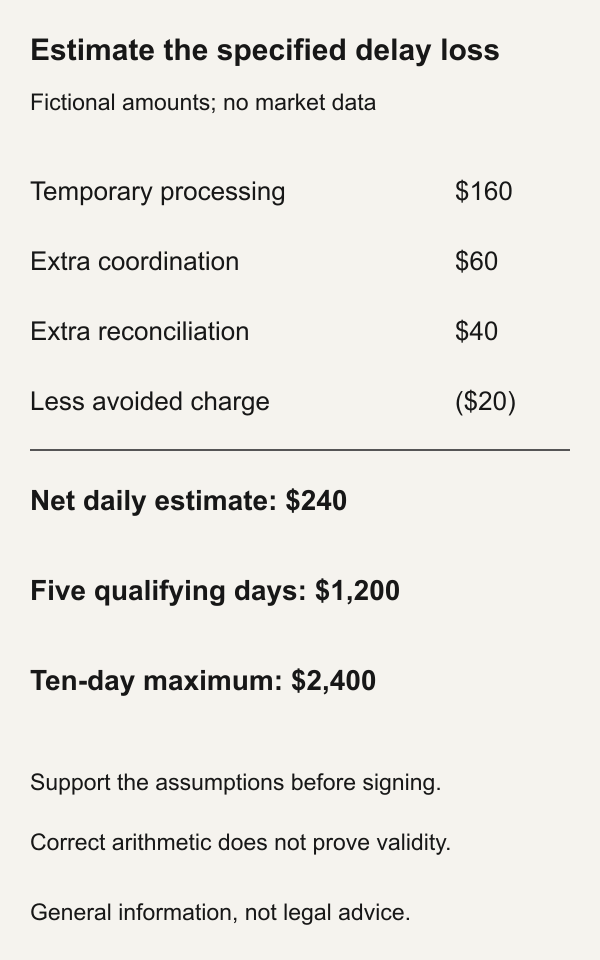
Five eligible delay days produce 5 × $240 = $1,200. The planning model assumes a replacement process becomes available after ten eligible days, so the proposed maximum is 10 × $240 = $2,400. That ten-day assumption must be supported and reviewed in a real deal. Fifteen eligible days would still produce $2,400 under this cap, not $3,600. The cap ends accrual of this agreed amount; it does not itself authorise indefinite non-performance.
Write the trigger, exclusions and cap together
The following is a discussion draft for the fictional model, not a complete contract or an approved clause. Schedule A would need objective delivery tests, evidence and the deadline. Counsel must resolve governing law, causation, excused delay, termination, aggregate liability limits and the consequences of an invalid clause.
For Elm Systems' failure to deliver the processing tool meeting the objective delivery requirements in Schedule A by the stated deadline, the agreed liquidated damages are $240 for each complete 24-hour period of qualifying delay after that deadline, ending when conforming delivery is made, up to a total of $2,400.

Qualifying delay excludes periods caused by Harbour Supply's failure to provide the agreed prerequisites and periods excused under the Agreement's specified delay provisions. The parties shall record the affected periods and their supporting evidence without counting overlapping exclusions twice.

This amount addresses only the temporary-processing, additional coordination and additional reconciliation losses described in the dated estimate, net of the avoided Elm operating charge. It replaces actual damages for those same delay losses. Any service credit paid for the same losses shall reduce the amount payable here. Remedies for other breaches must be addressed separately, subject to the Agreement and applicable law.
Do not silently change “complete 24-hour period” to “each day or part of a day.” A six-hour delay generates no complete period in this illustrative formula. Set the deadline’s time zone and identify the evidence of conforming delivery. If a grace period is intended, state whether accrual starts after it or reaches back to the original deadline.
For an application exercise, suppose eight complete periods pass after the deadline and two distinct periods are excluded because Harbour did not supply required access. Six qualifying periods remain: (8 − 2) × $240 = $1,440. Do not automatically subtract two categories of excused delay if they describe the same interval. The record needs dates, duration, cause and the clause supporting each exclusion.
Compare the justified estimate with a punitive-looking alternative
| Proposal | What the reviewer should examine |
|---|---|
| $240 per complete qualifying day, maximum $2,400 | Evidence for incremental costs, uncertainty, avoided charges, ten-day replacement assumption and legal validity |
| $25,000 immediately for any delay, including one minute | Why such different delay lengths produce the same amount and how it relates to anticipated loss |
| $240 daily plus actual recovery of the same processing costs | Duplicated loss categories and how the remedies should interact |
| One amount for delivery delay, data loss and every other breach | Distinct harms, evidence and whether each trigger needs separate treatment |
The second proposal looks punitive in this fictional cost model; that observation is not a judicial determination. There is no universal acceptable percentage of contract value or automatic daily rate. Increasing the amount solely to pressure performance leaves the compensation question unanswered.
California, New York and federal procurement use scoped rules
California: Civil Code section 1671, reproduced in the 2025 code edition, distinguishes contexts. Subdivision (b), subject to the stated exceptions, treats a provision as valid unless the challenger establishes unreasonableness under circumstances existing when the contract was made. Subdivisions (c) and (d) apply a different rule to specified personal, family or household purchases or rentals and residential dwelling leases: the provision is generally void, with an exception where actual damage would be impracticable or extremely difficult to fix. Subdivision (a) preserves expressly applicable statutory rules. Classify the transaction before choosing a test; a business example does not settle a consumer or residential clause.
New York: the Court of Appeals in JMD Holding Corp. v Congress Financial Corp., 4 NY3d 373 (2005) discussed reasonable proportion to probable loss and difficulty of precise estimation, while rejecting plainly disproportionate penalties. It found the borrower had not met its burden to obtain summary judgment invalidating the early-termination fee and remitted the case. That result is more specific than a blanket declaration that every negotiated amount is enforceable. The decision also explains that an accepted liquidation supplies the damages measure for the breach, whereas rejection as a penalty leaves actual damages to be proved.
Federal procurement: FAR 11.501 limits use to important timely performance where damage is difficult or impossible to estimate accurately or prove. The rate must forecast compensation rather than punishment. It addresses justified maxima, changing rates and mitigation. These are federal procurement instructions, not a universal commercial-contract checklist or permission to copy a government rate.
These sources show why the calculation and the legal test need separate review. Other jurisdictions and transaction-specific statutes may differ. None of the cited decisions evaluates the fictional $240 model.
Avoid charging twice for the same loss
Map each proposed remedy to a loss category. In the example, temporary processing costs are inside the daily amount. Billing them again as “actual damages” would contradict the discussion draft. A service credit addressing the same delay loss should be reconciled using the agreed overlap mechanism. For a separate outage-credit calculation, use the SaaS service-credit claim guide.
For post-breach evidence and a separate actual-loss calculation, see actual damages for a business contract. Whether a claimant can recover a particular category remains a contract and law question. The breach-of-contract claim guide addresses the wider claim calculation; a liquidated amount is not automatically the total lawsuit value.
Copyable estimate and review worksheet
PRE-SIGNING LIQUIDATED DAMAGES REVIEW
Specified breach / delivery test / deadline and time zone:
Anticipated incremental loss components:
Quantity × rate / evidence / owner / observation date:
Avoided costs deducted / overlapping items removed:
Why loss is uncertain or difficult to estimate:
Proposed amount / counting unit / grace period:
Excused periods / causation / exclusion evidence:
Stop event / maximum / reason for maximum:
Service credits and actual damages for the same losses:
Other remedies / aggregate cap / termination interaction:
Governing law / transaction category / legal assessment:
Unresolved issues / reviewer / agreed final version:
Clause checklist
- Define a specific breach and objective completion evidence.
- Document the pre-signing forecast with support for each component.
- Remove routine, avoided and duplicated costs.
- Explain uncertainty and test different delay lengths.
- State counting units, exclusions, the stop event and maximum.
- Reconcile credits, actual damages and liability caps.
- Check transaction-specific statutes and governing law.
- Preserve the assessment and final agreed version before signing.
Frequently asked questions
Are liquidated damages clauses enforceable?
They can be, but the applicable law, transaction, wording and circumstances matter. The jurisdiction notes above explain different rules; the label or parties’ signatures do not remove that analysis.
What is an example?
The fictional clause charges $240 per complete qualifying day of specified delivery delay, capped at $2,400. Its estimate is transparent, but it still needs legal assessment.
How do I calculate the amount?
Identify anticipated incremental loss, support the quantities and rates, deduct avoided costs and remove overlap. Test the proposed formula across several durations and explain its maximum.
Does “not a penalty” make the clause valid?
No wording substitutes for applying the relevant legal test to the substance. Include the forecast and its assumptions in the review record.
Can I claim liquidated damages and actual damages together?
Check the loss each remedy addresses, the agreement and applicable law. The illustrative wording replaces actual recovery for the same defined delay losses and credits overlapping service credits. It leaves other breaches for separate assessment.
What if the agreed amount is rejected?
JMD describes actual damages being proved when a penalty clause is rejected under its New York analysis. Obtain advice on the applicable jurisdiction and remaining agreement; invalidity is not an automatic award of the stated sum.
Sources
- Cornell Wex: liquidated damages, secondary definition.
- California Civil Code section 1671: 2025 statutory text reproduced by Justia.
- New York Court of Appeals: JMD Holding, March 31, 2005, official opinion.
- FAR 11.501: federal procurement liquidated-damages policy.
Prepared with AI assistance. The banner is an AI-generated fictional illustration. All example rates, tasks, periods, clauses and worksheets are original illustrative aids. No market measurement, real loss, professional approval or judicial assessment of the example is claimed.