

How Much Can You Sue for Breach of Contract?
By Anirudh Menon, Viaclause editor
A claim amount, a court ceiling and money collected are different. Compare filing choices before waiving part of a contract claim.
There is usually no fixed cap. You can sue for the provable loss the breach caused (expectation damages), limited to losses that were foreseeable, reasonably certain and not avoidable through mitigation. That usually means compensatory (expectation) damages, plus foreseeable consequential and incidental losses; nominal damages if no loss is proven; or an enforceable liquidated amount. Punitive damages are generally unavailable for a pure breach. Liquidated-damages, limitation-of-liability and attorney-fee clauses can raise or lower the figure. Your court also has its own limit, and small-claims ceilings vary by state. A supported $9,000 claim, a $6,250 California small-claims ceiling and cash collected are different numbers.
Keep four figures separate: the supported loss, any enforceable contract limit, the amount sought in your chosen court and cash actually collected.
What goes into the supported claim?
Start with the unpaid fee or supported loss, deduct credits and saved costs, and avoid counting the same loss twice. Expectation damages aim to put you where performance would have left you.
Deduct costs the breach saved you; the original contract price is not automatically your damages (First Union National Bank v. Naylor, N.C. Ct. App. 1991). Use our actual-damages calculation, foreseeability and mitigation guide and material-breach guide for those separate questions.
For example, model UCC section 2-715 addresses a goods buyer’s reasonable incidental expenses and consequential losses within its conditions. The applicable state law and contract still control recovery.
Can a liability clause reduce the amount?
Yes, if the clause applies and is enforceable. Check whose liability it limits, covered claims, aggregate or per-claim wording and exceptions. A liquidated-damages formula and a liability ceiling are different.
Use the SaaS liability and indemnity claim map to relate the alleged claim to the relevant cap or exception.
For goods, model UCC section 2-719 permits changes to remedies but addresses an exclusive remedy that fails of its essential purpose and unconscionable consequential-damages exclusions. The state's enacted rule and facts control. A service agreement needs its own governing-law analysis; this goods provision does not validate a service-contract cap.
For a disputed $7,500 cap, show both figures: supported loss before the cap and recovery if it applies. Do not treat a disputed reduction as agreed.
How much can you sue for in small claims court?
California illustrates the difference; these are not nationwide limits. Ordinary small-claims monetary limits are $6,250 under CCP section 116.220 and $12,500 for natural persons under section 116.221, subject to statutory exceptions.
Los Angeles County distinguishes individuals and sole proprietors from LLCs, corporations and partnerships, and warns against splitting a claim. The LLC owner cannot use a personal name to claim the higher limit.
Section 116.231 generally limits a claimant to two small-claims actions over $2,500 per calendar year, with an exception. Check special claim and defendant rules too.
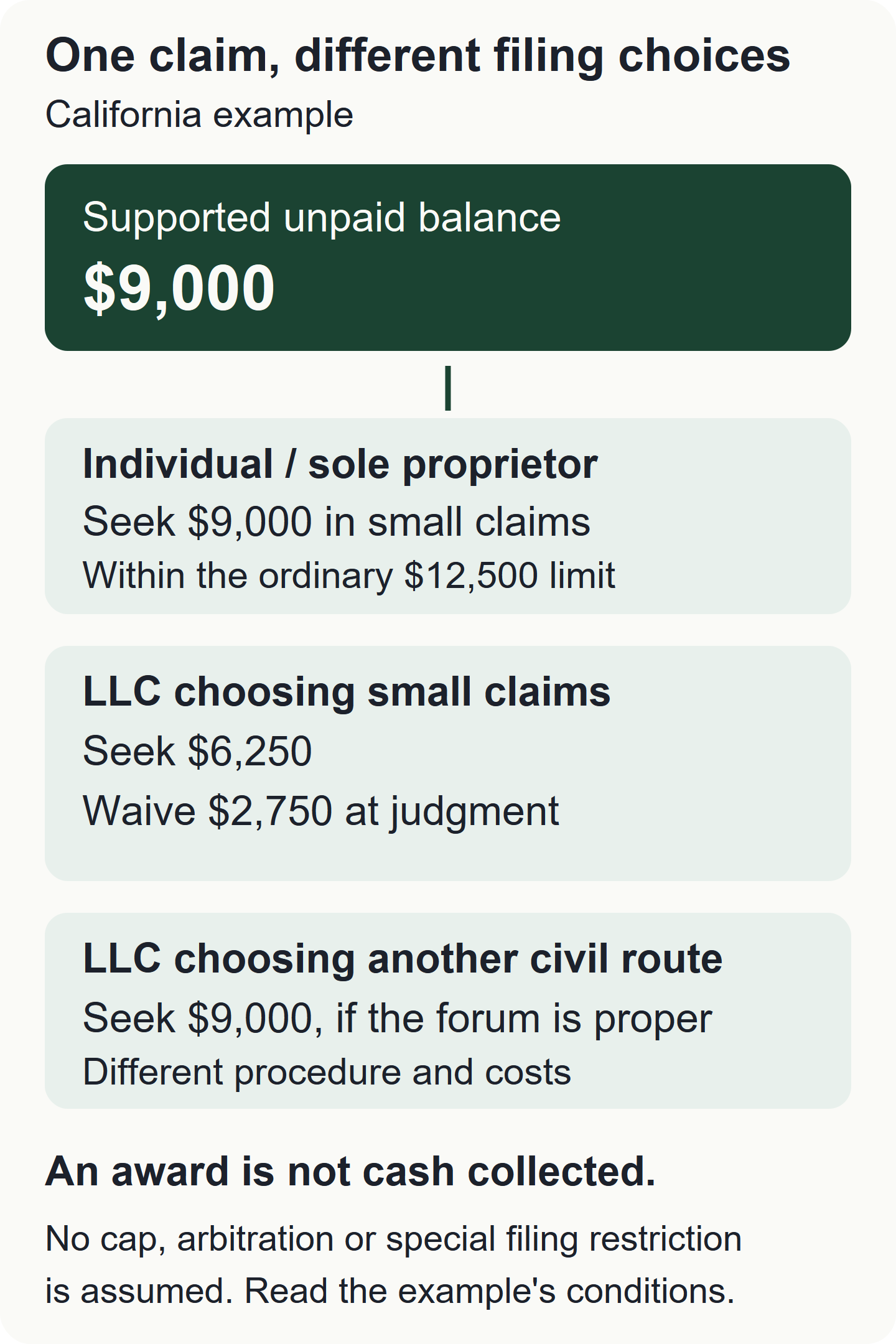
Worked example: the same $9,000 claim, different filing choices
A hypothetical California service-fee dispute. Assume $9,000 is the supported unpaid balance after all credits, the work was completed as agreed, no liability cap or arbitration clause applies, and no special jurisdictional or annual-filing restriction affects the claimant. Interest, court costs and attorney fees are outside the example.
| Claimant and choice | Amount sought | What the choice means |
|---|---|---|
| The contracting claimant is an individual operating a sole proprietorship. | $9,000 in small claims. | The claim fits within the ordinary $12,500 natural-person ceiling, under the assumptions above. The court still decides liability and amount. |
| The contracting claimant is an LLC and chooses small claims. | $6,250, with excess waived. | $9,000 minus $6,250 is $2,750 relinquished through the waiver. The owner cannot save that remainder for a second case on the same claim. |
| The LLC instead pursues the full claim through a suitable civil action. | $9,000. | It preserves the full amount sought, but must satisfy the court's other requirements and account for different procedures and legal costs. Filing for $9,000 does not guarantee a $9,000 award. |
Section 116.220(d) allows waiver where excess amount is the sole jurisdictional problem; the waiver becomes operative at judgment. Choosing the smaller forum does not mean the invoices prove less.
California section 85 sets a $35,000 amount condition for limited civil cases, excluding fees, interest and costs, plus relief-type requirements. It classifies a case; it does not cap contract liability.
Do not split one cause of action to preserve the excess for later. Allstate Insurance v. Mel Rapton discusses that rule in an insurance-subrogation dispute.
Will winning put the full amount in your bank account?
No. The court does not collect for you. Enforcement documents and a debtor examination may help; payment is still uncertain. A $6,250 award with $1,000 paid leaves $5,250 unpaid principal, before adjustments.
Keep expected unreimbursed legal expense separate from the claim. Fee recovery needs a basis, such as California section 1717 for qualifying contract actions with fee provisions; not every legal bill is recoverable.
Complete this record before choosing the amount to demand
Completed example: bookkeeping LLC; supported balance $9,000; no assumed cap; small-claims ceiling $6,250; waiver $2,750; collection prospects unknown. Decide whether to waive that amount or investigate another forum.
CLAIM AMOUNT AND FORUM RECORD
Actual claimant and legal form:
Defendant's correct legal identity:
Contract, governing law and dispute clause:
Supported principal or loss, with evidence references:
Credits, refunds and saved costs already deducted:
Additional disputed losses, listed separately:
Remedy clause, cap, exclusions and unresolved scope:
Proposed court and source for its current limit:
Annual-filing or special-claim restrictions checked:
Amount waived if choosing the smaller forum:
Interest, court costs and attorney-fee basis, separately:
Collection facts known and evidence still missing:
Expected unreimbursed expense, not a damages item:
Decision, responsible person and date:
Use our vendor breach response guide to establish performance, and the email collection guide to preserve supporting correspondence.
Frequently asked questions
Can I sue for more than the contract price?
Sometimes. The contract price is not itself a universal ceiling on recoverable loss. Additional losses need a legal basis, evidence and compliance with applicable limits; an enforceable remedy clause can change the result. Do not multiply the price just because the breach was frustrating.
Can I recover attorney fees?
Only where an applicable legal or contractual basis supports them, and subject to its requirements. Keep fees separate from the underlying loss and do not assume a court will reimburse every legal expense.
Can I add interest to a contract claim?
For example, in California, Civil Code section 3289(b) sets 10% annual interest after breach for a contract entered into after January 1, 1986 that does not stipulate a legal interest rate. It excludes a note secured by a deed of trust on real property. Judgment interest is separate: CCP section 685.010 generally sets 10% on unpaid principal, but qualifying personal-debt judgments below $50,000 and medical-expense judgments below $200,000 against natural persons carry 5% when entered or renewed on or after January 1, 2023. Under section 685.020, interest generally starts at entry; installments have a separate rule. Do not use one rate for every debt or count the same period twice.
How long do I have to sue?
California generally allows four years for an action founded on a written contract under CCP section 337(a) and two years for an oral contract under section 339(1). Other states differ. Special rules can displace those periods, including the sales-of-goods rule expressly excepted in section 339. Identify the governing claim, accrual date and any applicable tolling before calculating a filing deadline.
Can I recover emotional-distress damages?
Generally not for an ordinary commercial breach. In Erlich v. Menezes (1999), 21 Cal.4th 543, California's Supreme Court rejected emotional-distress damages for negligent home construction causing economic injury and property damage without an independent tort duty. It recognized narrow exceptions, including contracts in which emotional well-being is the object. Frustration over an unpaid business invoice does not itself establish an exception.
Does a judgment expire if I cannot collect?
In California, an ordinary money judgment generally becomes unenforceable 10 years after entry unless timely renewed, subject to statutory exceptions: see CCP section 683.020. Renewal is not unlimited for every judgment. Section 683.110 restricts qualifying personal-debt and medical-expense judgments to one renewal. Check the judgment type and renewal deadline rather than assuming a judgment lasts forever. Other states have different rules.
Sources
- California Civil Code section 3360, nominal damages.
- California Civil Code section 1671, liquidated damages.
- California Civil Code section 3294, punitive damages.
- Model UCC section 2-715, goods buyer incidental and consequential damages.
- Cornell LII Wex: expectation damages.
- First Union National Bank v. Naylor.
- Model UCC section 2-719.
- California CCP section 116.220.
- California CCP section 116.221.
- California CCP section 116.231.
- Los Angeles County: How to Sue in Small Claims Court.
- California CCP section 85.
- Allstate Insurance v. Mel Rapton.
- San Mateo Superior Court: What Happens After the Trial.
- California Civil Code section 1717.
- California CIV section 3289.
- California CCP section 685.010.
- California CCP section 685.020.
- California CCP section 337.
- California CCP section 339.
- California CCP section 683.020.
- California CCP section 683.110.
- Erlich v. Menezes (1999), 21 Cal.4th 543.