

What Are Actual Damages? A Business Contract Calculation
By Anirudh Menon, Viaclause editor
Separate damages from a deposit refund, avoid double counting and check a proposed claim against actual cash outlay.
AI-generated editorial illustration by Viaclause. Person and setting are fictional.
Actual damages are money intended to compensate for proven loss, rather than punish the other party. In a business-contract dispute, the question is what loss the breach caused and which measure of recovery the governing law and contract permit. The answer is not automatically the contract price, everything your business spent, or every sale it hoped to make. Start with the definition, then use the worked example below to separate replacement-cost damages from a deposit refund.
Place this issue in context with the contract breach consequences guide before choosing a response.
Common examples of actual damages in a business contract
- Replacement or cover-price difference: the additional cost of equivalent substitute performance, using the applicable measure.
- Repair or correction costs: reasonable costs to address defective performance, where supported by the governing remedy.
- Extra freight or expediting: qualifying additional expenses caused by the breach, rather than ordinary costs already budgeted.
- Returned price or deposit: repayment or restitution, labelled separately from compensation for the replacement-price difference.
- Provable lost profits: supported profit loss, subject to causation, classification and contractual limits.
What counts as actual damages?
The term generally means compensatory damages. Cornell's overview of damages distinguishes compensation from punishment and describes expectation, reliance and restitution as different contract remedies. Do not add those labels together as if each were a separate invoice. First identify the remedy that fits the loss.
| Term | Plain meaning | Question to resolve |
|---|---|---|
| Actual or compensatory damages | Compensation for proven harm. | Which loss, caused by which breach, supported by which evidence? |
| Expectation | The benefit of the promised performance. | What position would performance have produced, compared with what happened? |
| Reliance | A measure based on expenditure in reliance on the agreement. | Is this an alternative theory, and is any amount already included elsewhere? |
| Restitution | Recovery directed at benefits the other party received. | What payment or benefit should be returned? |
| Liquidated damages | An agreed contractual amount or formula for breach. | Is it enforceable, triggered and exclusive for this loss? |
For a breach with no proved loss, nominal damages may be relevant; they are different from a substantial compensation award. Cornell's actual-damages definition makes that distinction. Its discussion also covers tort claims. Do not import examples of emotional-distress recovery into an ordinary commercial-contract demand.
For an unpaid job without signed terms, our contractor nonpayment guide separates an agreed-price balance from a reasonable-value claim and the licensing rules that can bar recovery.
Choose the calculation before adding the numbers
A buyer who receives nothing has a different starting point from a buyer who keeps defective goods. For example, New York UCC section 2-714 addresses accepted goods and requires notification. Its usual warranty measure compares the value at acceptance with the value the goods would have had as warranted, subject to special circumstances. That is not an instruction to demand the full replacement invoice while keeping everything received.
The example below instead concerns a seller's complete nondelivery. Section 2-711 allows specified buyer remedies, including recovery of price already paid, when its conditions are met. Section 2-712 permits a reasonable substitute purchase made in good faith without unreasonable delay. Its cover measure uses the difference between substitute cost and contract price, plus qualifying incidental or consequential damages, less saved expenses.
These are New York goods-law examples. Article 2's scope provision also addresses hybrid transactions. Do not assume the same statutory formula governs a pure consulting engagement or SaaS service. Identify the transaction, governing law and remedy first. For the earlier operational decisions, use our guide to handling a vendor's breach of business contract.
Worked example: a deposit refund is not the cover-price difference
This is a synthetic calculation, not a reported dispute or predicted award. Assume a New York sale of goods, complete nondelivery, a qualifying cover purchase, no remaining payment owed to the original seller, and no applicable contractual remedy restriction. The purchased substitute is equivalent, not an upgrade. Assume the extra freight is reasonable and caused by the breach.
- The original goods cost $10,000, with delivery included.
- The buyer paid a $4,000 deposit. The remaining $6,000 was never paid and is no longer owed in this example.
- The substitute goods cost $12,500, plus $600 extra freight.
- The seller has already returned $1,000 of the deposit.
- There are no other saved expenses or recoveries.
| Component | Calculation | Evidence |
|---|---|---|
| Cover-price difference | $12,500 minus $10,000 = $2,500 | Original order, equivalent replacement order and payment record. |
| Additional freight | $600 | Separate freight invoice and explanation of why needed. |
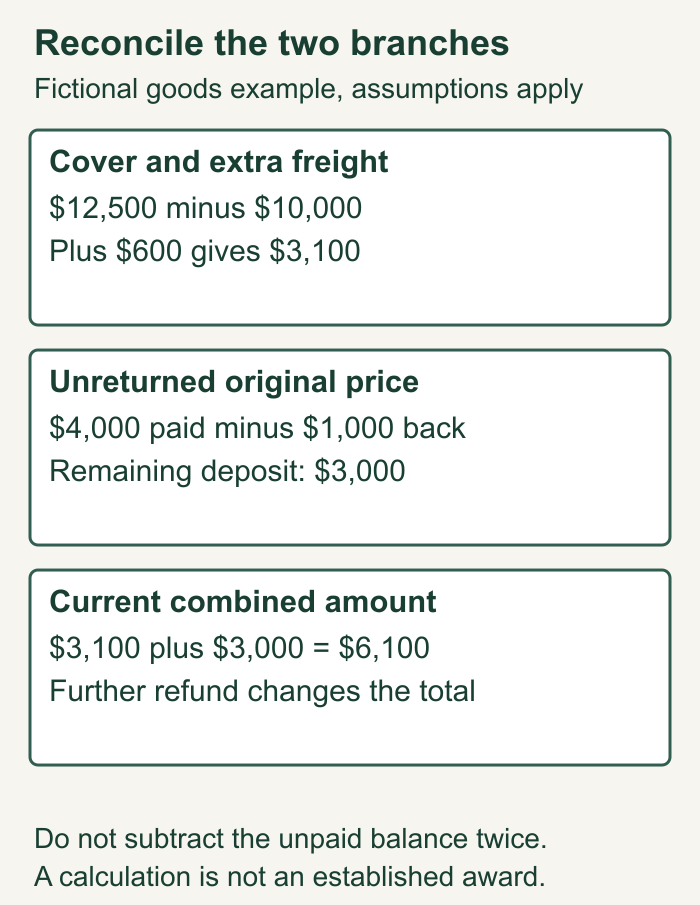
| Damages subtotal in this example | $2,500 + $600 = $3,100 | Reasonableness, causation and remedy review remain necessary. |
| Unreturned deposit | $4,000 minus $1,000 already returned = $3,000 | Deposit payment and refund transaction. |
| Combined remaining amount | $3,100 + $3,000 = $6,100 | Separate refund and damages lines, not a second claim for the same payment. |
Now check the result another way. The buyer's actual net cash outlay is $4,000 + $12,500 + $600 minus $1,000 = $16,100. Full original performance would have cost $10,000. The difference is $6,100. Both routes agree under the stated assumptions.
Two mistakes would distort this example. Subtracting the unpaid $6,000 again from the $3,100 cover calculation would count the original-price allowance twice. Adding the entire $4,000 deposit to the combined remaining amount would ignore the $1,000 refund. Conversely, treating that refund as compensation for the separate $2,500 price increase would erase a different loss. Label what each payment settles.
If the seller returns the remaining $3,000 deposit, the example's remaining amount falls to $3,100. A promise to refund it is not a completed refund: record promised and received amounts separately. If a replacement includes better equipment, different quantities or future services, first allocate the price to equivalent performance. The simple reconciliation no longer answers the whole dispute.
Keep uncertain downstream losses outside the supported subtotal
An invoice can establish a payment without establishing that the vendor must reimburse it. Under New York UCC section 2-715, incidental expenses must meet the statute's requirements. Consequential losses include losses arising from needs the seller had reason to know at contracting that could not reasonably have been prevented by cover or otherwise. Record what the seller knew then, not merely what it learned after the failure.
Suppose the example buyer also lists $20,000 in cancelled customer orders. Do not add $20,000 to $6,100. Preserve the orders, cancellation reasons, replacement-sales evidence and costs that would have been incurred. Gross revenue is not itself a calculation of lost profit. Keep this item on an unresolved schedule while evaluating causation, the correct profit measure, proof and contract exclusions.
Nor does “lost profits” automatically mean consequential damages. In Biotronik v. Conor Medsystems, New York's Court of Appeals held that lost profits under the particular exclusive distribution agreement were general damages. The majority evaluated the agreement's structure; it did not establish that all lost profits escape consequential-damages exclusions. The decision addressed classification, not a universal dollar award. The practical lesson is to read the actual bargain before assigning a category.
Read the remedy clause before turning the worksheet into a demand
Actual loss and legally recoverable damages are not interchangeable totals. New York UCC section 2-719 permits contractual changes to remedies, with limits including failure of an exclusive remedy's essential purpose and unconscionability rules for consequential-damages exclusions. A commercial loss is not automatically outside an exclusion. Neither is every limitation automatically effective in every circumstance.
Map the loss to the SaaS liability and indemnity claim map before treating a headline cap as conclusive.
Record the relevant clause, its scope and any exceptions beside the calculation. Does the cap apply to all claims or only a defined category? Is repair the exclusive remedy? Does a service credit replace another recovery? Do not silently subtract a cap from the accounting loss: show the uncapped calculation and the proposed contractual adjustment separately.
For agreed damages, New York UCC section 2-718(1) applies a reasonableness test and invalidates unreasonably large penalties. Do not stack an agreed amount and actual losses for the same injury without checking what the clause permits. Interest, litigation costs and attorney fees also need their own legal basis and calculation; they are not included in our $6,100 example.
A copyable loss schedule for finance and legal
Use one row for each distinct loss. Attach original records, not just totals pasted into a demand email. Our email-evidence collection guide explains how to preserve related messages. Keep disagreement visible: a documented amount can still have an unresolved legal basis.
Use the breach claim amount worksheet after establishing the supported loss subtotal.
Contract and governing law:
Breach and affected obligation:
Calculation date and owner:
Chosen remedy and legal basis:

For each loss:
Item ID and description:
Amount and document reference:
Connection to the breach:
Equivalent performance or upgrade allocation:
Costs saved, already reflected where:
Refunds or reimbursements received, allocated where:
Other line that could count the same loss:
Contract restriction and exception under review:
Status: supported / disputed / unquantified

Supported subtotal:
Separate return-of-price amount:
Unresolved losses, excluded from subtotal:
Proposed contractual adjustment and reason:
Reconciliation against actual cash position:
Reviewer and remaining questions:
Close the accounting reconciliation before asserting recovery
Give finance and the responsible legal reviewer the same itemized record, including documents that cut the total down. A supported arithmetic subtotal can still have disputed causation or legal classification. Keep the remedy assessment beside the amount rather than relabeling a spreadsheet as an award.
Completed reconciliation record
SYNTHETIC NONDELIVERY RECORD D01
Original equivalent performance: $10,000, delivery included.
Paid original price: $4,000; $6,000 unpaid and assumed not owed.
Equivalent substitute: $12,500; reasonable extra freight: $600.
Original-price refund received: $1,000.
Cover branch: $12,500 minus $10,000 plus $600 = $3,100.
Return-of-price branch: $4,000 minus $1,000 = $3,000.
Combined remaining amount under assumptions: $6,100.
Cash check: $4,000 + $12,500 + $600 minus $1,000 = $16,100;
minus the $10,000 original-performance position = $6,100.
Further received deposit repayment of $3,000: remaining $3,100.
Unpaid refund promise: separate; not treated as received cash.
Excluded: $20,000 cancelled gross sales, profit loss unresolved.
Review: transaction scope, qualifying cover, causation, proof,
remedy restrictions and any proposed settlement allocation.
Not claimed: liability established, legal approval or award.
If later evidence changes an assumption, revise the applicable branch and retain the earlier version. For example, a substitute including an upgrade requires an allocation before treating its full price as equivalent performance. A settlement payment may have an agreed allocation or release conditions; identify them before subtracting or stacking it. Do not assume every incoming payment has the same legal purpose.
Loss-schedule checklist
- Identify the governing law, transaction and affected contractual promise.
- Select the applicable remedy measure before collecting totals.
- Give each distinct item a stable identifier and original evidence reference.
- Separate paid costs, unpaid estimates, received refunds and offers.
- Record saved expenses and where they already enter the formula.
- Allocate upgrades and unaffected performance rather than assuming equivalence.
- Check for the same injury appearing under multiple labels.
- Keep disputed profit or other unquantified items outside the supported subtotal.
- Show contractual limits and legal questions separately from the accounting total.
- Reconcile against the actual cash position under explicit assumptions.
- Retain calculation versions and dates as payments or evidence change.
- Obtain appropriate review before presenting an amount as recoverable.
Frequently asked questions
What is the difference between actual, punitive and statutory damages?
Actual damages compensate for proven loss. Punitive damages punish misconduct and are generally unavailable for an ordinary breach of contract. Statutory damages have an amount or range fixed by a statute.
Are actual damages the same as compensatory damages?
Generally, yes. Both refer to compensation for loss. The remedy and its calculation still depend on the claim and governing law; the label alone does not prove the amount.
Can actual damages be more than the contract price?
They can be. A qualifying replacement-price difference and other recoverable losses are not defined simply by the original price. A contractual cap or exclusion may change the recoverable amount. Keep the calculation and the limitation analysis separate.
Can I claim the full replacement invoice?
Not automatically. In the New York cover example, the statutory damages calculation subtracts the original contract price. Recovery of the unreturned deposit is recorded separately. Accepted defective goods and service contracts can require different measures.
Do I have to buy a replacement to recover?
New York UCC section 2-712(3) says failure to cover does not bar other remedies. That does not make avoidable losses recoverable: the requirements for the remedy and any consequential loss still matter.
Are lost profits always consequential damages?
No. Biotronik illustrates why classification depends on the agreement. Identify what generated the profit and what the contract promised, then check proof and any exclusion.
Does a spreadsheet prove actual damages?
No. It organizes a theory and its arithmetic. The contract, underlying transactions, causal evidence and applicable legal measure must support it. An unresolved item should remain visible without being presented as established recovery.
Should an offered refund reduce the current total?
Keep an unpaid offer separate from a completed receipt. Record its proposed allocation and conditions. In the example, only the received $1,000 refund is subtracted from the current cash position; a further received $3,000 would change the remaining amount.
Can the same payment be listed as both deposit loss and replacement cost?
Trace what each line represents and reconcile the combined result against the cash position. The example separates the equivalent cover-price difference from unreturned original price. Do not count the same injury again under a different label.
Sources
- Cornell LII: Statutory damages, statutory amounts or ranges; inspected September 27, 2026.
- Cornell LII: Damages, terminology and contract-remedy distinctions.
- Cornell LII: Actual damages, compensation and nominal-damages distinction; its tort discussion is not a commercial recovery rule.
- New York UCC section 2-102, goods and hybrid-transaction scope.
- New York UCC section 2-711, buyer remedies and return of price.
- New York UCC section 2-712, qualifying cover and damages measure.
- New York UCC section 2-714, accepted-goods measure and notification.
- New York UCC section 2-715, incidental and consequential damages.
- New York UCC section 2-718, subsection 1 on liquidated damages.
- New York UCC section 2-719, contractual remedy limitations and exceptions.
- Biotronik A.G. v. Conor Medsystems Ireland, Ltd., 22 NY3d 799 (2014), majority's contract-specific classification of lost profits.