

Contract Management KPIs: Definitions, Denominators and Owners
By Anirudh Menon, Viaclause editor
Define five contract KPIs with cohorts, clocks and owners. Reproduce renewal and obligation rates from explicit example rows, with missing data kept visible.
Contract management KPIs are selected measures of how well a business creates, approves, performs and renews its contracts. Useful indicators connect a defined population and calculation to a decision: who should remove a delay, check an obligation or resolve an upcoming renewal. A percentage needs its numerator, denominator, reporting period and missing-data count beside it.
A practical starting set is signing cycle time, on-time obligation completion, renewal rate, timely renewal decisions and approved exception coverage. These are five suggested measures, not a universal standard. Choose the ones that answer your team's decisions, then use the contract lifecycle management guide to place their records and owners in the workflow.
This is operational education and not legal advice. The datasets, thresholds and organisations below are fictional. A dashboard status does not establish breach, enforceability, entitlement to a remedy or legal compliance.
Choose a decision before choosing a KPI
Start with a question that someone can act on. If the question is whether procurement is deciding renewals before notice deadlines, a count of signed contracts provides little help. Measure decisions against the relevant deadlines and identify unresolved records. If the question is whether a service team delivers on time, count due obligations at the obligation level.
CLOC's Core 12 legal operations framework describes business intelligence as collecting, organising, analysing and presenting data to support decisions. It does not prescribe this article's five KPIs or formulas. The dictionary below is an original operational design that readers should adapt to their portfolio.
Write the action in plain language: review overdue obligations with the delivery owner, resolve an unknown renewal classification, or investigate a stage whose elapsed time changed. Select a baseline from your own comparable records before setting a target. A new metric cannot demonstrate improvement until its definition and data collection are stable.
A metric dictionary with explicit denominators
Use a named reporting period and an as-of timestamp. Keep the metric version, source extract and exclusions with each published result. The following choices are suggested definitions, not industry benchmarks.
| KPI and cohort | Calculation and boundary | Owner and action |
|---|---|---|
| Signing cycle time: agreements fully signed in the period | Median elapsed time from accepted complete intake to final required signature. Report count and contracts missing either timestamp. Open and cancelled requests have separate age and cancellation reports. | Legal operations owns event quality. Process owners inspect delays by contract type and complexity. |
| Confirmed on-time obligations: obligations due in the period | Number with evidence of completion by their applicable deadline divided by all due obligations. Future obligations are excluded. Missing evidence remains in the denominator and is reported separately. | Delivery owner resolves exceptions. Contract administrator reconciles evidence and authorised deadline changes. |
| Renewal rate: agreements reaching their current term end in the period | Renewed agreements divided by known eligible agreements. Eligibility means continuation was a genuine available business choice under a documented rule. Show eligibility and outcome coverage separately. | Commercial or procurement owner explains decisions and resolves unknown classifications. |
| Timely renewal decisions: actionable notice deadlines in the period | Decisions approved and recorded by the internal decision cutoff divided by all actionable deadlines. The cutoff should allow the agreed notice process. Show missing deadlines and decisions. | Renewal owner checks approaching deadlines and incomplete decisions. |
| Approved exception coverage: signed agreements containing identified policy exceptions | Agreements with all required exception approvals recorded before signing divided by signed agreements containing identified exceptions. Missing approval evidence stays visible. Unreviewed agreements are a separate coverage gap. | Policy owner reviews unauthorised or unverified exceptions. Legal operations maintains approval records. |
The renewal rate measures an outcome; timely renewal decisions measure process execution. They may move in different directions. A deliberate exit can be a good commercial decision while lowering the renewal rate. An automatic renewal can increase the rate while revealing a missed decision deadline. Use renewal ownership to assign the decision and notice tasks separately.
Worked renewal dataset: 75% with a coverage warning
Fictional Northwood Services reviews six agreements whose current terms end in September 2026. Its written eligibility rule includes agreements for which continuation remained a genuine available business choice at term end. A planned, completed one-off project is excluded. Reviewers must document the classification rather than exclude any lost renewal after seeing its outcome.
The snapshot is October 1, 2026 at 00:00 UTC. Each row is one agreement. Copy the CSV text into your own spreadsheet, preserving the IDs and the explicit unknown values.
agreement_id,term_end,eligibility,outcome,reason
R01,2026-09-05,yes,renewed,continuing service
R02,2026-09-10,yes,renewed,continuing service
R03,2026-09-15,yes,renewed,continuing service
R04,2026-09-20,yes,not_renewed,supplier changed
R05,2026-09-25,no,not_applicable,one-off project completed
R06,2026-09-30,unknown,unknown,classification and evidence missing
- Known eligible cohort: R01 through R04, four agreements.
- Confirmed renewals in that cohort: R01 through R03, three agreements. The reported known-cohort rate is 3 / 4 = 75%.
- Eligibility coverage: five classifications known out of six term-ending agreements, or 83.33%. R06 is a visible gap.
- Outcome coverage within the known eligible cohort: four outcomes known out of four, or 100%. That does not resolve R06's eligibility.
Do not title the result simply “portfolio renewal rate: 75%.” If R06 later proves eligible and lost, the result becomes 3 / 5 = 60%. If eligible and renewed, it becomes 4 / 5 = 80%. If genuinely ineligible, it remains 75%. Those are possible resolutions of this fictional row, not estimates of its outcome. The owner must inspect the agreement and decision evidence.
For a spreadsheet with the header in row 1, eligibility in column C and outcome in D, the known-cohort calculation is COUNTIFS(C2:C7,"yes",D2:D7,"renewed") / COUNTIFS(C2:C7,"yes"). Label it accordingly. If there are no known eligible agreements, return “n.a.” rather than zero or 100%. Unknown outcomes within a known eligible cohort must remain in that denominator and be disclosed.
Worked obligation dataset: completion and evidence are different
Northwood also reviews September obligations. This dataset has one row per distinct obligation, with an agreement ID as its parent. The due date means the end of that UTC calendar day, and the snapshot is the same October 1 timestamp. Completion dates represent accepted evidence of completed performance under this fictional procedure.
obligation_id,agreement_id,due_date,completion_date
O01,R01,2026-09-05,2026-09-04
O02,R01,2026-09-10,2026-09-10
O03,R02,2026-09-15,2026-09-16
O04,R03,2026-09-20,2026-09-19
O05,R04,2026-09-25,2026-09-25
O06,R04,2026-09-30,unknown
O07,R04,2026-10-05,unknown
| Measure | Included records | Result |
|---|---|---|
| Due obligations | O01 through O06. O07 is future and excluded. | 6 |
| Confirmed on-time completion | O01, O02, O04, O05 | 4 / 6 = 66.67% |
| Completion evidence available, including late completion | O01 through O05 | 5 / 6 = 83.33% |
| Late completion with evidence | O03, completed the day after its due date | 1 |
| Due obligation with unknown completion | O06 | 1 |
Dividing four on-time records by the five with completion evidence produces 80%. That answers “what share of documented completions were on time?” It is a different measure and must not replace the 66.67% confirmed on-time rate across all six due obligations. If O06 is later confirmed on time, the latter becomes 5 / 6 = 83.33%. Missing evidence alone does not prove that performance was late.
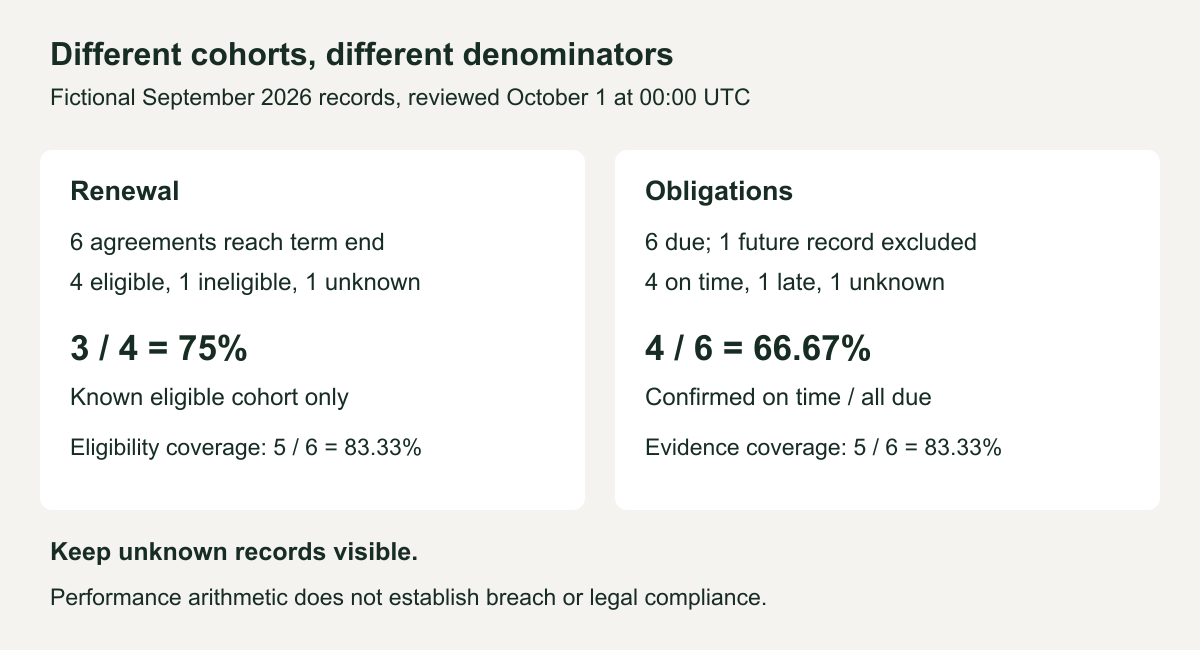
Do not join the datasets and then count agreements from the expanded obligation rows. R04 appears three times in the obligation dataset. Count unique agreement IDs for renewal and distinct obligation IDs for performance. A recurring monthly obligation needs a separate occurrence ID for each due event.
Define clocks and keep unfinished work visible
A completed-contract cycle-time report omits open requests by design. Pair it with the age of open requests, the count of cancellations and timestamp coverage. Otherwise, closing easy requests while leaving difficult ones open can make the completed median look better without improving the backlog.
Use a complete-intake acceptance event consistently. Preserve the original request date separately so incomplete intake does not disappear. State whether elapsed calendar time or business time is used. A business-time clock needs a timezone, work schedule and holiday calendar. Do not deduct weekends from a calendar-time result without changing its label.
Parallel finance and legal reviews create overlapping intervals. Summing team durations can exceed elapsed time. Keep elapsed workflow time separate from effort and use the union of overlapping wait intervals when measuring overall waiting. The approval-delay worked example provides the detailed timing method.
When a deadline changes, retain its previous value, the authorised amendment, effective date and reason. Distinguish a prospective change from a retrospective correction to erroneous data. Publish a restatement note when corrections alter a reported result. Keep genuinely cancelled or waived obligations in the source history and apply a documented exclusion rule.
Use targets and jurisdiction notes carefully
A KPI target is a management choice unless a relevant contractual or legal requirement makes it something else. Label internal thresholds separately from promised service levels and legal deadlines. Escalating an unknown record for investigation is useful even when no percentage target has been missed.
US federal procurement has a specific evaluation framework. FAR 42.1503 calls for objective facts supported by program and contract performance data, tailored to the contract's requirements. Its evaluation factors include quality, schedule and management, with specified qualifications for cost control and other factors. Agencies assign evaluation responsibilities and use supporting narratives. This is federal past-performance evaluation, not a mandatory five-KPI list for private businesses. A private dashboard cannot substitute for that regulated process.
For financial value claims, GAO's 2020 Cost Estimating and Assessment Guide product summary describes documenting scope, assumptions and data, and updating estimates with actual costs. Its subject is program cost estimation, not contract renewal benchmarks. Apply the same discipline to a local business case: distinguish cash expenditure, capacity released and a hypothetical opportunity. The CLM business-case guide develops that distinction.
Copy a KPI specification before building the dashboard
KPI name and version:
Decision supported and accountable owner:
Record grain and unique ID:
Reporting period and as-of timestamp:
Eligible population and inclusion rule:
Numerator / denominator or clock start / stop:
Timezone, calendar and event evidence:
Exclusions and authority for changes:
Missing data and coverage calculation:
Source systems and extraction date:
Target basis and required action:
Reviewer, disputes and correction history:
A completed specification for the obligation example says: version 1, one obligation occurrence per ID, September due-date cohort, October 1 at 00:00 UTC snapshot, on-time evidence count divided by all six due records, future obligations excluded, missing completion retained and disclosed, delivery owner investigates O06. That gives the reviewer a reproducible method rather than just a chart.
Monthly review checklist
- Freeze the reporting period, extract and as-of timestamp.
- Check unique IDs, duplicates, parent links and the correct record grain.
- Reconcile eligible, excluded and unknown records to the original population.
- Show missing timestamps and evidence beside the performance result.
- Review open requests and cancellations alongside completed cycle times.
- Check target definitions and investigate changes in portfolio mix.
- Record each action, owner, due date and later correction.
Use a contract audit to check selected source records and corrective actions. For shared ownership, the contract administration guide explains how to keep obligations, evidence and changes together.
Frequently asked questions
What are five useful contract management KPIs?
Signing cycle time, confirmed on-time obligation completion, renewal rate, timely renewal decisions and approved exception coverage form a useful starting set. Each needs a defined population, missing-data measure and owner. Replace a measure when it does not support a real decision.
Are there four KPIs every manager must use?
No universal four-item list fits every portfolio. A procurement team, sales team and delivery team make different decisions. Choose a small set and define it consistently before comparing periods.
Should cancelled contracts enter cycle-time metrics?
A time-to-signature cohort includes completed signatures. Report cancelled requests separately, including age and reasons. Keep cancellations in the intake history so removing difficult requests cannot invisibly improve the completed result.
How should parallel approvals be counted?
Elapsed time follows the workflow clock. Overall wait time requires merging overlapping intervals. Team effort is a separate measure. Adding simultaneous reviewers' hours does not measure the time the requester waited.
Should missing completion evidence count as failure?
For confirmed on-time completion, an unverified due obligation stays in the denominator but does not enter the confirmed numerator. Label its status unknown and investigate it. Do not turn the reporting convention into a legal finding of breach.
What is a good contract renewal rate?
Set a target using a stable eligibility rule, your comparable history and the commercial objective. Show deliberate exits and missing classifications. This example's 75% is arithmetic from fictional rows, not a market benchmark.
Sources
- CLOC Core 12, business intelligence and legal operations framework; no prescribed five-KPI standard.
- FAR 42.1503: Procedures, US federal past-performance evaluation requirements, roles and objective evidence.
- GAO-20-195G product summary, March 12, 2020 program cost-estimating guidance. The full guide is not relied on here.
Prepared with AI assistance. The banner is an AI-generated illustration of fictional adults. The graphic, datasets and metric dictionary are original illustrative aids. No actual customer portfolio, benchmark study, CLM test or professional legal review is claimed.