

A CLM Rollout Needs an Operating Agreement
By Anirudh Menon, Viaclause editor
Before configuring a platform, settle who owns the decisions, the data and the obligations after signature.
AI-generated editorial illustration. People depicted are fictional.
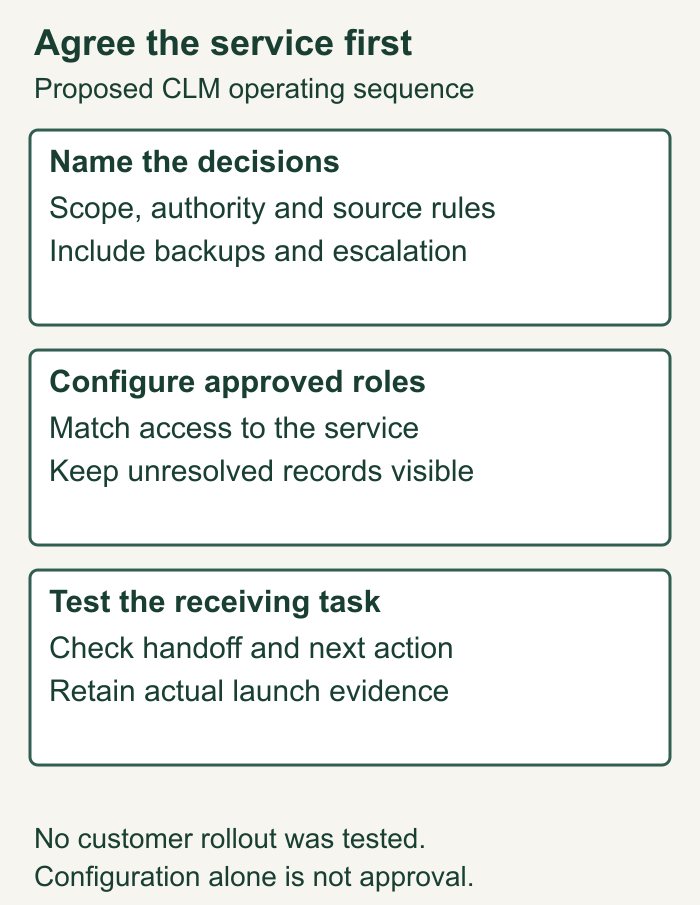
A contract lifecycle management rollout needs an agreed service scope, named decision owners, traceable records and tested handoffs before launch. Its internal operating agreement connects the people who request, approve, sign and manage contracts. Software settings should express that agreement. If those people have never settled who can accept a deviation or maintain a renewal date, configuration alone cannot settle it for them.
Start with a bounded service
Choose a contract family and write down what the service promises. For example: a requester submits a supplier agreement, the team checks required information, legal reviews exceptions, an authorized person signs, and an owner receives the resulting obligations. Include the points where work pauses and who can resolve each pause.
Use the CLM business-case worksheet to connect the bounded service to a testable investment decision.
Ask requesters to walk through a recent ordinary matter and a difficult one. Record what was missing and what happened outside the intended workflow. These are recommended discovery activities, not interviews conducted by Viaclause. Their purpose is to reveal decisions that a feature checklist cannot make.
CLOC’s Core 12 framework separates technology from knowledge management, information governance and training. That distinction helps frame the implementation work: a platform can store a clause, but someone still needs to decide whether that clause remains approved.
Make responsibilities explicit
Our recommended operating agreement assigns four responsibilities:
- Process owner: manages routing and stalled work.
- Legal policy owner: maintains approved positions and exception rules.
- Data steward: checks fields, sources and unresolved records.
- Business owner: manages each signed agreement in use.
One person may hold several roles. The important point is that a stalled approval, disputed field or missed reminder has somewhere to go.
Document who can change routing rules, approve an exception and update the playbook. Establish a route for urgent requests that records the decision afterward. An emergency route that relies on an undocumented personal favor cannot be reliably reproduced when that person is absent.
Define the record before migration
Begin with fields that enable a decision: the contracting entities, agreement status, accountable owner, relevant dates and links to amendments. For each field, define its meaning, source and handling of uncertainty. A date copied from a draft must not silently become the operative deadline.
FAR 4.803 offers a concrete public example of contract records including modifications and administration documents. Its scope is federal acquisition. Commercial teams should use it as an illustration of connected records, not assume that its requirements govern their contracts.
For migration, our recommendation is to sample a small group of agreements and check the complete document family. Mark unresolved records for review. Do not convert an unknown value to a blank that later behaves like a confirmed absence. A smaller repository with visible uncertainty can support better decisions than a larger one with false precision.
Test the handoffs
Use a walkthrough that begins with intake and ends after signature. Include a changed approver, a replacement document and an amendment affecting a reminder. Ask the receiving team to show what it sees and what it will do next. The test is complete when the recipient can act, not when the sending system displays a success message.
Run the spreadsheet versus CLM handover test to test whether another colleague can complete the task.
Agree on launch evidence before configuring the workflow. Examples include completed access checks, resolved critical migration questions, successful reminder delivery and a named support route. Choose criteria that reflect this service’s risks; no universal budget percentage or timetable belongs in every rollout.
Measure the service after launch
Compare the pilot with its own starting point. Track waiting time separately from legal review time, record work returned for missing information, and check whether contract owners can locate their obligations. Investigate exceptions as well as averages. A faster standard path can conceal a small group of difficult requests that has become much slower.
Use the contract approval-delay measurement to monitor elapsed waiting time without double counting.
Expand only after the team can explain those results and support the next contract family. A credible implementation plan ends with continuing ownership: who maintains templates, checks data, trains new users and retires obsolete rules. That continuing work is what turns a configured platform into a dependable contracting service.
Turn the operating agreement into an accountable service charter
This is an internal operating record, not a substitute for delegated signing authority or a negotiated customer contract. The CLOC legal-operations overview describes functions supporting legal service delivery. Our proposed charter assigns concrete decisions within those functions; it is not a CLOC-mandated role model or certification.
Keep platform permissions separate from policy authority. Ironclad's user-management documentation describes roles and group or assignment-based access in its platform. A configured account role does not by itself establish the business authority to approve a commercial exception or sign an agreement. Match approved responsibilities to the actual configured access and test the resulting scope.
Similarly, Ironclad's metadata-import instructions distinguish transformation and preview choices from future workflow behavior. Do not assume a successful import fixes the intake or field-management process. Name the source, interpretation and change owner for the fields that drive action.
| Decision | Owner to name | Evidence to retain |
|---|---|---|
| What belongs in this service? | Process and business owners | Included contract family, exclusions and complete intake fields. |
| Who can accept an exception? | Legal policy and delegated business approvers | Approved position, escalation route and recorded decision. |
| Which document supports a field? | Data steward and interpretation owner | Source packet, amendment link and visible unresolved status. |
| Who receives the signed obligation? | Named business owner with backup | Traceable handoff, action date and receiver's acceptance. |
| What happens when the workflow fails? | Support and process owners | Approved fallback, exception record and return-to-service check. |
Filled walkthrough plan
SYNTHETIC SERVICE WALKTHROUGH S01
Service: supplier agreement intake through post-signature handoff.
Packet: supplier agreement and a later amendment affecting notice.
Requester: supplies the required packet and business objective.
Process owner: checks routing and identifies a missing approver.
Legal policy owner: reviews the exception, not merely a blank field.
Data steward: links the amendment and records interpretation scope.
Signing owner: verifies the applicable delegated authority.
Business owner: receives the operative packet and notice action.
Backup: named in the service record before the primary is absent.
Proposed test: receiving owner locates the source and next action
using the approved record, without relying on the sender's memory.
Current result: walkthrough proposed, not run for this article.
Open point: conflicting notice language stays unresolved until
the responsible interpretation owner records a reviewed outcome.
Launch: no passing test or authorized deployment inferred.
A completed run would add its actual observations, outputs and corrections. A system notification that a handoff was sent is different from evidence that its recipient can locate the packet and perform the agreed task. Keep both sides of that handoff visible. Use the contract administration plan for continuing obligations after launch.
Copyable internal service charter
Service scope, contract family and exclusions:
Business objective and agreed intake requirements:
Process owner, legal policy owner, data steward and business owner:
Approver/signing authority, backups and escalation route:
Permitted platform roles and account-access checks:
Approved templates/playbook and change-control owner:
Source packet, field definitions and unresolved-status handling:
Post-signature handoff, action owner and receiving evidence:
Launch criteria and actual test records:
Open exceptions, impact, accountable owner and disposition:
Support route, approved fallback and recovery verification:
Training and maintained instructions:
Baseline scope, waiting/review time and measurement limitations:
Next review date, rule-maintenance owner and expansion decision:
Before expanding beyond the pilot
- Confirm the bounded service and who can approve its scope.
- Match configured roles to authorized decisions and access.
- Test an absent approver and the approved escalation route.
- Check a replacement document and a later amendment.
- Keep unknown, not reviewed and confirmed absence distinct.
- Verify both source links and post-signature action ownership.
- Retain actual handoff, access and reminder outcomes.
- Assign open exceptions and support responsibilities.
- Separate elapsed waiting from active review and setup effort.
- Keep unsuccessful and difficult cases visible in the measurement.
- Confirm maintained training, rule changes and backup owners.
- Authorize expansion only for the scope supported by the evidence.
Frequently asked questions
What should happen before CLM configuration?
Agree service scope, intake requirements, decision authority, record definitions and launch evidence. Configuration then expresses those choices, with its actual behavior tested.
Does an administrator role mean someone can sign contracts?
Do not infer signing authority from a software role. Record the applicable delegated authority and separately configure and test access.
Can one person hold all four responsibilities?
Roles can overlap in a small team. Make each responsibility, escalation route and backup explicit so a missing person or disputed field does not strand the service.
Is importing metadata enough to complete a rollout?
No. Verify document identity, field meaning, relationships, access and the receiving task. The import result and continuing workflow are distinct checks.
How should unknown dates be handled?
Keep a visible review status and source scope. Do not silently turn an unreadable, conflicting or missing input into a confirmed absence of an obligation.
What should launch approval rely on?
Use pre-agreed evidence for the actual service: access, source records, escalation, handoff, reminders and support. This article supplies no universally sufficient sample size or acceptance threshold.
Has Viaclause measured a CLM failure rate?
No verified deployment dataset supports the withdrawn prototype figure. This is an operating method to evaluate, not a measured success formula or guarantee.
Editorial note
This explainer replaces the prototype’s unsupported claim that 73% of CLM implementations fail. Viaclause has no verified dataset supporting that number, and has not reviewed the enterprise deployments described in the old sample. The implementation sequence below is an editorial recommendation, not a measured success formula.
Sources
- CLOC Core 12
Corporate Legal Operations Consortium. Professional operations framework; not a CLM failure-rate study. - FAR 4.803: Contents of contract files
Acquisition.gov. Federal acquisition recordkeeping example, not a rule for every commercial contract. - CLOC: What is Legal Ops?, full substantive overview inspected October 7; functional scope, not endorsement of this charter.
- Ironclad: Manage Admin, Standard, and Requester Users, updated September 29, 2026. Full substantive instructions inspected October 7; account roles and assignment scope.
- Ironclad: Use Metadata Import, May 12, 2026. Full substantive instructions inspected October 7; transformation, review and workflow distinctions.
Sources checked September 26 and October 7, 2026.