

Contract Risk Management: Assess, Accept and Monitor
By Anirudh Menon, Viaclause editor
Assess contract risk with a worked supplier-dependency example, completed register, control evidence, named acceptance authority and reassessment triggers.
Contract risk management is the ongoing work of identifying what could go wrong under an agreement, assessing the business exposure, choosing contractual and operational controls, recording who accepts the remaining risk, and monitoring changes. A useful assessment connects each risk to the actual contract version, evidence, an accountable owner and a decision.
Start with a loss scenario, not a red label. “Supplier risk: high” says little. “If this sole supplier stops service, we cannot dispatch orders until we restore current records elsewhere” identifies the dependency to investigate. This guide provides a worked supplier example, a completed risk register and a checklist you can adapt.
All organizations, wording, tests, dates and measurements in the worked example are fictional illustrations, not customer results. The banner is an AI-generated illustration.
What belongs in contract risk management?
Contract risk can arise from the terms, the counterparty, your ability to perform, the surrounding legal requirements, or a change after signature. Read the whole agreement, including incorporated schedules and amendments, before evaluating one clause. The University System of New Hampshire’s institutional review checklist expressly checks attachments, performance timing, triggering events, remedies, notice and signing authority. It is that institution’s checklist, not a universal legal standard.
| Risk area | Contract-specific question | Evidence to request |
|---|---|---|
| Performance and continuity | Can the supplier deliver, and can you continue if it cannot? | Deliverable criteria, dependency map, recovery exercise and transition terms. |
| Financial exposure | What must you pay, and what could remain unrecovered? | Price schedule, invoice controls, claim-specific liability terms and counterparty information. |
| Legal and regulatory exposure | Which laws apply to the parties, activity and data? | Jurisdiction analysis and advice tied to the actual transaction. |
| Information and intellectual property | Can you access, use, transfer and protect the material you need? | Data inventory, permissions, license terms, security commitments and export checks. |
| Internal execution | Can your team meet its own deadlines and obligations? | Assigned owners, budgets, notice calendar, approvals and performance records. |
These are practical review categories, not an exhaustive legal taxonomy. A single outage may create several exposures. Keep them connected without counting the same cost repeatedly.
Contract lifecycle management organizes the agreement from intake through closeout. Risk management asks what could fail at each stage and what decision is justified. Contract administration supplies the owners, records and routine checks that put those decisions into practice.
A five-step assessment you can use
1. Describe the event and the business consequence
Use: “If [event] happens, [activity] is affected because [dependency].” Name the relevant agreement and clause. Distinguish a future risk from an issue that has already happened. A missed delivery requires an issue response as well as a reassessment of future performance risk.
Check both sides of the transaction. A customer’s promised approval or data delivery can be a supplier dependency. Do not assume every risk comes from the counterparty.
2. Assess impact, likelihood and uncertainty separately
Identify what matters: service interruption, replacement time, cash exposure, lost access, people affected or a legal obligation. Record the evidence date and limitations. If you do not have a defensible probability, write “likelihood not quantified” rather than inventing a percentage.
For information-system risks, NIST’s risk-assessment glossary describes assessment as part of risk management and includes consideration of threat, vulnerability and planned or existing controls. That security context is useful for a supplier-system scenario; it is not a contract-enforceability test.
If your organization uses low, medium and high ratings, define their decision consequences. For example, a critical dependency might require an operations executive’s acceptance regardless of deal price. A score is a prioritization tool, not a measured loss probability. Multiplying two ordinal ratings does not create a monetary expected loss.
3. Compare the available responses
- Avoid: remove the dependency, change the scope or decline the arrangement.
- Reduce: negotiate specific duties and implement controls that reduce the failure’s likelihood or impact.
- Allocate: agree how particular costs or claims are handled, then assess whether the promised recovery is usable.
- Accept: authorize a defined remaining exposure, with limits, an owner and reassessment triggers.
A proposed redline has not changed the agreement. An agreed export right has not proved that your team can restore the export. An indemnity or insurance arrangement needs its own coverage, process and recovery assessment. Use the liability-cap and indemnity claim map for the separate claim analysis and the indemnification-clause example to check claim handling and defense duties.
4. Record the residual-risk decision
Residual risk is what remains after the controls you can actually rely on. Record which controls are agreed, which are operating, what evidence supports them, and what is still unknown. Name the person authorized under your organization’s policy to accept that exposure. A deal champion’s enthusiasm is not evidence of delegated authority.
Separate contract-signing authority, budget approval and risk acceptance. They may belong to different people. CLOC’s Core 12 legal-operations framework treats financial management, vendor management, information governance and service delivery as distinct functions. It does not prescribe the approval roles or thresholds in the example below.
5. Monitor the conditions that supported the decision
Set a routine review and event triggers: a failed recovery exercise, unavailable export, material scope change, new subcontractor, changed data category, missed milestone or approaching renewal. Name who checks the trigger, where evidence is saved and what happens when a condition fails. Updating the spreadsheet without escalating a failed condition leaves the decision unsupported.
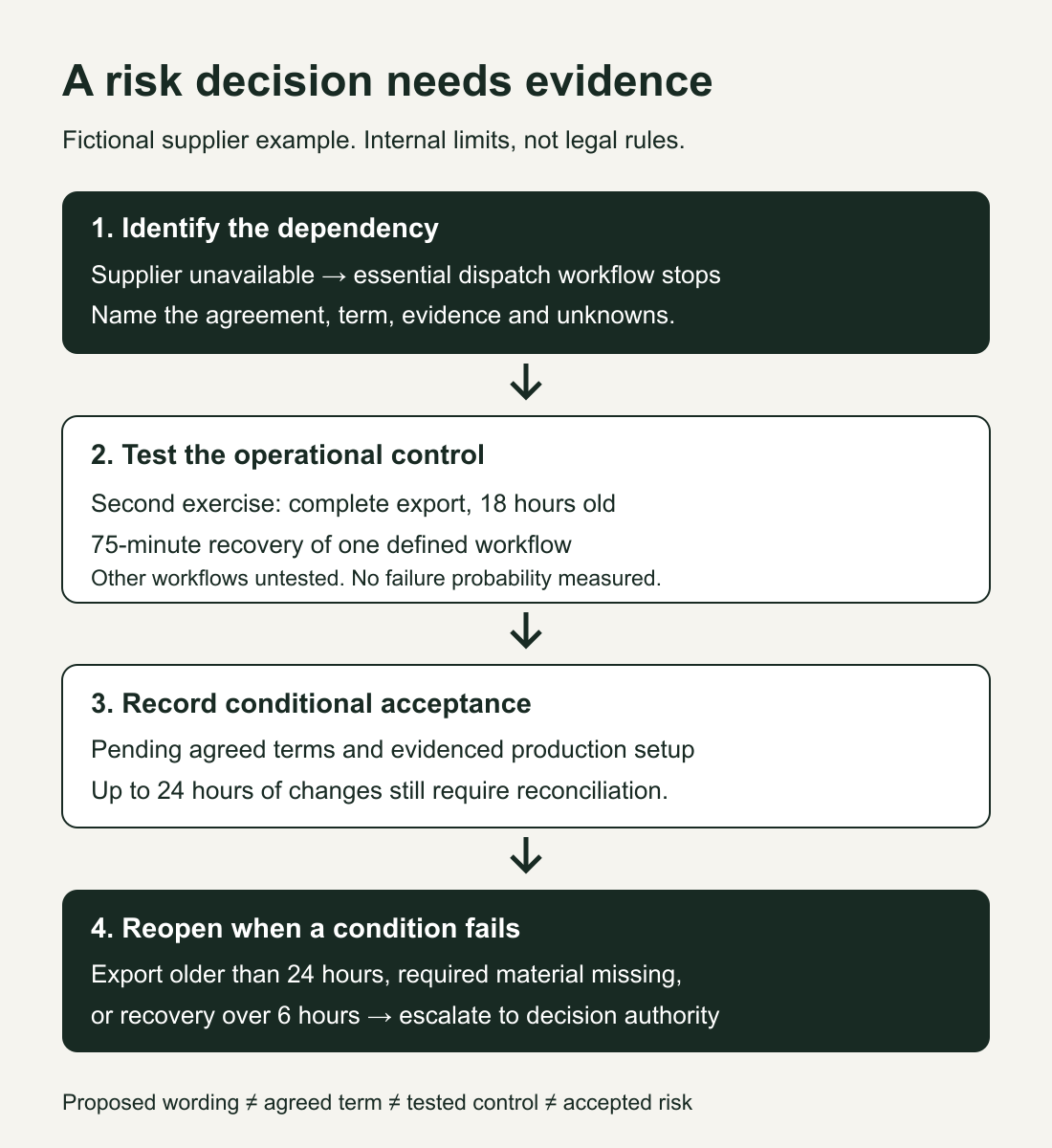
Worked example: a supplier outage and an incomplete export
Fictional assumptions: Alder Parts LLC uses Wren Dispatch LLC to prepare order dispatches. The agreement is still under negotiation. Alder’s internal operating requirement is to resume one essential dispatch workflow within six hours, using records no more than 24 hours old. These are Alder’s chosen limits, not statutory requirements or industry benchmarks.
The original draft contains this invented provision:
Customer may request a CSV export of order records. Supplier will provide the export within ten business days after the request.
That wording does not establish a daily export process or address attachments, restoration elsewhere, dependencies during an outage, or the time needed to receive a requested export. Read other schedules for those details before concluding they are absent.
In the fictional first exercise, a seven-day-old CSV is available and the team imports its rows in 54 minutes. However, dispatch attachments are missing. This is not a successful recovery merely because import time is below six hours: both freshness and the required information failed. The observation concerns this exercise, not the likelihood that Wren will fail.
Keep the contractual change and operational control separate
Alder proposes a schedule covering daily exports of identified order fields and dispatch attachments, a documented format and manifest, customer access to the exports, and the permissions needed for the agreed backup use. It also proposes transition cooperation and a notice process for export failures. Counsel must integrate that wording with confidentiality, security, license, termination and liability provisions. This is a negotiation specification, not a complete clause ready for signature.
Alder’s operations team separately builds an access-controlled backup workflow, a named checker and an alternate dispatch process. Daily production exports alone will not demonstrate recoverability. In a second fictional exercise, the team uses a complete export that is 18 hours old and resumes the defined dispatch workflow in 75 minutes. It checks required fields against the manifest and opens the necessary dispatch attachments.
The second exercise meets the stipulated 24-hour freshness and six-hour recovery limits for that workflow. It does not prove every record, integration or business process can be restored. The buyer still accepts up to 24 hours of changes that may need reconciliation, manual processing during disruption, and uncertainty about other workflows. For a more detailed exercise design, use the SaaS shutdown recovery test.
Copy this completed contract risk register
The following record is an original fictional example. Its evidence identifiers describe assumed records within the scenario, not documents or tests obtained from an actual supplier. An unfulfilled condition means “pending,” not “approved.”
Risk ID: R-01
Agreement: Alder / Wren dispatch SOW, draft 4
Event: sole supplier service becomes unavailable
Consequence: essential dispatch workflow stops
Term: requested CSV within ten business days
Evidence: fictional exercises E1 and E2
E1: 7-day-old CSV; 54-minute import; attachments missing
E2: 18-hour-old complete export; 75-minute scoped recovery
Likelihood: not quantified
Impact: critical dispatch dependency; monetary loss not modeled
Proposed term control: daily defined exports, manifest, access and backup-use permissions
Operational control: restricted backup workflow and alternate dispatch process
Residual exposure: up to 24 hours of changes; manual reconciliation; other workflows untested
Risk owner: Priya Shah, operations lead
Decision authority: COO, under fictional internal delegation
Decision: conditional acceptance, pending agreed schedule and live export setup
Release evidence: executed schedule, access check and production export record
Review: November 2, 2026, or earlier trigger
Trigger: export age over 24 hours, missing required material, or recovery over 6 hours
Action: reopen decision with COO; assess alternative operation before continued dependence
In this scenario the COO’s conditional decision supports preparation, not unrestricted go-live. Once the schedule is executed and the production setup is evidenced, record a dated release decision. If the parties reject the export terms, the business decision must be revisited with that rejection recorded. Do not silently replace a contractual commitment with a hopeful assumption.
Test the record with a later failure
Assume a later export is 30 hours old. That exceeds the chosen 24-hour limit even if the last recovery exercise was fast. Priya saves the failed freshness check, reopens R-01 and escalates to the COO. The response may involve restoring the feed, using an alternative process or pausing the affected launch. The old acceptance cannot be carried forward as though its conditions still hold.
If the supplier has already missed an operative obligation, preserve the actual terms and facts separately using the vendor-obligation facts record. A red risk rating is not proof of breach.
Jurisdiction and legal-review boundaries
Use the governing law, transaction type and applicable mandatory rules to determine whether a contractual control works. Internal approval cannot resolve a legal prohibition. As a California example, Civil Code section 1668 declares contracts aimed at exempting a person from responsibility for their own fraud, willful injury or violation of law contrary to legal policy. That provision is not a complete answer to the enforceability of every ordinary limitation-of-liability clause.
Do not treat an approved redline, an internal risk waiver or an email as automatically modifying the parties’ contract. California Civil Code section 1698 provides for written modification, addresses specified oral modifications, and preserves rules including estoppel and waiver in appropriate cases. Follow the agreement’s change process and obtain transaction-specific advice; this article does not claim that every unwritten change is ineffective.
These are labelled California statutory examples, not a nationwide opinion on the fictional SOW. Data protection, sector rules, public procurement and cross-border requirements need their own review when relevant. Risk acceptance documents a business decision within lawful limits; it does not make conduct lawful or guarantee a remedy.
For a version-specific approval record, use the contract review checklist to identify issues, evidence, decision owners and unresolved questions.
A checklist before approving or renewing
- Identify the operative agreement, schedules, amendments and relevant version.
- State the event, dependency and consequence for each material risk.
- Separate evidence from assumptions, with dates and unresolved questions.
- Assess your own performance duties as well as the counterparty’s.
- Mark controls as proposed, agreed, implemented or tested.
- Check the legal scope, permissions, exclusions and claim process.
- Confirm the risk owner and the actual acceptance authority.
- Record residual exposure and any conditions before release.
- Assign monitoring evidence, review dates and event triggers.
- Reopen decisions when conditions fail or the agreement changes.
Frequently asked questions
What belongs in a contract risk register?
The agreement and term, loss scenario, exposure, evidence and unknowns, controls and their status, residual risk, owner, decision authority, decision conditions and monitoring triggers. Attach the underlying records so another reviewer can understand the decision.
Does a liability cap eliminate contract risk?
No. An outage can stop operations before any claim is resolved. Review the particular cap, exclusions, exceptions, remedies and enforceability separately. Even an assumed available monetary recovery does not restore missing records or supply a replacement workflow.
Who should own contract risk management?
Use cross-functional responsibility: legal for the legal analysis, procurement for the commercial relationship, finance for exposure and funding, and relevant operational or security teams for controls. Give each risk a named owner and use your organization’s actual acceptance policy.
Are there universally required five steps or seven types?
This article’s five steps are a practical workflow, not a statutory sequence. Category counts vary with the purpose of a framework. Completeness means addressing the material exposures for this transaction, rather than reaching a preferred number of headings.
How is contract risk management different from ERP?
An enterprise resource planning system can provide transaction and operating records used in an assessment. It does not, by itself, supply the term interpretation, control evidence, authority or residual-risk decision recorded here. Evaluate the actual system and workflow rather than assuming integration proves a control.
Do you need software to start?
A controlled register and accessible evidence can support the first review. At greater scale, evaluate tools against the actual workflow: version links, field accuracy, owners, approvals, deadlines, permission controls and exportability. Treat an AI-generated risk flag as an item to verify against the source text and context.
What should you measure?
Use decision-relevant measures such as failed control checks, overdue acceptance conditions, unresolved material issues and triggered reassessments. Define the denominator and observation period if reporting a rate. The number of signed agreements or detected clause deviations alone does not show whether remaining exposure is acceptable.
For confidentiality drafting, use the non-disclosure agreement template after identifying the information, purpose and permitted recipients.
Sources
- University System of New Hampshire: institutional Contract Review Checklist, procedure 12-009
- NIST CSRC: risk-assessment glossary and source-specific definitions
- CLOC: Core 12 legal-operations framework
- California Civil Code section 1668: unlawful exemptions from responsibility
- California Civil Code section 1698: modification of written contracts and preserved legal doctrines