

Non-Disclosure Agreement Template: Filled Example and Checks
By Anirudh Menon, Viaclause editor
Copy a business NDA review template with a filled mutual example, information exclusions, disclosure and retention decisions, and US protected-reporting checks.
A non-disclosure agreement template is a starting contract for defining confidential information, permitted use and disclosure, and the recipient's handling duties. Choose a unilateral NDA when only one party receives protected information, or a mutual NDA when each party may disclose and receive it. Complete the business decisions before circulating the document for signatures.
The copyable structure below is an original business-to-business review draft, followed by a complete fictional mutual NDA. Use the business form for the stated evaluation; an employee or individual consultant agreement needs its own legal and operational review. US federal reporting, trade-secret and worker safeguards follow the template. Start with the contract formation guide and use the lawyer review packet to resolve the choices.
Decide what each party actually needs to share
List each information stream, its owner, its purpose and its intended recipients. Mutual duties can apply to different material: one company may share unreleased drawings while the other shares manufacturing methods. Mutual does not mean equal amounts of information or a transfer of intellectual property.
If three or more businesses will exchange material, map each discloser, recipient and onward-disclosure route in a multilateral agreement or coordinated agreements. Adding names to a two-party form can leave duties and permissions ambiguous. For employee or contractor use, review consideration, prior confidentiality obligations and any proposed invention assignment separately; the business sample does not assign inventions or prohibit taking another job.
Do not insert customer personal data, production credentials or regulated records merely because an NDA exists. This sample permits only the stated evaluation and deliberately leaves those categories out of its worked example. If a later project needs them, define the additional access, processing and security terms before disclosure. Define an approved project in its separate scope and service agreement.
Copyable NDA structure for business review
Resolve every bracket and select one direction in clause 1. The placeholders are substantive decisions. Clause 11 is a conditional worker-notice supplement, not something to omit automatically when an individual consultant is involved.
NON-DISCLOSURE AGREEMENT: BUSINESS REVIEW DRAFT

Parties: [full legal name, entity type and address of A]
and [full legal name, entity type and address of B].
Effective date: [date].

1. Direction and purpose
Select: [mutual] or [unilateral: name discloser/recipient].
Each party with recipient duties shall use protected
information only to [specific evaluation or project].
In a mutual arrangement, each is a discloser when sharing
its material and a recipient when receiving the other's.

2. Information covered
Confidential Information means the nonpublic information
described in Schedule A, disclosed for the Purpose and
identified as confidential when provided. Schedule A
states how oral or visual disclosures are identified and
confirmed. Copies and analyses containing that information
remain subject to these duties. Unrelated information is
not included merely because the parties discuss business.

3. Exclusions
Recipient duties do not cover information the recipient
can demonstrate: was already lawfully known without a
confidentiality duty; became public without breach of this
agreement; was independently developed without using the
protected information; or was lawfully received from a
third party without a confidentiality restriction.
Keep evidence supporting the applicable exclusion.

4. Use, access and security
Use the information only for the Purpose. Give access
only to the Schedule B roles that need it for that Purpose
and are subject to appropriate confidentiality duties.
Apply the agreed Schedule B safeguards. The recipient
is responsible for its permitted representatives'
compliance with these contractual handling duties.
Do not upload material to external tools or disclose it
to other recipients without the agreed written permission,
except as allowed by clauses 6 and 11.

5. Duration
New disclosures under this agreement may occur during
[defined disclosure window]. Ordinary confidentiality and
use duties continue for [selected period and starting
point]. Duties for information qualifying as a trade
secret continue while it retains that status, subject to
applicable law and protected-disclosure provisions.
Ending discussions does not shorten the selected duties.

6. Required and protected disclosures
For an ordinary legally compelled disclosure, notify the
discloser if legally permitted and reasonably practicable,
cooperate with lawful protective measures, and disclose
only what the legal requirement demands.
Nothing here blocks lawful reporting, cooperation with
government investigations, or disclosures protected by
applicable law. No company permission or advance company
notice is required for such protected communications.
Preserve applicable legal-privilege restrictions.

7. Return, deletion and limited retention
On written request or [specified trigger], stop new use
and return or delete covered working material within
[selected period], subject to lawful preservation duties.
Schedule C identifies necessary legal-retention copies
and backups not practicably removable individually.
Restrict access to retained copies; do not reuse them
for the evaluation or other commercial work. Continuing
duties under clause 5 apply. Confirm completed actions
and identify retained categories, basis and access limits.

8. Incident handling
Promptly notify the discloser of known unauthorized access,
use or disclosure affecting its protected material, except
where law prohibits notice. Preserve evidence, contain
the incident and coordinate the agreed response contacts.
Additional incident deadlines belong in Schedule B.

9. Other commercial boundaries
No ownership transfer or commercial licence is granted.
Only the limited use needed for the Purpose is permitted.
This NDA does not require a purchase, partnership or
project. A separate agreement must authorize that work.
Information is supplied for evaluation without a promise
of accuracy or a commitment to rely on it for production.
No residual-memory licence, publicity permission or
reverse-engineering right is granted by this agreement.
Agree permitted evaluation tests separately in Schedule B.
Neither party guarantees an automatic injunction or award;
relief remains subject to applicable law and evidence.

10. Administration and signatures
Governing law: [jurisdiction after review].
Dispute forum or process: [reviewed choice].
Routine notices: [recipient/address/method for each party;
when delivery takes effect]. The routine notice rules do
not apply to protected reporting.
No assignment or delegation without the other party's
written consent. A waiver must identify the waived duty
in writing; inaction alone does not waive later compliance.
If a provision is unenforceable, separate the remainder
only to the extent applicable law permits.
This agreement and its schedules are the complete agreed
confidentiality terms for [defined transaction]. List
existing agreements that continue: [names or none]. State
which terms control a conflict; do not silently cancel
existing data, IP, service or worker obligations.
Amendments require both parties' written agreement.
Include Schedules A, B and C with the signed version.
Execution method and counterparts: [agreed method after
checking applicable formalities and identity evidence].
Authorized signer for A: [name, title, signature, date].
Authorized signer for B: [name, title, signature, date].

11. Conditional US worker immunity notice
For an agreement subject to 18 USC 1833(b), an individual
has federal and state trade-secret immunity for disclosure
made confidentially to a federal, state or local official,
directly or indirectly, or to an attorney, only to report
or investigate a suspected legal violation; or made in a
sealed filing in a lawsuit or other proceeding.
In an employer-retaliation lawsuit about reporting a
suspected violation, the individual may give the secret
to their attorney and use it in the proceeding if documents
containing it are sealed and further disclosure occurs
only by court order. This does not authorize unlawful
access or other independently prohibited acts.
Reviewer: confirm applicable notice delivery.
The ordinary exclusions, durations, confirmation method and retention mechanics above are proposed contract choices. They are not claims that every jurisdiction requires precisely this wording or will enforce it.
Complete the three schedules: a worked example
Fictional transaction. Alder Device Works LLC and Harbor Prototype Labs LLC, two invented California companies, are evaluating a small enclosure prototype. Alder shares unreleased drawings; Harbor shares a nonpublic proposed manufacturing approach and evaluation pricing. The parties choose mutual duties because both disclose. This is a completed decision example, not a real signed agreement.
| Field | Completed choice | Reason and remaining review |
|---|---|---|
| Purpose and disclosure window | Evaluate one enclosure prototype between October 6 and November 6, 2026. | No production deployment or purchase commitment. A later project needs separate approval. |
| Schedule A: covered information | Alder's ADW-E1 drawing package; Harbor's HPL-M1 method note and HPL-P1 evaluation-price sheet, all revision 1. | Identify actual file versions and mark them. Public brochures and unrelated material excluded. |
| Oral and visual disclosures | Identify confidentiality at the meeting; confirm the covered subject in writing within five calendar days. | An invented documentation rule. Check whether it matches how demonstrations actually occur. |
| Schedule B: recipients and safeguards | Named engineering evaluators and legal advisers, purpose-limited access, controlled folder, no external uploads without permission. | Confirm actual access and confidentiality arrangements. No customer personal data or credentials shared. |
| Ordinary duty period | Three years from each disclosure. Trade-secret duties follow clause 5. | An example choice, not a universal lawful or optimal duration. Track each disclosure date. |
| Schedule C: return and retention | Delete working copies within 15 calendar days of written request; identify lawful preservation copies and inaccessible routine backups. | Invented deadline subject to the actual system and legal holds. Retained copies stay restricted. |
| Law, forum and signatures | California law; San Francisco County state courts and federal courts there with jurisdiction; named managing members and wet-ink counterparts in the completed example. | Illustrative choices requiring review for the real parties; the example remains unsigned. |
If ADW-E1 is disclosed on October 6, 2026, its selected ordinary period runs to October 6, 2029. A separate November 6 disclosure has its own November 6, 2029 endpoint. Those dates illustrate the parties' chosen rule. Track termination of discussions separately from continuing protection using the survival clause guide.
A complete filled mutual NDA example
Fictional agreement, unsigned. The following version completes the contract choices for the enclosure evaluation. Names, addresses, contacts, dates and safeguards are invented. The three-year protection, 15-day deletion and incident deadline are negotiated example terms, not legal minimums. Replace this transaction and obtain review before execution. Unlike the blank form, the example has no unresolved purpose, recipient, duration or forum field.
MUTUAL NON-DISCLOSURE AGREEMENT
Fictional completion example, unsigned

Alder Device Works LLC, a California company, at
10 Example Lane, San Francisco, CA 94105, and Harbor
Prototype Labs LLC, a California company, at
20 Sample Avenue, San Francisco, CA 94105, agree:

1. Purpose and effective date
Effective October 6, 2026, each may disclose information
solely to evaluate technical feasibility and an evaluation
price for one enclosure prototype. Neither is required to
disclose information, buy anything or proceed with a project.
New disclosures are covered from October 6 through
November 6, 2026, inclusive. Either may end discussions
earlier by written notice; existing handling duties survive.

2. Information and exclusions
Schedule A is part of this agreement: Alder's marked
ADW-E1 revision 1 drawing package; Harbor's marked HPL-M1
revision 1 manufacturing-method note and HPL-P1 revision 1
evaluation-price sheet. Copies and analyses containing that
material are covered. Oral or visual disclosures about
those packages must be identified as confidential when
made and confirmed by subject in writing within five
calendar days. Unrelated or unconfirmed material is outside
this selected contractual definition.
The recipient need not protect information it proves was
lawfully known without a duty before receipt, became public
without a breach by it or its representatives, was developed
independently without using covered information, or was
lawfully received from a third party without a restriction.

3. Permitted access and safeguards
Schedule B is part of this agreement. Alder's evaluator
is Riley Tan; Harbor's evaluator is Sam Reed. Each may
also give purpose-limited access to its legal adviser
under professional confidentiality duties. No affiliate,
subcontractor or replacement evaluator has automatic access.
Employees must have written confidentiality obligations;
each recipient is responsible for its permitted persons'
compliance with these handling terms.
Use an access-controlled project folder with multifactor
authentication, named accounts and access logs. No external
AI upload, personal email, public link or local download.
Permitted tests are visual review and dimension comparison
against the drawings only. No disassembly, source-code
analysis or production use. Additional recipients, tests
or disclosures require the discloser's written permission,
subject always to clause 5. No personal customer data,
production credentials or regulated records are to be shared.

4. Duration
Ordinary confidentiality and purpose-limited use duties end
on the third anniversary of each disclosure. For material
qualifying as a trade secret, those duties continue while
it qualifies, subject to applicable law and clause 5.
Ending discussions does not release these duties.

5. Compelled and protected disclosure
For an ordinary legal demand, notify the discloser when
legally permitted and reasonably practicable, cooperate
with lawful protective steps, and disclose only material
the demand requires. Nothing restricts lawful reporting,
protected disclosures or cooperation with government
investigations. Protected communications require neither
company permission nor advance company notice. Applicable
legal privilege remains preserved.

6. Return, deletion and retention
On written request or the end of discussions, stop evaluation
use and delete covered working copies within 15 calendar
days after the trigger. Schedule C permits one restricted
legal preservation copy only when a lawful duty requires it,
and routine system backups that cannot practicably be
removed individually. Backups expire under the recipient's
90-day rolling overwrite cycle unless a lawful hold applies.
No evaluation or commercial reuse is permitted. If a backup
is restored, isolate the protected material and delete it
again before business access, subject to any lawful hold.
Continue clause 4 protection. Confirm deletion in writing,
identify retained categories and basis, and restrict access
to legal or system administrators needing it for retention.

7. Incidents
Notify the other party within 24 hours after discovery of
known unauthorized access, use or disclosure of its covered
material, unless law prohibits notice. Initial notice may
be preliminary. Preserve logs, contain access, identify the
affected versions and provide updates as facts are confirmed.
Incident contacts are the routine contacts in clause 9.
This agreed deadline is separate from statutory obligations.

8. Commercial boundaries and remedies
Each keeps its rights in its own information. This NDA
grants only evaluation use, no ownership transfer, production
licence, residual-memory licence or right to publicize the
other's name or this evaluation. The parties will not disclose
their discussions publicly without joint written agreement,
except under clause 5. Information is provided for evaluation
without a promise of accuracy, completeness or fitness for
production. Any production project or IP transfer needs a
separate agreement. Each may seek remedies available under
applicable law; no injunction, damages or fee award is automatic.

9. Administration
California law governs, subject to mandatory applicable law.
The parties choose the state courts in San Francisco County
and federal courts there with subject-matter jurisdiction.
Routine notices must be written and sent to Avery Chen at
[email protected] or Morgan Patel at
[email protected]. They take effect upon confirmed
receipt; a sender receiving no confirmation must deliver a
copy by tracked courier to the relevant address above.
This mechanism does not apply to clause 5 protected reporting.
Neither party may assign rights or delegate duties without
the other's written consent. Changes and specific waivers
require both parties' signed writing; delay alone is no waiver.
If a term is unenforceable, remaining terms continue only to
the extent applicable law permits. This document, including
Schedules A, B and C stated above, is the complete agreement
on confidentiality for this evaluation. The example assumes
no earlier agreement covers these materials. No other service,
data-processing, employment or IP agreement is cancelled.
Execution is by authorized wet-ink signers in counterparts;
each keeps the complete signed agreement and schedules.

Named signers in this fictional example:
Avery Chen, Managing Member, Alder Device Works LLC
Morgan Patel, Managing Member, Harbor Prototype Labs LLC
Intended execution date: October 6, 2026
Signatures: unsigned educational example
The corporate example does not replace separate worker agreements or their applicable immunity notices. Use conditional clause 11 above in the relevant worker review. If a real individual contractor signs directly, review that relationship and the notice before circulating the form.
Completed closeout record: assume Alder receives a deletion request on November 6, 2026. The sample's 15 calendar days expire on November 21, 2026, counting from the next day. Alder records removal of working copies and evaluator access by that date, identifies one restricted copy subject to a lawful hold and the routine backup category, and confirms the access restrictions. The hold's release and backup overwrite are tracked separately. This illustrates the agreed process; it is not evidence that any real deletion occurred.
Four disclosure and retention decisions
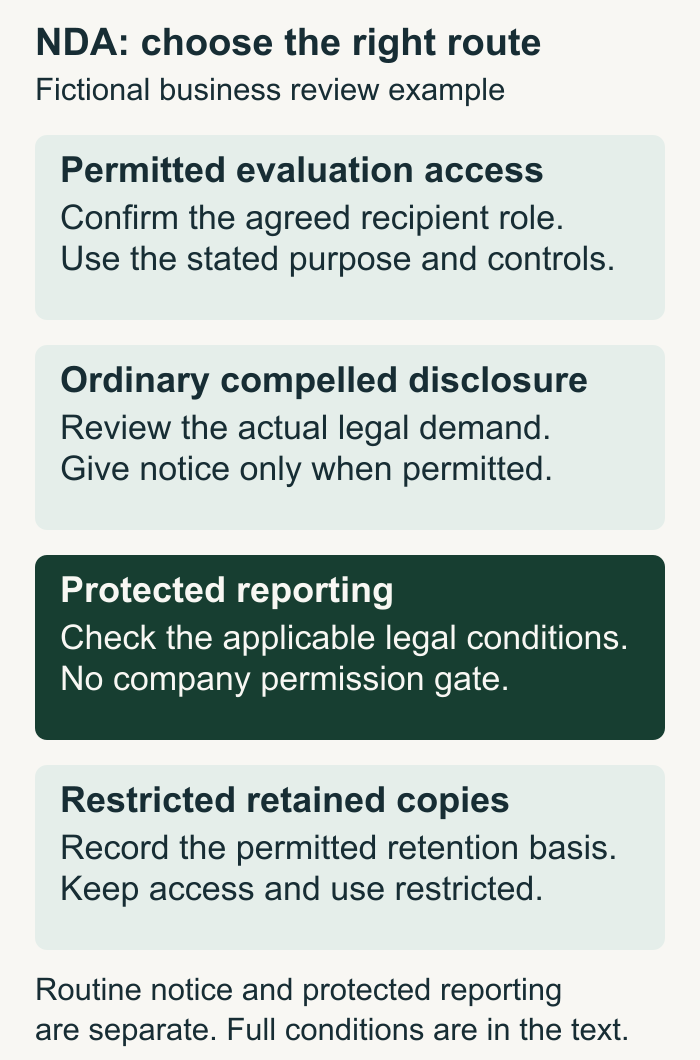
| Event in the example | Decision under the sample | Record to preserve |
|---|---|---|
| A named engineer needs ADW-E1 for the evaluation. | Confirm Schedule B role, purpose and safeguards before granting access. | Access approval, file version and recipient obligation. |
| A recipient receives a legal demand for HPL-M1. | Have the demand reviewed. Use the compelled-disclosure route, with notice only when permitted and practicable. | Demand, reviewed scope, notice decision and material actually produced. |
| An individual seeks a legally protected reporting channel. | Use the protected-reporting provision; do not route it through a company permission gate. | Obtain advice on the legal conditions without imposing prohibited company notice requirements. |
| The evaluation ends while one copy is subject to a lawful preservation duty. | Stop evaluation use, delete ordinary working copies as required, restrict the retained copy and document its basis. | Deletion confirmation, retained category, access controls and preservation review. |
For example, retaining a restricted legal-hold copy does not justify forwarding it to a new product team. If material was exposed, use the vendor breach response guide to organize incident evidence rather than assuming the NDA itself prevents a breach.
US legal checks before using the template
Worker notice: applicable employer confidentiality agreements entered into or updated after May 11, 2016 require immunity notice, including for individual contractors and consultants. The statute permits a cross-reference to a reporting policy furnished to the worker. Missing notice limits specified exemplary-damages and attorney-fee remedies against the unnotified worker. Clause 11 summarizes conditions; check actual delivery. 18 USC 1833(b), immunity and notice.
SEC reporting: Rule 21F-17 prohibits impeding direct communications with SEC staff about possible securities-law violations, including by enforcing or threatening confidentiality terms. Its legal-representation exception is specific. Keep that channel outside the ordinary demand-notice process; a general clause requiring company approval must not swallow the reporting protection. 17 CFR 240.21F-17, current eCFR text.
Covered employee activity: NLRA section 7 protects concerted activity for mutual aid or protection; section 8(a)(1) prohibits employer interference. Coverage has statutory exclusions, including independent contractors and supervisors. Review employee confidentiality language against these rights, rather than treating all workplace discussion as proprietary. This is distinct from the DTSA's broader worker definition. 29 USC 157, protected activity; 29 USC 158(a)(1), interference; 29 USC 152, coverage definitions.
Sexual assault and harassment disputes: the Speak Out Act limits judicial enforcement of nondisclosure and nondisparagement clauses agreed before a dispute arises when the alleged conduct violates federal, tribal or state law. It applies to claims filed on or after December 7, 2022 and preserves more protective state rules. It also preserves employer and employee protection of trade secrets and proprietary information. Do not equate a general business NDA with a valid settlement restriction. Speak Out Act, sections 3 to 5.
Trade-secret status and safeguards: the federal definition requires reasonable secrecy measures and independent economic value attributable to secrecy. A label alone does not establish status. The definition of improper means excludes reverse engineering and independent derivation; an agreed restriction on testing is a separate contractual choice needing review. 18 USC 1839(3) and (6).
Make the sample's controls real: inspect folder permissions, test whether the external-upload restriction is feasible, brief evaluators and document disclosures. If the recipient cannot meet a restriction, negotiate it before access. A contract promise is useful evidence of an intended handling duty; it does not install the promised controls.
Remedies and work restraints: the federal DTSA civil action concerns misappropriated trade secrets related to products or services used or intended for interstate or foreign commerce. It provides conditional remedies, not an automatic injunction for every NDA breach. Its injunction limits address employment entry, evidence of threatened misappropriation and applicable state restraints law. Have state contract remedies and any employment restraint reviewed separately. 18 USC 1836(b)(1) and (3), civil action and remedies; non-solicitation scope guide.
Competitor diligence: an NDA does not grant an exemption from competition law. Sherman Act section 1 addresses agreements in restraint of interstate or foreign trade. Before competitor discussions, have the information and purpose reviewed; avoid assuming confidentiality makes coordination lawful. A practical diligence plan can limit fields, use clean-team recipients and keep independent decision-making records. Those are proposed controls, not a statutory safe harbor. 15 USC 1, restraint-of-trade prohibition.
Review choices that templates often hide
| Choice | Question for the real transaction | Decision in the filled example |
|---|---|---|
| Marking and oral disclosures | Will unmarked material still be covered? Who confirms a demonstration, and what if confirmation is late? | Specified marked packages; oral subjects confirmed within five calendar days. Unconfirmed material outside the selected contract definition. |
| Residual knowledge and testing | Does a residuals clause permit use of remembered ideas? Can prototypes be opened, tested or reverse engineered? | No residual licence; two named evaluation tests. Broader use needs permission and review. |
| Affiliates and advisers | Which legal entities need access? Can the recipient actually bind or supervise them? | Named employees and legal advisers; no automatic affiliate or subcontractor access. |
| Publicity and warranties | Can either announce discussions? Is anyone relying on the data to make a purchase or design decision? | No public announcement without joint agreement, subject to reporting protection. Evaluation data has no accuracy or production-fitness promise. |
| Precedence and future work | Does a prior MSA or confidentiality agreement already apply? Which survives and governs a conflict? | Assumes none covers the materials; leaves other types of agreement in place. A production project needs its own terms. |
| Remedies, notices and assignment | Does a clause purport to waive bond requirements, guarantee fees or transfer obligations without consent? Is the forum practical? | Available lawful relief only; receipt-based routine notices with courier fallback; mutual assignment consent. |
Check the discloser's authority to share third-party material. An NDA with a new recipient is not permission to breach a former employer's or supplier's confidence. Record the provenance and permitted disclosure basis in the review packet. This is a diligence step, not a representation that every confidentiality promise can be waived by the new parties.
UK reference, limited scope: the UK Intellectual Property Office's guidance supports identifying the purpose, information, recipients and disclosure records. Its mutual example illustrates purpose-limited access and signature fields. These are useful drafting comparisons; the English-law model does not establish US enforceability or resolve current UK employment, settlement or execution requirements. Review those separately before using a UK form. UK IPO NDA guidance; UK IPO mutual NDA example.
Frequently asked questions
When should an NDA be mutual?
When each party will receive information needing agreed protection. Map the actual streams first. In the worked example both companies disclose; if only Alder disclosed, the recipient duties would be assigned accordingly.
How do I turn the mutual example into a unilateral NDA?
Identify the sole discloser and recipient, make receiving duties apply to that recipient, and replace the two information streams with the discloser's actual material. Review the consideration and execution requirements for the chosen law. Do not merely change the title while leaving reciprocal duties or irrelevant schedules inside.
Does signing an NDA guarantee it is enforceable?
No such guarantee is made by this sample. Have authority, contract formation, clarity of scope, applicable mandatory rules and the chosen remedies checked. Keep the full agreed version and evidence of execution, not just an isolated signature image.
Who should prepare the non-disclosure agreement?
The business owner should identify purpose, information and operational limits. A qualified reviewer should check the legal choices and final wording. Neither a download nor a signature proves that the terms fit the transaction.
Does confidential information have to be marked?
This sample selects a marking and oral-confirmation process. That is its drafting choice, not a claim that every NDA or statutory protection has the same requirement. Resolve treatment of demonstrations and unmarked files before sharing them.
Should ordinary confidential information and trade secrets have the same duration?
The sample separates the selected ordinary period from trade-secret status. Its three years are illustrative. Assess information life, actual secrecy measures and applicable law rather than assuming a universal duration or perpetual coverage for everything.
Can an NDA stop reporting suspected wrongdoing?
The reporting route has legal conditions and must be checked against the particular law. Clause 6 of the blank template keeps protected communications separate from company permission and routine demand notices. Use the specific US checks above when relevant; a public leak of everything is not the same as a protected communication.
What if confidential information is sent before signing?
Pause further sharing, record what was disclosed, when and to whom, and ask the reviewer whether an agreement can address the actual history. This sample starts its disclosure window on its effective date. Do not backdate a signature or assume earlier disclosures are covered without an express, reviewed choice.
What is the difference between an NDA and an SLA?
An NDA addresses confidential information handling. A service level agreement addresses specified service performance commitments and related processes. The enclosure-evaluation NDA does not establish uptime, delivery acceptance or payment obligations.
Can a recipient keep a backup after a deletion request?
The answer under this sample depends on Schedule C and lawful preservation duties. An identified retained category remains subject to access and use restrictions. Do not promise complete deletion while omitting known backups or legal holds from the completion record.
Before disclosure and signature: checklist
- Choose unilateral or mutual duties from actual information flows.
- Define the purpose and covered files, demonstrations and disclosures.
- Complete the exclusions and preserve supporting records.
- Specify recipient roles and feasible security controls.
- Separate disclosure window, ordinary protection and trade-secret treatment.
- Keep protected reporting independent of company permission and routine notice.
- Check applicable worker immunity notice and other jurisdictional requirements.
- Resolve deletion, backups, legal holds and retained-copy access.
- Complete law, forum, authority and all schedules before signing.
Keep the executed version, disclosure log and retention decisions together in the contract repository. If access depends on a vendor, verify the export before exit so the evidence remains retrievable.
Sources
- 18 USC 1833: immunity and notice, GPO 2024 edition
- 18 USC 1839: trade-secret definitions, GPO 2024 edition
- 18 USC 1836: civil action and remedies, GPO 2024 edition
- 17 CFR 240.21F-17: direct SEC communications
- NLRA employee rights, 29 USC 157; employer interference, 29 USC 158; coverage, 29 USC 152, GPO 2024 edition
- Speak Out Act, enacted Public Law 117-224
- Sherman Act section 1, GPO 2024 edition
- UK IPO NDA guidance, published March 12, 2015
- UK IPO mutual NDA model, English-law comparison
This is an educational template and fictional completion example. Obtain qualified advice on the final agreement and applicable law. Prepared by the Viaclause editorial team. The documentary banner is an AI-generated illustration of fictional people.