

Vendor Promises Missing From the Contract? Check Them Before Signing
By Anirudh Menon, Viaclause editor
Separate what a vendor demonstrated, quoted and committed to in writing. Use a promise worksheet and a practical export example before signing.
If a vendor promise matters to your buying decision, identify where it appears in the agreement before signing. Record what must be delivered, for which product tier, by when and how you will check it. If the vendor will not make the commitment, decide whether the purchase still works without it.
AI-generated editorial illustration by Viaclause. People and setting are fictional.
A demonstration answers one question: can the vendor show this activity in that environment? Your purchase needs further answers. Is the capability included in your package? Does it require paid implementation or another supplier? Is it available now, or dependent on a future release?
Find the gap between the promise and the purchase
Public terms illustrate why the written package needs checking. HubSpot's Customer Terms, section 12.8, say the agreement supersedes earlier proposals and agreements and addresses comments about future functionality. This is a product-specific example, not a conclusion that every sales statement is legally irrelevant.
Also distinguish software from implementation work. Salesforce's customer agreements overview identifies the order form as specifying products, services, quantities and prices, and separately describes professional services such as implementation and customization. Check your proposed package and the documents it incorporates; do not assume a subscription includes every service discussed during evaluation.
The worksheet below is our proposed procurement method. It helps prepare a precise request for the vendor and counsel. It is not a legal ruling on whether an earlier statement is enforceable.
Create one record for each material promise
Copy these fields into a controlled spreadsheet or procurement record. Prioritize promises whose absence would change the decision to buy.
- Promise and evidence: exact statement, speaker, date and link to the retained email, proposal or authorized demo record. Separate the vendor's words from your interpretation.
- Required outcome: the task your team must complete, with the relevant users, data and operating environment.
- Delivery scope: product edition, limits, implementation services, third-party components and customer responsibilities.
- Acceptance evidence: an agreed test, who runs it and what counts as completion.
- Written commitment: proposed clause or schedule, document version, delivery date and confirmation that the final agreement includes it.
- Failure decision: agreed response if the outcome is late or incomplete, plus any notice and cure procedure counsel needs to check.
- Buying decision: proceed, proceed with a recorded limitation, defer or select another option. Name the person authorized to accept that limitation.
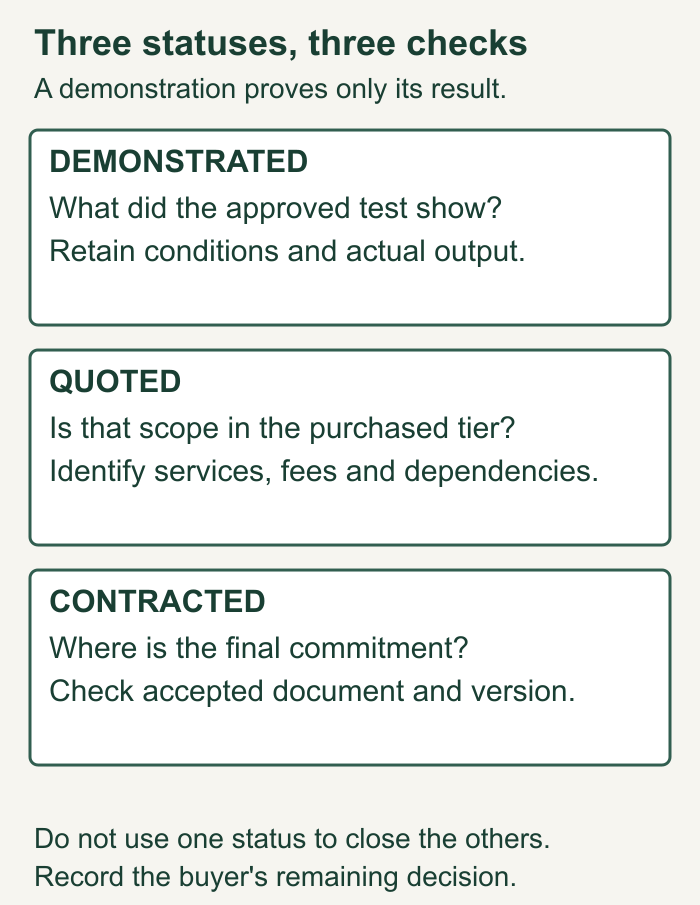
Use separate statuses for “demonstrated,” “included in quoted scope” and “included in the final agreement.” They describe different evidence. A successful demonstration should not automatically close the other two fields.
Work through one promise before signing
Hypothetical example: a salesperson says, “Your team can export all contract data.” The buyer needs to leave the platform later with documents, metadata and amendment relationships intact.
Translate a material delivery promise into the statement of work template with a testable acceptance criterion.
The proposed order names a subscription tier but does not define the export. The buyer's test request could be:
Using an approved synthetic agreement with two amendments and five metadata fields, please demonstrate the export available in our quoted tier. Identify the output formats, whether files and relationships are included, any additional fee, who performs the export and the delivery time. Please identify the provision in the proposed agreement that records the agreed scope.
Suppose the demonstration returns a spreadsheet but omits the signed documents and amendment links. That result establishes a narrower capability in the test. Ask whether the missing elements require a different product, service or future release. Update the worksheet instead of recording “export supported.”
If an acceptable export is essential, request a defined commitment and counsel's review of how it fits the agreement. If the vendor declines, assess a tested alternative and its cost or defer the purchase. Do not treat an informal promise to “sort it out later” as a completed scope decision.
Give counsel a precise unresolved question
Provide the promise record and the proposed contract documents. Ask counsel to check incorporation, conflicting terms, authority, amendment requirements and the effect of any entire-agreement or future-feature wording. If two included documents disagree, use the separate contract-conflict worksheet.
Use the lawyer review quote comparison if you need to commission advice on the unresolved promise.
A proposed delivery date also needs a consequence the parties have agreed. Ask about appropriate acceptance, payment, correction or exit terms rather than assume a missed date creates a refund or cancellation right. These are negotiation subjects; this article does not provide a universal clause or recommend withholding payment.
For a future feature, make the purchase decision twice: once assuming delivery as described and once assuming it does not arrive. Record whether the present product meets the minimum need in the second case. That gives the approver a visible dependency to accept or reject.
If you already signed
Preserve the dated sales material, signed documents, amendments and evidence of the actual shortfall. Ask counsel to assess the specific agreement, applicable law and communications before asserting a remedy. A missing written commitment is a reason to investigate, not enough by itself to conclude that you have no rights or that the vendor committed fraud.
Prepare a focused review packet identifying the outcome you need: delivery, a workable substitute, revised pricing or an exit assessment. For export promises, the data-export guide explains how to test usability before access ends.
Read future-feature and export wording in its actual scope
Atlassian's Customer Agreement, effective October 1, 2026, provides a second concrete example: section 20.15 says purchases are not contingent on delivery of future functionality or features. Its beta provisions separately warn that a feature may never be released. This is the vendor's stated agreement, not a prediction about your claim or a rule that every roadmap statement has no legal effect.
An export promise also needs a timing and package check. HubSpot's Product Specific Terms, section 1.3, address retrieval for Smart CRM and Free Services, including assistance during the subscription at the customer's reasonable cost and no post-termination or post-expiration access for those services. Check the terms for the actual product. Do not generalize that specific free-service provision to every paid subscription.
Technical documentation can narrow what a demonstration establishes. For example, Ironclad's repository-sharing guide distinguishes visible-column and all-column exports and says sharing a view does not grant access to every record. Those documented features do not establish your quoted entitlement or a complete document export. Ask the vendor to demonstrate the specific outcome you need.
A completed promise record for the export example
The following entry uses the fictional scenario above. It records a gap rather than declaring a legal breach.
PROMISE RECORD P-01: FICTIONAL EXPORT
Sales statement: team can export all contract data.
Buyer outcome: retrieve signed documents, five agreed metadata fields and links to two amendments in usable formats before access ends.
Demonstrated: spreadsheet produced in the approved test; documents and amendment links not produced.
Quoted: subscription tier named; complete export scope not defined.
Contracted: specific export commitment not located in the current proposed package.
Dependencies: vendor to identify additional service, configuration, customer work or future release required.
Acceptance evidence sought: buyer opens output, matches agreed fields and follows amendment relationships using the quoted route.
Commercial questions: fees, delivery time, authorized requester and availability before exit.
Open issue: demonstrated output is narrower than required outcome.
Decision owner: procurement approver, with IT reviewing usability and counsel checking the agreed documents.
Current buying decision: deferred pending scope or an approved alternative.
Final document reference: not yet agreed.
“Not located” is a review result with a defined scope, not proof that no statement can matter. Attach the actual proposed documents and retained messages. If the vendor supplies a revised schedule, update the contract status only after confirming that the final accepted package includes that version.
A written clarification request you can adapt
This proposed request asks for a concrete commitment. It is not a universal legal clause or a demand for an automatic refund.
Subject: Confirm scope for [material outcome] before signature
We need [outcome] for [users, environment and purpose]. Your [dated statement/demo] described [vendor's actual words].
Our proposed order is [version and tier]. Please confirm:
1. What is available now in that exact package?
2. What implementation, configuration, third-party service or customer work is required?
3. What output, format and limits will the agreed test cover?
4. What delivery date and acceptance evidence can both sides agree?
5. Which final agreement document and provision will record the commitment?
6. What response is proposed if the agreed delivery or test is not met?
Please distinguish a committed deliverable from a forecast or roadmap item. Identify any added charges or dependencies so the approver can assess them.
We will review the proposed commitment with the rest of the agreement before making the purchase decision.
Checklist before signature or an amended commitment
- Exact promise: retain the original statement, date and context; label the buyer's inference separately.
- Product scope: confirm tier, users, limits, present availability and third-party dependencies.
- Delivery work: identify who provides configuration, implementation and training, and where that work is purchased.
- Acceptance: use an agreed task and usable output rather than a feature name alone.
- Document package: locate the commitment in the final version and check incorporated schedules, precedence and amendment formalities.
- Failure response: obtain review of notice, correction, payment and remedy provisions without assuming they all provide the same right.
- Approval: record who accepted the remaining limitation or future dependency and what alternative was assessed.
- Handover: give the implementation owner the final promise record, agreement reference and test plan.
The Salesforce agreements overview illustrates the product-versus-professional-services distinction. The checklist is our procurement proposal; it does not establish any customer's Salesforce scope or enforceability.
Frequently asked questions
Are vendor promises binding if they are not in the contract?
The answer needs the actual documents, communications, governing law and claim. Preserve the evidence and obtain advice. This guide explains how to remove a purchasing uncertainty before signature; it does not decide enforceability of a missing statement.
Does an entire-agreement clause mean we should delete sales emails?
No. Preserve the record. A clause is one part of the legal analysis and is not an instruction to destroy relevant communications. HubSpot's example wording does not decide every possible dispute or claim.
Is a successful demo enough?
It establishes what was demonstrated under the observed conditions. Check whether those conditions match the purchased tier, configuration and users, and whether the required outcome is included in the final documents.
How should a roadmap feature affect the buying decision?
Evaluate the current product without that feature, then record the dependency if you still propose to buy. Ask whether the vendor offers a defined commitment or only a forecast. The approver should see the consequences if delivery does not occur.
Should we add a promise to the purchase order ourselves?
Check whether the vendor accepts that document and the proposed change. HubSpot's section 12.8 expressly rejects additional or different purchase-order terms. That example shows why a unilateral insertion does not by itself establish mutual acceptance.
Does a software subscription include implementation?
Read the actual package. Salesforce's overview separately describes professional-services agreements for implementation and customization. Identify the statement of work, tasks, dependencies and price rather than assume every demo activity is included.
What if we have already signed?
Preserve the signed package and earlier evidence, describe the actual shortfall and request a focused legal review. Do not announce a refund, fraud or cancellation conclusion from the absence of one clause alone.
Sources
- HubSpot Customer Terms of Service, modified September 16, 2026. Section 12.8 supplies a specific entire-agreement and future-functionality example; not a universal rule about sales representations.
- For Salesforce Customers: agreements overview, checked September 27, 2026. Explains the stated roles of order forms and professional-services agreements; not evidence of a particular customer's entitlements.
- Atlassian Customer Agreement, effective October 1, 2026. Inspected October 7: future-feature and beta scope.
- HubSpot Product Specific Terms, modified September 16, 2026. Section 1.3 inspected October 7: Smart CRM and Free Services retrieval scope.
- Ironclad: Share Repository Information, April 10, 2025. Full guide inspected October 7: export columns and permission-limited views.