

What Is a Wet Signature? Ink, Electronic and Digital Compared
By Anirudh Menon, Viaclause editor
A wet signature is ink on paper. Compare electronic and digital signatures, check US and international rules, and keep the right signed copy.
AI-generated illustration of fictional people signing a paper document. Not a photograph of an actual transaction.
A wet signature is a handwritten signature made directly on a physical document, usually with pen and ink. Printing a document, signing it and scanning it creates a wet-signed paper original and an electronic copy. Drawing or pasting a signature into a PDF does not create that paper original. Adobe's wet-signature explanation describes the paper-signing and scanning workflow.
For the broader formation check, review the four contract elements alongside this specialist question.
If someone asks for a wet signature, clarify what they need delivered: a scan of the signed document, the original paper, or both. That question can prevent a rejected submission even when the signer used the requested pen.
Wet signature, scanned copy and electronic signature
| What happened | What you have | What to confirm |
|---|---|---|
| A person signed the printed agreement. | The paper bearing the handwritten mark. | Who receives and retains that paper? |
| The signed pages were scanned. | An electronic copy of the paper document. | Will the recipient accept the scan, and must paper follow? |
| A person signed using an electronic process. | An electronic record and whatever supporting evidence that process retains. | Is this method accepted for this document and transaction? |
The federal definition of an electronic signature covers an electronic sound, symbol or process associated with a record and adopted with intent to sign it. The appearance of handwriting is not the whole test. See 15 U.S.C. section 7006(5). A pasted image should not be treated as proof, by itself, of who authorized its use.
Digital signatures add cryptographic checks
An electronic signature is the broad legal category. A digital signature is a cryptographic technique: a private key signs data and a corresponding public key verifies it. Properly implemented, it helps authenticate the source and detect changes. It is not just a picture of handwriting, and it does not by itself encrypt the document. See NIST's digital-signature definition.
When is a wet signature still required?
Not simply because it is a contract. 15 U.S.C. section 7001 generally protects electronic form in interstate or foreign commerce, preserves substantive requirements and does not compel private acceptance. Check applicable law and the agreed process.
Use the statute-of-frauds checklist to examine written-evidence requirements separately from ink or electronic format.
Section 7003 excludes specified matters, including rules governing wills and certain court documents, from section 7001. That is not a nationwide declaration that every document in those categories must be signed in ink. The applicable document, state and filing rules still need checking.
Keep two questions separate: whether the agreement was validly made, and whether the receiving office accepts this format. Our contract amendment sample addresses what a change should identify; choosing a signing method does not supply missing terms.
Ask for the rule or instruction behind the request. A legal execution requirement, a receiving office's submission rule and a counterparty's preference need different responses. Record which one applies instead of collecting ink for every document indiscriminately.
- Wills: check the state's execution law. Florida section 732.522 allows electronic signatures for electronic wills and specifies conditions for remote witnessing. “All wills need ink” is therefore wrong.
- Court documents: read the court's current filing rule. Under the printed-signature route for a declaration in California appellate rule 8.75(a)(2), the filer must obtain a signature on the printed document before filing and keep the original available for inspection. The rule also provides an electronic-signature route; do not apply the paper route to every filing.
- Notarized and real-estate documents: distinguish the signature medium, personal appearance and recording requirements. California's Secretary of State says electronic notarization is possible with traditional requirements met, while physical appearance remains required under its current guidance. Confirm the notary and recorder's applicable process for the particular instrument.
UK and India: two useful scope checks
| Jurisdiction | What the source supports | What to check next |
|---|---|---|
| England and Wales, not the whole UK | HM Land Registry Practice Guide 82 accepts specified electronic-signing routes for deeds. Its conveyancer-certified route requires signing in the witness's physical presence. | Its Mercury route starts with ink on the signature page, which is returned with the final agreed document in one email to the conveyancer. Follow the route-specific conditions, including physical witnessing where required. |
| India | IT Act section 10A protects contract formation from rejection solely because electronic means were used. The First Schedule excludes wills. Read the older consolidation with the 2022 First Schedule amendment, which removed entry 5 concerning immovable-property contracts. | Do not reuse an old blanket property exclusion. Removing that entry does not itself settle registration, stamping, witnessing or the particular office's requirements. |
Is a scan an original, and will a court accept it?
Distinguish the physical signing act, a recipient's original-delivery instruction and a court's evidence rule. They answer different questions. Scanning an ink-signed sheet produces an electronic reproduction. It does not send the paper through email, and printing that reproduction does not apply the signer's ink to the new sheet.
In U.S. federal evidence law, Rule 1001 defines originals and duplicates, including accurate electronic reproductions. It also treats an accurate readable output of electronically stored information as an original of that information. Rule 1003 generally admits a duplicate like an original unless authenticity is genuinely disputed or admitting it would be unfair. These are evidence rules for federal proceedings, not instructions to destroy paper or a guarantee that every scan proves a valid agreement.
Practical example: a supplier emails a complete, readable scan of its ink-signed agreement. The customer accepts scans for onboarding but asks its records team to retain the paper. Those instructions can coexist. Calling the scan an accepted onboarding copy is clearer than claiming it satisfies every possible original requirement.
Consumer disclosures need a separate check
Under E-SIGN section 7001(c), electronically supplying legally required written consumer disclosures involves consent, paper and withdrawal information, and demonstrated access, subject to the detailed statutory conditions. A signature button alone does not establish that disclosure process.
For a business workflow, keep evidence of what disclosure was supplied, its version, the recipient's access and any paper request. Treat choosing the signature method and fulfilling the disclosure obligation as separate release tasks. Do not substitute a sales team's preferred signing tool for the process required for the actual transaction.
Are wet signatures safer than electronic signatures?
Assess the evidence and controls of the particular process. Ink can be copied or forged; a saved signature image can be reused without permission. A paper original can supply physical evidence, while an electronic process may record authentication, events and the document version. Neither category makes identity, authority and agreement unchallengeable.
NIST's technical definition connects properly implemented digital signatures with origin authentication and data integrity. It does not say a scanned autograph is cryptographic protection. If you need that protection, verify the signed file using the appropriate software and retain verification evidence. A screenshot of a green badge is weaker operational evidence than preserving the signed file that can actually be checked.
- Identity and authority: use the agreed verification process and record the signer's business capacity. A familiar-looking mark does not establish company authority.
- Version integrity: retain the approved execution copy, the signed copy and any correction correspondence. Keep later edits separate from the completed record.
- Access: restrict the signed agreement and signature images to staff who need them. Do not maintain a casually shared folder of reusable autographs.
- Custody: record the paper's location, custodian and transfers. Keep readable digital copies with controlled access and backups.
Costs and delays: compare the actual workflow
Paper introduces printing, travel or delivery, scanning and physical-storage tasks. Electronic signing can remove some of those tasks, but it can introduce authentication, device-access and exception-handling work. There is no reliable universal saving for your transaction without measuring your own process.
A simple comparison worksheet can record, for each method: preparation owner, signer access, witness or notary appointment, delivery deadline, return format, original custodian, rejected submissions and retrieval steps. Estimate costs using your actual printing and courier quotations and staff records. Measure completed transactions rather than transferring a vendor's customer statistics to your business.
When changing methods, begin with a document category whose legal and recipient requirements have been checked. Preserve a paper route for exceptions, document the exception owner and give the signer clear instructions. The electronic-signature guide explains the broader legal and evidence questions; the digital-versus-electronic comparison explains what a cryptographic signature adds.
How to sign and keep wet-signed copies
- Confirm the final version, permitted signing method and any required witnesses before signing.
- Print the complete approved document and sign the required places using the requested ink and date format.
- Scan every required page. Check legibility, order, attachments and whether both sides of a page contain information.
- Send the accepted format to the specified recipient and save the receipt.
- Label the scan as a copy and record who holds the paper. Follow the applicable retention and preservation requirements before disposal.
Worked example: the signature was right, the delivery was wrong
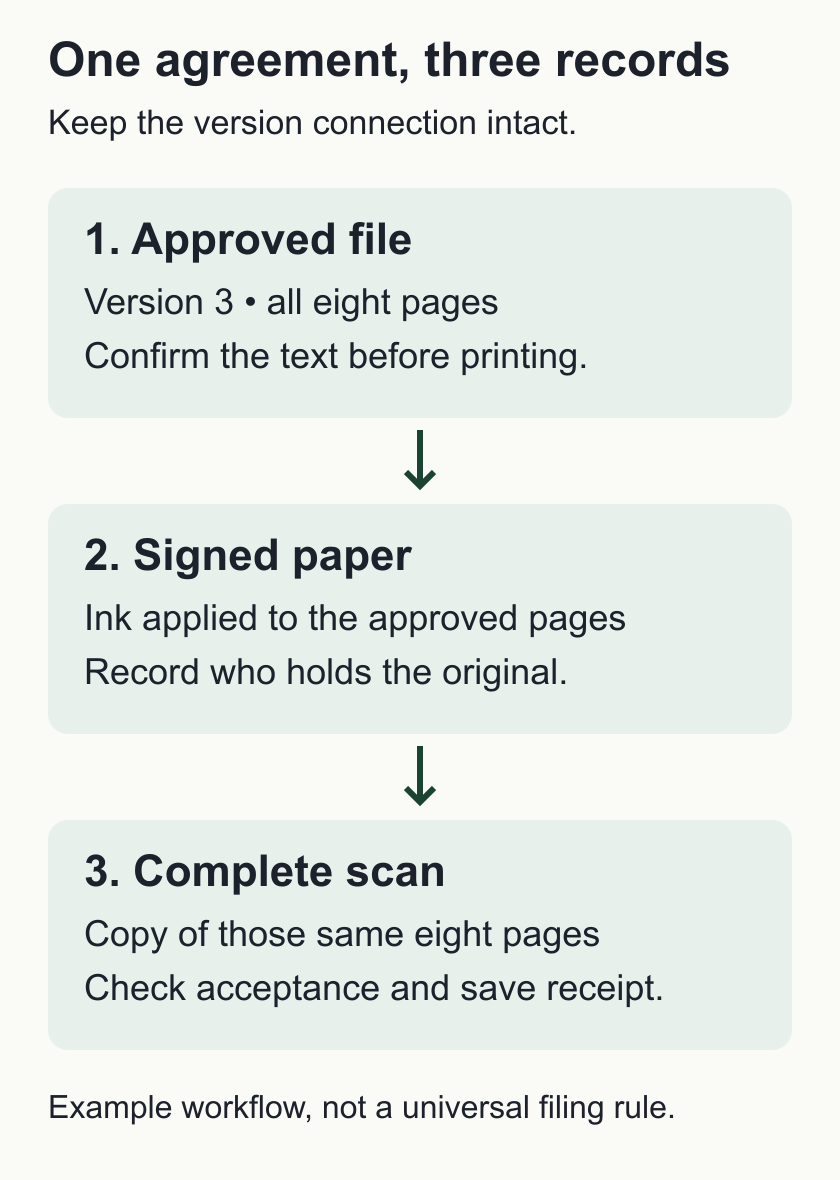
A fictional supplier receives an eight-page service amendment. The customer's instructions say: sign the approved version in ink, email a complete scan by October 12, and deliver the paper original by October 15. These are assumed instructions for this example, not statutory deadlines.
The supplier signs on October 10 and emails only page eight. The mark is handwritten, but the submission does not contain the complete amendment requested. A coordinator then finds that the first seven pages in the email folder belong to an earlier draft. Joining those files would conceal the version problem rather than solve it.
The team compares the actual paper with the approved eight-page version, scans the complete document, checks page order and legibility, and sends the corrected file. It records the customer's receipt and dispatches the same paper original with a tracked delivery reference. It does not recreate a signature on another version.
| Artifact | Recorded check | Owner and next action |
|---|---|---|
| Approved amendment, version 3 | Eight pages; fee and effective-date clauses matched against paper. | Contract owner confirms this is the agreed text. |
| Complete signed scan | Eight legible pages; page order checked; sent October 11. | Coordinator saves receipt with the file. |
| Paper original | Same version as the scan; delivery required October 15. | Records owner keeps dispatch and delivery references. |
Use the contract repository record to connect those artifacts without calling every file an original. If versions disagree, resolve the document conflict before completing the record.
Copyable request before signing
Please confirm the signing and delivery requirements for [document/version]:
1. Is ink on the printed document required, or is electronic signing accepted?
2. Is a complete scan sufficient, or must the original paper also be delivered?
3. Are witnesses, notarization or other formalities required?
4. Which recipient, address, deadline and delivery method apply?
5. Who will retain the original, and how will receipt be confirmed?
We will use the confirmed version and retain the instructions with the signed record.
Common mistakes to avoid
- Sending only the signature page when the recipient requests the full document.
- Attaching a signed page to a different version without identifying the mismatch.
- Assuming an electronic-signature law overrides every recipient instruction.
- Discarding the paper before checking the retention requirements and agreed process.
- Calling a scanned signature a certificate-based digital signature merely because it is in a PDF.
Business checklist before releasing the signed record
- Identify the exact document, execution version, attachments and signing parties.
- Confirm whether ink is legally required, requested by the receiving office or chosen by agreement.
- Check signature capacity and any witness, notary, filing or registration formalities.
- State whether the deliverable is a complete scan, original paper, an accepted signature-page package or a specified electronic record.
- Check the returned pages against the approved version and resolve discrepancies without silently reconstructing the document.
- Save the delivery receipt, original's custodian and location, and any electronic verification evidence.
- Check preservation and retention requirements before destroying paper or deleting signing evidence.
Frequently asked questions
Can a wet signature be emailed?
You can email a scan of the signed paper. Confirm whether the recipient accepts it and whether the original must follow. An instruction to email a scan and an instruction to deliver original paper are different tasks.
How can you tell if a signature is wet?
Examine the physical document and signing history. A PDF's appearance cannot establish whether ink was applied to that sheet. A printed image can resemble an autograph, including in blue. Preserve the signing record and paper rather than relying on color alone.
Is DocuSign the same as a wet signature?
No. The brand does not identify the signing act. Electronic signing produces an electronic record; printing, signing in ink and returning a scan creates a paper original plus a copy. Confirm the process actually used and what evidence was retained.
Is drawing a signature on a screen wet signing?
No ink is applied to paper. The mark may qualify as an electronic signature if adopted with intent to sign and associated with the record, under section 7006(5). Its handwritten appearance does not establish those conditions by itself.
Can I paste an old signature image into a PDF?
That creates a different process from signing a printed copy. Confirm permission, intent, association with the particular record and the recipient's accepted method. An image saved from another transaction does not itself show that its owner approved this one.
Does a wet signature have to be cursive or in blue ink?
The term describes physical signing rather than prescribing a handwriting style or ink color. Follow the document's actual signing instructions and applicable rules. Do not infer legal compliance or originality from cursive writing, color or a visual match.
Does ink make an agreement legally binding?
Ink alone does not supply missing terms, authority or other substantive requirements preserved by section 7001. Check formation separately using the contract-elements guide above.
Must I send the whole agreement or only the signature page?
Follow the approved delivery process. The worked amendment requires all pages. The England-and-Wales Mercury route described above expressly uses a signature page linked with the final document. Do not transfer that specialized procedure to an unrelated submission.
Can both parties sign separate copies?
Confirm whether counterparts are accepted for this document and how they will be assembled and retained. Use identical approved text, clearly identify each signing party and preserve the agreed process. Separate copies do not cure conflicting versions or missing execution formalities.
Do wills and court documents always require ink?
No universal answer follows from E-SIGN's exceptions. Florida's electronic-will provision and California appellate rule 8.75 illustrate document-specific electronic routes with conditions. Check the jurisdiction and current rule for the actual document.
Does notarization always mean paper and in-person signing?
Signature medium and personal appearance are separate questions. California's current official FAQ permits electronic notarization subject to traditional requirements while requiring physical appearance for California notaries. Do not generalize that position to other jurisdictions or ignore an applicable remote-notarization rule.
Can I destroy the original after scanning?
Section 7001(d) recognizes qualifying accurate, accessible electronic retention within its scope. Check separate original-delivery, preservation and document-specific obligations before disposal; having a scan is not enough.
Can I obtain a wet signature without meeting the signer?
Where the checked requirements permit it, send the final document for the signer to print, sign and return through the accepted channel. Physical signing does not itself require the requester to be present. Required witnesses or notaries still need their own compliant arrangements.
What if the signer returns the wrong version?
Stop the release and compare the returned pages with the approved execution copy. Obtain instructions for correcting or repeating execution. Keep the rejected version and correspondence in the record. Do not paste the existing autograph onto corrected terms and call it the same signing event.
Sources
- Federal Rule of Evidence 1001: originals and duplicates.
- Federal Rule of Evidence 1003: duplicate admissibility and exceptions.
- NIST: digital signatures.
- Florida section 732.522: electronic wills.
- California appellate rule 8.75: signing routes and originals.
- California Secretary of State: electronic and remote notarization.
- HM Land Registry Practice Guide 82.
- India IT Act: section 10A and First Schedule, read with amendment.
- India notification S.O.4720(E), 2022: First Schedule changes.
- Adobe: wet signatures and the print, sign and scan workflow.
- 15 U.S.C. section 7001, hosted by Cornell LII: electronic form, preserved requirements and retention.
- 15 U.S.C. section 7003: exceptions to section 7001.
- 15 U.S.C. section 7006: electronic-signature definition.