

Statute of Frauds: Written Evidence, Exceptions and Examples
By Anirudh Menon, Viaclause editor
Understand the statute of frauds with California and New York examples, signed-record checks, goods quantity limits, exceptions and a copyable evidence worksheet.
AI-generated documentary illustration of fictional receiving-office colleagues. Not a photograph of a real transaction.
The statute of frauds requires specified agreements to have sufficient signed written evidence or a qualifying record before they can be enforced. It does not mean every oral contract is void. First identify the governing law and transaction, then check the required evidence and any applicable exception. California and New York have different enacted provisions. See California's general writing categories and New York's general writing rule.
This guide uses selected California and New York rules, with actual New York opinions explaining difficult boundaries. It is not a fifty-state survey. A signed record can address a formalities requirement without proving agreement, authority, every disputed term or the amount payable. Start with the contract formation basics, then keep those questions separate in the worksheet below.
Start with three questions
- What agreement is alleged? Identify the parties, promises, consideration, terms, date and decision-makers. Preserve evidence against the alleged agreement as well as evidence supporting it.
- Does an enacted writing requirement cover it? Identify the jurisdiction and category. A services invoice is not automatically a goods sale; an arrangement involving land requires its own analysis.
- What record or supported exception satisfies that requirement? Identify who signed, what the record establishes, its quantity or scope limits and the facts supporting any alternative route.
For New York goods, UCC section 2-204 recognizes formation through sufficient conduct and allows some open terms if the parties intend a contract and there is a reasonably certain remedy basis. That formation rule does not erase a separate statute-of-frauds requirement. For the broader conduct question, use the implied contract evidence guide.
The six familiar categories, with jurisdiction limits
The familiar teaching list is a memory aid, not one nationwide statute. Read the governing enactment and any additional transaction rules.
| Category | Scoped rule | Practical question |
|---|---|---|
| Marriage consideration | New York 5-701(a)(3) covers promises in consideration of marriage, excluding mutual promises to marry. | What is the promised exchange? Do separate family-law formalities apply? |
| Performance beyond one year | California 1624(a)(1) and New York 5-701(a)(1) address performance by the agreement's terms, measured from making. | Can the promised performance finish within a year, or did work merely run late? |
| Land and longer leases | California 1624(a)(3) and New York 5-703(2) address real-property sales and leases longer than one year. | Which property interest, consideration, duration and agent authority are proved? |
| Executor or administrator promises | New York EPTL 13-2.1 covers a personal representative's promise to answer for a decedent's debt or default, alongside specified trust and testamentary promises. | Distinguish the representative's promise from ordinary administration of estate assets. |
| Goods of $500 or more | California 2201 and New York 2-201 contain signed-record requirements and specified alternatives. | What quantity is supported? Are the alternative route's conditions met? |
| Suretyship | The general statutes address specified promises to answer for another's debt, default or miscarriage: California 1624(a)(2); New York 5-701(a)(2). | Is this a secondary guarantee or an independent obligation? Apply the relevant exceptions. |
Additional categories exist. California's statute includes specified compensated real-estate agency and business-credit promises; New York's includes specified negotiation compensation. Their conditions and exclusions matter. Specialized financial-contract routes are not general permission to rely on an oral deal. Check the complete California enactment and New York enactment.
The one-year rule concerns possible performance
In D & N Boening v. Kirsch Beverages, New York Court of Appeals (1984), opinion reproduced by OpenJurist, the court distinguished expected duration from possible complete performance under the actual terms. A beverage distributorship continuing indefinitely and ending within a year only through breach was barred. Breach is not a permitted mode of performance. The court affirmed dismissal.
Do not assume every indefinite arrangement escapes the rule, or every project expected to last 18 months falls within it. Read the required duties and any lawful completion or termination provisions. Boening traces the writing rule to the English 1677 statute, but today's decision requires the enacted law governing today's agreement.
Fictional California service example: On October 6, the parties promise distinct reports for each of the next 18 monthly periods, with no alternative full performance within a year. That raises the California 1624(a)(1) writing issue. A report promised within six months that happens to arrive in month 14 presents different terms. These examples identify the issue; they do not establish liability.
Before treating a cancellation clause as resolving the question, check who may use it, on what conditions and whether it constitutes a permitted completion rather than breach. For future projects, preserve scope and successive duties in a statement of work. The California verbal-agreement guide addresses the separate problem of proving spoken terms.
Land sales, leases and written agent authority
New York 5-703 distinguishes creating property interests from a contract to sell property or lease it for longer than one year. The latter requires a signed contract or memorandum expressing consideration. An agent's authority for that route must be in writing. Property identification and agreed terms still need assessment; a broker's involvement alone is not a complete evidence answer.
For a fictional two-year warehouse lease, collect the property description, term, price, alleged acceptance, complete signed records and written authority. Do not infer that an unsigned draft is binding simply because keys changed hands. The part-performance route below requires its own facts and remedy analysis.
Guarantees and the main-purpose argument
California 1624 refers to exceptions in Civil Code 2794. Among its original-obligation categories, subsection (4) concerns a promise supported by consideration beneficial to the promisor. Match the actual promise and consideration to the statutory category; a business motive is not an evidence checklist by itself.
In Martin Roofing v. Goldstein, New York Court of Appeals (1983), opinion reproduced by OpenJurist, the court required beneficial new consideration and an intended independent obligation to pay, rather than secondary liability for a corporation's debt. A remote shareholder benefit was insufficient. The opinion expressly declined the broader main-purpose rule, and affirmed dismissal. Do not export a generic leading-object exception into every state.
For a proposed owner guarantee, record the original debtor, creditor, existing debt, exact promise, consideration received by the proposed guarantor and whether the original obligation continues. A later statement that the owner wanted the project finished does not replace those facts.
What writing or record is sufficient?
Identify the party to be charged: the party against whom enforcement is sought. This determines whose signature or authorized act the applicable route requires. It does not invariably mean both signatures on one final document. New York 5-701 permits a note or memorandum. Keep the relevant statute with the evidence.
Related records can matter. In the New York opinion Crabtree v. Elizabeth Arden Sales (1953), reproduced by OpenJurist, the court explained that a memorandum need not occupy one document and considered signed payroll records with an unsigned office memorandum. Authentication, connection to the same transaction and required terms are essential checks. The discussion does not turn unrelated drafts into a contract.
- Preserve the complete record, not a cropped signature or selected message.
- Identify the signer, role, authority and record they intended to authenticate.
- Connect attachments and versions to the message or approval referring to them.
- Check the transaction's required terms, rather than assuming the same contents satisfy every category.
- Retain contrary terms, reservations, missing approvals and disputes.
Goods: signed quantity and the merchant-confirmation route
California Commercial Code 2201(1) generally requires a signed record indicating a sale for $500 or more. An omitted or incorrectly stated term is not automatically fatal, but enforcement under that paragraph cannot exceed the quantity shown. Confirm that the signer's act is attributable to the party against whom enforcement is sought or an authorized agent or broker.
The alternative confirmation route is between merchants, not automatically between any two companies. New York 2-104 defines merchant status through goods dealings, relevant occupational knowledge or attributed knowledge, and defines between-merchants treatment for the transaction.
Under New York 2-201(2), check a timely received confirmation sufficient against its sender, the recipient's reason to know its contents and an objection in a record within ten days after receipt. This formalities route does not by itself prove that the parties agreed. Do not treat silence as universal acceptance of unsolicited terms.
Goods exceptions: identify the supported quantity
New York 2-201(3) supplies these alternatives for a contract otherwise valid:
- Special manufacture: unsuitable ordinary resale, plus a substantial manufacturing start or procurement commitment before notice of repudiation, in circumstances indicating the goods were for this buyer.
- Court admission: a qualifying admission in pleading, testimony or otherwise in court, limited to the quantity admitted.
- Accepted payment or goods: identify the goods for which payment was made and accepted, or goods received and accepted. Dispatch alone does not establish those conditions.
Maintain separate records for formation, signed quantity, payment, receipt, acceptance, objections and returns. A route addressing the writing requirement does not dispense with otherwise-valid-contract conditions, defenses or proof of the claimed amount.
Worked scenario: 100 claimed units, 60 recorded and 20 overlapping
All parties, dates, records and amounts in this scenario are fictional. Assume a California sale of ordinary components, no special financial regime, and a seller seeking enforcement against the buyer. These assumptions organize the evidence rather than decide an actual dispute.
- October 6, call: Valley Components says the buyer ordered 100 units at $12 each. The buyer disputes the quantity. The alleged total is $1,200.
- October 7, record VC-60: a buyer-signed record identifies 60 units at the same alleged price. Assume the signature is authentic and authorized; preserve the actual record.
- October 12, receiving: evidence identifies 20 received and accepted units from within those same 60. Those are not a second, disjoint order.
- October 13, review: the reviewer locates no signed quantity record for the other 40 and marks that gap unresolved. The example assumes no established additional confirmation, manufacturing or admission route.
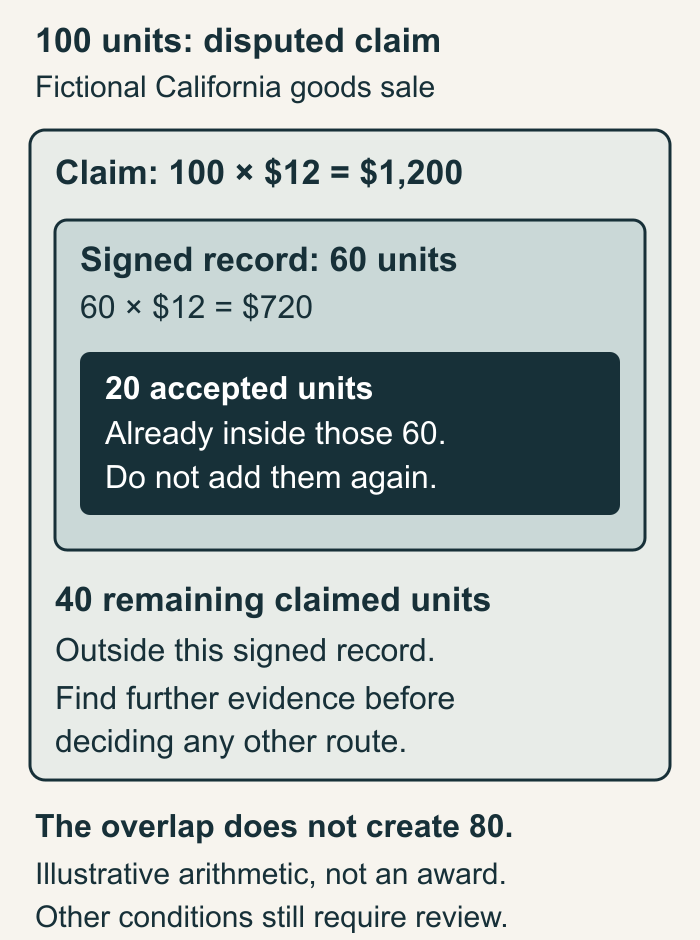
| Evidence | Calculation | Review entry |
|---|---|---|
| Seller's allegation | 100 × $12 = $1,200 | Disputed claim, not established liability. |
| Buyer-signed record | 60 × $12 = $720 | Quantity recorded: 60. Other conditions remain. |
| Accepted subset | 20 × $12 = $240 | These 20 are inside the 60; do not add them again. |
| Outside the identified signed record | 100 minus 60 = 40 | Retrieve further evidence before resolving the gap. |
The signed-record route and accepted-goods route have different conditions under California 2201. The overlap does not create an 80-unit signed record. The $720 and $240 are arithmetic at the alleged price, not amounts a court necessarily awards. Nor does the 40-unit gap establish that every possible remedy fails.
Part performance and estoppel are not universal escape routes
New York 5-703(4) preserves equity's power to compel specific performance in cases of part performance. That is a particular real-property provision and remedy, not a rule that paying any invoice validates every oral promise.
In Messner Vetere v. Aegis, New York Court of Appeals (1999), opinion hosted by Cornell, performance had to be unequivocally referable to the agreement. The claimant's pleaded inaction lacked the required detrimental reliance; the other party's performance alone did not suffice. Both certified questions were answered negatively. Footnote 1 also rejects attributing a parallel partial-performance rule under 5-701 to the court's earlier decisions.
For promissory estoppel against a New York statute-of-frauds defense, Matter of Hennel, New York Court of Appeals (2017) requires established estoppel elements and an injury sufficiently severe that applying the statute would be unconscionable. Ordinary unfairness or losing the promised bargain is not enough. On the actual property-and-mortgage record, the court reversed and dismissed the claim.
Collect the exact promise, reliance, expense, foregone alternatives, causal link and available benefit. Mark the transaction and remedy. Avoid declaring an exception established merely because someone worked, paid or trusted the speaker.
Can an email or electronic signature satisfy the requirement?
Electronic recognition is not automatic authentication. California 1633.7 recognizes electronic records and signatures for applicable writing and signature requirements. Section 1633.2(h) requires a sound, symbol or process associated with the record and executed or adopted with intent to sign. A name appearing somewhere in an email is not the entire inquiry.
Section 1633.5 requires agreement to transact electronically, assessed from context and conduct. Section 1633.3 contains exclusions, including specified testamentary transactions, and preserves other substantive law. California 1624(d) separately restricts ephemeral electronic messages for real-property conveyance contracts. Do not assume every text message qualifies.
Preserve message headers, complete bodies, attachment versions, signer identity, authority and approval context. Use the email evidence packet to collect originals. The wet signature guide covers physical signing; changing the medium does not supply missing terms or authority.
Copyable completed evidence record and blank worksheet
The completed record converts the component example into review tasks. It does not substitute an assistant's conclusion for a court's finding.
FICTIONAL RECORD: VC-100
Agreement alleged: 100 ordinary components at $12 each
Law and category: California goods sale; special financial regime excluded by assumption
Party to be charged: Buyer, not the seller sending the invoice
Formation: Seller alleges October 6 call; buyer disputes quantity
Signed evidence: VC-60, October 7, 60 units; signature and authority assumed for illustration
Claimed quantity: 100
Recorded quantity: 60
Receipt and acceptance: 20 units on October 12, all inside the signed 60
Overlap control: 20 is not added to 60
Outside identified signed record: 40
Other routes: No established extra confirmation, special manufacture or court admission assumed
Amount status: $1,200 allegation, $720 and $240 illustrative values; no liability finding
Open issue: Complete order correspondence and exception evidence for the remaining quantity
Task owner: Contract owner
Next step: Retrieve originals and record contrary evidence before requesting legal assessment
Store the originals, versions and worksheet together in the contract repository. Use this blank copy for the next review:
STATUTE-OF-FRAUDS EVIDENCE WORKSHEET
Agreement alleged and date made:
Governing jurisdiction and transaction category:
Formation evidence and contrary evidence:
Party against whom enforcement is sought:
Exact enacted provision and category:
Required contents, signature and agent authority:
Complete record ID, date and version:
Electronic agreement and signing-intent evidence, if relevant:
Claimed quantity, property interest or duration:
Scope actually supported by the record:
Proposed exception and evidence for each condition:
Overlap between payment, receipt, acceptance and signed-record sets:
Requested remedy and unresolved defenses:
Missing records, retrieval owner and next step:
Reviewer and date:
Before relying on the agreement: checklist
- Identify governing law, transaction classification and the alleged agreement.
- Separate formation, written evidence and remedy questions.
- Record the party to be charged and signer's authority.
- Preserve complete records and connect each version to its approval.
- Check possible performance by the actual terms for the one-year issue.
- Check land-specific contents, duration and written agent authority.
- Distinguish a secondary guarantee from an independent obligation under the applicable rule.
- Check signed quantity and every proposed goods exception separately.
- For merchant confirmations, preserve receipt and any timely objection.
- Record overlap so accepted goods are not counted twice.
- Document reliance and the requested remedy before relying on an equitable exception.
- Flag gaps for qualified advice before asserting enforcement or rejecting obligations.
Frequently asked questions
Does the statute of frauds invalidate all oral contracts?
No. New York 5-701 lists covered categories. Check the category, conditions and applicable exceptions.
What are the six types of contracts?
The familiar list is marriage consideration, beyond-one-year performance, land, specified estate-representative promises, goods above the enacted threshold and suretyship. It is a screening aid. For example, estate promises have their own New York source, EPTL 13-2.1.
Does every deal above $500 need writing?
No. That threshold here concerns ordinary goods sales under California 2201, not every consulting or service agreement.
What if work actually takes more than one year?
Actual duration alone does not answer whether the terms permit full performance within a year. Boening distinguishes that possibility from ending through breach.
Must both parties sign the same final document?
Not invariably. Crabtree discusses connected writings and authentication. Apply the transaction's signature and content requirements; do not assume any collection of drafts suffices.
Does an unanswered confirmation prove a deal?
No. New York's merchant-confirmation route addresses a formal requirement under stated conditions. The underlying agreement still needs proof.
Does partial performance always solve the missing writing?
No. Messner Vetere explains the bounded New York property doctrine and required reliance; it does not supply a universal exception for every category.
Is reliance on a promise enough?
Not under the New York defense analysis in Hennel. Estoppel elements and unconscionable injury are required, not ordinary disappointment.
Does a typed email name count as a signature?
Context and intent matter. Under California 1633.2(h), the symbol or process must be associated with the record and adopted with intent to sign, within the applicable framework.
Sources
- California Civil Code 1624: current general categories, agent authority and electronic-message qualification.
- California Commercial Code 2201: goods records, quantity and alternatives; amended effective January 1, 2025.
- New York General Obligations Law 5-701: categories, charged-party signature and specialized qualifications.
- New York General Obligations Law 5-703: real-property writing, authority and equitable part performance.
- New York UCC 2-201: signed records and alternatives; displayed revision June 5, 2026.
- New York UCC 2-104: merchant definitions.
- New York UCC 2-204: formation and open terms.
- New York EPTL 13-2.1: specified estate, trust and testamentary promises.
- D & N Boening v. Kirsch Beverages, 63 N.Y.2d 449, November 20, 1984: actual New York Court of Appeals opinion reproduced by OpenJurist; one-year interpretation.
- Crabtree v. Elizabeth Arden Sales, 305 N.Y. 48, January 21, 1953: actual opinion passages reproduced by OpenJurist; connected writings and authentication.
- Martin Roofing v. Goldstein, 60 N.Y.2d 262, November 29, 1983: actual New York Court of Appeals opinion reproduced by OpenJurist; independent duty and main-purpose distinction.
- Messner Vetere v. Aegis, 93 N.Y.2d 229, March 25, 1999: actual New York Court of Appeals opinion hosted by Cornell; version marked uncorrected and subject to revision.
- Matter of Hennel, 29 N.Y.3d 487, June 29, 2017: official corrected opinion; estoppel and unconscionable injury.
- California Civil Code 2794: original-obligation exceptions.
- California Civil Code 1633.2: record and electronic-signature definitions.
- California Civil Code 1633.3: current scope and exclusions.
- California Civil Code 1633.5: agreement to transact electronically.
- California Civil Code 1633.7: electronic writing and signature recognition.