

Are Electronic Signatures Legally Binding? A US Review Checklist
By Anirudh Menon, Viaclause editor
Assess electronic-form recognition, consent, authority, formalities and retained evidence. Work through a fictional business contract and consumer disclosure record.
Electronic signatures can be legally binding in the United States. For covered interstate or foreign-commerce transactions, ESIGN prevents denial of legal effect solely because a signature or record is electronic. It preserves other substantive obligations and generally does not force a person to accept electronic signing. Electronic form therefore does not settle every validity question. 15 USC 7001(a) and (b), official 2024 edition.
An electronic signature involves an electronic sound, symbol or process associated with a record and adopted with intent to sign it. ESIGN's consumer definition concerns primarily personal, family or household use. 15 USC 7006 definitions. This guide reviews US business evidence and a separate consumer-disclosure scenario. It is a practical review framework, not a statutory five-part test or a platform certification.
For signing methods and terminology, use the electronic signature guide. This page's question is whether the particular transaction and evidence support reliance on the signature. The contract elements guide covers the wider formation requirements.
1. Ask five questions about the actual document
| Review question | Locate this evidence | Escalate when |
|---|---|---|
| What transaction and law apply? | Document category, parties, jurisdiction and regulatory requirements | Scope or a special document procedure is unresolved |
| Was there intent to sign and agreement to use the process? | Presented terms, signing action and communications | An automatic footer or pasted name is the only evidence |
| Who acted, and for whom? | Recipient details, authentication record and authority evidence | A shared mailbox or delegate leaves the actor unclear |
| Are other formalities satisfied? | Witness, acknowledgment, filing or delivery requirements where applicable | A signature image is being treated as the whole execution process |
| Can the exact record and evidence be retained? | Operative file, attachments, event record and retrieval result | Only a screenshot or expiring link remains |
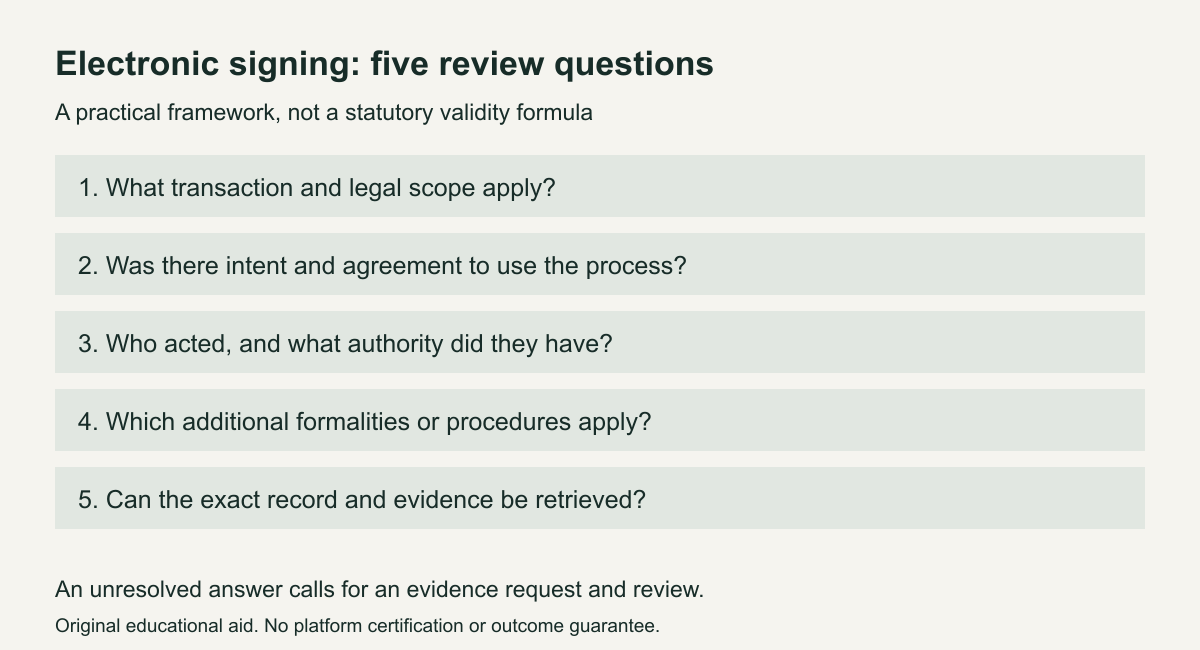
Write down an answer and its evidence location for each question. “The vendor is compliant” is not an evidence location. The file and event record need to relate to the agreement you are reviewing. If there is a gap, state the gap rather than selecting a software brand as the answer.
2. California example: a name and timestamp are not the entire analysis
CACI 380 explains California agreement to transact electronically through context and conduct. Its authorities distinguish attributing a name to someone from establishing intent to sign, and explain why a name and timestamp alone were insufficient on the cited Ruiz facts. These are fact-sensitive California materials, not a nationwide evidence minimum. Official 2026 California civil instructions, CACI 380 and authorities.
Fictional business scenario: Linden Design and Canyon Supply negotiate a $3,600 illustration-services agreement. Each representative confirms the final LD-07 terms and the agreed electronic workflow. The designated signer opens the identified file, takes the stated signing action, and returns the completed record. The reviewer has the final document, all attachments, invitation, communications, event export and separate evidence of company authority.
This is a stronger review packet than a screenshot of “completed.” It still rests on assumptions: the parties are capable, the object and terms are lawful, remaining formation requirements are met, no additional formality applies and the recorded signer actually acted. The completed record below captures those assumptions rather than promising enforceability.
COMPLETED FICTIONAL BUSINESS REVIEW
Record: LD-07, services scope and fee schedule included.
Parties: Linden Design and Canyon Supply.
Use: Business illustration services, $3,600.
Jurisdiction: California example; interstate-commerce scope reviewed.
Electronic process: Both representatives agreed in retained emails.
Intent: Signing action described with the final record displayed.
Actor: Designated individual and recipient details recorded.
Authority: Separate company approval retained; not inferred from title.
Terms: Final signed LD-07 and referenced attachments retained.
Evidence: Invitation, communications and event export archived together.
Open checks: Actual actor, substantive validity and applicable formalities.
Assessment: Packet supports review under the stated assumptions.
Owner: Designated reviewer to resolve open checks before reliance.
If the invitation instead goes to a shared mailbox, log the change. If someone else signs, identify who and the basis for acting for the company. The representative-signing guide addresses that separate issue. Access to an inbox should not substitute for your authority record.
3. Consumer disclosures need a separate branch
When legally required written information is delivered electronically to a consumer, ESIGN includes a special consent process. It includes prior information about paper options, withdrawal, scope, procedures, paper-copy requests and access requirements, plus electronic consent or confirmation demonstrating access to the relevant form. FDIC's January 2014 examination chapter explains this for financial institutions; it is dated guidance, not a complete current rule for every industry. FDIC ESIGN examination guidance.
Fictional consumer scenario: Rowan applies for a personal-use service. Assume counsel has identified a legally required written disclosure and determined that the ESIGN consent branch applies. The business proposes to deliver it as a downloadable PDF. Rowan clicks a generic account-creation button, but the reviewer cannot locate the prior consent information or a record demonstrating access to that PDF form.
The correct worksheet entry is disclosure-delivery review unresolved. It is not “every contract void.” Section 7001(c)(3) preserves consumer-contract effectiveness against denial solely for failure to obtain the electronic access-demonstrating consent or confirmation specified in (c)(1)(C)(ii). That narrow provision does not excuse every disclosure deficiency. 15 USC 7001(c)(3).
Build an evidence request for the actual workflow: what was shown before consent, what scope the person agreed to, the access-demonstrating event, the delivered record and any withdrawal or format changes. Confirm the underlying disclosure's content and timing separately. Do not use an ordinary business signing paragraph to close this consumer review.
FICTIONAL CONSUMER DISCLOSURE GAP RECORD
Document: Counsel-identified required written disclosure.
Recipient: Rowan, primarily personal-use transaction.
Proposed form: Downloadable PDF.
Located: Generic account-creation click.
Missing: Prior consent information and form-access evidence.
Decision: Hold the electronic disclosure-delivery determination.
Next request: Preserve the actual screens, consent record,
access demonstration, delivered PDF and withdrawal procedure.
Separate check: Applicable disclosure content, timing and remedy.
Do not record: Blanket invalidity of the whole consumer contract.
The example identifies a missing-evidence problem. It does not demonstrate a compliant platform, report a real consumer test or determine the remedy for a particular regulated product. The statutory process must be matched to the actual transaction.
For a UK document, use the UK electronic-signature legality guide to identify the legal jurisdiction and separate agreement, execution and registry procedures before choosing a workflow.
4. Exceptions and formalities are document-specific
Section 7003 excludes specified categories from section 7001, including certain testamentary and family-law records, court documents and listed notices. Its text also addresses agency extension of the rule. An ESIGN exception calls for the governing document law and procedure; it does not itself declare a universal wet-ink requirement. 15 USC 7003.
For a proposed will, deed, court submission or regulated notice, identify the exact category before choosing a workflow. Ask which jurisdiction, signing actors, witness or acknowledgment steps, delivery method and receiving-office requirements apply. This guide does not resolve those separate regimes. Keep the wet signature guide available when a process asks for an original paper signature.
Where an execution instruction mentions notarization, do not assume that inserting a signature image fulfils the notary's role. Identify the applicable authorised-person and information requirements. ESIGN addresses electronic notarization and acknowledgment without eliminating the other required information. 15 USC 7001(g).
5. Preserve what the evidence actually shows
When legally required retention applies, ESIGN addresses accurate, accessible electronic records capable of later reproduction for the required period. 15 USC 7001(d). The FDIC chapter also makes retained-record accessibility a specific examination check for institutions. FDIC examination procedures.
For LD-07, a practical packet would place the final signed agreement, attachments and process evidence in one retrievable record. Keep the original export format alongside a readable view where useful. Record later corrections separately. Try retrieving the packet using an authorised colleague's access and note which files were actually located; an undocumented “stored” status is less useful.
An event export records what its system reports. A recipient address, timestamp or IP field can help investigation, but assess the link to the actual actor and terms. The digital versus electronic signature guide explains the distinct technical integrity question. Use the contract repository guide for a retrieval exercise.
Copyable electronic-signing review checklist
ELECTRONIC-SIGNING REVIEW
Transaction, document category and jurisdiction:
Business or consumer purpose:
Applicable scope, exceptions and special procedures:
Exact presented terms and referenced documents:
Intent and agreement evidence:
Actual actor, authentication and representative authority:
Consumer disclosure branch required? Basis and reviewer:
Prior consent information and access evidence, if required:
Other execution, delivery, filing or acknowledgment steps:
Final record, attachments and event evidence locations:
Retention requirement and actual retrieval result:
Unresolved issue, responsible person and next action:
Assessment date and later correction history:
FAQs
Is every typed name legally binding?
No automatic conclusion follows from a typed name. Determine intent, the record and surrounding evidence. The California example illustrates why those questions remain separate.
Does using Adobe or another platform guarantee validity?
A platform choice does not answer all five review questions. Examine the specific workflow, transaction and retained packet.
Are there exactly four legal requirements for an electronic signature?
There is no universal count supplied by this article. The five questions above organise review and do not replace applicable law.
Is consumer consent the same as business agreement to sign electronically?
No. The consumer-disclosure scenario uses an additional statutory branch for required written information. Keep its review record separate.
Does an audit trail prove company authority?
Record the asserted actor and signing events, then locate the authority basis separately. The LD-07 example retains both.
Do ESIGN exceptions mean paper is always mandatory?
No universal paper conclusion follows from the federal exception alone. Check the governing document rules and receiving procedure.
Names and records are fictional original examples. The graphic and worksheets are original aids; the banner is an AI-generated fictional illustration. No real transaction, platform compliance test or professional legal review is claimed.
Sources
- 15 USC 7001, official 2024 edition, recognition, preserved obligations, consumer disclosures, retention and acknowledgment.
- 15 USC 7003, official 2024 edition, specified exceptions.
- 15 USC 7006, official 2024 edition, definitions.
- Official 2026 California civil instructions, CACI 380 with directions and cited authorities, printed pages 212 through 214.
- FDIC ESIGN examination chapter, updated January 2014, financial-institution consumer disclosures and retention review.