

Signing on Behalf of Someone Else: Authority and Signature Blocks
By Anirudh Menon, Viaclause editor
Use clear company, agent and individual signature blocks. Check authority, expiry, limits and personal guarantees with a worked signing example and review worksheet.
Signing on behalf of someone means signing as a representative for an identified person or organisation. A clear signature block identifies the principal, the actual signer and the signer's capacity. Whether the act binds the principal depends on authority and applicable law, not just the words “for,” “By” or “p.p.” See the Cornell agency overview.
This US-focused guide supplies three illustrative blocks, a worked authority check and a reusable record. California statutes illustrate specific rules; other jurisdictions and document types can differ. For the wider evidence of identity and assent, use our electronic-signature guide.
Identify who is making the commitment
Start with the parties named in the agreement. “Signing for my boss” can mean sending a routine letter for an executive, committing the executive personally, or committing a company. Those are different tasks. Name the intended principal before choosing the signature notation.
| Situation | Principal or committing party | Evidence to check |
|---|---|---|
| Employee signs a company's purchase agreement | The named company | Entity rules, delegation, transaction limits and required approvals |
| Agent acts under a power of attorney | The named individual | The instrument, applicable formalities, current effect and covered act |
| Owner agrees to a personal guarantee | The owner in individual capacity | The separate guarantee terms and the individual's informed agreement |
| Assistant transmits an approved letter | The person or organisation represented in that communication | The instruction and whether the letter creates any commitment |
Keep three checks separate: identity, capacity and authority. Knowing that Jordan actually signed does not establish that Jordan could commit Northline Tools Inc. to this agreement. The contract-elements guide helps place signing in the broader formation review.
Check actual authority and the counterparty's position
Under California Civil Code sections 2316 and 2317, actual authority concerns what the principal confers or allows the agent to believe; ostensible authority concerns what the principal causes or allows a third person to believe. The latter is not established simply by an agent announcing their own power.
California Civil Code section 2334 protects specified reliance on ostensible authority where the third person acts in good faith and with ordinary care. A missing internal approval is therefore not, by itself, a universal conclusion about enforceability. Review the principal's conduct, communicated restrictions and the counterparty's knowledge.
For an internal signing decision, read the actual approval evidence. Check the granting person or body, transaction type, amount, term, effective dates, exclusions and any joint-signing requirement. Compare those limits with the final version, including its schedules. An approval for a shorter, cheaper draft should not be silently carried over to an expanded commitment.
Worked example: a genuine signature with three unresolved gaps
Fictional facts: Northline's written delegation permits Jordan to sign service purchases up to $50,000 and six months, through October 5, 2026. The October 6 draft is $58,000 for twelve months. Assume the signer identity is known; no real signature test or legal finding is being reported.
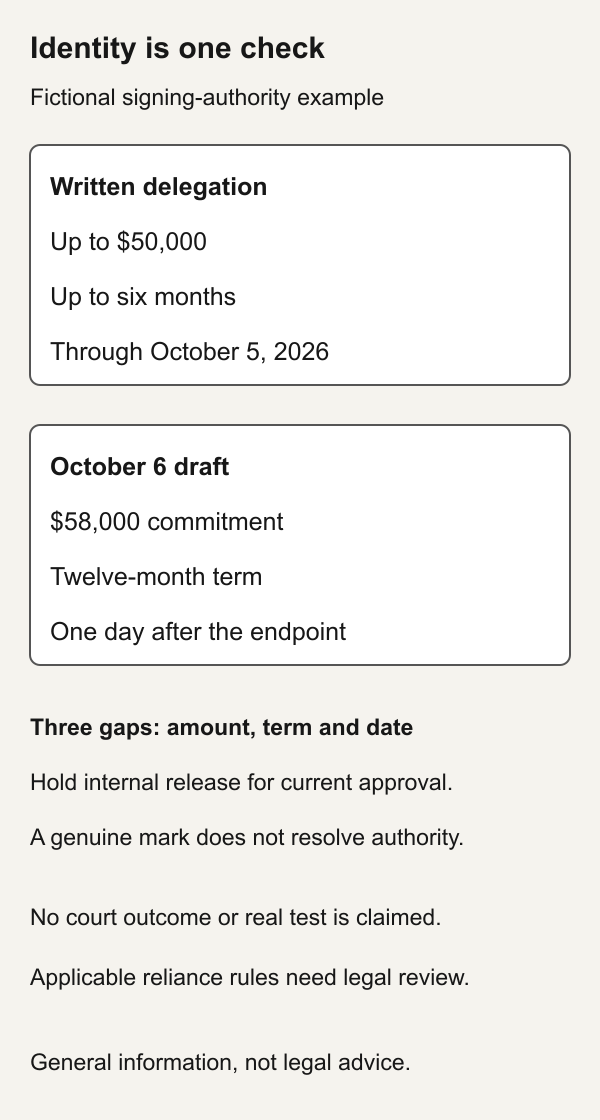
| Check | Comparison | Internal release action |
|---|---|---|
| Amount | $58,000 exceeds $50,000 by $8,000 | Obtain approval for the full revised commitment |
| Term | Twelve months exceeds six months by six | Obtain approval for the revised duration |
| Date | October 6 follows the October 5 endpoint by one day | Confirm current authority before signing |
Our operational response is to hold release and route the final draft to the appropriate approver or signer. Keep the earlier delegation; do not overwrite its endpoint. Request a current approval identifying this version, amount and term. These gaps do not establish a court outcome: ostensible authority, ratification and other rules can require a separate legal analysis.
If the draft has already been signed, preserve the actual signature date and record the authority issue. Do not change the audit history to make the expired delegation appear current. Send the facts and final version for review using our lawyer-review packet guide.
Three clear signature blocks
These are formatting examples, not completed contracts, powers of attorney or guarantees. Use the receiver's required form and the applicable instrument. The signer's own name and disclosed capacity provide a clear starting point without imitating the principal's handwriting.
1. Authorised company representative
Northline Tools Inc.
By: [Jordan's own signature]
Name: Jordan Reed
Title: Procurement Director
Date: [actual signing date]
Use this only after confirming authority for the actual company and commitment. “By” identifies the signing representative; a title field describes capacity. If a form uses “Its,” complete it with the requested office or capacity, rather than treating the printed label as an authority grant.
California Corporations Code section 313 provides a specific protection, subject to section 208(a), for listed written instruments signed by one officer from each specified group: chairperson, president or vice president; and secretary, assistant secretary, chief financial officer or assistant treasurer. The other party must lack actual knowledge that those officers lacked authority. This is a conditional corporate rule, not proof that any title, lone signer or LLC signature qualifies.
2. Agent under a power of attorney
Principal: Avery Shah
By: [Nora's own signature]
Name: Nora Grant
Capacity: Attorney-in-fact for Avery Shah
Authority: Power of attorney dated [date]
Date: [actual signing date]
The CFPB power-of-attorney explanation distinguishes the legal instrument appointing an agent from the act performed under it. Before using this block, check that the instrument is valid, effective and covers the transaction. Verify any limits, required co-agents and receiver-specific procedures. Do not turn an ordinary workplace instruction into a purported power of attorney.
For bank acceptance issues, the CFPB's bank-acceptance answer points to state law and circumstances such as forgery, revocation or exploitation concerns. Check the process in advance instead of assuming a signature label will resolve an institutional objection.
3. Individual signing a personal guarantee
For the separately reviewed personal guarantee:
Guarantor: Jordan Reed, individually
Signature: [Jordan's own signature]
Date: [actual signing date]
This block illustrates an individual commitment. It supplies no guarantee terms. Identify the covered obligations, beneficiary, limits and enforcement conditions in the separately reviewed text. Keep the company signature and individual guarantee clearly distinguished; do not infer a personal guarantee merely from an officer's company signature.
California Civil Code section 1624(a)(2) generally requires specified promises to answer for another's debt to be evidenced in signed writing, with exceptions referenced in section 2794. Check the applicable rule and exceptions rather than treating this illustrative block as a universally sufficient guarantee.
Written permission, p.p. and ratification
California Civil Code section 2309 permits oral authorisation generally but requires written authority for an agent to enter a contract that law requires in writing. Record written evidence as a practical control; do not assert that every agency appointment everywhere needs a formal power of attorney.
The notation “p.p.” is used to indicate representation. It is not a substitute for checking the source and scope of authority. Plain wording is often clearer for the reader: “Jordan Reed, for and on behalf of Northline Tools Inc.” The surrounding document should identify the actual committing party.
California Civil Code sections 2307 and 2310 address subsequent ratification and its required manner. Ratification is a legal question, not an instruction to add a later approval note and assume the problem disappeared. Preserve the original facts and obtain advice on the available response.
Electronic signing and the authority record
Address a signing request to the real authorised representative and make the principal and capacity visible in the document. An email-authentication result or a signature image answers a different question from the scope of an approval. See our digital versus electronic signature comparison for the limits of cryptographic evidence.
Keep the exact signed output with the authority evidence that applied at signing. If a further commitment is added later, review it separately. Use a contract repository to retain the approved version, signature record, delegation and unresolved qualifications together.
Copyable authority review record
Principal / committing party: [legal name]
Signer identity and capacity: [name, role]
Final document and schedules: [version]
Authority source: [instrument or approval]
Granting person or body: [reference]
Scope: [transaction, amount, duration]
Effective dates: [start, endpoint]
Exclusions / joint signing: [details]
Comparison with final draft: [gaps or clear]
Counterparty facts requiring review: [facts]
Decision: [ready / hold / signed issue]
Reviewer and next action: [name, action]
Signed output and authority storage: [links]
Checklist before signing
- Name the principal consistently in the agreement and block.
- Identify the real signer and capacity.
- Review the authority source, dates and transaction limits.
- Compare the final version, including schedules.
- Check applicable entity, instrument and jurisdiction requirements.
- Separate any personal guarantee from company execution.
- Resolve outstanding limits before internal release.
- Preserve the signed output and authority record together.
Frequently asked questions
How do I sign on behalf of my boss?
Clarify whether the principal is your boss personally or the company, confirm authority for this act and identify your own name and representative capacity. Do not assume an instruction to send a letter permits signing a contract.
Does “p.p.” or “for” create authority?
No such conclusion follows from the notation. It discloses representation; examine the underlying authority and applicable reliance rules.
Can any employee sign for a company?
An employee role alone should not close your internal review. Check the authority for this commitment and any applicable entity-specific rules.
Do I always need a power of attorney?
No universal requirement applies to all representative acts. Check the jurisdiction, instrument and transaction. A workplace delegation and a formal power of attorney are different records.
Can a later approval fix an unauthorised signature?
Ratification may be relevant, but its conditions and consequences need legal review. Preserve what happened rather than backdating or rewriting the record.
What if the electronic signature is valid but the approval expired?
Keep identity and authority findings separate. Hold an unsigned release for a current approval; escalate an already signed transaction with its actual dates and complete evidence.
General information. Banner: AI-generated documentary illustration of fictional adults, not a real signing event.
Sources
- Cornell Wex: agency overview.
- California Civil Code: authority of agents, sections 2304 to 2326.
- California Civil Code: principals and third persons, including section 2334.
- California Corporations Code: section 313, conditional officer-signature protection.
- CFPB: power of attorney and agent appointment.
- CFPB: power-of-attorney acceptance at a bank.
- California Civil Code: section 1624, specified writing requirements.