

Are Electronic Signatures Legally Binding in the UK? Check the Document and Jurisdiction
By Anirudh Menon, Viaclause editor
Compare England and Wales contracts, individual deeds and land-registration routes. Keep Scottish and Northern Irish guidance separate, with completed review records.
Electronic signatures can be legally effective, but “UK” is not enough information to choose a signing process. Identify the legal jurisdiction, document and any execution or registration requirements. For England and Wales, the Law Commission's 2019 conclusions recognise electronic execution where the signer intends to authenticate and the required formalities are satisfied. Its project excluded wills and registered land dispositions. Law Commission: electronic execution.
This guide compares an ordinary England and Wales business agreement, an individually executed deed and a proposed HM Land Registry submission. It then gives separate, narrowly scoped Scottish and Northern Irish registration notes. It does not turn those particular procedures into a universal rule for every contract in each jurisdiction.
The US electronic-signature legality checklist is the related legality hub, with explicitly different legal scope. Use the electronic signature guide for terminology and the digital versus electronic signature guide for the separate technical-integrity question.
1. Separate agreement, execution and registration
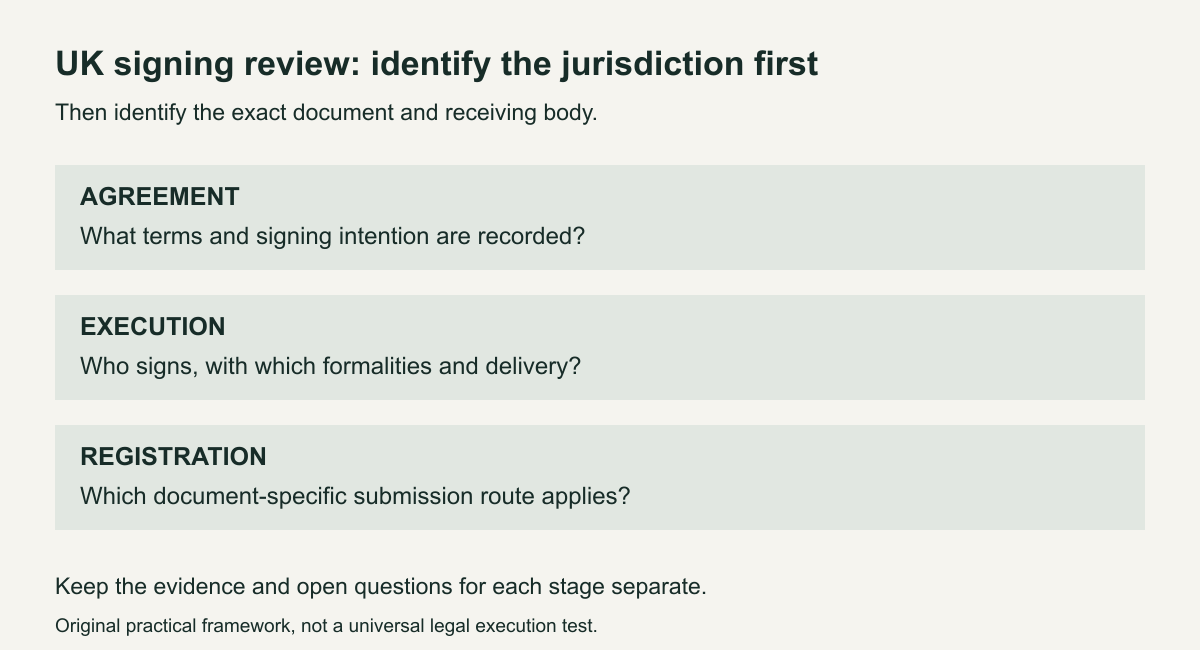
An agreement record answers what the parties accepted. An execution record answers who signed, in what capacity and with which formalities. A registration record answers what the receiving registry accepts and what must accompany the submission. Keep those questions visible even when a single platform supplies parts of the evidence.
Electronic Communications Act 2000 section 7 makes an electronic signature and related certification admissible on authenticity or integrity questions in legal proceedings. Admissibility does not itself establish valid execution of every document. Electronic Communications Act, section 7.
| Document and scope | Separate issue to review | Record to prepare |
|---|---|---|
| Ordinary England and Wales agreement | Authenticating intent, terms, authority and applicable formalities | Exact terms, signing action and communications |
| England and Wales deed signed personally by an individual | Deed execution, attestation and delivery | Signer, physically present witness, final document and delivery decision |
| HM Land Registry submission | Document-specific acceptance and chosen signing route | Conveyancer's route review and required submission material |
| Scottish Register of Deeds electronic submission | Applicable QES route, exceptions and usual registration checks | Original electronic document and registration review |
| Northern Irish registered-land deed | Local execution and submission requirements | Solicitor's local procedure review; no imported English workflow |
2. Worked example: an ordinary business agreement
Fictional example: Ash Studio and Elm Services agree on a £4,800 design-services contract governed by England and Wales law. Their authorised representatives confirm the final AS-04 file and use an agreed electronic signing process. Assume the remaining contract requirements are met and counsel has identified no additional document formality.
The review packet contains AS-04, its fee schedule, the invitation, the signing-event record and the communications identifying the terms and representatives. The example supports an evidence assessment under stated assumptions, not a predicted court result. A different fact, such as a disputed signer's authority, requires a revised review.
COMPLETED FICTIONAL AGREEMENT RECORD
Jurisdiction: England and Wales.
Document: AS-04, ordinary design-services agreement, £4,800.
Assumptions: Capable parties, lawful terms, remaining formation
requirements and representative authority verified separately.
Terms: AS-04 with fee schedule retained as presented.
Intent: Identified representative takes the stated signing action.
Evidence: Invitation, communications and event record kept together.
Additional formality: None identified for this stated example.
Assessment: Evidence packet supports review under assumptions.
Open issue if facts change: Identify actor, authority or file mismatch.
Next action: Preserve the exact operative record and review changes.
The amount is a fictional fee, not a statutory electronic-signing threshold. A signature drawn with a mouse, a typed name and a cryptographic signature describe different methods; none is a substitute for identifying which document the person meant to authenticate.
3. Individual deeds: witnessing and delivery remain separate
For England and Wales, section 1 of the Law of Property (Miscellaneous Provisions) Act 1989 requires a deed's intended character and valid execution. For an individual signing personally, the specified route involves a witness who attests the signature, plus delivery as a deed. The Act also provides a distinct directed-signing route. 1989 Act, section 1.
The Law Commission's stated witnessing conclusion requires physical presence even when signatures are electronic. Its discussion of possible video-witnessing reform is not permission to treat a remote video call as satisfying that stated route. Law Commission conclusions and reform discussion.
Fictional variation: Maya is asked to execute AD-02 as an individual deed. The draft identifies itself as a deed. Maya and the proposed witness can be physically together, but the reviewer has not yet confirmed the final wording, witness suitability, execution process or delivery arrangements. Record these open items before scheduling the signing.
FICTIONAL INDIVIDUAL-DEED PLAN
Jurisdiction: England and Wales.
Document: AD-02, identified as an individual deed.
Proposed signer: Maya signing personally.
Proposed witness: Physically present for the signing.
Record to retain: Final file, attestation and witness details.
Open checks: Suitability, actual process and all execution formalities.
Delivery: Responsible adviser to confirm when and how it is delivered.
Status: Signing plan only; no completed execution claimed.
Avoid: Marking the deed delivered solely because a platform
shows all signature fields completed.
Do not copy this individual's plan into a company execution block. Identify the legal entity and the applicable execution route first. A company's internal approval, a person's authority and the document's formal execution are different review fields. The representative-signing guide supplies a practical authority worksheet, with its own jurisdiction scope.
4. HM Land Registry: check the route for the actual document
Practice Guide 82 distinguishes Mercury signing, conveyancer-certified electronic signatures, simple electronic signatures and QES. Its appendix gives document-specific treatment. A transfer in the table is not accepted through the simple-signature column. The conveyancer-certified route includes controlled platform steps, physical witnessing where required, in-platform dating and a regulated conveyancer's certificate. The platform audit record is retained, not lodged with the application. QES is a separate route with its own conditions. Practice Guide 82, sections 3, 7, 8 and appendix 1.
Fictional registration review: The adviser is preparing a proposed TR1 transfer and selects the conveyancer-certified electronic route for review. The file is TR1-Final-06 with its referenced plan. The reviewer must confirm that the applicable guide requirements and transaction conditions are met. The following record is a preparation aid, not a certification that the transfer has been executed or will be registered.
FICTIONAL REGISTRATION ROUTE RECORD
Registry: HM Land Registry, England and Wales.
Document: Proposed TR1, version TR1-Final-06 and referenced plan.
Source: Current Practice Guide 82 reviewed on October 6, 2026.
Proposed route: Conveyancer-certified electronic signature.
Route owner: Transaction conveyancer to confirm requirements.
Evidence file: Final document and execution/process evidence.
Submission review: Required certificate and supporting material.
Private process evidence: Retain appropriately in the file.
Open checks: Every applicable route condition and completion event.
Status: Preparation record, not a signed conveyancer certificate.
Save the source version reviewed and ask the responsible conveyancer to check it again at execution. If the planned document or route changes, reopen the record. Do not infer acceptance because a platform can insert a signature into a PDF. Likewise, a general legal execution conclusion does not replace a registry-specific submission decision.
5. Scotland and Northern Ireland: keep local procedures local
Scottish Register of Deeds: Registers of Scotland accepts original electronic documents signed with QES, subject to limited exceptions and usual checks. Its July 3, 2026 execution guidance says that the qualified aspect replaces witnessing for self-proving electronic documents and discusses annexations and validation. This is that registry context, not a rule that every Scottish contract requires QES or that every Scottish register accepts the same process. Registers of Scotland: QES service; QES execution guidance.
Northern Irish registered land: Department of Finance guidance describes Rule 175 attestation for deeds other than corporate-body deeds, and points to separate corporate practice directions. It does not provide the English PG82 route. Obtain the local solicitor's execution and submission assessment before selecting an electronic workflow; this article does not establish a complete Northern Irish e-signing route. Northern Ireland registered-conveyancing guidance, execution of documents.
For a UK-wide business, put jurisdiction in the intake form instead of assuming that the same signing settings work for all legal documents. Distinguish the signer's physical location, governing law, document category and receiving registry. A witness travelling to another room or a file routed to another office can change the practical plan without changing the recorded governing-law field.
Final checklist
- Name the legal jurisdiction and exact document.
- Confirm the final terms, referenced material and representative authority.
- Record authenticating intent and the actual signing action.
- Identify witnessing, attestation, delivery and other required formalities.
- Choose the receiving body's document-specific route where applicable.
- Keep the source version and execution evidence together.
- Separate a proposed plan, completed execution and registration outcome.
- Assign unresolved issues to the relevant local adviser.
- Test retrieval of the final packet using the contract repository exercise.
FAQs
Can an electronic signature be used for an England and Wales deed?
The Law Commission recognises that capability subject to authenticating intent and required formalities. Identify the precise route before signing. Law Commission conclusions.
Can a witness watch remotely by video?
Do not use a video-only witness for the physically present route described above. Other jurisdictions and specialised procedures require their own review.
Is a typed name always sufficient?
No automatic conclusion follows. The AS-04 example assumes a defined ordinary agreement and supporting intent and authority evidence.
Does court admissibility mean the document was executed validly?
These are separate questions. Section 7 addresses authenticity and integrity evidence; execution requirements still need assessment.
Does every Scottish contract need QES?
The Scottish note concerns the Register of Deeds electronic route. Do not extend that particular registration procedure to all contracts.
Must every document be signed in wet ink?
No general conclusion follows from a request for paper. Identify whether it reflects a legal formality, receiving procedure or counterparty requirement. The wet-signature guide explains the method.
All names, fees and records are fictional original illustrations. The banner is AI-generated, and the graphic and worksheets are original educational aids. No actual execution, conveyancer certification, registry submission or professional legal review is claimed.
Sources
- Law Commission electronic-execution project, 2019 conclusions, 2020 government response and project scope.
- Electronic Communications Act 2000, section 7, electronic evidence.
- Law of Property (Miscellaneous Provisions) Act 1989, section 1, England and Wales individual-deed execution.
- HM Land Registry Practice Guide 82, current route guidance and signature table read October 6, 2026.
- Registers of Scotland QES service, Register of Deeds acceptance.
- Registers of Scotland execution guidance, July 3, 2026, QES electronic documents.
- Northern Ireland Department of Finance conveyancing guidance, execution paragraph and separate corporate directions.