

Implied Contract: Conduct, Examples and an Evidence Checklist
By Anirudh Menon, Viaclause editor
Understand implied-in-fact contracts through conduct. Compare repeat paid work with an unsolicited extra, and use an evidence record and future-work confirmation.
An implied-in-fact contract is an actual agreement shown by the parties' conduct rather than stated entirely in words. The practical question is what both sides did that supports agreement to the particular work and terms. A missing signature, an invoice or one person's expectation does not answer that question by itself.
California's Civil Code section 1621 defines an implied contract through conduct showing its existence and terms. This guide uses California authority and a separately identified New York case to explain business-service evidence. It is not a nationwide rule for every employment, property or government transaction.
Express, implied-in-fact and implied-in-law
Keep the basis of the obligation clear. Spoken terms can make an express agreement; “not signed” does not mean “implied.” A transaction may also contain words and conduct that must be assessed together. Our contract-elements guide is the cluster starting point for formation questions.
| Basis | What to look for | Keep separate |
|---|---|---|
| Express agreement | The parties' spoken or written agreed terms. | Absence of a formal signed document does not erase words actually agreed. |
| Implied-in-fact agreement | Conduct, interpreted in context, supporting actual agreement. | Identify the work and terms that the conduct supports; do not assume every later extra was included. |
| Implied-in-law, or quasi contract | A possible restitution obligation without actual agreement. | Its basis and limits differ from proving an agreed fee. |
Cornell's implied-contract explanation distinguishes intentional conduct supporting assent from implied-in-law restitution without mutual assent. Our quasi-contract guide supplies the benefit and return worksheet for that separate question.
Which conduct supports agreement?
California scope: CACI 305, Implied-in-Fact Contract directs attention to conduct, relationship and surrounding circumstances. Its instruction requires intentional conduct by both sides and knowledge, or reason to know, that the other side will interpret it as agreement. Friendly cooperation or an undisclosed intention to charge is not a substitute for examining that mutual conduct.
Build a chronology rather than counting favorable facts. Who supplied the work inputs? What did the provider deliver? Did the recipient use it, request revisions or object? What prior work was billed and paid? Was this the same scope, or an expansion? Preserve contrary evidence, including a rejection, a free-trial description or a requirement for approval before work.
Authority needs its own record. Identify the people involved and the evidence supporting their ability to act for the organization. Access to a shared folder does not by itself settle company authority. A commercial process owner and an authorized approver may be different people.
Paired example: repeat work and an unsolicited extra
Hypothetical facts: Harbor Reporting supplies Cedar Operations with a monthly report. In August and September, Cedar's operations lead placed the monthly source file in the established work folder. Harbor returned the same report format; Cedar used it and paid each $900 invoice. No signed services agreement is located. The organizations, months and amounts are invented for comparison.
| Question | October repeat report | New dashboard |
|---|---|---|
| Work initiation | Cedar puts October's data in the same work folder through the same lead. | Harbor creates a dashboard on its own initiative. |
| Prior pattern | Two earlier reports used and paid at $900 each. | No earlier dashboard order, use or payment. |
| Recipient's conduct | Cedar downloads and uses the October report in its operations meeting. | Cedar says it did not request the dashboard and does not use it. |
| Price evidence | Earlier invoices and payment records support investigating the $900 pattern. | Harbor alone puts $1,200 on a new invoice. |
| Evidence still needed | Authority, actual prior terms, scope match, objections and applicable formalities. | Any contrary request, approval, knowing use or later agreement. |
| Working assessment | There is conduct from both sides worth evaluating for an agreed repeat service. | The stated facts do not establish an agreed dashboard fee. |
The $900 pattern helps identify the alleged October price; it does not automatically prove a debt or a standing commitment for every future month. The proposed $1,200 dashboard fee needs separate support. Adding them gives $2,100 of invoiced charges, not $2,100 of established liability. This is an evidence comparison, not a predicted judgment or recovery amount.
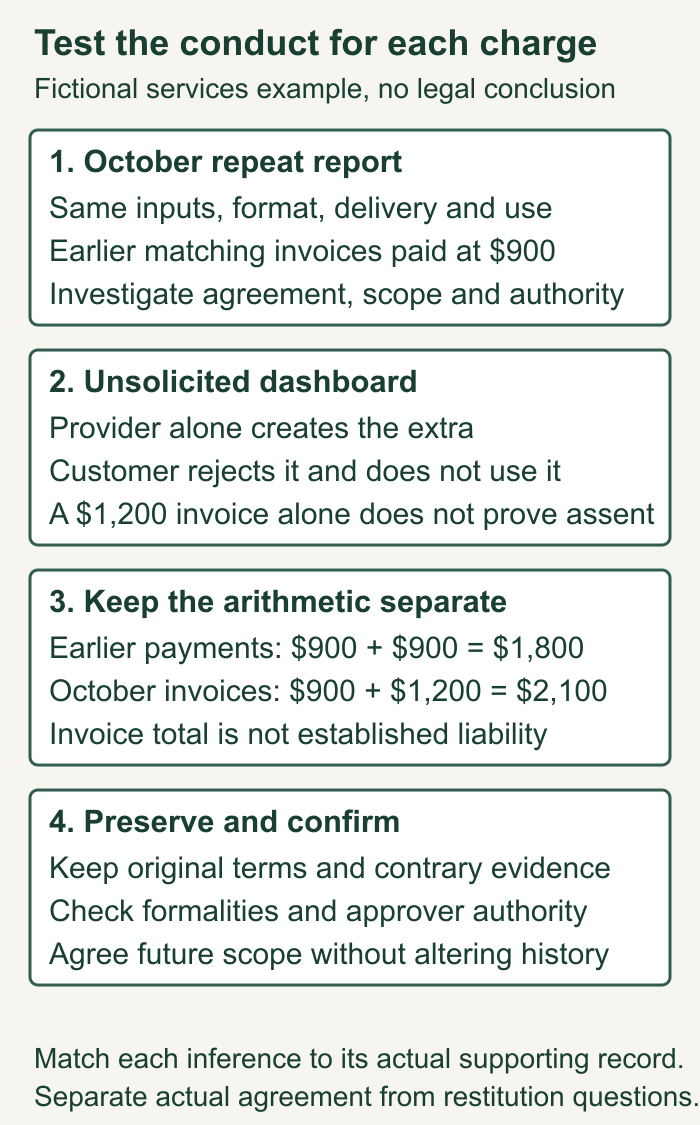
If the actual history includes an email or conversation expressly agreeing the work and price, retain it and describe it accurately. Do not force the evidence into an “implied” category merely because no one signed a PDF.
A court example: conduct and disputed pricing
New York example: in AMCAT Global v. Greater Binghamton Development (2016), the Appellate Division, Third Department affirmed a finding of an implied-in-fact remediation contract. The record included a signed authorization to perform services, accepted work, earlier payments and advance rate sheets, although the proposed full contract had not been executed. The alleged price cap was not proved.
The lesson is to retain the full sequence and pricing evidence, including partial documents. The decision did not establish that one payment always proves every claimed term, and its particular New York construction facts do not decide the reporting example above.
Copyable agreement-evidence record
Use one record per disputed service or extra. Separate an observed fact from the inference you want a reviewer to draw.
Matter / parties / jurisdiction:
Specific service and period:
Person alleged to authorize work and authority evidence:
Existing agreement, proposal, order or signature condition:
Words actually agreed, if any:
Conduct by customer: [dated fact and source]
Conduct by provider: [dated fact and source]
Prior matching work, invoices and payments:
Scope and price inference supported by those facts:
Contrary facts, exclusions, objections and unpaid extras:
Writing, licensing or other transaction-specific rule to check:
Claimed amount / payments / disputed items:
Missing evidence and person who may hold it:
Next action and date:
Filled extract for October: customer uploads input and uses the returned report; provider delivers the established format. Earlier matching invoices and payments show $900 per report. Missing evidence includes the lead's authority and any agreed limits. Keep the dashboard's $1,200 charge as a separately disputed item. Store originals and versions in a retrievable contract record.
Confirm future work without rewriting history
When work is ongoing, ask for clear future terms. This neutral template requests confirmation; it is not a mechanism for making silence count as assent.
Subject: Confirming proposed work for [period]
Please confirm whether [legal entity] authorizes [defined deliverables] for [fee and currency], with delivery by [date] and payment under [terms].
The proposed scope excludes [extras]. Please identify the authorized approver and any governing agreement or purchase-order requirements.
Our records for earlier work are [brief factual description]. Any disputed earlier charge remains a separate question.
Please send approval or corrections through [agreed channel]. We will coordinate the start date after confirming the required authorization.
For a larger project, the SOW template defines deliverables, acceptance and change authority. Preserve prior communications as they were; a new confirmation should not purport to manufacture earlier agreement.
Check writing requirements and intended signature conditions
California scope: Civil Code section 1624 imposes signed-writing requirements for specified categories, including certain real-property arrangements and agreements whose terms cannot be performed within a year. Categories, exceptions and separate transaction laws require examination. “Work was done” is not a universal way around a required form.
Run the statute-of-frauds checklist separately from the conduct-based agreement analysis.
Also distinguish a statute's requirement from the parties' intention about a future signature. CACI 306, Unformalized Agreement addresses whether the parties agreed to terms and intended to be bound before a final writing was completed and signed. It does not justify ignoring an actual condition that approval or signature must come first. Our California verbal-agreement guide explores the related spoken-agreement question.
Employment handbooks, property transactions, public contracts and licensed construction can raise different rules. If the issue is a contractor's unpaid work, use the scoped contractor nonpayment guide for its separate licensing and remedy cautions. This article does not assert a universal deadline or a right to payment.
How to prove the specific contract you allege
Formation, terms, performance and loss are separate questions. First identify the exchange: what work did each side reasonably understand was being requested and supplied? Then identify the term in dispute, such as the rate, quantity, approval limit or continuation period. Evidence of one report does not necessarily establish an agreement for a year's reports. For California, the official CACI 305 instruction focuses on intentional conduct by both parties understood as agreement. It does not remove the other contract questions.
Next record what was performed and the particular failure alleged. An unpaid invoice may support the claimed breach only after the agreement and applicable payment terms are established. Preserve delivery, acceptance, corrections, payments and objections together. Finally, calculate the demand separately from the legal measure of recovery. Do not describe an outstanding balance as an awarded debt or add the same payment to two theories of recovery.
A practical file should let another person test your inference. Put the original message, upload log or payment beside the proposition it supports. For example, a download establishes that a file was downloaded; meeting minutes may support actual use; a prior paid invoice identifies a historical charge. None alone proves the recipient approved a different deliverable. Where a record is missing, identify who may hold it rather than filling the gap with a reconstructed certainty.
Completed review of the repeat report
FICTIONAL OCTOBER REVIEW, NO LEGAL CONCLUSION
Parties: Harbor Reporting / Cedar Operations
Work: October report in the established monthly format
Customer evidence: October data uploaded; report used in meeting
Provider evidence: delivered report and dated delivery record
Price inference: matching August and September payments of $900
Prior payments: $1,800 for those two earlier reports, not October
October report invoice: $900, allegedly unpaid
Dashboard invoice: $1,200, separately rejected and unused
Invoice total: $2,100; no finding of liability
Missing: approver authority, earlier terms, approval conditions
Contrary material: dashboard objection, any scope or signature condition
Next step: preserve complete records and obtain scoped legal review
Future work: request express scope and authorization before starting
The two earlier $900 payments total $1,800. They are price-history evidence, not a credit or payment for October on these facts. The October invoice and dashboard invoice total $2,100. Neither calculation decides the outcome. If a later record shows a $300 October payment, the remaining claimed report balance would be $600; the dashboard dispute remains separate. That additional payment is a hypothetical variation, not a fact in the original scenario.
Employment handbooks and promises of job security
California example: in Foley v Interactive Data, 47 Cal.3d 654 (1988), the Supreme Court allowed an alleged implied employment-security contract to proceed beyond the pleading stage. The employee alleged repeated assurances, personnel guidelines and a history of promotions and favorable treatment. The Court considered the full circumstances rather than requiring a signed good-cause clause. It did not decide that those allegations had already been proved at trial. Its contract discussion also distinguished the statutory at-will presumption from evidence of an agreement to different terms.
Guz v Bechtel National, 24 Cal.4th 317 (2000) supplies important limits. Long service, raises and promotions alone did not establish a guarantee of continued employment. Specific personnel policies could nevertheless support particular contractual commitments despite an ambiguous general disclaimer. The Court did not infer broader protection against eliminating the employee's work unit; it returned narrower policy issues for further consideration. Its implied-covenant discussion did not create employment-security terms beyond the parties' agreement.
For a handbook review, obtain the version actually distributed, acknowledgment, offer letter, applicable employment agreement and relevant communications. Identify the precise promised procedure or benefit and what the employee knew. Compare a policy describing usual practice with an asserted commitment to a defined result. Record any reservation of discretion, approval limit and contrary promise. Have employment counsel examine the complete package under the applicable jurisdiction. A “not a contract” sentence or favorable annual review should not be treated as a universal answer.
Fictional Cedar's handbook says performance dismissal follows a specified review process, while a manager tells a worker that a job is secure. Preserve both statements and their dates. Ask whether the handbook was communicated, what discretion it reserves, who made the assurance, and what contract terms already apply. A service-invoice analysis does not decide this employment question. Statutory discrimination, wage and other employment protections also require their own analysis.
Public entities require a separate authority check
Retired Employees Association of Orange County v County of Orange, 52 Cal.4th 1171 (2011) answered a certified California-law question about implied retiree-health benefit rights. It held such arrangements possible absent a legislative prohibition, with the required contractual intent. It did not decide that the particular county had promised permanent continuation of the disputed premium pool. Preserve ordinances, resolutions and adoption circumstances; an administrator's routine action should not substitute for the legally required public decision.
Federal claims have another limitation. 28 USC section 1491(a)(1) provides the Court of Federal Claims' contract jurisdiction, subject to its terms. In Hercules v United States, 516 US 417 (1996), the majority distinguished contracts implied in fact from obligations implied in law: the Tucker Act contract jurisdiction reaches the former, not the latter. Each asserted contractual obligation needs the appropriate basis. That distinction is not a promise that any government employee's request creates an enforceable federal contract.
If a public customer receives and uses your work, obtain advice on authority, approvals, procurement rules and the correct claim route before relying on a private-company analogy. Preserve the purchase order, delegation, appropriation or approval records available for review. Actual acceptance can be relevant evidence while mandatory public-contract requirements remain a separate question.
An implied agreement differs from an implied term
Asking whether conduct created a contract differs from asking whether an existing contract contains an unstated term. Keep a proposed term precise: who must do what, on which trigger, and with what limit? Then examine the existing text and the applicable legal rule. Do not turn a disappointing omission into a new obligation simply by calling it necessary or fair.
English-law example: Marks and Spencer v BNP Paribas, [2015] UKSC 72 concerned rent paid in advance and a commercial lease's break clause. The Supreme Court rejected the claimed repayment term. Lord Neuberger's discussion explains business necessity and obviousness, clear expression and consistency with express terms; fairness or an assumption that reasonable parties might agree is insufficient. Those tests address implication into that existing contract. They are not a universal US formation test or a reason to assume every lease supplies a particular refund.
For a fictional signed services agreement that omits a delivery time, first inspect the entire agreement, incorporated order and governing law. A reviewer might need to analyze an implied term or a statutory rule. For Harbor's unsigned repeat report, the earlier question is what conduct shows actual agreement. Calling both situations “implied” must not collapse their evidence or tests.
India: promises through conduct still need legal requirements
Indian Contract Act 1872, sections 8 to 10, distinguishes acceptance through performing proposal conditions, express promises made in words and implied promises made otherwise. Section 10 also requires the specified consent, capacity, consideration and lawful-object conditions and preserves separate laws requiring writing, witnesses or registration. A conduct-based promise therefore does not bypass every formality or guarantee recovery. This is a limited statutory comparison, not advice about a specific Indian employment, property or public procurement dispute.
Prevent ambiguity in the next transaction
- State the legal entities and the person authorized to approve work.
- Define deliverables, periods, price, currency and acceptance steps before work starts.
- Identify the governing agreement and any prerequisite order or signature.
- Require approval of changed scope through a recorded channel.
- Record who can approve extras and who merely supplies operational inputs.
- Retain delivered versions, objections and payment records with the agreed terms.
- Use a consistent explanation when a sample, trial or favor is offered without charge.
- Separate resolution of past disputed work from authorization for future work.
This operational checklist helps produce clear evidence. It is not a disclaimer that erases an existing agreement. A new signature or acknowledgment should accurately describe what is being agreed now and leave earlier records intact.
Implied-contract checklist
- Identify the precise service, period and alleged terms.
- Retain any express words as well as conduct.
- Build a dated sequence for both parties' actions.
- Match prior payments to the same scope and rate.
- Separate each new extra and its approval evidence.
- Check authority, existing documents and contrary facts.
- Review writing requirements and any intended signature condition.
- Keep invoiced amounts distinct from established liability.
- Confirm future scope without altering earlier records.
Frequently asked questions
Can an implied contract hold up in court?
Yes, agreement can be proved through conduct under the scoped authorities above. Whether this particular agreement and its terms are established remains an evidence and applicable-law question. AMCAT illustrates a finding supported by a substantial record, not a guarantee.
Is a verbal contract an implied contract?
Spoken agreed terms are express evidence. The distinction concerns how agreement is shown, rather than whether the parties signed a document. Preserve words and actions where both matter.
Does accepting work prove the invoice amount?
Examine the price and scope evidence separately. Earlier matching payments, rate sheets or agreed words may help. A provider's unilateral invoice does not itself establish that the recipient agreed to every charge.
Can silence create an implied contract?
Do not treat silence alone as automatic approval. Examine the whole interaction and the applicable rule. In the repeat-report example there are affirmative actions, while the dashboard recipient rejects the extra.
What is an example of an implied offer?
Conduct proposing an exchange can raise that question: in the hypothetical repeat-service relationship, placing the next input in the established work folder may support an inference of requesting the same service. Context, scope and both parties' subsequent actions still matter.
How does this differ from quasi contract?
An implied-in-fact claim asks whether the parties actually agreed through conduct. Quasi contract concerns a possible restitution obligation without that agreement. Different evidence and limits apply.
Can an employee handbook create an implied contract?
It can be relevant evidence under the California decisions discussed above, but the precise policies, communications, existing terms and jurisdiction matter. Neither a handbook nor a disclaimer automatically resolves every claimed promise. Separate a termination procedure from a broader guarantee of continued employment.
Does long service prove a right to keep my job?
Guz rejected that inference from longevity and favorable treatment alone. Examine actual policy commitments and communications instead. Statutory employment protections are separate from whether the employer agreed to a particular contractual term.
Is an implied term the same as an implied-in-fact contract?
No. One question concerns an unstated term within an existing agreement; the other asks what conduct shows the agreement itself. Marks and Spencer illustrates the first under English law. The repeat-report evidence illustrates the second without predicting a finding.
Do implied contracts work with government customers?
Public-contract authority and formalities need separate review. The California county and federal decisions above have different scopes. Use of a service does not by itself establish every mandatory approval or the proper forum for a claim.
What should I do before demanding payment?
Preserve the agreement evidence, work history, authority, contrary records and itemized calculation. Identify any notice, dispute or filing requirements with counsel. Separate the agreed-fee allegation from restitution and avoid treating the invoice total as an established judgment.
Sources
Sources checked October 6, 2026. State authorities are limited to their identified jurisdictions.
- California Civil Code section 1621: conduct showing existence and terms.
- Judicial Council of California, CACI 2026, instructions 305 and 306: intentional mutual conduct and intended pre-signature agreement, printed pages 98 to 101.
- Cornell Wex, Implied contract: distinction from implied-in-law restitution.
- AMCAT Global v. Greater Binghamton Development, 2016 NY Slip Op 04491: Third Department assessment of conduct, authorization, payments and disputed pricing.
- California Civil Code section 1624: specified writing requirements and qualifications.
- Foley v Interactive Data, 47 Cal.3d 654 (1988), majority opinion reproduced by Stanford: employment-contract allegations and procedural stage.
- Guz v Bechtel National, 24 Cal.4th 317 (2000), opinion reproduced by Stanford: precise policy terms, longevity, disclaimers and implied-covenant limits.
- Retired Employees Association v County of Orange, 52 Cal.4th 1171 (2011), opinion reproduced by Stanford: certified public-benefit contract question and reserved factual merits.
- 28 USC section 1491(a)(1), statutory text hosted by LII: the Court of Federal Claims contract-jurisdiction provision.
- Hercules v United States, 516 US 417 (1996), official bound U.S. Reports at the Library of Congress: majority discussion at pages 423 to 424.
- Marks and Spencer v BNP Paribas, [2015] UKSC 72, official judgment: paragraphs 18 to 23, 49 to 56 and separate opinions.
- Indian Contract Act 1872, official India Code PDF: operative sections 8 to 10 and preserved formalities.
By Anirudh Menon, Viaclause editor. The banner is an AI-generated illustration of fictional people.