

Quasi Contract: Meaning, Examples and Restitution Checklist
By Anirudh Menon, Viaclause editor
A quasi contract prevents unjust enrichment without an agreement. Compare four examples, existing-contract limits and a copyable benefit-and-return record.
AI-generated illustration of fictional accounts staff investigating a transfer. Not a photograph of a real business or dispute.
A quasi contract is a legal obligation imposed to prevent unjust enrichment, even though the parties did not agree to a contract. It is also called a contract implied in law. The usual focus is restitution: returning a benefit or paying its legally recoverable value. It differs from an implied-in-fact contract, where conduct establishes an actual agreement. Cornell's quasi-contract definition explains these distinctions.
For a business, the first question is practical: what did the recipient receive, why was it transferred, and does an existing agreement already govern it? A missing signature alone does not answer that question. Start with the agreement requirements in our contract-elements guide, then use the benefit record below.
Express, implied-in-fact and quasi contracts compared
| Basis | Where the obligation comes from | Hypothetical example | First evidence to find |
|---|---|---|---|
| Express contract | The parties communicate agreed terms. | A buyer emails acceptance of a consultant's stated price and scope. | Offer, acceptance, terms and applicable formality requirements. |
| Implied-in-fact contract | An agreement is inferred from conduct. | A buyer repeatedly requests and accepts the same paid service without restating every term. | Requests, prior dealings and conduct indicating assent. |
| Quasi contract | Law supplies a restitution obligation without an agreement. | Money meant for one supplier reaches a different business with no entitlement to it. | Transfer, correct recipient, actual benefit and reasons retention is unjust. |
California's Civil Code section 1621 describes an implied contract through conduct. That is different from the absence of agreement underlying quasi contract. This table classifies possible issues, not the outcome of a claim.
What must be shown for unjust enrichment?
In New York, Mandarin Trading Ltd. v. Wildenstein, Court of Appeals, 2011, identifies enrichment of the defendant at the claimant's expense and circumstances making retention inequitable. Contractual privity is not required, but a connection that is too remote can defeat the claim. Identify the actual recipient and the path of the benefit; “someone profited from my work” is insufficient detail.
For services, quantum meruit asks a related valuation question. In Home Construction Corp. v. Beaury, New York Second Department, 2017, the stated elements were good-faith services, acceptance, expectation of compensation and reasonable value. The contractor's claim failed for lack of value evidence. An invoice records a demand; it does not necessarily establish that value. Our contractor nonpayment guide addresses the separate construction, licensing and notice issues.
Four quasi-contract examples to separate before making a demand
These scenarios are hypothetical. They show which facts to preserve, rather than promising recovery.
| Situation | Important distinction | Evidence and unresolved issue |
|---|---|---|
| Mistaken payment | A business receives money intended for another recipient. | Bank trace, payment instructions, recipient identity and any explanation of entitlement. Investigate applicable payment rules and defenses. |
| Requested work, no settled price | Requests and acceptance may support an actual agreement or a services-value claim. | Who requested the work, expected compensation, what was accepted and valuation evidence. Check governing law before choosing a theory. |
| Unrequested improvement | The provider starts work without checking whether the owner wants it. | Any objection, opportunity to refuse, communications and circumstances. Benefit alone should not be treated as consent or assured recovery. |
| Work covered by an existing agreement | The supplier dislikes the agreed payment conditions. | The operative contract, scope, changes and payment trigger. A different claim label does not itself remove agreed conditions. |
In Corsello v. Verizon New York, Court of Appeals, 2012, the court described mistaken receipt of money as a typical unjust-enrichment setting, but rejected unjust enrichment as a replacement for duplicative contract or tort claims. Establishing a benefit and identifying an available cause of action are separate tasks.
Can quasi contract override an express agreement?
Under the New York rule applied in Tompkins Financial Corp. v. John M. Floyd & Associates, Third Department, 2016, a valid, enforceable written agreement covering the disputed subject prevented quasi-contract recovery. The consultant could not use unjust enrichment to obtain payment contrary to the agreement's conditions. Check both enforceability and coverage, including orders and amendments; merely finding a document with the parties' names is not the whole inquiry.
The state and transaction matter. The New York decisions above illustrate particular claims; they are not a uniform US restitution statute. Before filing, check local elements, defenses, limitation periods and any special rules for the work or payment. An unsigned agreement might still be an agreement, and an unenforceable one does not automatically make every alternative claim available.
Worked example: reconcile a mistaken $2,400 payment
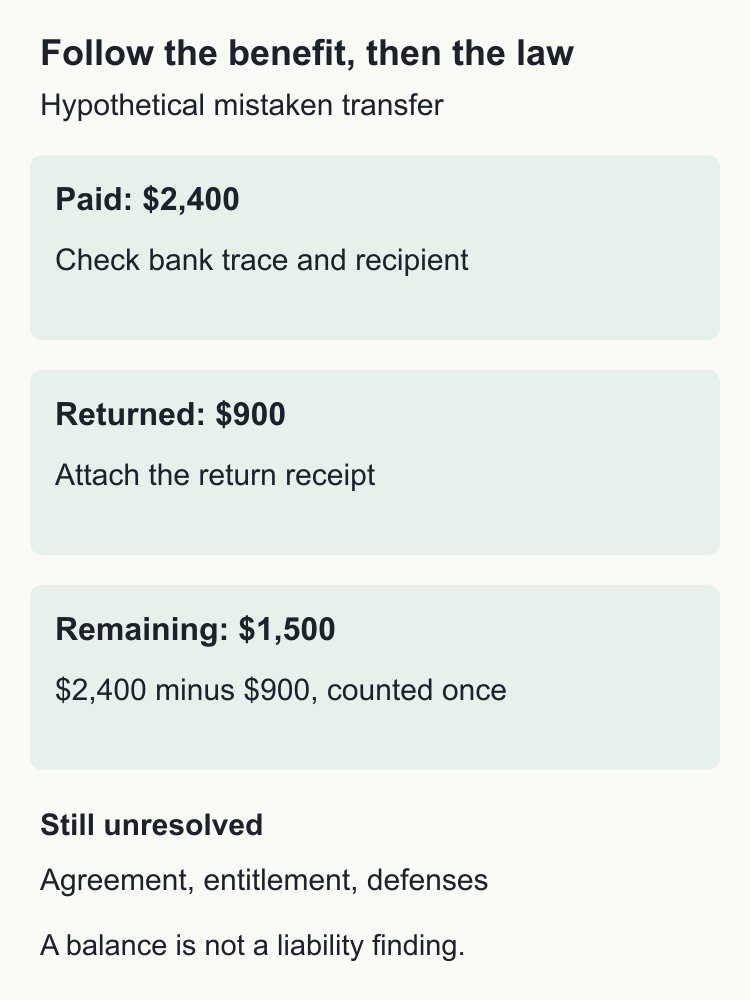
Hypothetical record: Cedar Trading intends to send $2,400 to Supplier A. Its accounts team enters Supplier B's bank details. B has no located invoice, agreement or outstanding debt supporting that payment. After the mistake is identified, B returns $900. Neither party has yet resolved whether a legal defense affects the remainder.
The transfer reconciliation is $2,400 paid minus $900 returned = $1,500 remaining. This is the balance to investigate and request, not an adjudicated award. If B later shows a valid entitlement or a relevant defense, the legal conclusion needs revisiting. Do not add the original $2,400 to the remaining $1,500, or count the returned $900 as still outstanding.
Copyable benefit-and-return record
Our proposed worksheet works for money or services. Use the completed row as an example, then replace every field with verified facts. Preserve the original files in a contract repository and link each amount to its receipt.
Record ID: Cedar transfer, October 6, 2026
Provider / recipient: Cedar Trading / Supplier B
Benefit: $2,400 bank transfer, reference CT-1006
Intended recipient and reason: Supplier A, invoice A-17
Agreement covering this transfer: none located with B
Recipient's explanation: requested, not yet received
Original evidence: bank trace and approved payment instruction
Value basis: amount credited; confirm with bank record
Returned / credited: $900, separate receipt B-1007
Remaining transfer balance: $1,500
Objections / defenses: unresolved; do not mark liability admitted
Applicable law and filing deadline: reviewer to confirm
Owner / next action: accounts lead, reconcile and request response
A neutral completion template for a payment query is:
On [date], [sender] transferred [amount], reference [ID], to [recipient].
Our records show the intended recipient or purpose was [details].
We have recorded [returns or credits], leaving [remaining balance].
Please explain any basis on which you believe the balance is payable
to you, or confirm arrangements to return it through [verified method].
We attach [records]. Please respond by [practical response date].
This is an information request, not a court filing, statutory notice or assertion that a response date extends a legal deadline. Use the correct method for any formal notice; our contract-notice guide explains the delivery record.
Checklist before relying on a quasi-contract claim
- Identify the exact recipient and the benefit actually received.
- Separate agreed terms from assumptions about consent.
- Search for agreements, orders and amendments covering the benefit.
- Record whether services were requested, accepted or rejected.
- Support money and value with records, not just an invoice total.
- Subtract all returns, payments and credits once.
- Preserve contrary evidence, including entitlement and objections.
- Confirm the local claim, defenses and deadlines before filing.
Keep restitution accounting separate from compensation for a broken bargain. Our actual-damages guide covers the latter calculation.
Frequently asked questions
What is quasi contract in simple words?
It is a law-imposed obligation to correct unjust enrichment without an actual agreement. The word “contract” describes the legal category; it does not mean the parties negotiated a new deal. Tompkins Financial explains this distinction.
Is every unsigned agreement a quasi contract?
No. Communications or conduct can show an actual agreement. California's section 1621 expressly addresses conduct-based contracts. Investigate agreement and any writing requirements first.
Are unjust enrichment and quantum meruit identical?
They concern related restitution questions, but do not assume identical elements. The New York authorities above distinguish enrichment from the specified services-value elements. Identify the theory and its local requirements.
Can a quasi-contract claim rescue any failed lawsuit?
No. Corsello rejected that approach. A claim's failure does not itself establish an independent restitution obligation.
Can I recover the amount on my invoice?
The amount demanded needs support. Beaury illustrates inadequate proof of service value despite an unsigned proposal and testimony. Record value evidence and prior payments separately.
Sources
Sources checked October 6, 2026. New York cases are jurisdiction-specific examples; Cornell is explanatory secondary material.
- Cornell Wex, quasi contract: definition, implied-in-law terminology and restitution.
- California Civil Code section 1621: agreement manifested by conduct.
- Mandarin Trading Ltd. v. Wildenstein, 2011: New York unjust-enrichment elements and attenuated connection.
- Home Construction Corp. v. Beaury, 2017: quantum-meruit elements and valuation proof.
- Corsello v. Verizon New York, 2012: mistaken benefits and duplicative claims.
- Tompkins Financial Corp. v. John M. Floyd & Associates, 2016: existing agreement and payment conditions.
By Anirudh Menon, Viaclause editor. General information. Examples, amounts and templates are hypothetical editorial illustrations.