

Counterparts Clauses: Signing Separate Copies of One Agreement
By Anirudh Menon, Viaclause editor
Compare three counterparts-clause options, check mismatched signed versions and build a completion index that preserves each signed original and delivery record.
A counterparts clause lets parties execute separate copies of the same agreed document and treat the signed copies together as one agreement. It can also specify delivery methods, paper-original follow-up and when the agreement takes effect. Those additional instructions matter as much as permission to use separate copies. The Cornell counterpart definition explains the underlying copy concept.
This guide provides original drafting options and a fictional completion example for an ordinary commercial agreement. Special documents and jurisdiction-specific execution rules need separate review. Use our electronic-signature guide for the broader questions of identity, assent and signing evidence.
Counterpart and counterparty mean different things
A counterpart is a copy of the instrument. A counterparty is the other person or entity in the transaction. If a buyer and supplier each sign a separate copy of the same agreed contract, those copies are counterparts; the buyer and supplier are counterparties.
Separate copies do not mean separate negotiated bargains. Compare the operative text, schedules and incorporated documents. A signing platform footer or different signature timestamp is a different kind of variation from a changed price or service term. Keep the association between each signature and the agreed text clear.
Three clause options and their consequences
The following original language is for review and adaptation, not an assurance of enforceability. The examples assume ordinary commercial parties have agreed to permitted electronic signing and delivery. They are not suitable substitutes for deed, consumer-disclosure, notarisation or regulated-filing requirements.
Option A: electronic delivery without a paper-copy duty
The parties may sign separate copies of the
agreed final text of this Agreement. Their
signed copies collectively record the same
Agreement. A signed copy may be delivered
by email as a PDF or through the agreed
signing platform. Such delivery does not
require a later paper original. The parties
may use electronic signatures where lawful.
This option addresses copies and methods. It does not itself define the effective date. Review the agreement's commencement and closing provisions, and decide whether you also need the completion condition in Option C.
Option B: a paper original on request
Replace Option A's sentence stating that no later paper original is required with this wording:
If a party signs on paper and delivers a PDF
copy, that party must provide its signed
paper original within five business days
after receiving the other party's written
request. This follow-up obligation does not
postpone effectiveness under the Agreement.
This replacement creates an operational follow-up duty while separating it from effectiveness. Define “business day” and where requests and originals must be sent. It applies to a paper-signed copy; do not describe printing an electronically signed file as producing a new handwritten original. Five business days is our illustrative negotiated period, not a statutory deadline.
Option C: receipt from every required party
Add to the chosen copies-and-methods clause:
Subject to the other express conditions in
this Agreement, it takes effect only when
the completion coordinator named below has
received a signed counterpart of the agreed
final text from each party listed below.
The coordinator must send the parties a
completion notice identifying that text
and the time the final required counterpart
was received.
Coordinator and address: [complete]
Required parties: [complete]
Complete the coordinator, address and required-party list before execution. This option chooses a receipt trigger and a recording duty. It does not make the notice a replacement for the stated receipt condition. Check for conflicting effective-date, escrow, funding or approval provisions elsewhere.
| Option | What it resolves | Work to track |
|---|---|---|
| A | Separate copies and agreed electronic delivery | The agreement's separate timing rule |
| B | A requested paper original after paper signing | Request, due date and actual dispatch/receipt |
| C | Effectiveness conditioned on every listed counterpart reaching the coordinator | Matching version, required-party list and last receipt time |
Worked example: two signatures, conflicting versions
Fictional facts: Alder Labs and Bright Harbor Services intend to sign a service agreement using Option C. Version 4 contains a $48,000 price and six-month term. Bright Harbor returns signed version 5 with $52,000 and eight months. Alder's signature is on version 4. The names, values and observations are invented, not a real transaction or signature test.
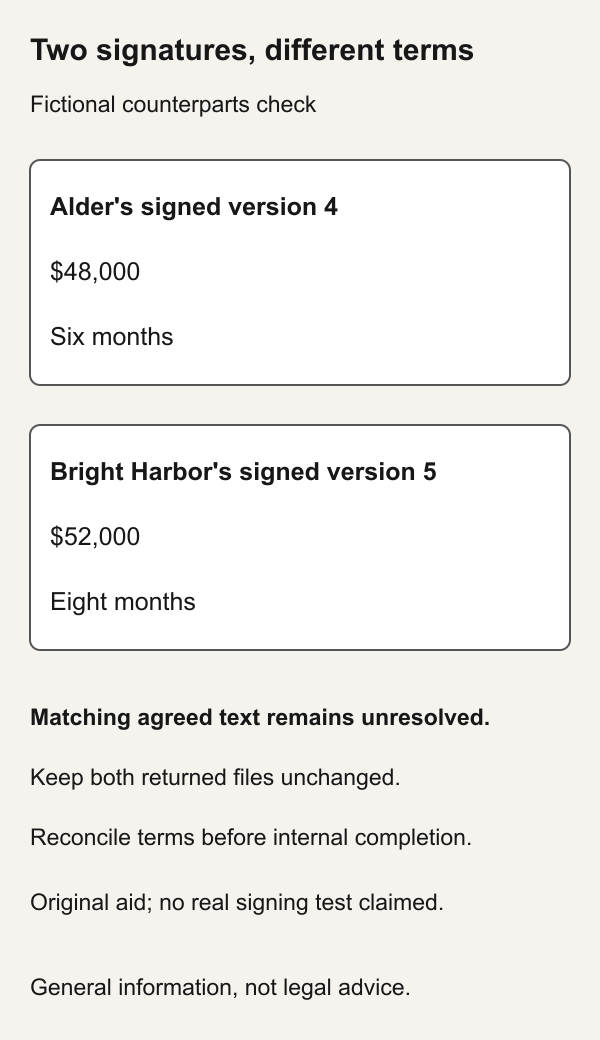
The coordinator records a mismatch and holds internal completion. The differences are $4,000 and two months. Calling both files “counterparts” does not show that they contain the agreed final text. Preserve both returned files, their delivery records and the issue; do not paste the signature from version 4 into version 5.
Compare the revisions using the blackline versus redline guide. Obtain a clear decision on the actual final terms. This operational hold is not a court finding that no contract could exist; earlier communications, conduct and other formation questions may need legal review.
A corrected completion record
In the fictional correction, both parties approve version 6 at $52,000 for eight months, then sign that version afresh. The coordinator receives Alder's counterpart at 10:40 and Bright Harbor's at 11:05 on Day 2. Assume all other express conditions are satisfied and each signer has the required authority. These are scenario assumptions, not real legal conclusions.
| Record | Retained evidence | Completion result |
|---|---|---|
| Superseded attempted set | Alder version 4 and Bright Harbor version 5, unchanged | Keep the mismatch history; exclude from the corrected final set |
| Agreed version 6 | Final text, schedules and approval references | Use as the comparison reference for both counterparts |
| Alder counterpart | Signed version 6 and receipt at 10:40 | One of two required receipts; still open |
| Bright Harbor counterpart | Signed version 6 and receipt at 11:05 | Two matching receipts, subject to remaining conditions |
| Coordinator notice | Version6 and last required receipt at 11:05 | Record the chosen contractual trigger without changing signature dates |
The two receipts are 25 minutes apart. Under the example's chosen wording, the later required receipt is the relevant completion event, not the earlier signature time. Another agreement may choose a different trigger.
Build an index without altering the signed originals
Keep every signed file in its received form, including the associated evidence needed to inspect it. A combined reading copy can be useful, but label it as a convenience compilation. Preserve the source files separately and do not assume combining PDFs retains every certificate signature or its validation result.
Link the approved text, schedules, counterparts, delivery records and unresolved issues in your contract repository. The index should let another reviewer retrieve the actual files, not merely report that “everyone signed.”
Agreement and agreed version: [reference]
Included schedules: [exact versions]
Copies/methods clause: [A, B or adapted text]
Effectiveness rule: [exact condition]
Coordinator and delivery route: [details]
Required parties/signers: [list and capacity]
For each received counterpart:
  Party and actual signer: [details]
  Signed file: [unaltered source reference]
  Final-text comparison: [result, gaps]
  Receipt evidence and time: [reference]
  Signing evidence: [reference, limitations]
Paper-original duty: [request, due, status]
Other closing conditions: [open or satisfied]
Completion status: [open / recorded / disputed]
Notice and repository index: [references]
Electronic delivery and jurisdiction limits
Federal ESIGN, 15 USC 7001, generally prevents denying effect solely because an in-scope record or signature is electronic, while preserving other substantive requirements. It does not generally compel acceptance of electronic signing. Consumer written disclosures have additional conditions, and section 7003 contains exceptions. This is not a blanket counterparts or document-eligibility guarantee.
For a state example, California Civil Code section 1633.5 applies its electronic-transactions rules to parties who agree to conduct the transaction electronically, judged from context and conduct, with further statutory constraints. Confirm the applicable scope and consent; do not assume a boilerplate clause answers every issue.
For a different jurisdiction, the Law Commission's 2019 England-and-Wales statement says electronic execution, including a deed, requires authenticating intent and satisfaction of applicable formalities. The statement is historical guidance, not this article's certification of current deed requirements. Check current instrument-specific witnessing, delivery and registration rules before adapting an ordinary-contract clause.
Check representative authority independently using our signing-on-behalf guide. If agreed terms later change, handle that through a separately reviewed amendment, rather than silently replacing pages in a signed counterpart.
Completion checklist
- Identify the agreed final text and every schedule.
- Confirm the required parties, signers and authority.
- Choose permitted methods and delivery routes.
- Read the effectiveness condition and other closing conditions.
- Compare received counterparts with the agreed text.
- Track missing signatures and paper-original duties separately.
- Preserve unaltered signed files and receipt evidence.
- Record the chosen completion event and any unresolved issue.
Frequently asked questions
Do all parties need to sign the same physical copy?
A suitable counterparts arrangement permits separate copies of the agreed text. Check the actual clause and document-specific rules, including who must sign which copy.
Can a deed be signed in counterparts?
It may be possible, but the jurisdiction, signatory and deed formalities matter. Do not use the ordinary-commercial examples here as proof of valid deed execution or delivery.
Does the clause fix mismatched signed versions?
No completion conclusion follows merely from calling the files counterparts. Reconcile substantive differences and preserve the original attempted set, as the worked example shows.
Is a scanned signature the same as an electronic signature?
A scan is a representation of the paper-signed document. Whether it supplies the agreed and legally adequate execution evidence depends on the facts, terms and applicable law. Keep the paper original when required.
Can I combine all signatures into one PDF?
A convenience copy should be clearly labelled. Preserve the received signed originals and evidence independently; merging files is not a substitute for validating the execution set.
When does an agreement signed in counterparts take effect?
Read the chosen timing and closing conditions. Option C uses the last required receipt by the named coordinator; other language may use signing, exchange or another agreed event.
General information. Banner: AI-generated documentary illustration of fictional adults, not a real closing.
Sources
- Cornell Wex: counterpart definition.
- GovInfo: official 2024 US Code, ESIGN chapter 96, recognition, preservation, disclosures and exceptions.
- California Civil Code: section 1633.5, agreement to transact electronically.
- Law Commission: electronic-execution project and 2019 statement for England and Wales.