

Warranty Clauses: Promises, Duration and Remedies
By Anirudh Menon, Viaclause editor
Draft a warranty clause around the promise, coverage dates, notice and remedy. Compare worked goods and services claims, with California law and copyable examples.
A warranty clause states a promised fact, quality or performance standard and explains what happens if it is not met. A useful clause identifies who makes the promise, what it covers, when coverage applies, how to notify a failure and which remedy follows. “We warrant our work” leaves most of those questions unanswered.
Review warranty obligations within the approval and recordkeeping process described in contract lifecycle management. Keep the promised standard, inspection evidence, notice and remedy in the same record.
Prepared with AI assistance. Clauses, prices, dates, measurements and claims below are original fictional business examples, not actual contracts or tests. The banner is an AI-generated illustration.
First identify goods, services or a mixed transaction
This guide uses California examples for negotiated business transactions. Its goods warranties come from the enacted Commercial Code; its service example relies on an agreed contractual performance obligation. Do not apply a goods disclaimer to every consulting, software or SaaS deal.
California Commercial Code section 2102 addresses goods and hybrid transactions. For a hybrid, the treatment depends on whether goods aspects predominate, and other law can still matter to nongoods aspects. Consumer and other specified-buyer statutes are preserved. Commercial Code section 2102.
The buyer of a physical instrument, a buyer of process-mapping services and a buyer of a bundled installation need separate scope checks. The examples below deliberately separate a physical-goods purchase from a pure services project.
Draft five connected parts
| Part | Question to resolve | Useful detail |
|---|---|---|
| Promise | What must be true? | A dated specification, defined deliverable or stated workmanship standard |
| Coverage | When and for whom does it apply? | Trigger date, inclusive end date, affected items and permitted use |
| Exclusions | Which failures are outside the promise? | Specific causes, evidence and the relationship to the promised standard |
| Notice | Who receives a claim and what must it contain? | Method, recipient, timing, defect description and supporting records |
| Remedy | What follows a covered failure? | Repair or re-performance deadline, costs, fallback and any exclusivity |
Acceptance, warranty coverage and remedies are separate clauses. A clause may allow a post-acceptance defect claim; a repair promise needs its own deadline. Read liability caps, exclusions and termination rights alongside it. The liability-cap claim map shows why the remedy's label alone does not establish the amount recoverable.
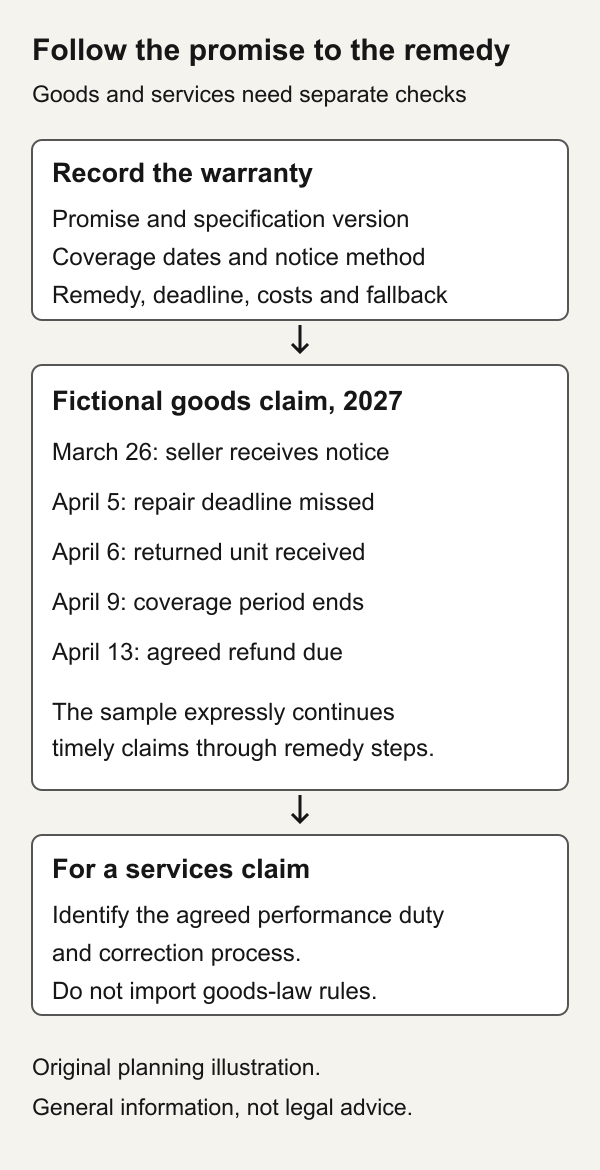
Worked goods clause: one defective instrument
Fictional purchase: four bench scales at $1,000 each, total $4,000. Specification G2 requires a reading within two grams of the reference mass under its defined test conditions. The seller's agreed warranty covers conformity during 180 consecutive calendar days, counting delivery day as day one. Delivery on October 12, 2026 gives an inclusive final day of April 9, 2027.
In California goods sales, express warranties can arise from bargain-related facts, promises, descriptions, samples or models. Formal words such as “warrant” are not essential; mere opinion or commendation is different. Commercial Code section 2313.
Example W1: negotiated business-goods warranty
Seller warrants that each scale conforms to specification
G2 during the 180-calendar-day period beginning on its
delivery date, with delivery counted as day one.

Buyer shall notify Seller in writing through the agreed
notice channel promptly after discovering a claimed
nonconformity and within that coverage period. The notice
identifies the unit, G2 requirement, observed failure and
available test and use records.

Seller shall repair or replace a covered unit at its cost
within ten calendar days after receiving the notice,
counting the next day as day one. Seller pays the agreed
return and redelivery freight.

If Seller does not complete repair or replacement within
that time, Buyer may return the affected unit for a refund
of its $1,000 price. Seller pays the return freight and
refunds the price within seven calendar days after receipt
of the return, counting the next day as day one.

A claim notified within coverage remains subject to these
remedy steps after coverage ends. This clause does not
exclude otherwise applicable statutory rights or make
these remedies exclusive.
This is an illustrative clause extract for legal review. Complete the actual notice channel and specification, and negotiate handling of disputed claims, access, unsafe use, misuse, replacement coverage and other risks. Its deadlines and prices are choices for this example, not legal defaults.
Fictional evidence: on March 25, 2027, the recorded G2 test for scale S3 shows 508 grams against a 500-gram reference. The eight-gram difference exceeds the example's two-gram tolerance. The record includes the applicable test conditions, instrument identifier and maintenance history; those assumed facts support the claim rather than proving an actual laboratory result.
| Event | Recorded date or amount | Consequence under W1 |
|---|---|---|
| Seller receives notice | March 26, 2027 | March 27 is day one of the ten-day remedy period |
| Repair or replacement not completed | April 5, 2027 | Day ten; the return/refund fallback becomes available |
| Seller receives returned S3 | April 6, 2027 | April 7 is day one of the seven-day refund period |
| Coverage ends | April 9, 2027 | Timely claim continues through its expressly agreed remedy steps |
| Refund deadline | April 13, 2027 | $1,000 for S3, plus the separately agreed return freight |
The contractual refund is for the affected unit. Do not automatically convert it into a $4,000 whole-order refund or combine repair and refund as if both were owed for the same outcome. Other remedies need their own contract and legal analysis.
For accepted goods, California requires notice of breach within a reasonable time after discovery or when it should have been discovered; acceptance does not by itself remove every nonconformity remedy. Commercial Code section 2607(2) and (3). W1's negotiated coverage and notice terms do not replace that statutory analysis. Use the contract notice and delivery-evidence guide before relying on an email alone.
Worked services clause: a missing handoff
Fictional project: a supplier produces four process maps for $4,800, with each map required to identify steps, owner roles and handoffs in scope S2. This is an agreed service standard, not an automatic application of goods merchantability rules. California's contract essentials and general contract-damages rule provide the starting legal framework. Civil Code section 1550; Civil Code section 3300.
Example S1: agreed services performance warranty
Supplier warrants that the four process maps conform to
scope S2, including each specified step, owner role and
handoff. Coverage lasts sixty consecutive calendar days
beginning on Buyer's written acceptance, counting that
date as day one.

Buyer shall promptly notify Supplier through the agreed
notice channel of a claimed covered omission discovered
during coverage, identifying the map and S2 requirement.
Supplier shall correct a covered omission without another
fee within five calendar days after receipt, counting the
next day as day one.

If correction is not completed by that deadline, the
parties will apply the agreement's separate escalation,
termination and remedy provisions. This warranty does
not itself make correction the sole remedy or exclude
otherwise applicable rights. Timely notified claims
continue through the agreed correction process.
The actual agreement needs completed fallback provisions; the reference to a separate remedy is not a substitute for drafting one. Pair the scope with the statement of work template so that the warranty is measured against a stable version.
Fictional claim: written acceptance occurs November 2, 2026; sixty inclusive days end December 31. On December 20 the buyer discovers that the signature-routing map omits the named approval handoff required by S2. The supplier receives notice on December 21, making December 26 the five-day correction deadline. An accepted map can still have the expressly covered omission. A later request to add a fifth map, however, is new scope in this example, not proof that the original warranty was breached.
Whether a failure supports termination depends on the whole agreement and governing law. Read the material breach guide before treating every warranty issue as an immediate exit right. Preserve the actual promise and facts using the vendor obligation and breach record.
Implied warranties and disclaimer examples
For California goods, merchantability generally applies when the seller is a merchant for goods of that kind, unless properly excluded or modified; ordinary-purpose fitness is one part of the standard. Commercial Code section 2314. Particular-purpose fitness has different conditions: the seller has reason to know the particular purpose and the buyer's reliance on the seller's skill or judgment. Commercial Code section 2315.
Section 2316 has specific disclaimer rules. Merchantability must be mentioned under its ordinary language rule, with conspicuousness for a writing; fitness exclusions must be written and conspicuous. It also addresses “as is,” examination and course-of-dealing situations. An express promise cannot simply be erased by an unreasonably inconsistent negation. Commercial Code section 2316.
Illustrative business-goods wording for counsel's review
EXCEPT FOR THE EXPRESS WARRANTY IN CLAUSE W1, AND ONLY
TO THE EXTENT PERMITTED BY APPLICABLE LAW, SELLER
DISCLAIMS IMPLIED WARRANTIES OF MERCHANTABILITY AND
FITNESS FOR A PARTICULAR PURPOSE.
Capital letters alone do not establish conspicuousness or validity. Review the entire presentation, transaction, conflicting promises and mandatory law. This example is not a consumer disclaimer or a general services disclaimer. Consumer rules can restrict exclusions, and a separately purchased repair service contract is different from the product warranty described in consumer guidance. FTC: consumer warranties and service contracts.
California also prohibits contractual exemption from responsibility for one's own fraud, willful injury and violation of law as described in Civil Code section 1668. A broad service disclaimer needs that review; a phrase preserving applicable law cannot guarantee a valid exclusion. Civil Code section 1668.
Exclusive remedies and liability caps
Under California's goods rule, an agreed remedy is optional unless expressly made exclusive. A limited remedy that fails its essential purpose can open access to Code remedies; consequential-damage limits have their own unconscionability rules. Commercial Code section 2719. Do not assume that provision automatically governs the pure service example.
Ask whether repair costs, freight, refund and re-performance are inside a general damages cap, outside it, or subject to a separate amount. Ask whether an exclusive repair remedy has a deadline and fallback. Read those choices together instead of treating “warranty,” “sole remedy” and “liability cap” as interchangeable protections.
Copyable claim record
Transaction: [goods / services / mixed]
Applicable-law review: [ ]
Promisor and claimant: [ ]
Warranty clause and specification version: [ ]
Coverage trigger / day-count rule / final day: [ ]
Acceptance evidence: [ ]
Affected item or deliverable: [ ]
Exact promised standard and observed difference: [ ]
Test conditions, use history and exclusions: [ ]
Discovery date / notice receipt evidence: [ ] / [ ]
First remedy / deadline / responsible owner: [ ]
Fallback / deadline / required return or cooperation: [ ]
Costs, cap and exclusivity cross-references: [ ]
Other rights and unresolved legal questions: [ ]
Claim status and next action: [ ]
Frequently asked questions
What is an example of a warranty statement?
“Supplier warrants that each process map includes the steps, owner roles and handoffs specified in S2.” That is the promise. S1 adds coverage, notice and correction, which the sentence alone leaves unresolved.
Is a warranty the same as a guarantee?
Read the actual obligation. A seller may use “guarantee” for a promise about its own goods; California's express-warranty rule does not require a particular formal word. A promise to answer for another party's payment is a different arrangement requiring its own analysis.
Can a contract exclude implied warranties?
Sometimes, subject to the transaction's applicable rules and mandatory protections. The California goods provisions above require more than adding a generic disclaimer. They do not establish a universal exclusion for services or consumers.
Does accepting delivery end warranty rights?
Not automatically. Distinguish acceptance rules, warranty coverage and notice. The California goods notice rule and the example's express post-acceptance coverage are explained above.
Does the warranty's end date cancel an unfinished claim?
Read the terms and applicable law. W1 expressly continues timely claims through repair and refund; its April13 refund deadline follows the April9 coverage end. Do not assume every contract has that provision.
Does a warranty breach always let us terminate?
No automatic conclusion follows from the label. Examine the failure, any cure process, termination rights, exclusive remedies and applicable law. Keep a disputed claim separate from a valid termination decision.
Warranty review checklist
- Goods, services and mixed aspects are identified.
- The promised standard points to an agreed, retained version.
- Coverage trigger and inclusive date calculation are clear.
- Notice recipient, method and evidence are specified.
- Exclusions are connected to actual causes and mandatory law.
- Repair or correction has a deadline, costs and fallback.
- Timely claims have an explicit treatment after coverage ends.
- Acceptance, termination, exclusivity and caps are read together.
- Consumer, cross-border and regulated transactions receive separate legal review.
Sources
- California Commercial Code section 2102: goods and hybrid scope.
- California Commercial Code section 2313: express goods warranties.
- California Commercial Code section 2314: merchantability.
- California Commercial Code section 2315: particular-purpose fitness.
- California Commercial Code section 2316: warranty exclusions.
- California Commercial Code section 2607: acceptance and breach notice.
- California Commercial Code section 2719: modified and limited remedies.
- California Civil Code section 1550: contract essentials.
- California Civil Code section 3300: contract damages.
- California Civil Code section 1668: prohibited exemptions.
- FTC: consumer warranty guidance and separate service contracts.