

Exclusivity Clause: Example, Performance and Exit
By Anirudh Menon, Viaclause editor
Review an exclusivity clause with defined products, territory and channel. Work a missed-target calculation, notice, cure and conversion to non-exclusive status.
An exclusivity clause restricts one or both parties from dealing with others within an agreed scope. It may reserve a distribution channel to one partner, require purchases from a specified supplier, limit competing services, or protect a negotiation period. The practical question is: who must refrain from what activity, for which products, customers and territory, and until when?
A useful clause also explains what happens when performance falls short. “Exclusive distributor” alone does not tell you whether the supplier may sell directly, whether future products are covered, or whether a missed target ends exclusivity. This guide works through a defined goods-distribution example, a review clause and a completed release record.
All parties, commercial terms, records, quantities and dates in the examples are fictional. The banner is an AI-generated illustration. The legal notes distinguish U.S. federal competition rules from a California goods-sales provision.
Separate the different promises called exclusivity
| Arrangement | Illustrative restriction | Question to resolve |
|---|---|---|
| Exclusive distribution | Supplier reserves specified sales through a defined channel to one distributor. | Are direct sales and named existing accounts reserved? |
| Exclusive purchasing | Buyer obtains defined goods or services only from one supplier. | What happens if the supplier cannot meet a verified need? |
| Exclusive supply | Supplier supplies defined goods only to the specified buyer within the agreed scope. | What products, customers and sales remain outside the restriction? |
| Service restriction | Provider agrees not to serve identified competing businesses for defined work. | How are competitors, work types and exceptions identified? |
| Negotiation exclusivity | A party agrees to specified limits on soliciting or negotiating alternatives during an agreed period. | Which communications are restricted, and when does the period end? |
These describe possible negotiated structures, not universal entitlements. The grant to a distributor and the distributor’s purchasing restriction are separate promises. One does not establish the other. This article concerns contractual exclusivity, not a government-granted market exclusivity right.
Write the intended commitment into the agreement rather than relying on a sales presentation. Use the missing vendor-promises check to compare the promised relationship with the operative wording.
Define scope before discussing minimum performance
Answer each of these questions in text or an identified schedule:
- Party: which legal entity is bound, and are affiliates included?
- Activity: is the restriction on appointment, direct sales, purchases, licensing or negotiations?
- Products or services: which named items are covered, and how are later additions made?
- Territory: what geography applies, and what transaction fact determines it?
- Channel and customers: which routes and buyers are covered or reserved?
- Time: what start, end, renewal and early-release provisions apply?
- Exceptions: which existing accounts, shortages or other situations are expressly addressed?
Test a real transaction pattern against the wording. An order placed outside the territory but delivered inside it can expose a gap if the clause never identifies the relevant location. A distributor’s website might sell both to industrial dealers and consumers. A named product restriction may not address a new model.
Those are drafting questions to resolve, not reasons to assume a wider restriction. Put changes through the agreed amendment process; the contract-amendment example shows how to identify the provision and resulting text.
Worked example: one product range, channel and release process
Fictional arrangement: Birch Sensors Inc. appoints Finch Field LLC for B100 and B120 humidity sensors sold to industrial equipment dealers for delivery in California. The example period is January 1 through December 31, 2027. Consumer sales and other products are outside the grant. Birch retains direct sales to the named existing dealer, Aster Farm Supply LLC.
Birch agrees not to appoint another distributor or make other direct sales in the covered channel while exclusivity remains in force. Finch remains free to handle competing brands: this example does not contain an exclusive-purchasing obligation.
Finch must reach 120 qualifying units per calendar quarter to retain the exclusive status. For this example, qualifying units are covered units delivered, accepted and paid for by the cutoff, net of returns recorded by that cutoff. These commercial definitions are chosen for the example; they are not legal minimums.
A performance condition is different from a purchase debt
The parties choose conversion to non-exclusive status as the consequence of failing this retention condition after notice and a cure opportunity. They do not create a separate obligation to pay for the numerical shortfall merely because the target was missed. Actual purchase orders and invoices have their own terms.
If the parties instead want a take-or-pay commitment, a minimum purchase obligation or damages for a shortfall, that requires separate wording and legal review. Do not read a revenue guarantee into an exclusivity condition.
An original exclusivity clause for review
This sample covers the example’s grant and retention condition. It is not a complete distribution agreement. Pricing, ordering, delivery, warranties, product rights, notices and disputes must be integrated into the surrounding agreement. Counsel must review the market and applicable law before use.
During January 1 through December 31, 2027, and while the exclusive status remains in force under this provision, Birch grants Finch the exclusive distribution channel for B100 and B120 humidity sensors sold to industrial equipment dealers for delivery in California. Birch shall not appoint another distributor for those covered sales or make those sales directly, except direct sales to Aster Farm Supply LLC.

Consumer sales, other products and sales for delivery outside California are excluded. Finch may handle competing brands. New products or changes to the territory, channel or reserved account require a written amendment agreed by both parties.

Exclusive status requires 120 qualifying units per calendar quarter. Qualifying units are B100 or B120 units delivered to Finch, accepted and paid for by the applicable cutoff, less returns recorded by that cutoff. Units are counted once. An evidenced quantity that Birch failed to supply by its agreed delivery date reduces the quarterly target by that quantity, without duplication.

After a quarterly shortfall, Birch may give Finch written notice identifying the quarter, adjusted target, qualifying units, evidence and remaining shortfall, using the agreement's notice procedure. Finch has fifteen calendar days beginning the day after receipt to supply evidence correcting the calculation or obtain additional qualifying units. Cure units count only toward that prior quarter, not a later quarter.

If an evidenced shortfall remains at the end of that period, exclusive status converts to non-exclusive status at the beginning of the following day. A calculation dispute raised within the cure period pauses conversion until resolved under the agreement's dispute procedure; the parties shall record the resulting cutoff and effective date.

Conversion alone does not terminate the agreement, cancel accepted purchase orders, create a debt for unpurchased target units or release other accrued obligations. Exclusive status does not return automatically after later purchases. Any restoration requires a written amendment agreed by both parties.
This wording uses a fixed target with a defined supplier-failure adjustment. It does not assume all of Finch’s requirements must come from Birch. Its written-amendment rule is the example’s selected contractual process, not a claim about every jurisdiction’s modification law.
The calculation-dispute pause must work with the actual dispute procedure, including an escalation route and who records resolution. An undefined dispute process can leave the parties uncertain about when they may appoint another distributor. Likewise, the notice method and receipt evidence must exist in the completed agreement.
Work the missed-target calculation
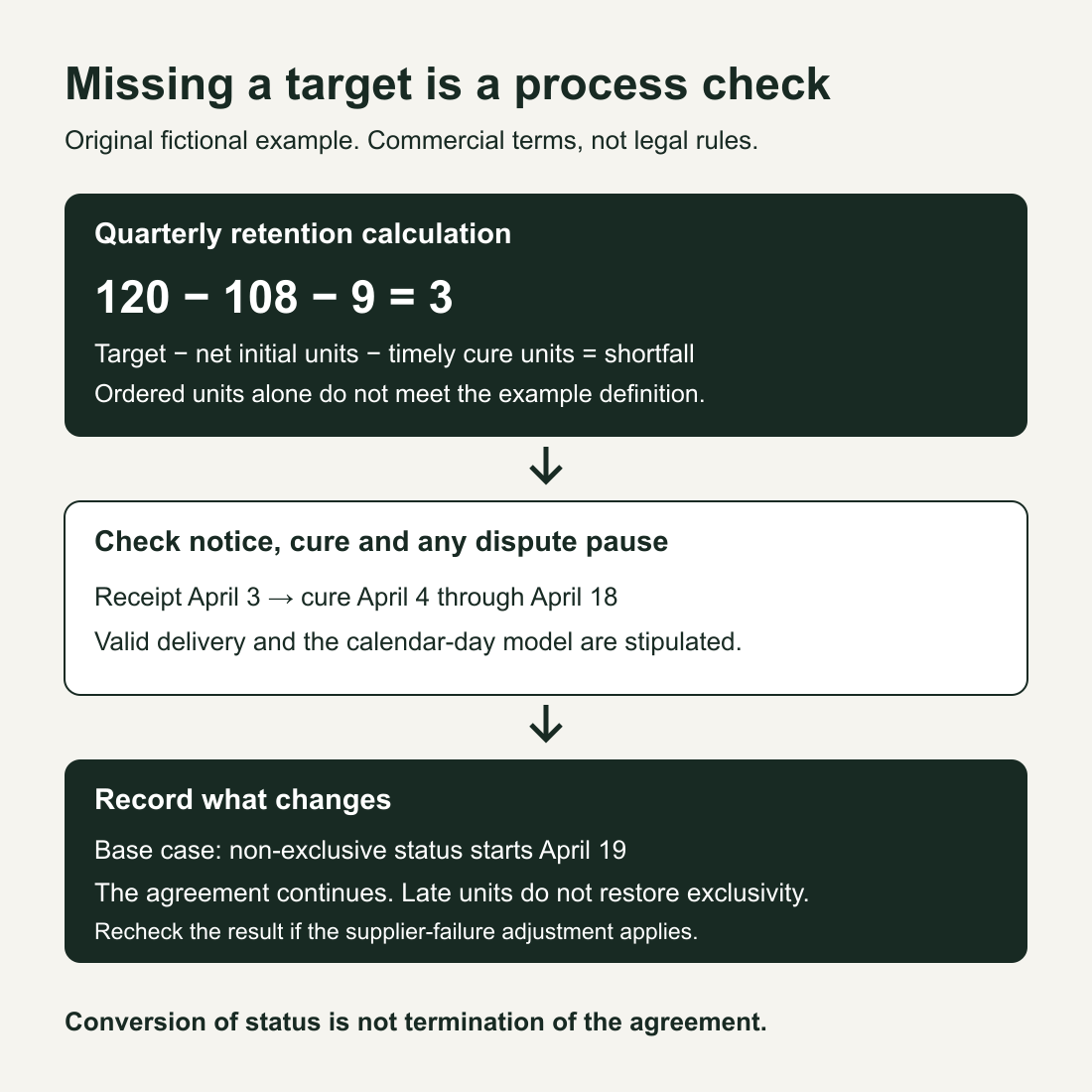
Assume the first quarter ends March 31, 2027. Finch has 112 accepted and paid units, with four returned by that date: 112 minus 4 = 108 qualifying units. There is no evidenced Birch supply failure in this base case, so the target remains 120 and the shortfall is 12.
Birch’s notice is validly received on April 3. Under the example wording and its stipulated calendar-day model, day one is April 4 and day fifteen is April 18. Valid delivery and receipt are assumptions for this worked example, not a ruling on a real notice. Use the notice delivery and evidence check before acting on an actual deadline.
Finch orders 15 additional units on April 10. Nine are delivered, accepted and paid for by April 18; the remaining six arrive on April 20. Merely ordering 15 is not enough under this definition.
| Step | Count | Effect under the example |
|---|---|---|
| Initial accepted and paid units | 112 | Starting quantity before recorded returns. |
| Returns by quarter end | 4 | Deducted once: 108 net qualifying units. |
| Timely qualifying cure units | 9 | 108 + 9 = 117 attributed only to the first quarter. |
| Remaining shortfall at April 18 cutoff | 3 | 120 minus 117; no pending calculation dispute in this stipulated case. |
| Units arriving April 20 | 6 | Too late for this cure; do not automatically restore exclusive status. |
With the stipulated facts and no dispute pause, conversion takes effect April 19. Finch can continue under the agreement on a non-exclusive basis. Birch can appoint another distributor for the previously covered channel under this provision. Other contract restrictions still need review.
Change one fact: the supplier caused the shortfall
Now assume a different case with the same 108 original qualifying units, but records establish 14 units Birch failed to supply by the agreed delivery date. The example’s adjusted target is 120 minus 14 = 106. The 108 units meet that adjusted target. There is no retention shortfall on those facts, so the base-case conversion should not be copied into this case.
Do not subtract the same supply failure twice or apply an informal excuse unsupported by the agreed definition. The adjustment, records and timing all matter. This is an interpretation of stipulated example terms, not a legal finding that every supplier-caused shortfall excuses every distributor obligation.
A completed exclusivity status record
Record: EX-07, fictional base case
Parties: Birch Sensors / Finch Field
Products: B100 and B120 only
Channel: industrial equipment dealers
Territory test: delivery in California
Reserved direct account: Aster Farm Supply
Competing brands: permitted for Finch
Quarter: January 1 to March 31, 2027
Target: 120; supply adjustment: 0
Initial count: 112 less 4 returns = 108
Notice received: April 3, valid delivery assumed
Cure window: April 4 through April 18
Timely cure count: 9; cumulative count: 117
Outstanding shortfall: 3
Calculation dispute: none in this scenario
Conversion: non-exclusive from April 19
Late arrival: 6 units on April 20, no automatic restoration
Continuing agreement: active, accepted orders preserved
Count control: 9 cure units not counted again in Q2
Status owner: Elena Park, commercial operations
Retained evidence: orders, deliveries, acceptance, payments, returns and notice receipt
Next action: notify sales and update the channel register
Keep the grant and its current status visible in contract lifecycle management. The sales team needs to know which appointments are currently allowed; procurement needs the count records; legal needs the notice and disputed issues. Contract administration connects those owners and records. Use the contract risk register to assess the dependency and record who accepts the remaining exposure.
U.S. competition law and California goods-sales notes
The FTC’s exclusive-dealing guidance says manufacturer-retailer exclusive dealing is generally lawful and evaluated by balancing competitive effects. It also explains how market power and blocked access to distributors or supplies can create competition concerns. A clear clause and commercial justification do not replace that market assessment.
For specified goods transactions, 15 U.S.C. section 14, Clayton Act section 3 addresses sales, leases and related pricing conditioned on not dealing in competitors’ goods where the effect may substantially lessen competition or tend to create a monopoly. Its stated scope concerns goods and other commodities; it is not a complete legal test for every service, employment or licensing restriction.
As a separate state-law example, California Commercial Code section 2306(2) provides that a lawful exclusive-dealing agreement in the relevant goods imposes, unless otherwise agreed, seller best efforts to supply and buyer best efforts to promote sales. Subsection (1) separately addresses output and requirements quantities, good faith and disproportionate quantities. Do not replace those distinctions with “exclusive means guaranteed purchases.”
The fictional fixed-target example is not an antitrust approval or a conclusion about all applicable California duties. Counsel should review the actual market, alternatives, duration, supply access, territorial and channel restrictions, and the full agreement. Employment, real estate, regulated distribution, IP licensing and international transactions need their own analysis. No market-share percentage or standard duration is supplied here as a substitute for that review.
Checklist before accepting or releasing exclusivity
- Identify each bound party and the exact restricted activity.
- List products, territory, channels, customers and reserved accounts.
- Resolve direct sales, online transactions, affiliates and future products.
- Distinguish exclusivity retention from purchase obligations.
- Define qualifying performance, returns, adjustments and evidence.
- Set the notice, cure, calculation-dispute and effective-date process.
- State what conversion changes and what obligations continue.
- Check for conflicting grants elsewhere in the contract portfolio.
- Complete applicable competition-law and transaction-specific review.
- Assign the status owner and communicate the recorded result.
Frequently asked questions
Are exclusivity clauses illegal?
Not automatically. The FTC’s cited guidance describes manufacturer-retailer arrangements as generally lawful while explaining competition concerns. The particular market and restriction matter. Other contexts require their own law and analysis.
Does exclusive distribution prevent the supplier selling directly?
Check the actual promise. The example expressly restricts covered direct sales while reserving a named account. A clause that only prohibits appointing other distributors may leave the direct-sales question unresolved.
Does an exclusive distributor have to buy only this supplier’s products?
Not under the example: competing brands are expressly permitted. An exclusive-purchasing promise needs its own scope. Do not infer it merely from the distributor’s exclusive appointment.
Can exclusivity cover future products?
The example excludes them until a written amendment adds them. A different agreement might define a broader product range. Test the actual definition and change mechanism rather than assuming either outcome.
What happens when a partner misses its target?
Apply the agreed count, adjustments and procedure. In the base case, 117 qualifying units against 120 leads to conversion after notice and cure. In the supplier-failure variation, 108 against the adjusted 106 target produces a different result.
Is conversion to non-exclusive status the same as termination?
No in this example: the agreement and accepted orders remain in place. Actual termination rights, payment consequences and continuing duties must be checked separately.
What if someone breaches the restriction?
Preserve the operative wording, transaction facts, exceptions and notices. Obtain advice on the available contractual and legal response. A clause naming damages or an injunction does not guarantee a court will grant either remedy.