

Adhesion Contract: Meaning, Examples and Enforceability
By Anirudh Menon, Viaclause editor
An adhesion contract is offered on a take-it-or-leave-it basis. See when it can be enforced, a $2,400 subscription example and a copyable review record.
An adhesion contract is a standard-form agreement imposed by a party with substantially stronger bargaining power, with little meaningful opportunity for the other party to negotiate. “Take it or leave it” describes how the terms are offered. It does not, by itself, make the agreement invalid. Cornell LII's adhesion contract overview introduces the distinction.
The useful question is which term is challenged, how it was presented, and which law governs. This guide explains the principal California doctrines, federal arbitration and consumer-law qualifications, real court examples, and a separate UK consumer note. Other states and countries can apply different tests.
Start with the contract formation hub if the basic agreement is disputed. An adhesion contract can involve reciprocal promises; the unilateral contract guide addresses the different question of accepting an offer through performance.
What makes a contract adhesive?
Common places to examine include insurance policies, residential leases, employment forms, online terms of service, software licences, credit-card agreements and standard consumer purchase documents. Whether a particular agreement is adhesive depends on its actual bargaining circumstances; the category alone is insufficient. Cornell LII: common settings.
Look beyond the document's label. Ask who drafted the important terms, whether that party controlled access to the product or relationship, and whether the recipient could meaningfully change the disputed provision. Selecting a price plan or correcting a name does not necessarily mean that an arbitration clause or liability allocation was negotiated.
Graham treated an experienced concert promoter's form contract as adhesive despite familiarity with its use. The court recognised standard forms' economic usefulness while examining the challenged provision separately. Graham, 28 Cal.3d 807 (1981).
Standardisation can make a recurring transaction easier to administer: the business uses one delivery process, support team and pricing structure rather than negotiating every purchase. The corresponding risk is concentrating control over terms while the recipient has little practical choice. Neither a long document nor a large company alone answers the legal question. A negotiated business agreement can also contain an unlawful provision.
| Situation | Useful evidence | Question that remains |
|---|---|---|
| Prewritten subscription terms | The actual plan, terms version and signup screen | Could the buyer negotiate the disputed term? |
| Employee may negotiate salary | Offer correspondence and the separate arbitration form | Was arbitration still a condition of employment? |
| Business chooses among suppliers | Available alternatives and redline responses | Was there meaningful choice in this transaction? |
| Parties negotiated a clause | The drafts and agreed changes | Does mandatory law still restrict that clause? |
How courts decide enforceability
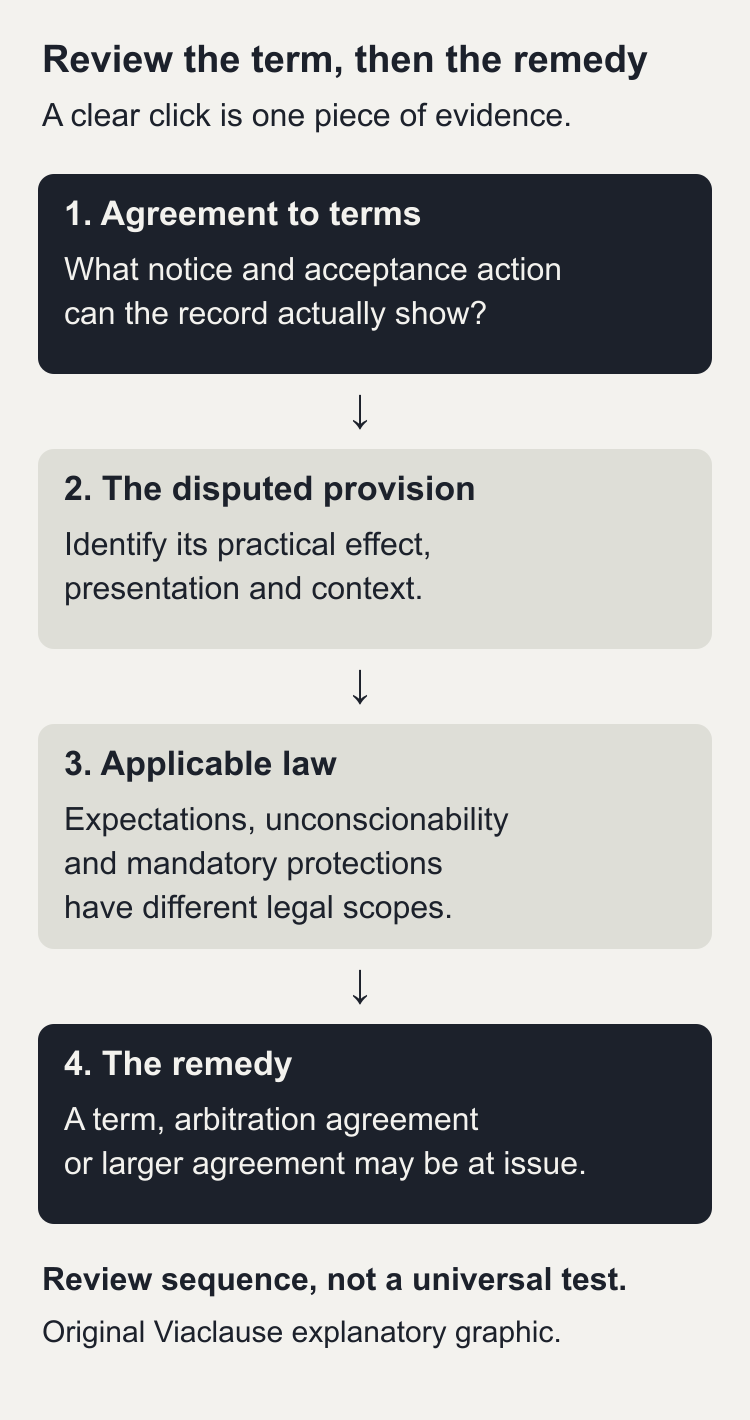
The following is a review sequence, not a uniform nationwide legal test. Keep formation, interpretation, fairness and statutory restrictions separate. A conspicuous checkbox may help prove assent while leaving the substance of an unfair term open to challenge.
- Identify the applicable law and contract setting. Consumer, employment, insurance and commercial agreements can engage different rules.
- Establish agreement to the particular terms. Save what the recipient saw and the action said to signify acceptance.
- Identify the disputed provision. Explain its practical effect rather than simply describing the whole contract as unfair.
- Apply the relevant doctrine or statute. Consider reasonable expectations, unconscionability and any mandatory protection within their actual jurisdictional scope.
- Consider the remedy separately. A defect can raise questions about a provision, an arbitration agreement or a larger agreement. Do not assume that every other duty disappears.
Procedural versus substantive unconscionability
California: Armendariz describes procedural unconscionability in terms of oppression or surprise, and substantive unconscionability in terms of overly harsh or one-sided results. Both are required, with a sliding scale: stronger evidence of one can reduce the degree of the other needed. Adhesion contributes to the procedural inquiry; it does not substitute for examining the substance. Armendariz v. Foundation Health Psychcare Services, 24 Cal.4th 83 (2000).
| Review question | Procedural evidence | Substantive evidence |
|---|---|---|
| What is being examined? | The circumstances of agreement and presentation | The actual allocation of rights, burdens and remedies |
| What should be collected? | Form, screen, notice, deadline, explanations, bargaining correspondence | Exact clause, reciprocal provisions, costs and practical consequences |
| What requires closer review? | Hidden terms or pressure to accept a condition without meaningful choice | Severely one-sided dispute rights, restrictions or burdens |
| What is an inadequate conclusion? | “It is a standard form, so it is automatically void” | “I regret the bargain, so it must be unconscionable” |
In Sanchez, the California Supreme Court stressed that an unfavourable bargain alone is insufficient; the analysis concerns substantial unfairness and the contract's commercial setting. It reversed the decision refusing to enforce the disputed automobile-sale arbitration agreement. That result is a reminder to examine the actual terms and applicable arbitration law rather than infer invalidity from the form. Sanchez v. Valencia Holding Co., 61 Cal.4th 899 (2015).
The reasonable-expectations doctrine
Graham identifies a separate limit concerning provisions outside reasonable expectations. The promoter expected arbitration, but the designated union tribunal was presumptively biased towards union members. The court rejected that arrangement and remanded for proceedings involving a neutral resolution route. Expected arbitration and fair arbitration are distinct questions; a personal expectation does not override every clear term. Graham's expectations and tribunal analysis.
When reviewing a proposed restriction, compare the sales description, declarations or offer summary with the complete terms. Identify any inconsistency, the placement of the restriction, and what was explained before acceptance. Preserve both documents rather than relying on a later recollection of what seemed to be promised.
Online terms: clickwrap, sign-in wrap and browsewrap
The label used by a product team does not establish a binding contract. Berman explains that, absent actual knowledge, the relevant California and New York inquiry requires reasonably conspicuous notice of the terms and an unambiguous act of assent. The Ninth Circuit found the small notice and “Continue” presentation insufficient in the challenged flow. Berman v. Freedom Financial Network, 30 F.4th 849 (2022), majority opinion.
| Common description | Typical presentation | Evidence to inspect |
|---|---|---|
| Clickwrap | A checkbox or acceptance button expressly associated with terms | Readable notice, working terms link, acceptance wording and actual event |
| Sign-in wrap | Notice that signup or sign-in also accepts terms | Whether the notice clearly connects that action to agreement |
| Browsewrap | Terms linked elsewhere, with acceptance asserted through use | Actual knowledge or legally sufficient notice and conduct in context |
A more recent example is Chabolla: the Ninth Circuit's 2025 majority affirmed refusal to compel arbitration in the ClassPass signup dispute. Its analysis treated notice and assent as separate requirements; later screens did not repair the missing connection between an earlier action and agreement. The decision includes a dissent, so this guide relies on the majority's reasoning. Chabolla v. ClassPass, No. 23-15999 (February 27, 2025).
For a business, keep the contemporaneous screen at the user's device size, linked terms, terms version and relevant acceptance event together. A log entry reading “accepted” has limited explanatory value if no one can reconstruct what the person was asked to accept. Later design changes should not replace evidence of the earlier transaction.
Real examples: insurance, leases and employment
Insurance: a restriction buried in an endorsement
In Haynes, an automobile policy limited coverage for permissive users through an endorsement. The California Supreme Court held the limitation insufficiently conspicuous, plain and clear to be enforceable. The practical lesson is to compare the declarations and apparent coverage with endorsements that narrow them. This was a particular policy and California decision, not a rule that every insurance exclusion is invalid. Haynes v. Farmers Insurance Exchange, 32 Cal.4th 1198 (2004).
Residential leases: a landlord's negligence waiver
Henrioulle concerned a printed residential lease purporting to exempt the landlord from injury liability. The California Supreme Court rejected the exemption under the public-interest principles applicable to that transaction. Its lease predated the later statute discussed in the opinion; this guide does not present the case as an application of that subsequently enacted law. Tenancy location, property type and the particular waiver remain important review inputs. Henrioulle v. Marin Ventures, 20 Cal.3d 512 (1978).
Employment: mandatory arbitration of statutory claims
Armendariz examined mandatory arbitration of California employment discrimination claims. For that setting, the court's safeguards included a neutral arbitrator, adequate discovery, a written award, available statutory remedies and employer responsibility for arbitration costs unique to that forum. These protections should not be copied as a universal checklist for every consumer or commercial dispute. The setting and rights being arbitrated matter. Armendariz's employment arbitration analysis.
Review restrictive employment terms individually. A non-solicitation provision raises a different scope and jurisdiction question from an arbitration procedure; use the non-solicitation guide before borrowing wording from another relationship.
Consumer protections and the federal arbitration qualification
Consumer reviews: the federal Consumer Review Fairness Act addresses specified restrictions in non-negotiated individual consumer form contracts. It makes covered review restrictions, penalties and certain intellectual-property transfers void, subject to statutory qualifications. Employment and independent-contractor agreements are excluded from its definition. It does not immunise unlawful or defamatory content or nullify every confidentiality clause. 15 U.S.C. 45b.
Internet subscriptions: ROSCA prohibits covered internet negative-option charges unless the seller clearly discloses material terms before obtaining billing information, obtains express informed consent, and provides a simple mechanism to stop recurring charges. These are consumer internet-sales conditions, not a universal cancellation procedure for every business contract. 15 U.S.C. 8403.
Arbitration: Federal Arbitration Act section 2 generally supports enforcement of written arbitration agreements within its scope, while preserving applicable contract-revocation grounds and its stated statutory qualifications. 9 U.S.C. 2. In Concepcion, the Supreme Court held California's Discover Bank class-arbitration rule preempted by the FAA. Calling a clause adhesive does not avoid the federal-law analysis or establish that a class waiver is invalid. AT&T Mobility v. Concepcion, 563 U.S. 333 (2011), majority opinion.
Read the arbitration clause guide for the separate agreement, scope and procedure questions. These consumer protections also leave room for additional applicable state and sector-specific law; they are examples of targeted protections, not an exhaustive consumer-law inventory.
Clauses that deserve close inspection
A practical review should explain what each clause would do in this particular relationship. The following questions identify issues to investigate; they do not declare every listed term unlawful.
| Provision | Question to answer before accepting | Record to keep |
|---|---|---|
| Arbitration and forum | Which claims, procedures, decision-maker and costs are covered? | The incorporated rules and exact clause |
| Liability limit or indemnity | Whose losses are limited or shifted, and with what exceptions? | A worked loss scenario and allocation |
| Warranty disclaimer | Does it contradict a promise, and what mandatory rights apply? | Sales promises, warranty and applicable-law review |
| Renewal or termination | What action is required, by when, through which channel? | Notice terms, cancellation instructions and delivery evidence |
| Unilateral changes | How are changes notified and which version applies? | Version history and the actual change notice |
| Reviews or confidentiality | What information is restricted, and does consumer-review law apply? | Exact restriction, relationship type and statutory scope |
For renewal calculations, use the evergreen notice-window examples. Store the final terms and acceptance record in a contract repository so the dispute can be assessed against the right version.
Worked example: the same $2,400 commitment, different evidence
Fictional example: Alder Fitness sells a six-month plan at $400 per month. The scheduled total is 6 × $400 = $2,400. This is arithmetic for the stated plan, not a finding that every scheduled charge is legally recoverable.
In version A, the screen says “$400 monthly” and the six-month commitment appears only in linked terms. In version B, the screen expressly displays the six-month total and links the same terms beside an acceptance checkbox. The second version supplies different presentation and assent evidence. It still requires review of the cancellation conditions, statutory scope and fairness of any disputed charge.
Suppose the consumer has paid two instalments: 2 × $400 = $800. Four scheduled instalments remain, totalling $1,600. Record that schedule separately from the amount demanded on cancellation. A provider demanding the whole remainder should identify the contractual basis, applicable consumer rules, and any relevant facts concerning the demand.
Completed fictional review record
Provider: Alder Fitness
Plan: six months at $400 per month
Scheduled total: $2,400
Paid: $800 across two instalments
Remaining schedule: $1,600
Disputed term: payment demanded after cancellation
Presentation: compare version A and version B
Assent evidence: actual screen, linked terms and event
Legal scope: consumer location and applicable law unresolved
Next action: preserve documents and obtain a scoped review
Outcome: no conclusion that the demand is valid or void
Business drafting and implementation checklist
Use this as a review agenda for the legal, product and operations teams. Clear presentation should accompany a fair, legally reviewed allocation of rights; it is not a guarantee of enforceability.
- Identify the customer, employee or business relationship and the governing jurisdictions.
- Separate negotiable commercial choices from imposed legal terms.
- Explain price, term, renewal and cancellation together in plain language.
- Make significant restrictions visible before the acceptance action.
- Check that sales promises, summaries and full terms agree.
- Review one-sided burdens and the commercial reasons for them.
- Check consumer, employment, tenancy, insurance and arbitration restrictions where relevant.
- Provide a usable terms link and a copy the recipient can keep.
- Save the actual screen, terms version and acceptance event together.
- Give support staff instructions consistent with the stated cancellation process.
- Review changed terms and preserve the notice and agreement evidence.
- Assign an owner to unresolved questions before deploying the form.
Copyable form-review worksheet
Relationship and locations:
Governing law requiring review:
Terms version and date:
Disputed or significant provision:
Meaningful negotiation available:
Notice and acceptance action:
Sales summary compared with full terms:
Practical burden on each party:
Mandatory rights or sector rules:
Evidence retained:
Unresolved question and responsible reviewer:
Approved operational instructions:
If a provision is defective, does the whole contract fail?
Do not assume automatic rescue by a severability sentence, or automatic failure of the entire contract. In Ramirez, the California Supreme Court rejected a bright-line rule based simply on the number of unconscionable arbitration terms. The inquiry includes whether the central purpose is unlawful, whether deletion or restriction can cure the problem without rewriting, and whether severance serves the interests of justice. The case was remanded for further proceedings. Ramirez v. Charter Communications, No. S273802 (July 15, 2024).
The severability examples help organise a provision-by-provision review. Record which obligation is challenged and which obligations remain disputed rather than treating a clause challenge as permission to stop every payment or performance obligation.
UK note: consumer unfair terms and transparency
UK consumer analysis should start with its own framework. Consumer Rights Act 2015 section 62 provides that an unfair consumer term is not binding on the consumer. The statutory fairness inquiry considers good faith, significant imbalance to the consumer's detriment, and the relevant context. Section 68 requires written consumer terms and notices to be transparent, including plain, intelligible and legible wording. These are consumer provisions, not a general rule for all business or employment agreements. CRA section 62; CRA section 68.
Frequently asked questions
Are adhesion contracts illegal?
No automatic conclusion follows from the label. California's Graham decision separates adhesion from scrutiny of the challenged provision. Applicable law and the actual term matter. Graham.
Is every standard contract a contract of adhesion?
A prewritten form is a starting fact. Examine bargaining power and meaningful opportunity to negotiate rather than relying solely on its format. Graham's definition.
Can a click or signature cure an unfair term?
Agreement and substantive fairness are separate inquiries. Evidence of assent does not replace the applicable unconscionability analysis. Berman; Armendariz.
Does a footer link prove acceptance of online terms?
Do not assume it does. The relevant notice, knowledge and assent analysis depends on the presentation and governing law. Preserve the actual flow. Berman.
Is reasonable expectation the same as unconscionability?
Graham discusses them as separate limits. An expected dispute process can still present an unacceptable decision-maker. Graham.
Are class-action waivers automatically unenforceable?
No. For arbitration agreements within the FAA's scope, Concepcion makes federal preemption part of the analysis. Concepcion.
Can a consumer form prohibit negative reviews?
The federal Consumer Review Fairness Act makes specified restrictions in covered form contracts void, with exclusions and qualifications. Check whether the relationship and restriction fall within the statute. 15 U.S.C. 45b.
Does one defective term invalidate everything?
The remedy requires its own analysis. Ramirez rejects a simple term-counting approach to severing unconscionable arbitration provisions. Ramirez.
What should I keep before challenging a form?
Keep the signed or accepted version, signup screens, sales statements, invoices, notices and correspondence. Identify the exact disputed demand and any approaching deadline. This is an evidence checklist, not a conclusion about your claim.
Should a business stop using standard forms?
Review its terms, presentation and operational implementation together. The appropriate response may involve a targeted correction, meaningful choices or a different contracting process. Standardisation alone does not decide fairness.
Prepared by the Viaclause editorial team using the sources below. The retained banner is an AI-generated fictional illustration.
Sources
Cornell LII Wex: adhesion contract overview, introductory definition and distinction.
- Graham v. Scissor-Tail, California Supreme Court (1981), opinion reproduced by Stanford's California Supreme Court Resources.
- Armendariz, California Supreme Court (2000), opinion reproduced by Stanford.
- Sanchez v. Valencia Holding, California Supreme Court (2015), opinion reproduced by Justia.
- Berman, Ninth Circuit (2022), official majority opinion.
- Chabolla, Ninth Circuit (2025), official opinion, majority reasoning.
- Haynes, California Supreme Court (2004), opinion reproduced by Stanford.
- Henrioulle, California Supreme Court (1978), opinion reproduced by Stanford.
- 15 U.S.C. 45b, Consumer Review Fairness Act, Cornell LII.
- 15 U.S.C. 8403, internet negative-option sales, Cornell LII.
- 9 U.S.C. 2, Federal Arbitration Act, Cornell LII.
- AT&T Mobility v. Concepcion (2011), Supreme Court majority opinion reproduced by Cornell LII.
- Ramirez v. Charter Communications, California Supreme Court (2024), opinion reproduced by Justia.
- Consumer Rights Act 2015, section 62, UK legislation service.
- Consumer Rights Act 2015, section 68, UK legislation service.