

Consideration in Contract Law: Value, Promises and Exceptions
By Anirudh Menon, Viaclause editor
Understand consideration through promises, gifts and forbearance. Compare a worked services price change with California's goods modification rule and exceptions.
Consideration in contract law is the value given or promised in exchange for a promise. It can be money, goods, work, another promise or an agreed restraint on exercising a lawful right. Ask what induced the promise and what was given for it. A signature or a recital of consideration is evidence to examine, rather than a substitute for the transaction.
For a concrete US reference, California Civil Code section 1605 recognizes an induced benefit or prejudice, including promised performance, subject to existing-entitlement and existing-duty limits. This guide uses California for its business examples, identifies other courts when explaining their cases, and separately outlines England and Wales and India. State law and the transaction matter.
What counts as consideration?
Identify the promise you want enforced, the person making it, and the exchange sought for that promise. A benefit to the promisor and a legal detriment to the promisee are ways of describing that exchange. A detriment can mean accepting an obligation or restricting a lawful freedom, even if the decision improves the promisee's health or finances. The classic New York decision Hamer v. Sidway, 124 NY 538 (1891) illustrates this distinction.
| Form | Example | Evidence to retain |
|---|---|---|
| Money for goods or services | Pine Stores pays $6,000 for Ridge Maps' six defined site reports. | Scope, price, acceptance and payment terms. |
| A promise for another promise | Ridge Maps commits to deliver; Pine Stores commits to pay later. | Both commitments and when the parties agreed. |
| Performance for a promise | A business offers a specified reward for completing a defined task. | The communicated offer and responsive performance. |
| Forbearance | A party agrees to settle a claim genuinely disputed in good faith. | The dispute, concessions and exact release. |
| Property or another noncash benefit | A business transfers equipment for an agreed service. | What is transferred and the service requested in return. |
California's 2026 civil jury instruction 302, printed pages 88 to 90 explains exchange, agreement and clear terms, with capacity or lawful purpose added when disputed. See the contract elements guide for the wider formation review.
Executed, executory and past consideration
Executory describes a commitment still to be performed. Executed describes performance already supplied as the requested exchange. California section 1609 permits consideration to be executed or executory, wholly or partly. These labels describe performance status; they do not decide every formation question.
For example, on October 2 the fictional parties exchange promises for six reports and $6,000. Neither side has yet performed, but the exchange already exists. On November 30 Ridge Maps delivers as agreed. The work is now performed consideration for the earlier payment promise. It does not become invalid merely because the invoice follows delivery. A unilateral contract instead seeks performance in return for a promise; two reciprocal promises are not the only possible structure.
Past consideration raises a different timing issue: an act was completed before the later promise, without having been sought as its exchange. Suppose a friend volunteers a report with no payment arrangement, then receives a later promise of $1,000 as thanks. That chronology raises a bargain problem. Compare a professional report requested with an understanding of payment, followed by an invoice: the earlier request and agreement can change the analysis. Keep the request, response and payment understanding, not just the later thank-you message. California's particular statute and a qualified common-law exception are discussed below.
Consideration versus a gift or an illusory promise
A condition is not necessarily an exchange
A gift promise seeks no bargained return. A condition might merely specify how the recipient collects the gift. Conversely, a promise of a painting in return for completing a requested project might be a bargain, despite the word “gift.” The relationship between promise and requested act matters. In Pennsy Supply v. American Ash, 2006 PA Super 54, paragraphs 7 to 11, a Pennsylvania court considered allegations that free paving material was supplied to avoid the supplier's disposal costs. It reversed dismissal because the alleged collection and supply could mutually induce one another. This was a pleading decision and remand, not a finding of proven liability.
In Dougherty v. Salt, 227 NY 200 (1919), reproduced court-opinion excerpt, an aunt gave her eight-year-old nephew a $3,000 note as a present. The New York court found no bargain, even though the note recited value received. Affection and a printed recital did not turn that gift promise into consideration. The linked university teaching excerpt supports this point; it does not reproduce every part of the appeal.
Check whether the supposed promise commits anyone
“I may order a report if I feel like it” leaves the buyer without the stated purchase commitment. Compare “I will buy two reports meeting Appendix B by December 15,” which identifies an obligation and a quality condition. A condition, cancellation right or discretionary term needs review in the full agreement; do not declare every conditional promise illusory. An implied contract may require attention to conduct as well as words.
Sufficient consideration does not mean an equal price
Sufficiency asks whether the law recognizes the exchange. Adequacy concerns its economic value. In Hamer, an uncle promised $5,000 for his nephew's specified abstinence until age 21. The court treated the restriction of freedoms lawful under the law then applicable as consideration, without demanding a financial gain to the uncle. This historical case is not advice about what a minor may lawfully do today. Read the court’s reasoning at pages 544 to 546.
Do not extend this principle into “a court never examines price or fairness.” California Civil Code section 3391 specifically restricts specific performance when consideration is inadequate or the contract is not just and reasonable to the affected party. That addresses a remedy compelling performance; it is not a rule that every unequal exchange lacks consideration. A nominal price, such as $1, calls for checking the real transaction and any separate formality, consent or public-policy issue.
Lawfulness is also distinct from value. California section 1607 requires lawful consideration. A valuable illegal act does not become acceptable because the parties describe it as consideration. Keep the exchange question separate from capacity, consent, statutory protections and the remedy sought.
Forbearance, disputed debts and settlement
California instruction 302 cites authority that a compromise of claims asserted in good faith can provide consideration. A settled, undisputed debt raises a different question. Read instruction 302, printed page 89, on good-faith claims and disputes.
In a fictional review, Harbor Services invoices Elm Shop $1,500. Elm admits $900 and disputes $600, with a contemporaneous defect report. They negotiate payment of $1,200 and a release limited to this invoice. Harbor gives up $300 of its demand; Elm pays $300 more than its admitted amount. Record the actual good-faith dispute, payment date, release scope and acceptance. This example identifies reciprocal concessions; it does not establish that an unsigned draft discharged the debt.
A promise not to sue can be a material concession, so identify the right, claim and limits being released. Do not manufacture a dispute to create consideration or assume that any forbearance is lawful. The original invoice, complaint history and signed settlement often explain the exchange more clearly than “full and final” on a payment reference.
Past acts, moral obligations and alternative legal routes
A later promise of gratitude is not automatically a bargain. Nor does every jurisdiction treat earlier acts identically. California Civil Code section 1606 recognizes an existing legal obligation and specified moral obligations originating in a benefit or prejudice, limited to the corresponding extent of the obligation. Its text does not justify treating every grateful later promise as enforceable.
In Pao On v. Lau Yiu Long [1979] UKPC 17, reported at [1980] AC 614, a Privy Council appeal from Hong Kong, the court required an earlier act at the promisor's request, a shared understanding of remuneration or another return, and a benefit enforceable had it been promised in advance. A prior request alone was insufficient. The case also recognized that a contractual duty to a third party can supply consideration for a new direct obligation to someone else. These are separate questions from repeating a duty already owed to the same promisor.
Reliance and consideration are different theories. In California's Raedeke v. Gibraltar Savings and Loan Association, 10 Cal.3d 665 (1974), pages 672 to 674, the court explained promissory estoppel as a substitute in appropriate circumstances, while finding that requested procurement of a prospective buyer could instead be bargained performance. Identify the promise, request, response and resulting change of position before choosing a theory. The opinion's quoted modification statute predates the current wording, so use today's section 1698 for that separate issue.
Pennsy also reversed dismissal of an alternative Pennsylvania promissory-estoppel claim, allowing further proceedings on alleged promise and reliance. That does not make reliance on every vague assurance recoverable. Read Pennsy paragraphs 15 to 22 for the procedural limits. Restitution is another question: receiving a benefit and enforcing a contractual promise are different inquiries. See the quasi-contract guide when the evidence does not establish an agreed exchange.
Existing duties and promises to pay more
Separate a duty imposed by law, a contractual duty to the same party, and a contractual duty to someone else. California instruction 313 explains the existing-duty problem. Identify what the proposed promise adds. Read 2026 instruction 313, printed pages 113 to 114.
The historical Ninth Circuit decision Alaska Packers’ Association v. Domenico, 117 F. 99 (1902), reproduced opinion excerpt rejected extra compensation for workers who stopped and demanded more pay for the services they had already promised. The court treated their claimed defective-net justification as unproved and did not find the additional consideration they asserted. The case illustrates the existing-duty problem and pressure in negotiations; it does not establish today's modification rule for every state or transaction.
A different outcome appears in Rhode Island's Angel v. Murray, 322 A.2d 630 (1974), reproduced actual opinion. The court upheld a voluntary refuse-collection modification following an unanticipated increase of 400 dwelling units. Its adopted rule required a contract not fully performed by either side, unanticipated circumstances, and a fair and equitable modification. It rejected a rigid consideration analysis on those facts. A merely unprofitable contract does not by itself compel the customer to pay more.
A private promise to pay for a duty already imposed by law calls for checking what, if anything, has been added beyond that duty. California section 1605 includes the existing-duty limit. Public duties can raise separate lawfulness or authority issues, and a contractual duty to another party requires attention to whom the new obligation is owed. Pao On illustrates that third-party distinction in its own common-law setting. Do not carry its result into a California contract simply because the words “existing duty” appear in both.
California services modifications: read the actual route
Under California Civil Code section 1698, a written contract may be modified by a written contract, or orally to the extent the parties execute the oral agreement. Unless the contract expressly provides otherwise, it may also be modified orally with new consideration, subject to the statute of frauds where applicable. Subdivision (d) preserves specified doctrines, including estoppel, waiver and novation, in appropriate cases. Writing alone is not a universal guarantee of enforceability.
For a contract not in writing, California section 1697 specifically permits modification by written consent without new consideration. Instruction 313 also requires proof that the parties actually agreed to a modification. Review the existing agreement, form requirements, authority and exception relied upon before concluding that a services change always needs fresh consideration or never needs it.
Worked services review: an extra $900 for what?
Every name, date, amount and document below is fictional. Assume California law, a services transaction, a valid original bargain, competent parties, lawful scope and no agreed automatic price adjustment. The original October 2 agreement requires six site reports for $6,000 by November 30. No report has been delivered and no fee has been paid as of the October 6 review. The examples isolate consideration and modification questions, not a court outcome.
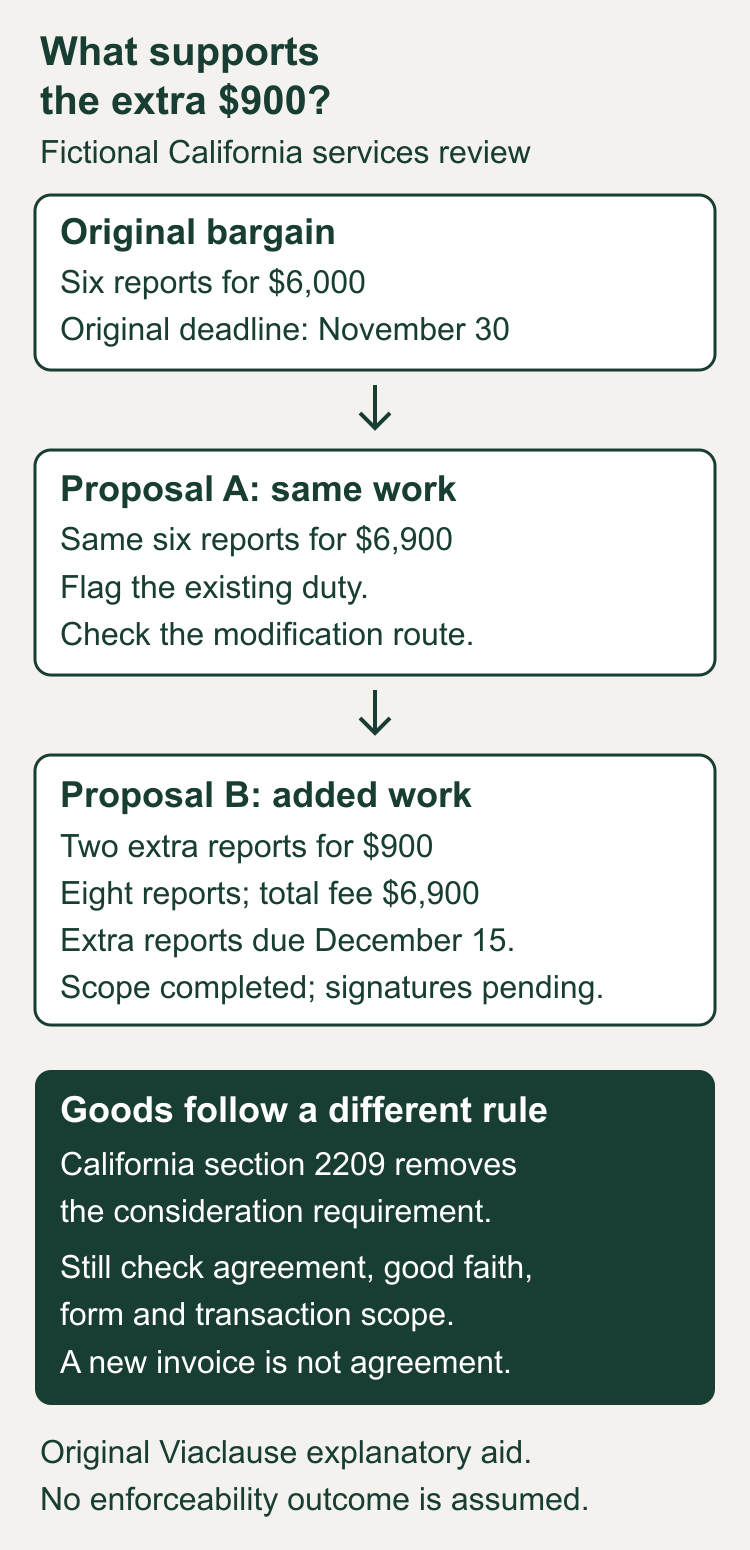
Proposal A: unchanged scope, higher price
Ridge Maps emails that its internal costs have risen and requests $6,900 for the same six reports. Pine Stores has not accepted. The increase is $6,900 minus $6,000 = $900. A revised invoice records the request but does not establish an agreed modification. The review flags unchanged duties and asks which California modification rule, contractual price-adjustment term or supported exception applies. The record does not assume that rising costs excuse performance or prove breach.
Proposal B: a completed description of extra work
Instead, Pine Stores requests reports for two additional sites, Bay Harbor and Brookside. Ridge Maps offers both for an additional $900, due December 15. Each added report costs $900 ÷ 2 = $450. Six original reports plus two extra reports = eight; $6,000 plus $900 = $6,900. The original six retain their November 30 deadline. Describing new scope identifies a proposed additional exchange. Compare the contract amendment sample when preparing the full document.
The following filled wording is a proposed amendment for these assumed facts. It remains unsigned and subject to the existing contract and legal review. It is not a general amendment template for all transactions.
PROPOSED AMENDMENT CON-23
Prepared: October 6, 2026
Parties: Ridge Maps LLC and Pine Stores LLC
Original agreement: Site Reports Agreement dated October 2, 2026

Additional exchange:
Ridge Maps will deliver one additional site report for Bay Harbor
and one for Brookside. Pine Stores will pay $900 for these two reports.

Appendix B, completed scope:
Each additional report will identify the site and inspection date,
include a site diagram and observations, list identified risks,
and provide recommendations with supporting site photographs.
Delivery format: one PDF per site to the customer project lead.
Additional reports due: December 15, 2026.
The six original reports remain due November 30, 2026.

Price and payment:
Original fee: $6,000, subject to the original payment terms.
Additional fee: $900, payable within 15 calendar days after delivery
of both additional reports satisfying Appendix B and a correct invoice.
Combined stated fee: $6,900. Example assumes no taxes or other charges.
An invoice alone does not activate this amendment.

Effectiveness and review:
This proposal becomes effective when both parties sign through
representatives with verified authority, subject to applicable law.
The original terms continue except for the changes stated here.
Maya Chen, proposed Ridge Maps signatory: signature pending.
Owen Bell, proposed Pine Stores signatory: signature pending.
Authority evidence and legal review: pending.
If both additional reports are delivered on December 15 and the correct invoice arrives that day, the proposed 15-day payment period reaches December 30. That arithmetic assumes this wording was agreed and became effective. It does not create an obligation while the amendment remains a proposal. The original $6,000 payment schedule is unaffected.
Completed review record
REVIEW RECORD CON-23, October 6, 2026
Original obligations: six reports; $6,000; November 30 delivery.
Performance to date: none, assumed for this example.
Proposal A: extra $900 for the same six reports; no acceptance recorded.
Concern: existing duty; identify a valid modification route or exception.
Proposal B: two additional reports; Appendix B populated above.
Additional exchange: two specified reports for $900.
Total scope if agreed: eight reports.
Total stated fee if agreed: $6,900; no taxes or other charges assumed.
Original deadline: November 30; added-work deadline: December 15.
Proposed additional payment date if delivered and invoiced December 15:
December 30, using 15 calendar days.
Signatures: both pending. Authority verification: pending.
Legal review: pending; confirm original modification and form requirements.
Present status: Proposal B is drafted, not activated.
Present action: route completed scope and price for authority and legal review.
Do not approve the revised invoice as proof of agreement.
Goods modifications follow a separate enacted rule
California Commercial Code section 2209 says an agreement modifying a contract within its sales division needs no consideration. It retains signed-writing or signed-record restrictions where applicable and incorporates section 2201 when the modified contract falls within that statute. Failed formal modifications may operate as waivers; retraction has its own notice and reliance limits. This is an agreement rule, not permission to change an invoice unilaterally.
In a separate fictional goods example, Pine Stores orders 200 sensors at $30 each: 200 × $30 = $6,000. A proposed unit price of $34.50 produces 200 × $34.50 = $6,900, an increase of $4.50 per sensor and $900 overall. Quantity is unchanged. The absence of extra sensors does not itself defeat a California sales modification for want of consideration. Check actual assent, applicable form and the reason for the change.
California section 1304 imposes good faith in performance and enforcement. Section 2201 generally requires a sufficient signed record for sales of goods priced at $500 or more, with listed exceptions, and limits enforcement beyond the quantity shown. The $6,900 sensor example therefore calls for a form review; “no new consideration” does not dispose of it.
Scope matters too. Current California section 2102 covers goods and treats hybrid transactions differently depending on whether goods predominate and which provisions concern the goods aspects or the transaction as a whole. Identify what a mixed equipment-and-service amendment changes. Do not apply the sensor rule automatically to consulting, employment, leases or every software arrangement.
England and Wales and India: important differences
England and Wales
Keep the English requested-act and third-party-duty analysis above separate from the California business examples. A variation also requires attention to the original contract and any form requirements.
In Rock Advertising v. MWB [2018] UKSC 24, paragraphs 16 to 20, the UK Supreme Court held the oral payment variation ineffective because the agreed writing and signature requirements were not met. It declined to decide consideration. The judgment discusses practical benefits, Williams v. Roffey and conflicting debt authorities; it does not establish that practical benefit automatically validates every promise to accept less. Estoppel was no rescue on those facts, and an informal promise alone was insufficient for the safeguard described.
A deed is a distinct formal instrument, not a label for any signed document. The Privy Council explained that consideration is not ordinarily required for a deed to bind the parties in Chen v. Ng [2017] UKPC 27, paragraphs 30 to 32, a British Virgin Islands appeal. For England and Wales, Law of Property (Miscellaneous Provisions) Act 1989, section 1 requires facial intention and valid execution; ordinary individual execution includes an attested signature in the witness's presence and delivery as a deed. Entity execution and the transaction require their own review. Do not cure an unsupported promise by merely changing a document's heading.
India
The Indian Contract Act 1872, sections 2(d), 25 and 63 expressly differs from a blanket rule that consideration must always move from the promisee and always be future performance. Section 2(d) includes acts, abstinence or promises by the promisee or another person, at the promisor's desire, including acts already done. Section 25 contains exceptions for specified registered writings based on natural love and affection between near relations, compensation for specified earlier acts, and signed written promises to pay time-barred debts. It preserves completed gifts and says inadequacy alone does not void freely given consent, though it may bear on consent. Section 63 permits remission, extension of time or acceptance of other satisfaction. Check the precise conditions rather than importing an English debt rule.
A copyable consideration evidence checklist
Use this with the signed agreement, proposed change and chronology. It documents facts for review; it does not score enforceability. For a continuing deal, the agreement renewal guide helps identify whether the parties are renewing obligations, changing them or negotiating a new term.
CONSIDERATION AND CHANGE CHECKLIST
1. Identify the governing law and type of transaction.
2. Name the precise promise to be enforced and the person making it.
3. Record the requested return: promise, act, goods, payment or forbearance.
4. Put request, acceptance, performance and later promise in date order.
5. Mark any duty already owed, its source and the person to whom it is owed.
6. Compare old and new scope, price, dates and rights side by side.
7. For a settlement, preserve the genuine dispute and each concession.
8. For a modification, identify the statutory or contractual route relied on.
9. Check writing, signed record, deed or other applicable formalities.
10. Verify authority and record each party's actual assent.
11. Keep delivery, payment and reliance evidence separate from formation.
12. Flag lawfulness, consent, special protections and remedy questions.
13. State the result precisely: proposed, agreed, signed, performed or disputed.
14. Preserve originals and versions; link each conclusion to its evidence.
Frequently asked questions
What is an easy example of consideration?
Six defined reports in return for a $6,000 payment promise identify an exchange. Check the remaining formation requirements too. California instruction 302 explains the formation questions.
What are the three or four types of consideration?
There is no universal numbered validity test. Lists may classify promises, performance and forbearance, or executed, executory and past acts. Identify the facts and apply the relevant law. California section 1609 addresses executed and executory consideration.
Does consideration have to be money?
No. A requested promise, service, property transfer or lawful forbearance may identify the exchange. A good business outcome by itself does not prove an agreed bargain. California section 1605 describes benefits and prejudice as inducements.
Does “in consideration of” or “value received” prove an exchange?
The wording describes an asserted exchange; inspect the actual transaction. Dougherty shows why a value-received recital did not convert the aunt's present into a bargain. Read the reproduced Dougherty opinion excerpt.
Does signing a contract prove consideration exists?
California section 1614 makes a written instrument presumptive evidence of consideration, and section 1615 addresses showing its absence. A presumption is not conclusive proof. Keep the bargain evidence alongside the signature.
Can a completed act support a later promise?
Timing and jurisdiction matter. Distinguish a gratuitous completed act from earlier requested work with an agreed return. Pao On's requested-act exception has three conditions; California and India have specific statutory provisions. Read Pao On’s first question on earlier requested acts.
Does doing the same work support a promise to pay more?
Flag the existing duty and check the applicable modification route. Angel and Alaska Packers show contrasting fact patterns; neither supplies a universal modern state-law answer. Angel explains its voluntary, unanticipated and equitable modification rule.
Must a California goods modification add something new?
Section 2209 removes the consideration requirement for an agreement within the sales division. Assent, good faith, applicable form and scope remain separate checks. Read the enacted California modification and waiver provision.
Is a very low price automatically invalid consideration?
Identify a real legally recognized exchange before debating its price. Also check the remedy: California section 3391 places adequacy and fairness restrictions on specific performance. Read section 3391’s particular remedy limits.
If promised work is not delivered, was there no consideration?
A promised exchange and subsequent performance are different facts. Nondelivery may raise breach or another issue; it does not automatically erase the original promise. California section 1609 recognizes consideration still to be performed.
Can reliance enforce a promise without a bargain?
In an appropriate case a distinct estoppel theory may be available, with its own requirements. Raedeke distinguishes such a substitute from requested performance that itself supplies consideration. Read Raedeke’s consideration and estoppel analysis.
Is the US rule the same as India's rule?
No. Read the conditions stated in India's Act rather than applying an undifferentiated US or English rule. Read the Indian Contract Act’s actual conditions.
Sources
- California Commercial Code section 1304: good faith.
- California Civil Code section 1605: induced benefit or prejudice.
- California Civil Code section 1606: existing legal and specified moral obligations.
- California Civil Code section 1607: lawful consideration.
- California Civil Code section 1609: executed and executory consideration.
- California Civil Code section 1614: written-instrument presumption.
- California Civil Code section 1615: showing absence of consideration.
- California Civil Code section 1697: written consent modifying a contract not in writing.
- California Civil Code section 1698: written and oral modification routes.
- California Commercial Code section 2102: goods and hybrid transactions.
- California Commercial Code section 2201: sufficient signed record and exceptions.
- California Commercial Code section 2209: modifications and waiver.
- California Civil Code section 3391: specific-performance restrictions.
- Judicial Council of California 2026 civil jury instructions 302 and 313, printed pages 88 to 90 and 113 to 114.
- Hamer v. Sidway, 124 NY 538 (1891), actual opinion in the New York courts archive.
- Dougherty v. Salt, 227 NY 200 (1919), actual opinion excerpt reproduced in Cleveland State University course materials.
- Alaska Packers’ Association v. Domenico, 117 F. 99 (1902), edited actual opinion reproduction hosted at Madisonian.net.
- Angel v. Murray, 322 A.2d 630 (1974), actual opinion reproduced on University of Kansas professor Stephen Ware’s site.
- Pennsy Supply v. American Ash, 2006 PA Super 54, actual Pennsylvania Superior Court opinion reproduced by Justia.
- Raedeke v. Gibraltar, 10 Cal.3d 665 (1974), actual opinion reproduced by Stanford Law Library.
- Pao On v. Lau Yiu Long [1979] UKPC 17, actual Privy Council judgment reproduced by BAILII.
- Rock Advertising v. MWB [2018] UKSC 24, official UK Supreme Court judgment.
- Law of Property (Miscellaneous Provisions) Act 1989, section 1, current official England and Wales text.
- Indian Contract Act 1872, official India Code Act, sections 2(d), 25 and 63.
- Chen v. Ng [2017] UKPC 27, paragraphs 30 to 32, official Judicial Committee of the Privy Council judgment, deed discussion in a British Virgin Islands appeal.
Prepared with AI assistance for Viaclause. This is general educational information. The business examples and records are fictional assumptions, not observed transactions or legal outcomes. The banner is an AI-generated fictional illustration.