

Void vs Voidable Contracts: Examples, Effects and Next Steps
By Anirudh Menon, Viaclause editor
Compare void, voidable and unenforceable contracts through three worked US examples, a completed fact record, rescission and restoration checks, and FAQs.
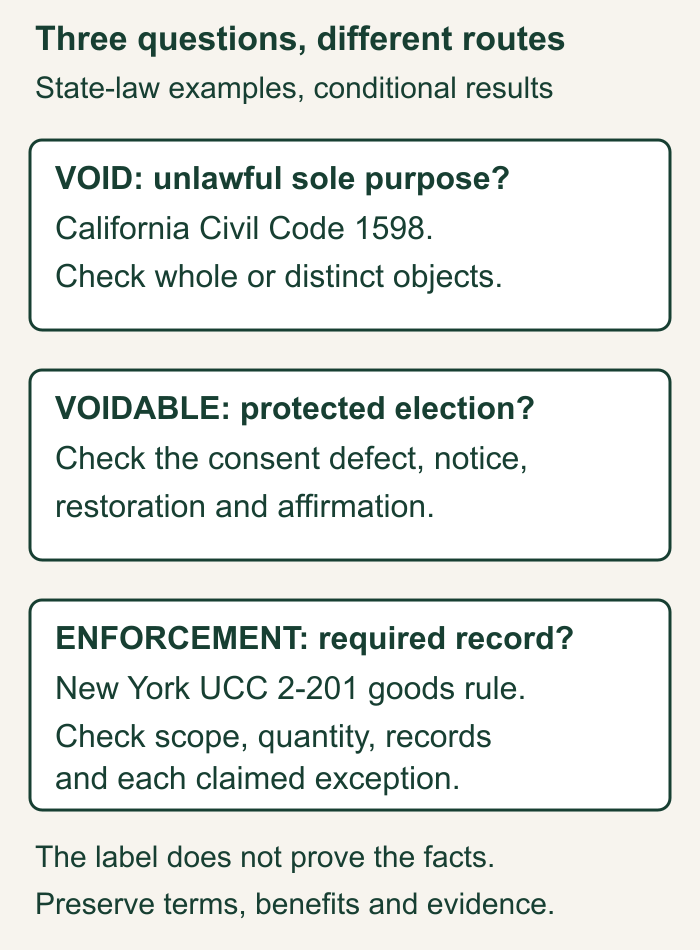
A void contract has no legal force as the agreement in question; a voidable contract can bind the parties unless the person entitled to avoid it exercises that right. An unenforceable contract raises a different question: whether a court can enforce an otherwise valid bargain. California distinguishes rescindable defective consent from a contract with a single unlawful object. New York's goods statute expressly recognizes agreements that are valid in other respects but lack the required record. California defective-consent rule California single-object rule New York goods record requirement
The practical question is therefore: what defect occurred, which law governs, who can invoke it, and what happens to performance and benefits already exchanged? This guide uses California law for consent, capacity and rescission, and New York's enacted Uniform Commercial Code for two goods examples. These are state examples, not a rule for every US jurisdiction or a guide to England, Wales or India.
First check whether an agreement was formed using the four elements of a contract. Then separate the defect from the remedy. A disputed label alone does not establish a right to retain property, stop payment or obtain damages.
Void, voidable and unenforceable: a comparison
| Question | Void | Voidable | Unenforceable |
|---|---|---|---|
| What is wrong? | A defect prevents the agreement from having legal force, such as a single unlawful object under California law. | A protected party has grounds to avoid an agreement, such as qualifying fraud inducing consent. | A rule restricts enforcement, such as a missing required record for a goods sale. |
| What must be established? | The defect and its effect on the whole agreement or a particular term. | The ground, entitlement to avoid, and applicable steps and defenses. | The rule's coverage, the records available and any exception. |
| Can later conduct matter? | A signature cannot make an unlawful sole purpose lawful; lawful distinct objects may be severable. | Subsequent valid consent may ratify a contract voidable solely for lack of due consent. | A sufficient record or statutory exception can change the enforcement analysis. |
| What about exchanged benefits? | Identify any surviving lawful obligation or separate restitution issue. | Rescission requires an analysis of restoration and available relief. | A defense to enforcement is not automatically a refund or title ruling. |
Authorities for this comparison: California single-object rule, California distinct-objects rule, California defective-consent rule, California consent ratification rule, California notice and restoration rule, New York goods record requirement.
What makes a contract void?
Illegal purpose, public policy and severability
California Civil Code section 1598 makes the entire contract void where its single object is unlawful, wholly impossible to perform or wholly unascertainable. Section 1599 separately addresses several distinct objects, preserving lawful ones while treating unlawful ones as void. Assess the actual transaction rather than treating any problematic clause as fatal to every obligation. California single-object rule California distinct-objects rule
Fictional example: an agreement's sole purpose is payment for the willful and malicious burning of a competitor's warehouse. California's arson statute covers procuring such burning. On those stated facts, the promised purpose is unlawful, and section 1598 supplies the contract consequence. Signatures and an approval workflow cannot make that purpose lawful. This example does not decide whether any money already transferred is recoverable. California arson statute California single-object rule
Actual case: Marathon Entertainment, Inc. v. Blasi (California Supreme Court, 2008). A personal manager claimed unpaid commissions; the artist challenged unlicensed procurement of employment under the Talent Agencies Act. The court held that the Act applied to managers, but that the Labor Commissioner could use severability to partially enforce a management agreement. A factual dispute prevented treating the entire agreement as automatically invalid. The case was remanded; the Supreme Court did not award the disputed commissions. Its lesson is that the regulatory rule, lawful services and separability matter. Marathon opinion, reproduced by FindLaw
A severability clause can help state the parties' intended treatment of defective terms. The result still depends on the law and facts; the clause does not guarantee that a court will preserve the deal.
Lack of assent can differ from misleading inducement
Actual case: Rosenthal v. Great Western Financial Securities Corp. (California Supreme Court, 1996). Investors challenging brokerage arbitration agreements alleged misleading representations about investments and the documents they signed. The court distinguished fraud in execution, which can negate assent, from fraud inducing an agreement that the signer understands. Most plaintiffs' evidence was insufficient to establish the former; a smaller group required further fact finding. Crucially, a reasonable opportunity to learn the document's character and terms mattered. A claim that someone was deceived therefore does not, by itself, establish that no contract ever existed. Rosenthal opinion, reproduced by OpenJurist
What makes a contract voidable?
California's rescission statute provides grounds including consent given by mistake or obtained through qualifying duress, menace, fraud or undue influence connected to the party against whom rescission is sought. Lack of free consent is not automatically absolute nullity. Establish the relevant ground, its factual elements and who is entitled to invoke it. California rescission grounds California defective-consent rule
- Fraud or misrepresentation: for intentional misrepresentation, California's current contract instruction examines an untrue representation, the speaker's knowledge, intent to induce agreement, reasonable reliance and whether the party would have contracted if it knew the truth. A later disappointment alone does not establish these facts. 2026 California contract jury instructions
- Mistake: materiality matters. California instructions distinguish a shared mistake from a unilateral mistake, including the other party's knowledge and exploitation and excessive carelessness. An assumed uncertainty can instead be part of the bargain. 2026 California contract jury instructions
- Duress: the economic duress instruction requires wrongful pressure, no reasonable alternative for a reasonable person in that position, and induced consent. Ordinary commercial difficulty does not establish the defense. 2026 California contract jury instructions
- Undue influence: the instruction examines misuse of trust, weakness of mind, needs or distress to obtain consent that otherwise would not have been given. 2026 California contract jury instructions
Actual case: Rich & Whillock, Inc. v. Ashton Development, Inc. (California Court of Appeal, 1984). A contractor faced an unpaid final bill of $72,286.45. The debtor offered $50,000 or nothing, knowing that nonpayment threatened the contractor with financial ruin. The trial court found bad faith and economic duress in the compromise and release. The appellate court affirmed the $22,286.45 balance award. The result depended on the acknowledged debt, wrongful withholding, vulnerability and lack of a reasonable alternative. It does not make every pressured settlement voidable. Rich and Whillock opinion, reproduced by Neochart
Minors and mental capacity require different questions
California permits a minor to disaffirm a contract before majority or within a reasonable time afterwards, except as otherwise provided by statute. One exception requires all statutory conditions for necessary support: reasonable value, actual provision and a minor outside the care of a parent or guardian able to provide that support. It is inaccurate to say every minor's contract is void or every purchase called a necessity is protected from disaffirmance. California minor disaffirmance rule California necessary-support exception
California also distinguishes a person entirely without understanding, who lacks power to contract but may owe the reasonable value of necessary support, from a person of unsound mind who is not entirely without understanding and contracts before judicial determination of incapacity. The latter contract is subject to rescission. The statute rejects proof based solely on isolated negligence or improvidence. Identify capacity at the relevant time and the legal test; age, diagnosis or a bad decision alone is not a classification. California entire-incapacity rule California rescindable-incapacity rule
An unauthorized signature is not automatically a voidable deal
Investigate the principal's authorization, representations to the counterparty and later conduct. California recognizes prior authorization and subsequent ratification; ostensible authority concerns what the principal causes or allows a third person to believe. Ratification has its own form and knowledge requirements. A signer exceeding an internal spending limit does not by itself decide the principal's external obligations. California agency authority rule California agency ratification rule California ostensible-authority rule
Unenforceable does not necessarily mean void
For New York goods sales priced at $500 or more, the enacted UCC generally requires a sufficient record signed by the party against whom enforcement is sought. Quantity limits enforcement under that rule. Merchant confirmations and the statutory exceptions for special manufacture, an in-court admission, or accepted payment or goods require separate checks. The statute describes noncompliant agreements that are otherwise valid. New York goods record requirement
Fictional example: two businesses orally agree on 320 ordinary brackets at $5 each, a $1,600 price. Assume formation is proven but there is no sufficient record, qualifying merchant confirmation, accepted payment or goods, in-court admission or special manufacture. On these assumptions, the writing defense is the issue. The deal's purpose is lawful; the record problem does not turn it into the warehouse example. If 80 brackets were received and accepted, the exception could change enforcement for those goods, without resolving the rest automatically. New York goods record requirement
Use the statute of frauds guide for records, exceptions and other contract categories. A missing signature is a question about a particular rule, not proof that all oral contracts are void.
Rescission, restoration and affirmation
Rescission unwinds an agreement on an available ground. It differs from using an agreed termination clause to end future obligations, asserting a breach claim, or negotiating a replacement. California's grounds also include specified failures of consideration, so a formation defect is not the only possible basis. Match the requested result to the legal route. California rescission grounds
For California rescission, section 1691 requires prompt notice and restoration, or a qualifying offer to restore, subject to its conditions and section 1693. The promptness trigger includes discovery of the facts, freedom from specified pressure or disability, and awareness of the right. A pleading seeking rescission can serve as notice or offer. Section 1693 addresses substantial prejudice from delay and allows a court to condition judgment on restoration. There is no universal fixed number of days in these provisions. California notice and restoration rule California delay and prejudice rule
Relief is not limited to simply returning the original price. Section 1692 addresses restitution, consequential damages to which a party is entitled and equitable adjustments, while barring duplicate or inconsistent recovery. Track use, deterioration, services and benefits on both sides. A disputed refund amount requires an analysis; it is not settled merely by writing that the contract is voidable. California rescission relief
Actual case: Village Northridge Homeowners Association v. State Farm (California Supreme Court, 2010). After settling an earthquake insurance claim and releasing disputed claims for an additional $1.5 million, the insured alleged misrepresentation of policy limits. It wanted to keep the payment, affirm the settlement and sue despite the release. The court rejected that approach in this setting and required the rescission route, while recognizing statutory flexibility over delayed restoration. It reversed and remanded. Do not treat a general option to affirm an ordinary fraudulently induced purchase as permission to ignore a release that was the purpose of a settlement. Village Northridge opinion, reproduced by Justia
Affirmation risk: a California contract voidable solely for lack of due consent may be ratified by subsequent consent. The current fraud instruction also recognizes that knowingly manifesting an intention to affirm can lose the right to avoid. Before renewing, amending or accepting further benefits after discovering a defect, record the knowledge and intended election. Loss of avoidance does not automatically decide every separate damages claim. California consent ratification rule 2026 California contract jury instructions
A completed fictional decision record
Vale Workshop LLC signs a California equipment purchase with Summit Bench Tools LLC for a cutter represented as new. The price is $6,000; a $1,500 deposit leaves $4,500 unpaid. Delivery occurs on October 3, 2026. On October 5, Vale finds a refurbishment sheet carrying the cutter's serial number VT208. These names and events are invented.
The sheet alone is a disputed fact, not a legal finding. For this teaching branch only, assume authentication, the seller's knowledge, reasonable inducement and the applicable rescission ground can be established. Vale understood it was signing an equipment purchase; the issue is alleged inducement, rather than an assumption that its assent never existed.
| Date | Event and evidence | Decision status |
|---|---|---|
| October 1 | Signed purchase record describes a new cutter; bank receipt records the $1,500 deposit. | Original transaction preserved. |
| October 3 | Delivery receipt and serial photograph identify VT208; Vale records no production use. | Return condition documented, not an agreed valuation. |
| October 5 | Refurbishment sheet found; its source and seller knowledge are still to be checked. | Potential ground logged; no final election made. |
| October 6 | Vale prepares a proposal to return the cutter against repayment of the deposit and cancellation of the unpaid balance. | Proposal for counsel review; not sent, accepted or adjudicated. |
The proposed unwind is internally consistent: seller receives the cutter back, buyer receives the $1,500 it paid, and the $4,500 future balance is addressed. The buyer has not paid $6,000 and has no assumed right to a $6,000 cash refund. Collection costs, use adjustments, shipping, taxes and any damages remain uncalculated. No withholding instruction or guaranteed outcome follows from the teaching assumptions. California's notice, restoration and relief provisions govern the legal review. California notice and restoration rule California rescission relief
An alternative would be seeking to retain the cutter while pursuing a legally available damages route. That is a different election and requires its own valuation and proof. The decision record should show which result the buyer wants, not mix a full unwind with retention of the machine.
Copyable evidence checklist, completed for this example
FILE: Vale Workshop / Summit Bench Tools / VT208
Governing law used for this exercise: California
Signed record: October 1, 2026, new cutter, $6,000
Money paid: $1,500 deposit, bank receipt retained
Unpaid price: $6,000 minus $1,500 = $4,500
Benefits received: cutter VT208, photographed at delivery
Discovery: October 5, refurbishment sheet
Fact checks open: authenticity, date, seller knowledge, reliance
Ground under review: qualifying fraud inducing consent
Desired branch: rescission, subject to proof and applicable defenses
Restoration proposal: return VT208 against $1,500 repayment
Future obligation to address: cancellation of $4,500 balance
Condition/use: no production use recorded in the fictional facts
Notice/election: counsel review pending; no notice sent
Post-discovery conduct: no renewal or amendment assumed
Third-party title/security interests: not verified
Adjustments/damages: not valued or agreed
Owner: Vale's designated contract reviewer
Next action: verify the evidence and election before sending notice
Status: proposed route, no legal finding and no agreed refund
Attach the complete contract, representations, messages, payment ledger and photographs to a lawyer review packet. Store originals and the decision record in the contract repository, with access restricted to the appropriate reviewers. Keep factual assertions separate from assumptions and from legal conclusions.
Business checks before signing, renewing or unwinding
- Identify the governing law, transaction category and protected party. Record the relevant capacity and authority evidence.
- Validate representations about condition, licenses and approvals against documents rather than leaving an unsupported assurance in negotiations.
- Preserve the final agreed version and execution record. For goods, retain quantity, confirmation and acceptance evidence.
- Give reviewers a visible path to question misleading statements, coercion or excessive pressure.
- When a defect is discovered, log the discovery date, knowledge, exchanged benefits and all later renewals, amendments and performance.
- Distinguish preservation, an interim operational arrangement, a formal election and an agreed release. Refer disputed choices to the responsible legal reviewer.
- Evaluate severability and the restoration ledger before promising that every obligation disappears or every payment is refundable.
Third-party goods risk: New York UCC section 2-403 allows a person with voidable title to pass good title to a good-faith purchaser for value in specified purchase transactions. Entrustment to a merchant dealing in that kind of goods has a separate rule. A contractual fraud dispute therefore does not necessarily permit recovery of the goods from every later buyer. Verify title, delivery, transfers and secured interests before treating an unwind as simple repossession. New York goods title rules
Frequently asked questions
What does void ab initio mean?
It means void from the beginning. California's single unlawful object rule is an example; it does not make every dispute over a term invalidate the entire agreement. California single-object rule California distinct-objects rule
Who can cancel a voidable contract?
The person with the relevant avoidance right must establish the applicable ground. Under California's consent rule, the analysis is rescission, not a cancellation option automatically available to the party responsible for the defect. California defective-consent rule California rescission grounds
Is every contract signed by a minor void?
No. California provides disaffirmance before majority or within a reasonable time afterwards, with statutory exceptions including carefully defined necessary support. Check the actual exception and facts. California minor disaffirmance rule California necessary-support exception
Can a voidable contract be ratified?
Yes in the relevant circumstances. California expressly permits subsequent consent to ratify an agreement voidable solely for lack of due consent. Knowledge and post-discovery conduct need review before assuming a renewal preserves avoidance rights. California consent ratification rule
Does missing a signature make an oral contract void?
No automatic rule follows. New York's goods writing requirement concerns enforcement of a covered sale and contains exceptions. Coverage, sufficient records and actual performance matter. New York goods record requirement
Does rescission always mean an immediate full refund?
No. California's statutes address notice, restoration, prejudice from delay and equitable adjustments. Damages must be legally available and cannot duplicate or conflict with other recovery. California notice and restoration rule California delay and prejudice rule California rescission relief
Is an adhesion contract automatically void?
Identify the legal defect rather than relying on the standard form label. California's unconscionability statute permits refusal of enforcement, enforcement of the remainder or limitation of a clause, depending on the court's determination. See the adhesion contract guide for the fuller assessment. California unconscionability remedies
Can an amendment make an illegal deal lawful?
An approval or new signature does not change an unlawful sole purpose. Separability of lawful obligations is a different question; Marathon illustrates the need to examine the regulatory context and actual services. California single-object rule Marathon opinion, reproduced by FindLaw
Does breaking a contract make it void?
Breach, avoidance and excuse are different questions. California recognizes specified failures of consideration as rescission grounds and separately addresses excuses for prevented or delayed performance. Neither provision makes every missed obligation proof that the agreement was void at signing. Use what happens if you break a contract to investigate the breach route. California rescission grounds California performance-excuse statute
Which category is riskier for a business?
The answer depends on exposure. Compare paid sums, property transfers, continuing commitments, discovery dates, evidence quality and the available legal route. The label alone does not measure the loss. The completed record above makes those questions visible.
Sources
Statutes were inspected on their official current pages on October 6, 2026. The Judicial Council document is the 2026 CACI edition. The four cases below are court opinions reproduced by the named hosts; they are primary decisions, not those hosts' summaries. No citator clearance or lawyer review is claimed.
- California Civil Code section 1566, defective consent
- California Civil Code section 1598, single-object invalidity
- California Civil Code section 1599, distinct objects
- California Civil Code section 1588, subsequent consent
- California Civil Code section 1689, rescission grounds
- California Civil Code section 1691, notice and restoration
- California Civil Code section 1692, rescission relief
- California Civil Code section 1693, delay and prejudice
- California Civil Code section 38, entire lack of understanding
- California Civil Code section 39, rescindable incapacity
- California Family Code section 6710, minor disaffirmance
- California Family Code section 6712, necessary support exception
- California Penal Code section 451, arson and procurement
- California Civil Code section 1670.5, unconscionability remedies
- California Civil Code section 2307, authority
- California Civil Code section 2310, agency ratification
- California Civil Code section 2317, ostensible authority
- California Civil Code section 1511, prevention of performance
- Judicial Council of California, 2026 CACI, instructions 330 to 335
- Rosenthal v. Great Western Financial Securities Corp., 14 Cal.4th 394 (1996), opinion reproduced by OpenJurist
- Village Northridge Homeowners Association v. State Farm, 50 Cal.4th 913 (2010), opinion reproduced by Justia
- Rich and Whillock v. Ashton Development, 157 Cal.App.3d 1154 (1984), opinion reproduced by Neochart from Caselaw Access Project
- Marathon Entertainment v. Blasi, 42 Cal.4th 974 (2008), opinion reproduced by FindLaw
- New York UCC section 2-201, goods records and exceptions
- New York UCC section 2-403, title and entrustment
Prepared by the Viaclause editorial team. General information. All business examples and worksheets here are fictional. The banner is an AI-generated illustration of a fictional business setting.