

Contract Rescission: Undoing an Agreement and Returning Value
By Anirudh Menon, Viaclause editor
Understand contract rescission with a California example, notice and restoration checks, a deposit ledger and the limits of three-day cancellation rights.
Contract rescission is the unwinding of an agreement, with restoration of exchanged value as the applicable law requires. It can follow an established legal ground or an agreement between the parties. It is different from simply stopping future work: identify the ground, act within the applicable timing rules, address notice and restoration, and record what each party must return.
This guide uses California law for a fictional business purchase, then distinguishes specific federal consumer rules, England and Wales, and India. Begin with the contract elements: a dispute about formation, a breach and a request to undo a deal can require different remedies.
Rescission, termination and cancellation
| Route | Purpose | Questions to resolve |
|---|---|---|
| Rescission | Unwind the transaction. | Ground or consent, notice, exchanged money and benefits, restoration, adjustments and other interests. |
| Termination | End future performance under an available right. | Trigger, effective date, accrued rights and surviving duties. |
| Cancellation | A word whose legal meaning depends on the rule being used. | Is this an Article 2 breach remedy, a consumer cancellation right, an agreed exit or rescission? |
| Damages | Compensate legally recoverable loss. | Entitlement, causation, measure and evidence, without counting the same loss twice. |
California Civil Code section 1688 states that rescission extinguishes a contract. California's goods law separately defines termination as ending the contract under an agreement or legal power otherwise than for breach; accrued rights survive. Article 2 cancellation is an end for the other party's breach and preserves the stated breach remedies. These enacted definitions are not a universal meaning for every cancellation clause. Civil Code section 1688; Commercial Code section 2106.
For an agreed prospective exit, compare termination for convenience. For the wider dispute, see what happens if you break a contract. Neither an exit label nor a stop-work email establishes a right to recover all past payments.
What grounds can support rescission?
California section 1689 permits rescission by all parties' consent. Its unilateral grounds include qualifying mistake, duress, menace, fraud or undue influence; particular failures of consideration; specified unlawful contracts with unequal fault; public-interest grounds; and other statutory rights. The responsible-party and other conditions in the actual provision matter. California grounds for rescission.
- Consent defect: What caused the person to agree, and who was responsible?
- Failure of consideration: What promised value failed, when, to what extent, and through whose fault? The statute distinguishes partial failure through the other party's fault, consideration becoming entirely void, and material failure before receipt.
- Mutual agreement: Do all parties consent to a complete unwind?
- Special statutory right: Does this transaction actually meet its coverage and procedure?
A minor performance problem, a later price change or disappointment with the bargain is not automatically a right to undo it. Record the proposed ground and its supporting facts separately from what the other party admits. Capacity, illegality and other specialist grounds require their own applicable law; do not infer that every defective contract can be rescued by a standard rescission letter.
Fraud, misrepresentation and an unfulfilled promise
California's actual-fraud definition covers specified false assertions, suppression, a promise made without an intention to perform, and other deceptive acts, with the stated intent to deceive or induce contracting. A later failure to deliver is not by itself proof that a promise was dishonest when made. Preserve what was said, by whom, when, the information available, what was omitted and how it affected the decision. Civil Code section 1572.
The California Supreme Court distinguishes fraud in execution, where the person does not know what they are signing and mutual assent is absent, from fraud inducing a known agreement, which ordinarily makes it voidable. That distinction affects whether rescission is needed. Village Northridge, discussion of execution and inducement. Keep the broader categories clear with void versus voidable contracts.
Mistake: a real case rather than buyer's remorse
In Donovan v. RRL Corp., 26 Cal.4th 261 (2001), an advertisement mistakenly listed a Jaguar at $25,995 rather than $37,995. The California Supreme Court found a contract but allowed rescission on the facts. For a unilateral factual mistake not caused or known by the other party, the majority required a basic-assumption mistake, materially adverse effect, no allocation of the risk to the mistaken party, and unconscionable enforcement. Ordinary negligence was not automatically disqualifying. The dissent disputed the procedural grant of relief. This is not a rule that every pricing error excuses performance. Donovan, pages 278 to 296.
For a buyer alleging a mistaken product description, preserve the agreed specification, the actual item, both parties' understanding and any allocation of risk. If the description is a contractual term, a warranty or breach remedy may also need assessment. Do not collapse those questions into a finding of fraud.
Notice, restoration and court relief in California
Subject to section 1693, section 1691 requires prompt notice and restoration, or an offer on a reciprocal condition, upon discovery of the facts, awareness of the right and freedom from the listed constraints. Its inability or positive-refusal qualification must be read in context. Service of a pleading seeking rescission-based relief can supply otherwise omitted notice or offer. This does not make a disputed demand self-proving. California notice and restoration rule.
There is no fixed number of days in that general promptness rule. Section 1693 addresses delayed notice and delayed restoration in an action or proceeding: the specified substantial prejudice matters, and restoration may become a condition of judgment. This timing flexibility is not permission to wait or a substitute for limitation-period analysis. Delay and substantial prejudice.
For California court claims, Code of Civil Procedure section 337(c) specifies four years for an action based on rescission of a written contract, ordinarily from the relevant facts, with its fraud-or-mistake discovery qualification. Section 338(d) separately specifies three years for relief on the ground of fraud or mistake with its discovery rule. Identify the actual cause of action, applicable provision, accrual and any tolling; these are not interchangeable deadlines or time allowed to postpone notice. Written-contract rescission limitation; Fraud-or-mistake limitation.
Use the notice method and evidence checklist to preserve recipient, contents, permitted methods, delivery and receipt. A contract's termination notice may not address rescission or a special statutory right. A request to discuss a refund may also communicate something different from a clear election to rescind.
Is rescission always a court order?
California's history is useful here. Runyan v. Pacific Air Industries explains that the 1961 reforms replaced the former dual procedures for enforcing a party's rescission and obtaining judicial rescission with the statutory rescission-relief scheme. Its older legal-versus-equitable discussion should not be treated as two untouched modern California pathways. Runyan, pages 311 to 314.
Current section 1692 permits rescission-based relief through an action, defense or cross-complaint, and other entitled relief if the court finds rescission was not effected. It permits restitution and consequential damages to which the party is entitled, bars duplicate or inconsistent recovery, and allows compensation and adjustment of equities. A court may be needed to resolve disputed grounds and enforce the return of value. Current rescission-relief provision.
Worked example: discovery, notice and restoration
All names, documents, dates and outcomes in this example are fictional. Cedar Workshop buys a bench instrument from Vale Equipment under a California agreement dated October 7, 2026. Assume the signed schedule promises manufacture in 2026, no other document qualifies that description, the price is $12,000, and no lender, resale or security interest exists. Cedar pays $7,200 on October 8; $4,800 remains unpaid. Delivery occurs October 9, followed by four hours of trial use.
On October 12 Cedar receives a manufacturer record identifying manufacture in 2016 for the delivered serial number. Cedar preserves the schedule, record, photographs and payment receipt, stops further trial use and records its reasons. Supplier knowledge, the legal ground and the validity of rescission remain disputed. The mismatch does not prove fraud, and the schedule might support other remedies.
For the notice demonstration only, assume Cedar's authorized reviewer decides to assert factual mistake as a claimed ground under section 1689(b)(1) and approves a reciprocal restoration offer on October 12. This is an assumption about a fictional decision, not observed advice or a recommendation to send this wording in an actual dispute.
FICTIONAL COMPLETED NOTICE EXAMPLE
Date: October 12, 2026
From: Cedar Workshop, authorized buyer representative Maya Reed
To: Vale Equipment, contracts representative Owen Blake
Agreement: October 7 bench instrument sale, schedule CW-07
Instrument: serial CW-271, instrument and listed accessories

Cedar gives notice that it rescinds the agreement on the alleged
ground of factual mistake about the manufacture year described
in the signed schedule, under Civil Code section 1689(b)(1).
The schedule states 2026; the attached manufacturer record for
this serial number states 2016. This ground remains disputed.

Cedar offers to restore the instrument and listed accessories,
conditional on reciprocal restoration of its 7200 USD payment.
The instrument remains available in recorded condition. Four
hours of trial use are disclosed; use and costs need accounting.
Cedar requests confirmation of collection and refund arrangements
and the treatment of the unpaid 4800 USD balance.

Attachments: signed schedule, manufacturer record, photographs,
accessory list, payment receipt and trial-use log.
Delivery record: approved contract delivery method, dispatch copy,
recipient and receipt evidence retained in the fictional file.
Status: asserted notice; entitlement and adjustments unresolved.
This example names the agreement, alleged ground, evidence and exchanged value. Its logistics request is not a new statutory deadline. The record must show the actual notice and restoration steps; a completed draft does not prove delivery, authority, entitlement or agreement on adjustments.
| Date | Fictional event | What it establishes |
|---|---|---|
| October 7 | Agreement and schedule signed. | Terms and identities to inspect. |
| October 8 | $7,200 payment. | Paid value, not the full price. |
| October 9 | Delivery and trial. | Possession, condition and use to account for. |
| October 12 | Record received; assumed authorized notice and offer. | Discovery and response evidence, not a ruling on promptness. |
| October 14 | Assumed mutual unwind signed. | Agreed terms, with completion still pending. |
| October 15 | Assumed agreed exchange completed. | Return, payment and release records to verify. |
Complete the value ledger before demanding a refund
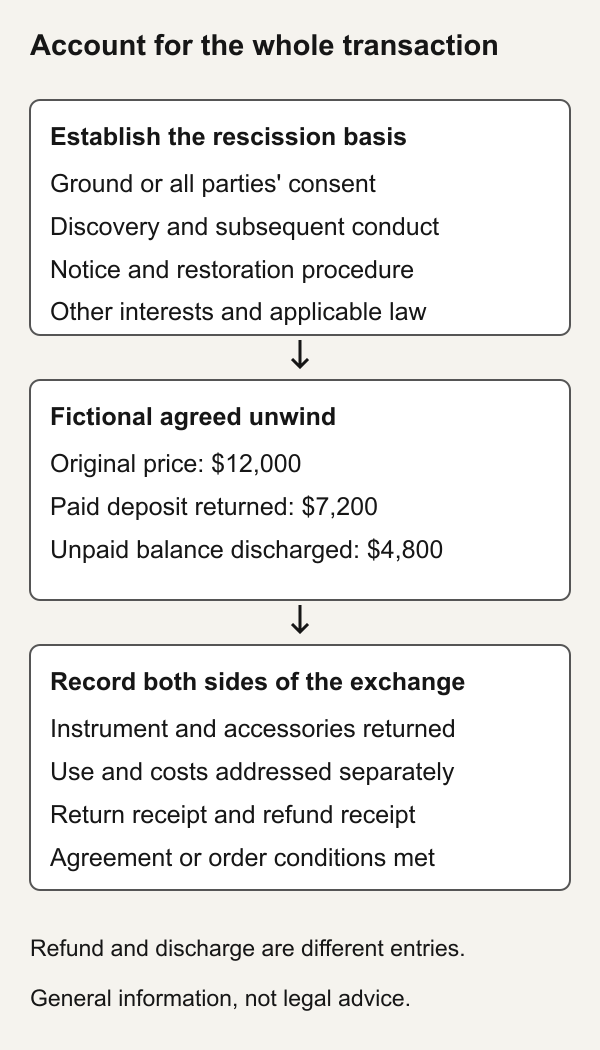
Now assume, as a separate negotiated alternative, that both parties sign a mutual unwind on October 14 without admitting fraud. They agree to return the identified property on October 15, refund the $7,200 deposit, discharge the unpaid $4,800, and make no adjustment for trial use or costs. Those are fictional settlement terms, not the result of the unilateral notice or a predicted award.
COMPLETED AGREED UNWIND RECORD, FICTIONAL
Original price: 12000 USD = 7200 paid + 4800 unpaid
Mutual agreement signed: October 14, 2026 by authorized parties
Property: instrument CW-271, accessories listed in schedule
Condition: recorded photographs and four-hour trial-use log
Return: Vale collects October 15; signs item and condition receipt
Refund: 7200 USD transferred October 15; Cedar confirms cleared funds
Unpaid balance: 4800 USD expressly discharged on completed exchange
Use and costs: no additional adjustment, expressly agreed
Collection expense and transit risk: Vale bears both after pickup
Release: mutual release of claims arising from this sale, effective
only after return, cleared refund and written balance discharge;
obligations under the unwind agreement remain enforceable
If exchange fails: release and balance discharge do not take effect;
parties retain disputed positions and pursue available remedies
Completion: October 15 return receipt, refund confirmation and
balance-discharge record attached in this hypothetical scenario
Case status: agreed resolution; no fraud finding or court judgment
The cash refund is $7,200, not $12,000. The other $4,800 is an unpaid duty discharged on the agreed conditions, not additional money returned. A proposal's signature and its completion are different events. State who bears collection costs and risk, what release covers, and what happens if return or refund fails.
If the instrument has been damaged, consumed, pledged or resold, replace the example's assumptions with evidence. Do not invent an hourly use charge, depreciation percentage or entitlement to freight. Record each claimed adjustment, its basis and whether agreed, disputed or ordered. A lender's interest cannot be erased merely by Cedar and Vale signing a private ledger.
Used benefits, damages and release agreements
In Runyan, a franchisee recovered the $25,000 franchise fee and net consequential relief after failure of consideration. The court accounted for received benefits and earnings rather than simply adding every expense to the refund. It distinguished fault-based grounds from mere mistake or illegality; it did not make consequential damages automatic in every rescission. Runyan, pages 314 to 319.
Keep refund, benefit adjustment and separately recoverable loss in different rows. A shipping receipt proves an expense occurred; it does not by itself prove the seller owes it. The actual damages calculation explains evidence and causation. A rescission analysis needs its own applicable measure.
In Village Northridge, 50 Cal.4th 913 (2010), an insured sought to retain an additional $1.5 million settlement, affirm its release and sue on released claims. The California Supreme Court required compliance with rescission rules, recognizing possible delayed restoration under section 1693. This disputed-claim release decision does not abolish every distinct fraud-damages route. Village Northridge, restoration and release analysis.
What can defeat or complicate rescission?
- Insufficient ground: Allegation, suspicion and a proved basis are different.
- Affirmation: Examine later consent, performance, renegotiation and acceptance of benefits with knowledge of the problem.
- Timing: Record discovery, awareness, notice, delivery, prejudice and the applicable claim deadline.
- Restoration: Account for property, money, consumed benefits and proposed adjustments.
- Other people's rights: Identify title holders, lenders, assignees and buyers.
- Release or settlement: Read what was surrendered, received and preserved.
California section 1588 permits subsequent consent to ratify an agreement voidable solely for want of due consent. Continued use is a fact to examine, rather than an automatic conclusion in every case. Preserve reasons for protective or necessary conduct. Subsequent consent and ratification.
Third-party protections depend on the transaction. California section 1689.9, for example, limits the specified home-solicitation cancellation right for affixed goods after a sale or encumbrance to a qualifying bona fide purchaser or encumbrancer. It is not a general rule for every business instrument sale. Specific affixed-goods consumer rule.
Three-day rights: coverage comes before the calendar
There is no universal three-day right to rescind every contract. The FTC guide identifies particular sales at homes, workplaces or temporary locations and exclusions, including entirely online, mail or telephone sales. The business instrument example does not acquire a consumer cancellation right merely because it involves a signed purchase. FTC coverage guide.
The FTC Cooling-Off Rule
The enacted rule covers defined door-to-door consumer transactions with the specified $25 home and $130 other-location thresholds and exclusions. Training courses have a special inclusion. Its business-day definition excludes Sundays and federal holidays, so Saturday can count. 16 CFR 429.0 definitions.
For a covered sale, the rule supplies the third-business-day cancellation window and written-notice procedures. It requires duplicate notices, oral explanation and seller actions, including refund within ten business days after receipt of valid cancellation. The notice also addresses making goods available and the twenty-day collection consequence. These special procedures are not California's general rescission clock. 16 CFR 429.1 cancellation procedure.
Completed timing illustration: Assume a covered sale occurs Friday, October 16, 2026 and no federal holiday falls within the counting period. Saturday October 17 is day one, Sunday October 18 is excluded, Monday October 19 is day two and Tuesday October 20 is day three. The covered cancellation window ends at midnight Tuesday. Preserve the appropriate timely mailing or delivery evidence; do not reuse this calendar for a different statutory right. FTC counting and notice examples.
Certain consumer credit secured by a principal dwelling
TILA creates a separate right for covered consumer credit secured by the principal dwelling, with specified exceptions including a residential purchase-money mortgage transaction. Its ordinary clock depends on consummation and delivery of the required information and forms, whichever is later; special extended-right and expiry rules have their own conditions. It is not a business purchase or general loan cancellation rule. 15 USC 1635; CFPB timing guide.
Regulation Z requires written exercise of a covered right and distinguishes mailing from other delivery. Missing required notice or material disclosures can extend the period, but earlier sale or transfer and the specified three-year limit matter. Its default restoration sequence requires creditor action within twenty calendar days after receipt, followed by consumer tender; courts may modify that procedure. Disputes about entitlement and amounts still require resolution. Do not read rescission as a free loan. Current Regulation Z 1026.23 and official interpretation.
England and Wales and India: separate legal routes
England and Wales: Under Misrepresentation Act 1967 section 1, performance of the contract or making the misrepresentation a term does not alone remove an otherwise available rescission right. Section 2(2) permits damages instead of rescission for a qualifying non-fraudulent misrepresentation when the statutory and equitable conditions are satisfied. This is a separate regime, not California's notice and restoration procedure. The official consolidated page flags an unapplied change to section 2(4); this explanation relies on sections 1 and 2(2), not that consumer-redress provision. Misrepresentation Act 1967.
India: Contract Act section 19 makes qualifying coercion, fraud or misrepresentation cases voidable, with causation and its stated ordinary-diligence exception. Section 19A separately addresses undue influence and just conditions. Section 64 requires restoration, so far as may be, of received benefits on rescission of a voidable contract; section 65 addresses advantage under agreements discovered void or contracts becoming void. Section 66 governs communication and revocation by the proposal rules, while section 75 concerns compensation for rightful rescission and non-fulfilment. Their conditions should not be replaced with an imported three-day period. Indian Contract Act, sections 19, 19A and 64 to 75.
Copyable evidence and settlement checklist
RESCISSION REVIEW RECORD
1. Identify agreement, parties, authority and governing-law facts.
2. Separate alleged ground from admitted and proved facts.
3. Preserve statements, omissions, timing and formation evidence.
4. Record discovery, awareness, constraints and subsequent conduct.
5. Identify notice content, recipient, method and delivery proof.
6. Inventory everything received by each party, including use.
7. Separate money paid, unpaid duties and claimed expenses.
8. Record restoration or reciprocal offer and its conditions.
9. Explain changed property, consumed services and disputed values.
10. Check ownership, lenders, resale, assignment and other interests.
11. Review prejudice, limitation periods and special statutory clocks.
12. Distinguish asserted rescission from mutual settlement.
13. Specify exchange, risk, release, effective date and failed exchange.
14. Attach signed agreement, return, cleared payment and discharge proof.
Status choices: alleged / disputed / agreed / ordered / completed.
Do not mark an event completed from a proposed document alone.
At contract formation, preserve the exact product specification and supporting representations; check counterparties and signing authority; retain a consistent change log; and state return logistics and exit rights clearly. These records help detect mismatches and later prove what was agreed. They cannot eliminate fraud or create a statutory rescission right outside its coverage.
Frequently asked questions
Can a signed contract be rescinded?
Signing does not exclude an applicable ground or agreed unwind, or create an automatic cooling-off period. Review the governing transaction and rule. California grounds.
Does a breach always justify rescission?
No. California's failure-of-consideration grounds have distinct fault, extent and timing conditions. An unwind must satisfy the applicable ground. Section 1689.
Can the other party refuse my rescission notice?
It can dispute entitlement and restoration terms. A notice records an asserted election, not a finding that the claim is correct or a guarantee of refund.
Must I restore everything before filing?
California includes qualifying offers and timing flexibility; restoration may be a judgment condition. Account for value, rather than assuming an absolute pre-filing return rule or exemption. Section 1691; section 1693.
Can a completed contract be rescinded?
England and Wales section 1 removes performance as that particular automatic bar; other requirements still matter. Restoration, consumed benefits and other rights need separate review. Misrepresentation Act section 1.
Can I keep using the item after discovering the problem?
Record what you did and why. Later consent may raise ratification questions, while protective handling and discretionary use present different facts. Do not assume a universal safe-use allowance. Section 1588.
Can I claim both a refund and damages?
California permits entitled complete relief without duplicate or inconsistent recovery. Keep refund, received benefits and each claimed loss distinct. Section 1692.
What if I spent the money received under a settlement?
Restoration is not automatically eliminated. Postponement can be available, subject to substantial prejudice and judgment conditions. Affirming a release while suing on released claims is different. Village Northridge.
Can an oral agreement be rescinded?
The general grounds statute is not limited by its text to signed contracts. Establish the underlying agreement, enforceability, ground and evidence; separate limitation and writing questions remain. Section 1689.
Is rescission the same as reformation?
No. California section 3399 permits qualifying revision when fraud or the specified mistake causes a writing not to express the parties' intention, protecting qualifying third-party rights. That differs from unwinding value. California revision provision.
Is there always a three-day deadline?
No. The covered FTC sale and covered consumer-credit rights have separate clocks and exclusions. California's general promptness rule is not a three-day rule, and claim deadlines require separate review.
Does rescission cancel a lender's or buyer's rights?
Do not assume so. Check ownership, security and transfers under applicable law. A private agreement to unwind between two parties does not by itself determine every third party's rights.
Sources
- California Civil Code 1688, extinction by rescission.
- California Commercial Code 2106, goods termination and cancellation definitions.
- Civil Code 1689, grounds and consent.
- Civil Code 1572, actual fraud.
- Civil Code 1691, notice and restoration.
- Civil Code 1692, relief and equity adjustment.
- Civil Code 1693, delay and prejudice.
- Civil Code 1588, ratification.
- Civil Code 1689.9, affixed-goods home-solicitation rule.
- Civil Code 3399, revision of a written contract.
- Code of Civil Procedure 337(c), written-contract rescission limitation.
- Code of Civil Procedure 338(d), fraud-or-mistake limitation.
- Runyan v. Pacific Air Industries, 2 Cal.3d 304 (1970), actual opinion reproduced by Stanford's law library.
- Village Northridge v. State Farm, 50 Cal.4th 913 (2010), actual opinion reproduced by Justia.
- Donovan v. RRL Corp., 26 Cal.4th 261 (2001), actual majority and dissent reproduced by Justia.
- 16 CFR 429.0, FTC rule definitions reproduced by LII.
- 16 CFR 429.1, FTC cancellation procedure reproduced by LII.
- FTC Cooling-Off Rule guide, official practical explanation.
- 15 USC 1635, TILA rescission statute reproduced by LII.
- Regulation Z 1026.23, current official rule and interpretation.
- CFPB rescission timing guide, official consumer explanation.
- Misrepresentation Act 1967, official consolidated text and amendment flags.
- Indian Contract Act 1872, official India Code text.
Prepared with AI assistance; legal sources checked October 6, 2026. General information. Examples, notices, dates and completed records are original fiction and assumptions, not actual claims, advice, tests or outcomes. The retained banner is an AI-generated illustration of fictional people.