

Termination for Convenience Clause: Example, Payment and Handover
By Anirudh Menon, Viaclause editor
Compare termination-for-convenience structures, review a sample clause and worked $6,450 settlement, and check notice, costs, handover and surviving duties.
A termination for convenience clause gives a specified party a contractual way to end an agreement, or defined work under it, without establishing the other party’s breach. The right depends on the actual clause: who may use it, when it becomes available, the notice required, compensation, transition duties and applicable law. It does not mean “cancel immediately and pay nothing.”
For a private service agreement, read the exit right together with the notice, payment, statement-of-work and handover provisions. This guide supplies an original clause for review, three possible structures and a worked settlement. Its legal examples are expressly scoped to a Maryland private subcontract decision and a federal procurement clause.
This article is general information. All sample wording, commercial choices, dates and amounts below are fictional. The banner is an AI-generated illustration.
Convenience, breach and non-renewal answer different questions
A convenience right is designed for an exit without proving breach. A breach-based right instead depends on the relevant contractual or legal grounds, including any required notice and opportunity to cure. Non-renewal usually concerns avoiding another term under the agreed renewal mechanism. Do not use one label as a substitute for checking the right you actually have.
If performance is the issue, see material-breach examples. If you already have a verified exit right and need to communicate it, the termination-letter guide supplies the separate notice structure. A well-written letter does not create a right missing from the agreement.
Compare three private-agreement structures
These are negotiation options, not standard legal requirements or a statement that every option is enforceable in every jurisdiction.
| Illustrative structure | Exit right and timing | Payment design | Handover question |
|---|---|---|---|
| Buyer-only exit | Buyer may end a specified SOW after a defined initial period, with agreed advance notice. | Accepted work, defined work-in-progress costs, approved unavoidable commitments and any agreed fee. | What unfinished work and customer records must be transferred, on what terms? |
| Mutual exit | Either party may end defined work using the agreed notice process. | Separate rules address amounts owed by the buyer and any prepaid but unearned balance. | If the supplier exits, how will the customer maintain continuity? |
| Restricted-window exit | A party may exit only at specified milestones or after a minimum commitment. | Milestone charges or an agreed exit schedule make the cost of each window identifiable. | Which deliverable must be usable at that milestone, and is transition support included? |
These choices allocate business risk. A supplier that spends heavily before the first delivery will examine committed costs and minimum terms. A customer dependent on continuous services will examine supplier exit rights, transition capacity and access to records. A mutual clause with identical notice periods can still have very different operational effects on the two parties.
What the clause should specify
- Holder of the right: buyer, supplier or both, and which named entity may act.
- Scope: the whole agreement, a SOW, a service line or part of the work.
- Availability: any initial period, milestone, minimum commitment or other condition.
- Notice: method, recipient, delivery rule, advance period and effective time.
- Work during notice: what continues, what stops and who may authorize further commitments.
- Compensation: completed work, valuation of incomplete work, unavoidable costs, fees, refunds and credits.
- Transfer: deliverables, data, materials, access and intellectual-property conditions.
- Continuing duties: payment, confidentiality, records, dispute provisions and other specifically surviving terms.
Do not leave “reasonable termination costs” to do all the work. Define evidence, allowable categories, exclusions, credits and the process for resolving disputed amounts. Also identify whether the MSA or SOW controls when their exit terms differ.
Original clause example for discussion
The following fictional buyer-only structure is a drafting aid for a project service SOW. Its 30-day period, six-month initial period, $750 fee and other terms are commercial choices for this example, not legal defaults. Qualified counsel should adapt the wording, its interaction with the rest of the contract and its enforceability.
Termination for convenience

After the initial six-month period stated in this SOW, Customer may terminate this SOW without alleging Supplier breach by giving notice under the Agreement's notice provision at least 30 calendar days before the stated termination effective time.

The notice must identify the SOW, affected work and effective time. Supplier will continue the agreed work through that time unless the parties agree otherwise in writing. After receiving notice, Supplier will avoid new commitments for the terminated work except those Customer authorizes in writing or those necessary for the agreed continuing work.

For a termination under this clause, Customer will pay: (a) fees for completed and accepted work not already paid; (b) documented costs of authorized work in progress that are not included in those fees; (c) approved, unavoidable third-party commitments, net of refunds, resale proceeds and other recovery; (d) separately authorized transition services at the SOW rates; and (e) the agreed $750 termination fee. No category may be counted twice. Unearned advances and other applicable credits will reduce the balance. This clause does not provide fees or profit for unperformed future work.

Supplier will provide the completed deliverables, identified work in progress and Customer records under the transfer, confidentiality and intellectual-property terms of the Agreement. Transition support must be documented with scope, owner, timing and any agreed charge.

The parties will reconcile supported amounts under the Agreement's invoicing and dispute process. Termination does not release accrued obligations or the specifically surviving provisions. This clause does not replace any separately available breach remedy or override applicable law.
The phrase “initial six-month period stated in this SOW” requires a real starting date in the completed SOW. The transfer sentence likewise requires actual transfer and intellectual-property terms elsewhere. Do not copy this clause into a document with those fields missing and call it complete.
Worked example: a $6,450 settlement balance
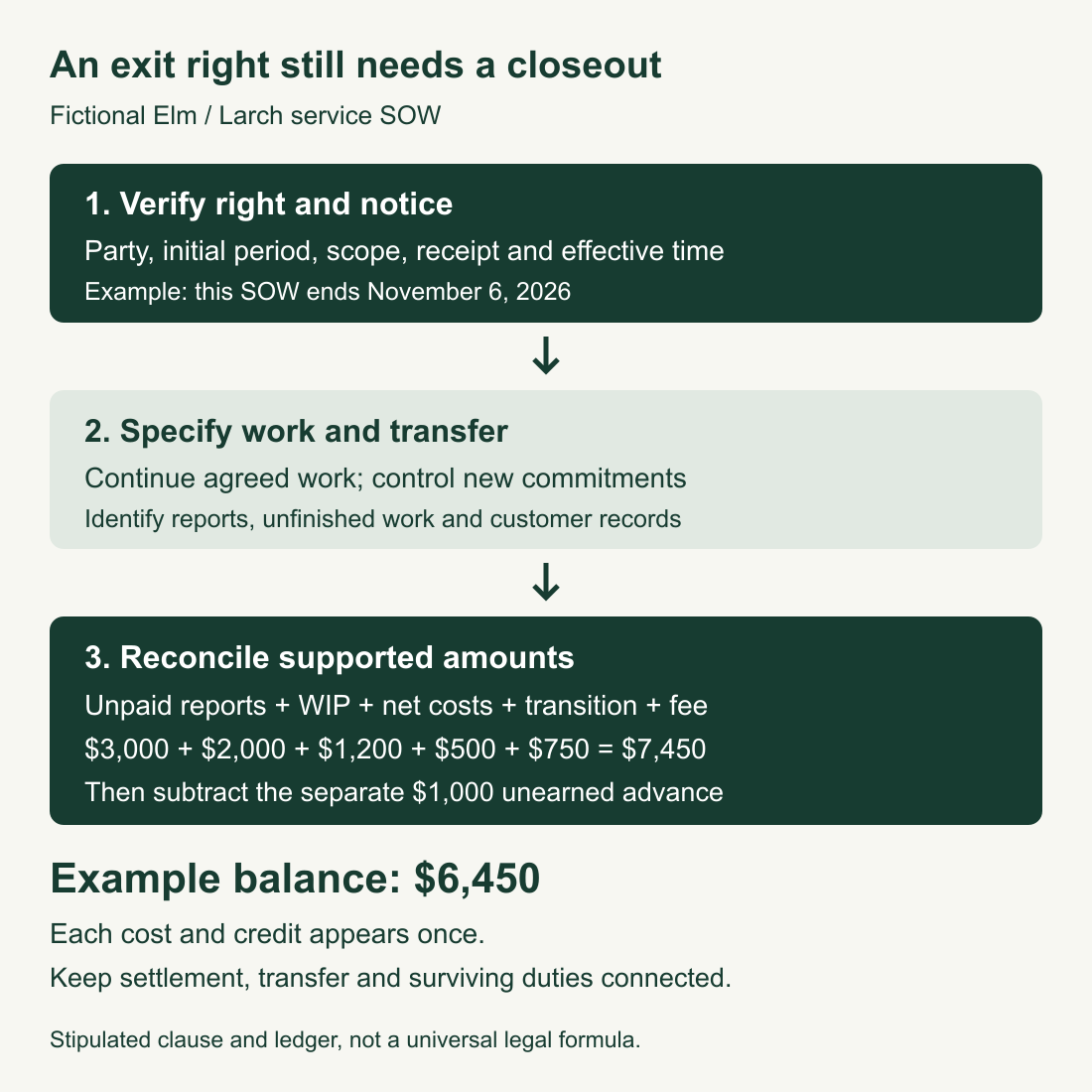
Fictional customer Elm Research LLC hires Larch Reports LLC for 12 project reports at $1,500 each, a total scheduled report price of $18,000. The parties use the illustrative structure above. The initial period has passed, notice is valid under their stipulated delivery and counting rules, and all example amounts below are agreed and supported.
For the completed notice record, assume receipt on October 6, 2026 and termination effective November 6, 2026. These dates provide more than 30 calendar days in this fictional model. In an actual contract, verify receipt, the counting rule and effective time instead of copying the date.
By the effective date, six reports are completed and accepted. Elm has paid $6,000 toward those accepted reports and separately paid a $1,000 advance that remains unearned and unapplied. The supplier also has two authorized reports in progress, an approved third-party commitment and separately authorized transition work.
| Settlement item | Calculation and evidence assumption | Balance impact |
|---|---|---|
| Accepted reports still unpaid | 6 × $1,500 = $9,000; less $6,000 already applied to those reports. | +$3,000 |
| Authorized work in progress | 2 incomplete reports with $1,000 documented cost each; no overlap with accepted-report fees. | +$2,000 |
| Unavoidable third-party commitment | $1,800 approved commitment less $600 recovered from cancellation; no overlap with report costs. | +$1,200 |
| Separately authorized transition | 5 hours × $100; distinct from the reports and third-party commitment. | +$500 |
| Agreed termination fee | The example clause's agreed fee, subject to applicable-law review. | +$750 |
| Unearned advance credit | $1,000 paid separately and not already applied to accepted reports or other charges. | −$1,000 |
| Net settlement balance | $3,000 + $2,000 + $1,200 + $500 + $750 − $1,000. | $6,450 |
The subtotal before the unapplied advance is $7,450. The net is $6,450 after that separate $1,000 credit. An equivalent full-ledger check is $13,450 in agreed charges less $7,000 total prior cash payments. This is contract-example arithmetic, not an estimate of legally recoverable damages. Taxes, interest, disputed charges and counterclaims are excluded by the example assumptions.
The remaining scheduled report fees are not automatically added. The illustrative clause excludes fees or profit for unperformed future work; incomplete work is valued under the stated cost category. A different contract or an improper termination could raise different entitlement questions.
Completed closeout worksheet
Agreement: Elm / Larch project SOW
Right: Customer-only convenience exit after initial period
Notice receipt: October 6, 2026, stipulated valid in this example
Effective date: November 6, 2026, timing confirmed under example terms
Scope: this SOW, not every agreement with Larch
Work through effective date: agreed reports and authorized transition
Completed and accepted reports: 6, evidenced separately
Incomplete reports: 2, cost records and transfer inventory retained
Further commitments: approval required under example clause
Third-party commitment: approval and $600 recovery recorded
Transition: five separately authorized hours, named handover owner
Advance credit: $1,000, separate from $6,000 applied payments
Supported net balance: $6,450, agreed under example assumptions
Transfer record: completed reports, identified work in progress and customer records
Continuing duties: specific payment, confidentiality and dispute provisions mapped
Closeout status: settlement and transfer evidence to be retained together
A request for $8,050 would reveal a problem if it came from ignoring both the $600 recovery and the $1,000 unearned advance: $6,450 + $600 + $1,000 = $8,050. Preserve the underlying invoices and approvals, reconcile each item and correct the statement. A spreadsheet total alone cannot establish that a category is payable.
Private-contract law is different from federal procurement
Maryland: discretion has limits in the private subcontract examined
In Questar Builders, Inc. v. CB Flooring, LLC (Maryland Court of Appeals, August 25, 2009, printed pages 32 to 45), the court read two subcontract provisions together as supplying a convenience-termination right. It held that the right could be enforceable subject to good faith and fair dealing, and rejected treating it as unlimited discretion.
The court vacated and remanded for further consideration of whether the right had been exercised in bad faith. It did not finally decide that ultimate issue on the existing record. The opinion distinguishes private contractual discretion from the federal government’s termination power and expressly leaves Maryland state-government contracts outside its conclusion. This is a private construction-subcontract authority, not a universal ruling that every commercial convenience clause has identical limits.
Before a proposed exit, retain the actual decision record for legal review. Do not invent a breach or a business justification after the event. A cheaper replacement bid or an attempt to evade existing obligations warrants careful review of the clause, facts and governing law.
Federal fixed-price example: FAR 52.249-2
FAR 52.249-2 is a federal procurement clause. It addresses a contracting officer’s notice specifying the extent and effective date of termination, stop-work and continued-work instructions, inventory and a settlement process. Its basic clause and construction alternates contain detailed compensation provisions. It is not the default payment rule for the fictional Elm/Larch service agreement.
For a government contract, identify the incorporated clause and applicable alternate before relying on deadlines, allowable costs or settlement rules. For a private agreement, do not paste federal terms into a settlement calculation merely because both documents use “termination for convenience.”
Handover and continuing duties need owners
Assign someone to each transfer item: a deliverable inventory, unfinished-work description, customer-data export, access transition and final reconciliation. Check whether payment or intellectual-property terms condition a particular transfer. Do not promise ownership of all unfinished work when the agreement only grants a limited license.
For a technology-service exit, use the data-export test before access ends. Use the survival-clause guide to identify which duties continue and for what period. The practical closeout belongs in contract administration and the broader CLM lifecycle, rather than ending when a notice is sent.
Before using the clause: checklist
- Locate the signed agreement, incorporated SOW and any amendments.
- Confirm the party, work scope and available convenience right.
- Check initial periods, restrictions and the governing-law questions.
- Verify notice method, recipient, receipt and effective time using the notice-evidence guide.
- Identify continuing work and avoid unapproved commitments.
- Map every compensation category to its contractual basis and evidence.
- Subtract prior applied payments, recoveries and unapplied credits once each.
- Agree the deliverable, data and access handover with responsible owners.
- Map surviving duties and preserve the decision, notice and closeout records.
- Hold disputed legal entitlement or incomplete evidence for review.
Frequently asked questions
Can either party terminate for convenience?
Only if the relevant right is available to that party under the agreement and applicable law. A buyer-only clause does not create a matching supplier right. Read the named entities and scope.
Does termination for convenience require a breach?
The convenience route is designed to operate without establishing counterparty breach. That does not remove its conditions or applicable legal limits. Review breach remedies separately if performance is disputed.
Is 30 days’ notice mandatory?
No universal 30-day rule is supplied here. The example uses 30 calendar days as a commercial choice. Your contract and applicable law determine the relevant period and counting requirements.
Must the buyer pay all remaining contract fees?
Check the compensation and commitment terms. The example pays specified supported categories and excludes unperformed future work. It does not establish what another agreement requires or what damages follow an improper termination.
Does ending the MSA terminate every SOW?
Read the dependency and order-of-precedence provisions. Identify which documents and work are affected in the notice. Do not rely on the label “MSA terminated” without checking the linked SOWs.
Can a buyer switch suppliers solely for a lower price?
Obtain legal review before treating that as unrestricted discretion. The Maryland private-subcontract decision above examines limits on exercising the right. The result depends on the actual contract, jurisdiction and facts.
Can I close the matter as soon as the notice is delivered?
The notice is one step. Reconcile the work, supported charges, credits, transfer and continuing duties before marking closeout complete. Keep disputed items identified rather than hiding them in a final status label.