

Executed vs Executory Contracts: Signed or Fully Performed?
By Anirudh Menon, Viaclause editor
Executed can mean signed or fully performed. Compare executory duties using a dated example, a copyable status ledger and scoped California and bankruptcy notes.
In the performance sense, an executed contract has been fully performed; an executory contract still has performance outstanding. But “executed” also commonly refers to signing or completing formal requirements. A signed contract can therefore still have future duties. Ask which meaning the speaker intends before marking a contract complete.
California expressly distinguishes completed performance from executory contracts in Civil Code section 1661. That state-law definition should not be treated as the complete test for every specialist use, particularly bankruptcy. This guide gives an original dated ledger for everyday administration and keeps the legal contexts separate. For other classification axes, see our types of contracts guide.
The two meanings of executed
| Term in context | Question it answers | What it does not establish |
|---|---|---|
| Executed, meaning signed | Have the required signing or formal steps been completed? | That delivery, payment or continuing duties are complete |
| Executed, meaning fully performed | Has the required performance been completed? | That no dispute, retained right or other legal issue can remain |
| Executory, in a performance discussion | What performance is still due? | A bankruptcy classification merely from the register label |
In a status email, replace an ambiguous sentence with an observable one: “Both parties signed on October 1; delivery is due October 5 and payment remains outstanding.” The date and duty tell the next person what to do. A bare “fully executed” does not.
Legal vocabulary can carry both senses. For background, Cornell's execute entry includes performance and formal completion, while its executory entry discusses unfinished performance. These dictionaries explain usage; the applicable statute, agreement and legal context determine a particular dispute.
A worked example across four dates
The following facts are fictional and chosen to make each stage visible. Buyer Alder Demo and supplier Harbor Demo agree to one shipment of 100 units at $100 each, a total of $10,000. Their example terms require signatures, delivery, recorded acceptance and payment. A separate warranty runs through October 6, 2027. We assume the stated events happen on the listed dates; this is not a real transaction or a rule that every goods contract requires these steps.
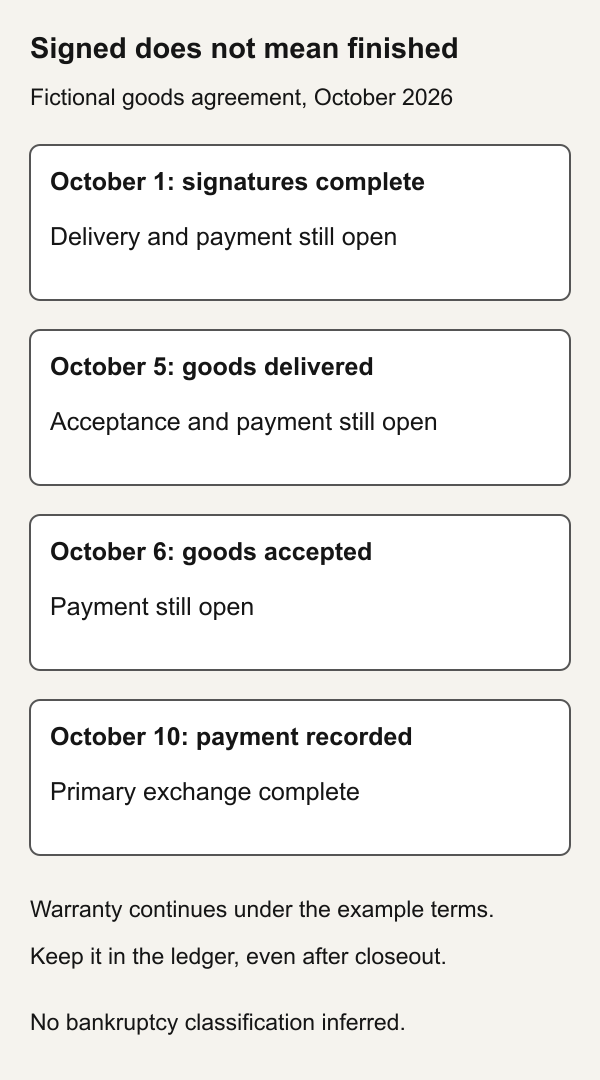
| Review date, 2026 | Evidence recorded | Performance still open | Clear register description |
|---|---|---|---|
| October 1 | Both signatures | Shipment, acceptance and $10,000 payment | Signed; performance not complete |
| October 5 | Receipt for 100 units | Acceptance and payment | Delivered; acceptance not yet recorded |
| October 6 | Example acceptance record | $10,000 payment | Accepted; payment pending |
| October 10 | Payment matched to the invoice | Agreed continuing warranty | Primary exchange complete; warranty monitored |
On October 1, “executed” could accurately describe the signature step in the intended administrative sense. It would be misleading to use that same word to report that all performance was finished. On October 5, a delivery receipt answers whether the shipment arrived, not whether the buyer accepted it under the example terms. On October 6, acceptance still leaves the invoice open.
On October 10, the primary exchange is complete under our assumed facts, but the warranty remains recorded. We deliberately do not label the entire agreement “nothing left to do.” Nor do we infer a bankruptcy result from this table. If you add confidentiality, indemnities or return duties to a real contract, review their scope instead of silently dropping them at closeout. Our survival-clause guide explains how to map continuing provisions.
A signed subscription with future duties
Consider a second fictional example: a software subscription signed on January 1 for January through December, with a $2,000 fee for each month and ongoing access during that period. The twelve fees total $24,000. The signature step can be complete on January 1 while future access and payments remain to be administered.
If the buyer prepays $24,000, the payment ledger changes; it does not prove that twelve months of access have already been supplied. If the provider supplies access for the first month, that does not prove delivery of the later months. Record each duty separately rather than deciding status from whichever department has finished its own task.
Renewal is another separate event. Do not erase a notice deadline because the original agreement has signatures or because a current invoice has been paid. Use the actual renewal language and calendar rules, as explained in our renewal terms and checklist. This example assumes monthly fees and continuous access; it is not a claim about any vendor's actual terms.
Copyable performance-status ledger
CONTRACT STATUS REVIEW
Agreement ID and governing-law reference:
Review date:
Signature status and evidence:
Effective date and conditions to check:
Delivery or service duty, owner, due date and evidence:
Acceptance duty, owner, trigger and evidence:
Payment duty, amount, due date and evidence:
Continuing provisions and review dates:
Disputed or unresolved items:
Next action and responsible person:
Specialist legal classification required? Why?

COMPLETED FICTIONAL ENTRY
Agreement: DEMO-GOODS-1
Review date: October 6, 2026
Signatures: both recorded October 1
Delivery: 100 units, receipt October 5
Acceptance: recorded October 6 under example terms
Payment: $10,000 pending
Warranty: agreed through October 6, 2027
Next action: finance to check October 10 payment record
Status: accepted, payment pending, warranty continuing
Bankruptcy classification: not assessed
Attach or reference the underlying record for each completed item. A reviewer note is useful, but a note that says “paid” without a matched payment record is not the same evidence as the match. Keep the agreement, amendments and ledger together in the contract repository so later reviews use the same version.
Partial performance and amended duties
If Harbor Demo delivers only 60 of the 100 units, the example has 40 units left to deliver. If the buyer pays $6,000 against the $10,000 total, $4,000 remains on that simple arithmetic ledger. These numbers describe quantities and payments only. They do not establish whether either party is in breach, whether payment is due yet, whether goods conform, or what remedy is available.
Record what the agreement actually makes conditional. In one contract, payment may depend on acceptance of the whole shipment; in another, progress payments may be permitted. A reviewer should not invent the trigger from the amount paid. If performance is disputed, distinguish the observed facts from the legal conclusion and use our vendor obligation and breach record.
A change also needs its own entry. For example, a fictional signed amendment might replace the October 5 delivery date with October 8. Preserve the original date, amended date, authority for the change and effective version. Do not rewrite the historical ledger to make an earlier missed event appear to have met a later date. Whether the amendment resolves any existing dispute depends on its terms and applicable law.
Jurisdiction notes: California and US bankruptcy
California: Civil Code section 1661 uses fully performed contractual object as the executed-contract distinction. Sections 1636 and 1641 direct attention to the parties' lawful mutual intention and the agreement read as a whole. Check the relevant text in the official interpretation provisions. A business status label should not override the actual duties or the governing legal meaning.
Federal bankruptcy: 11 USC section 365 concerns assumption or rejection of executory contracts and unexpired leases, subject to its conditions and exceptions. Read the official 2024 Code edition, particularly subsections (a) and (g); an ordinary unfinished-duty register is not a substitute for that analysis.
In Mission Product Holdings v. Tempnology, the Supreme Court's May 20, 2019 opinion, the Court discussed performance still due on both sides and held that rejection operates as breach rather than rescission. Its trademark-license holding shows why “rejected” should not be casually rewritten as “all existing rights erased.” A specialist must assess the contract, relevant law and proceedings before applying bankruptcy consequences. This article does not provide a classification test for every circuit or transaction.
For other states or countries, verify the relevant contract and insolvency rules.
Closeout checklist
- State whether “executed” means signing or completed performance.
- Separate signature date, effective date and performance dates.
- List each party's open duties with evidence and a responsible person.
- Check acceptance and payment triggers against the actual agreement.
- Preserve amendments and the history of changed obligations.
- Record continuing provisions and unresolved disputes.
- Use precise status wording before closing a workflow.
- Escalate bankruptcy or other specialist classification questions.
FAQs
What is an example of an executed contract?
In signing usage, the fictional agreement signed by both parties on October 1. In performance usage, look for completion of the required performance; do not overlook our example's continuing warranty.
What is an example of an executory contract?
A signed subscription with future services and payments provides a simple performance example. It is not automatically a bankruptcy conclusion.
Can a signed contract still be executory?
Yes, in an ordinary performance discussion: signatures can be complete while delivery or payment remains due.
Does executed mean legally valid?
The word alone does not answer formation, authority, required formalities or other enforceability questions. Use the actual facts and governing law.
Is partial performance enough to close the file?
Describe the unfinished items and the contractual conditions first. Our quantity and payment calculations are not a legal finding that the remaining performance can be ignored.
Is this the same as executed versus executory consideration?
No. That question concerns the consideration analysis and its applicable legal terminology. This ledger tracks contractual performance; see our consideration guide for that separate topic.
Banner: AI-generated fictional illustration.